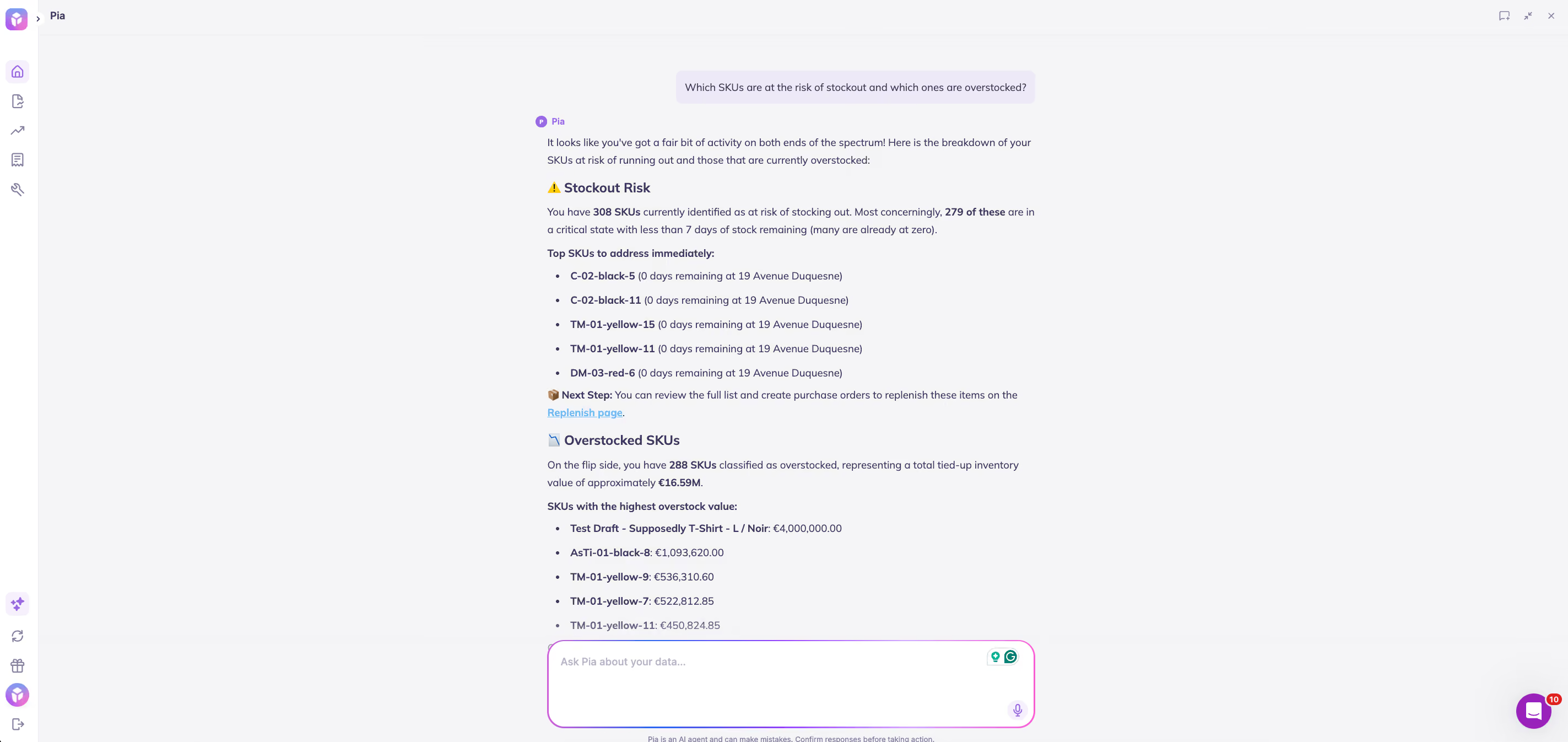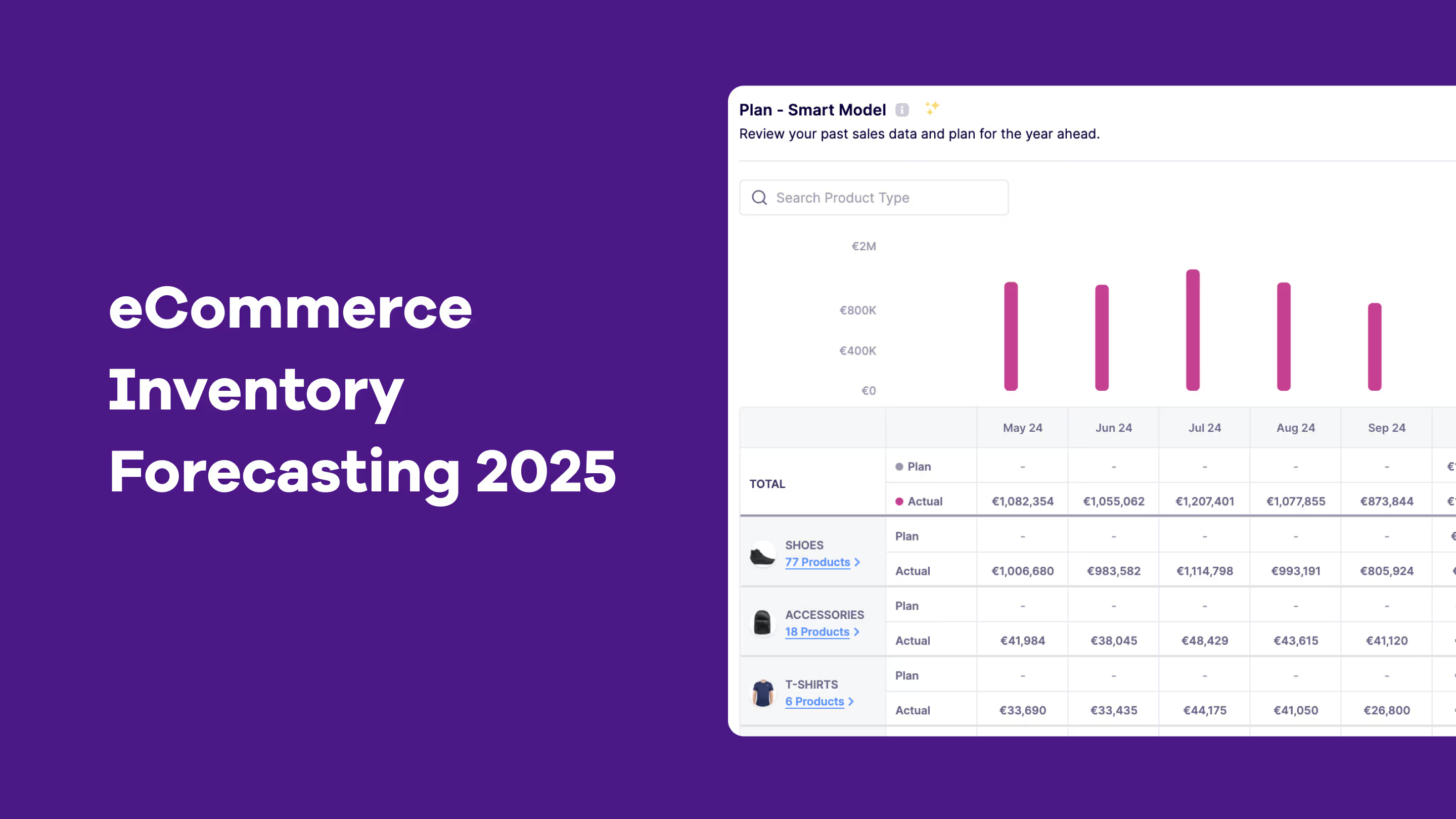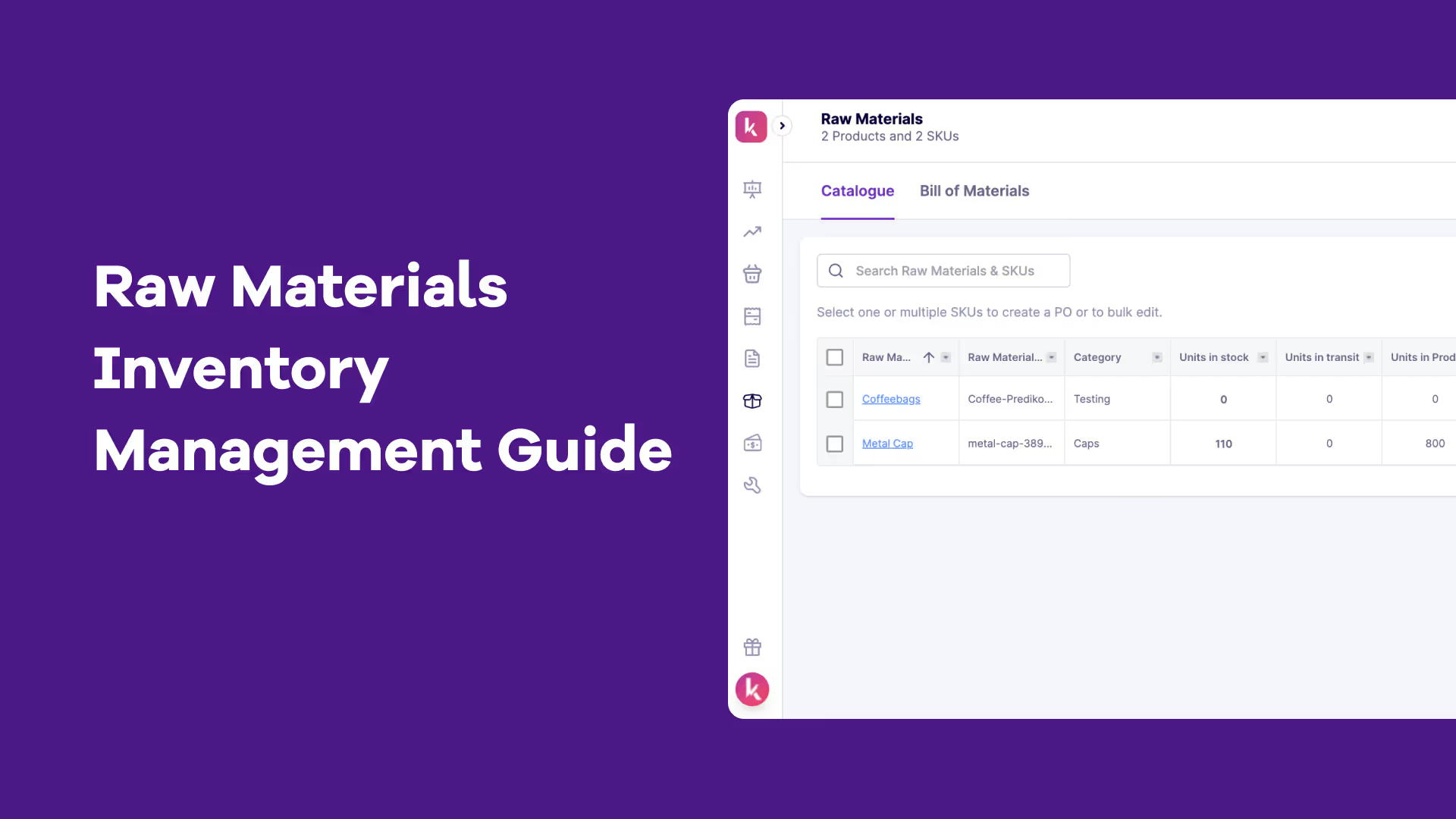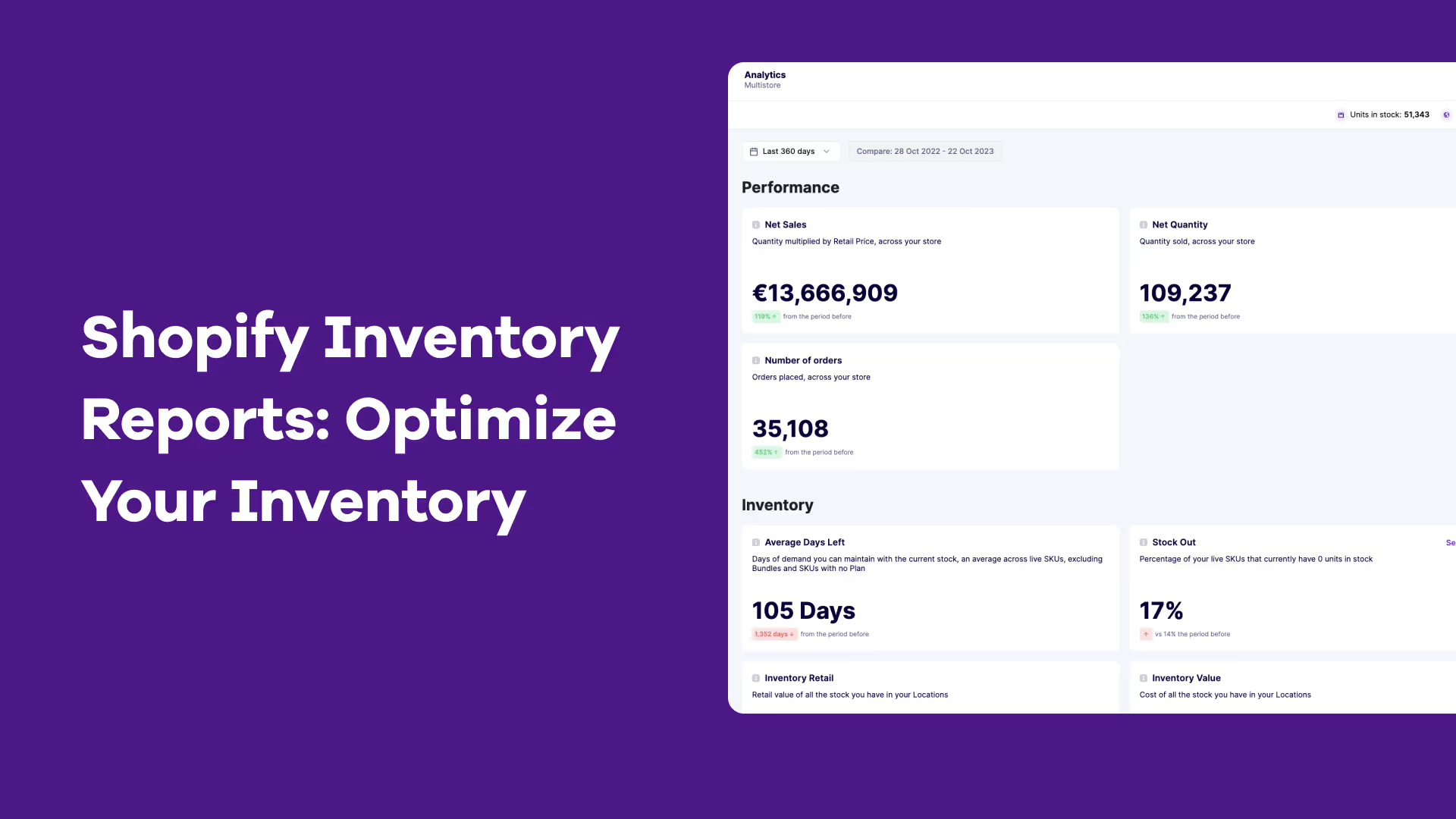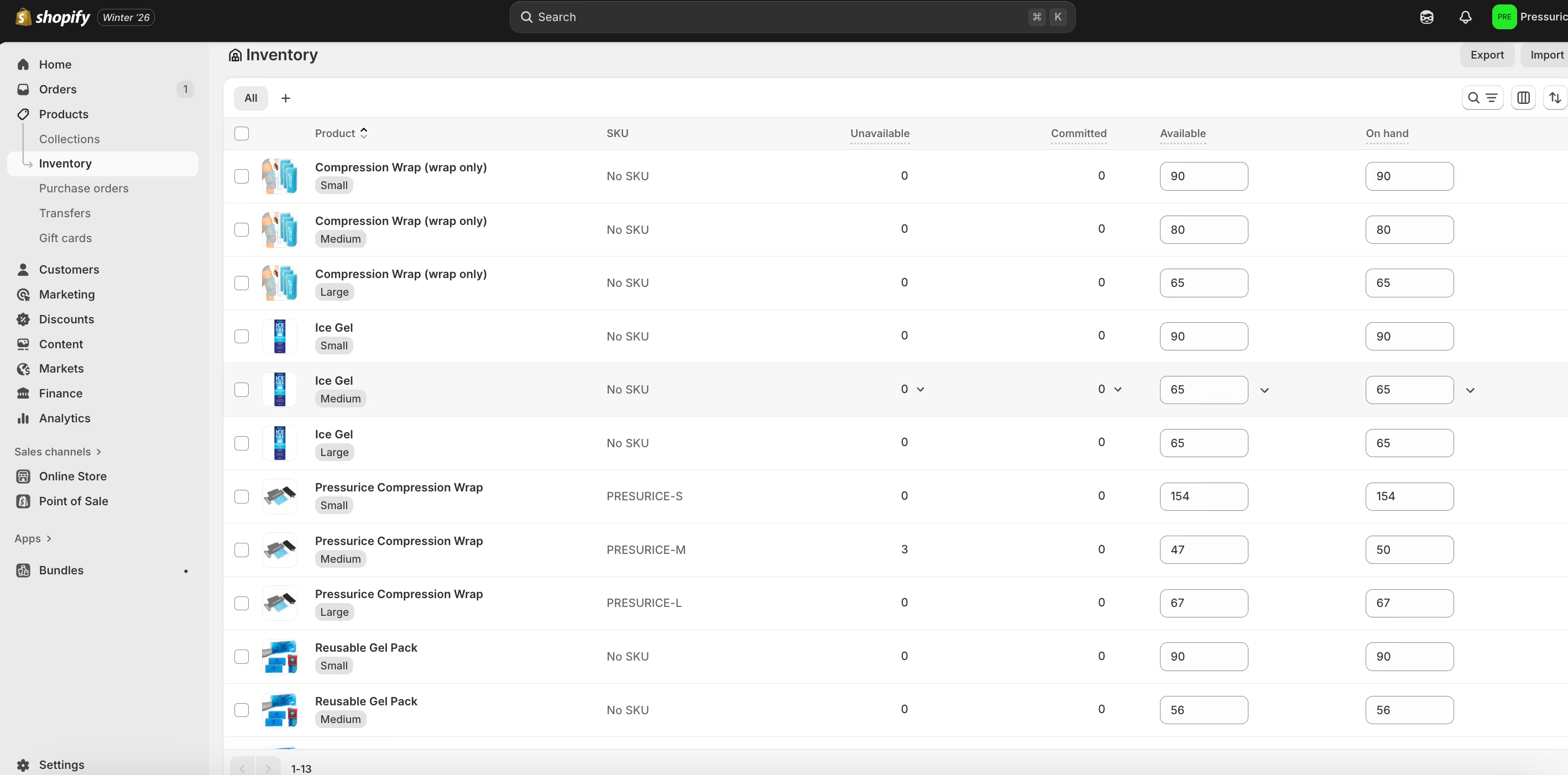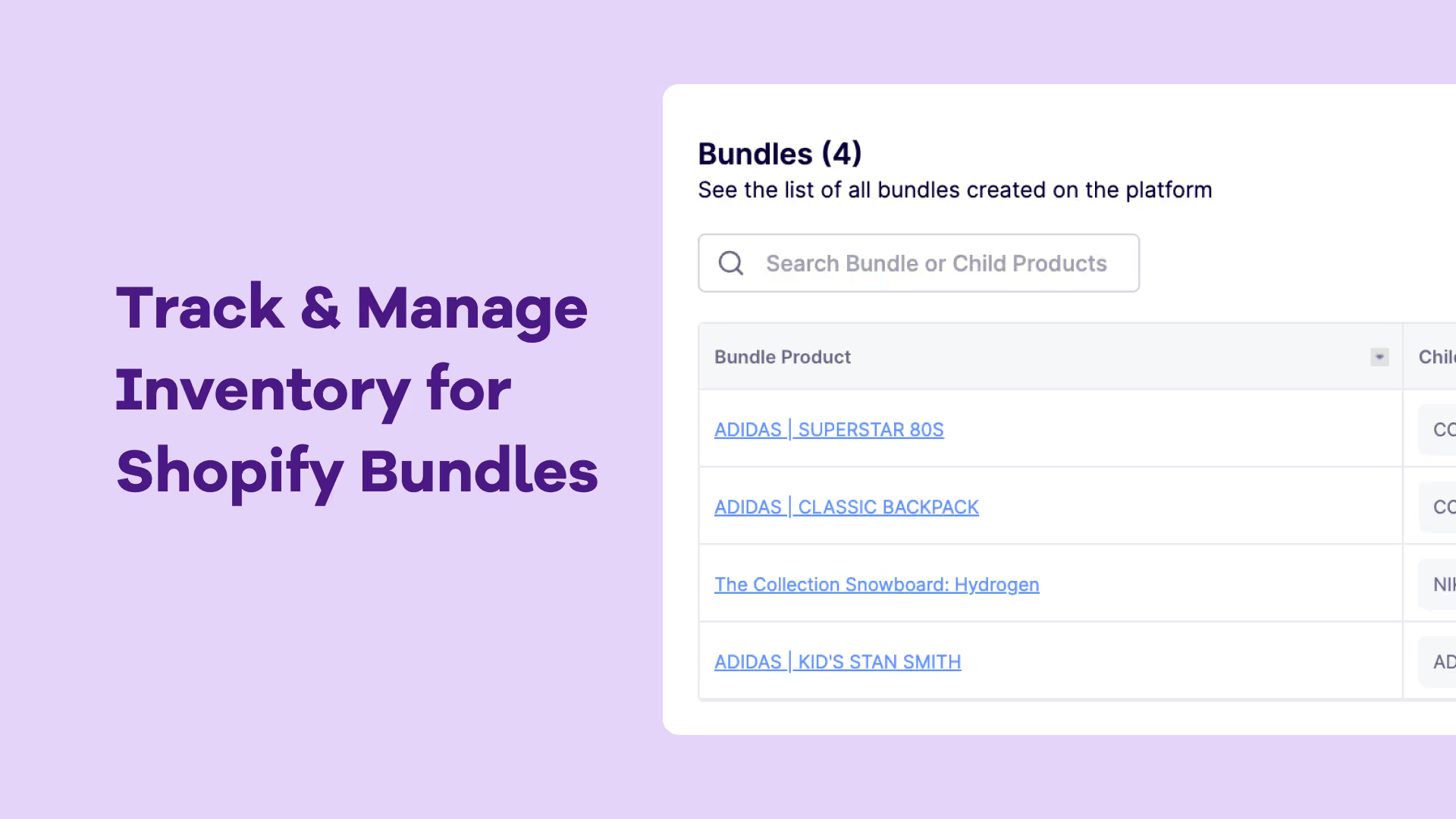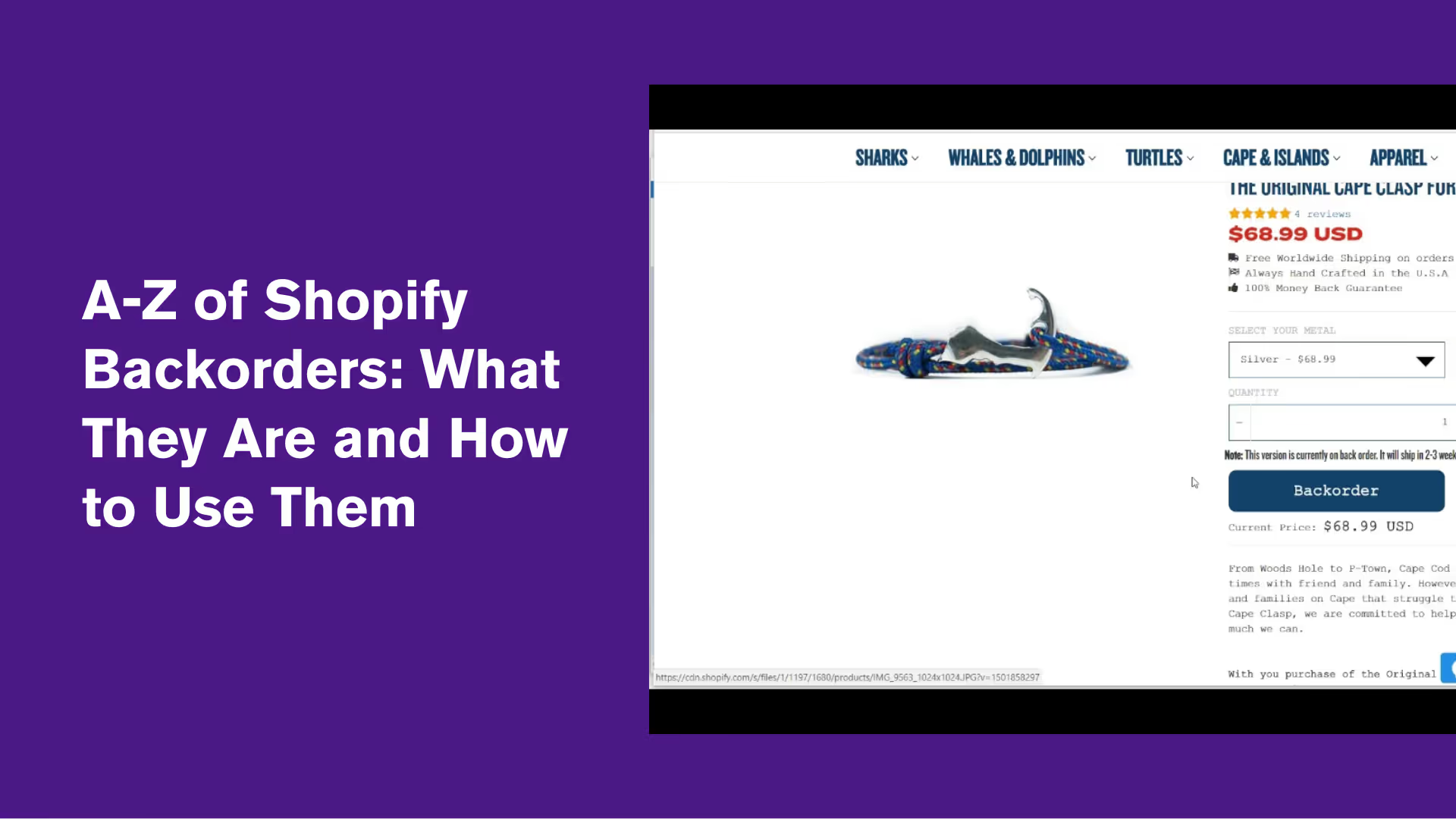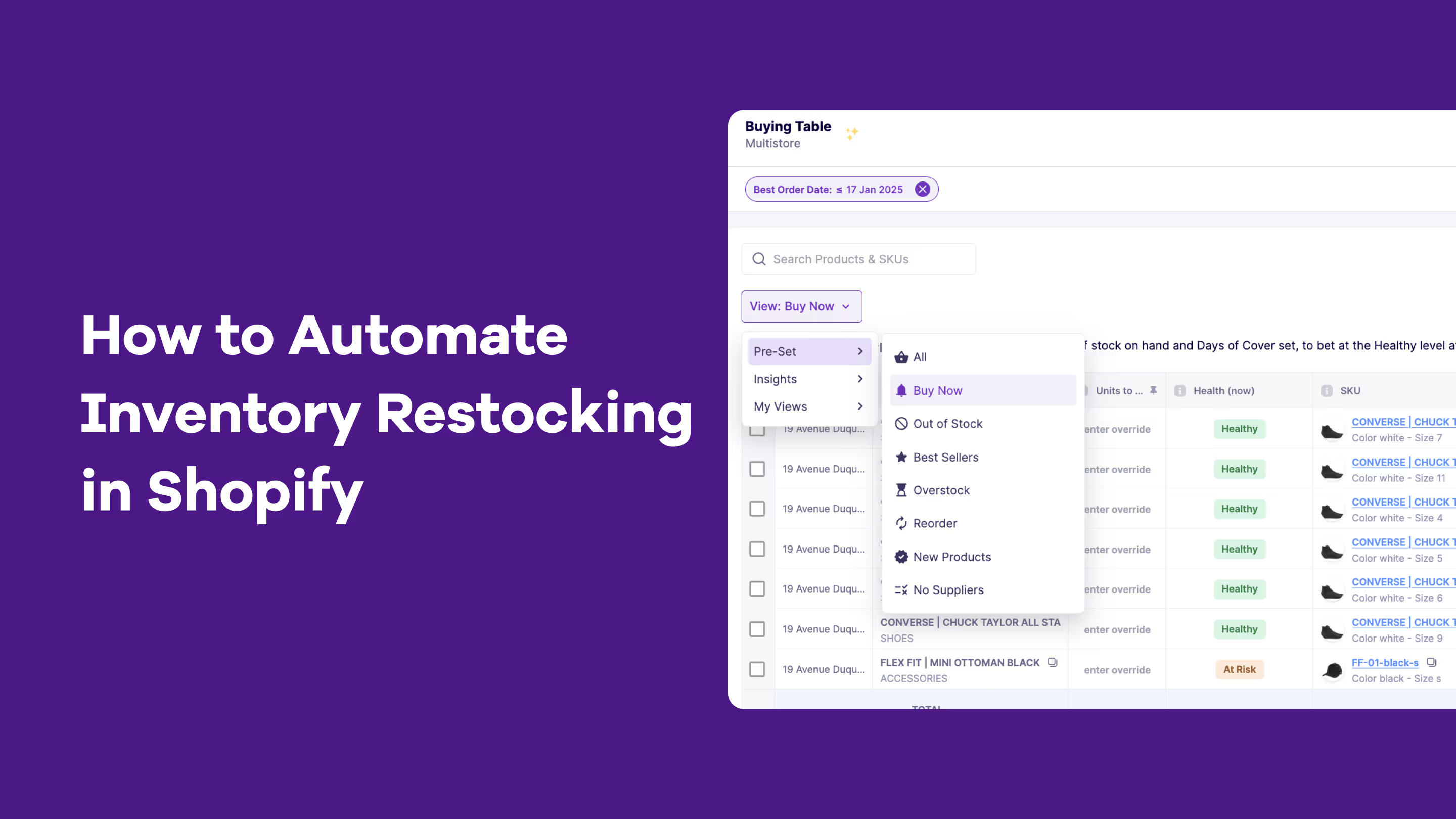




A step-by-step guide on how to bundle products on Shopify, covering bundle types, setup methods, inventory tracking, and common pitfalls.
Read Blog
Shopify supports selling product bundles; sets of two or more related products sold together as a single item.
Bundling products can increase the store’s average order value and help customers discover complementary items
Shopify doesn’t provide a built‑in bundle type; instead, you need to install Shopify’s free Bundles app or a third-party solution like Prediko.
Step 1: To get started, you need to determine the bundle type and eligibility
Bundle type
What it includes
How to create
Fixed bundle
Pre-determined set of different products; customers can choose variants if products have variants.
Supported by the Shopify Bundles app.
Multipack
A bundle containing more than one of the same product.
Supported by the Shopify Bundles app; duplicate product entries in the bundle.
Mix-and-match bundle
Customer chooses from interchangeable products; used for complex bundles like “Build your own bedding set”.
Not supported by Shopify Bundles. Use a third-party bundles app or build a custom solution using Shopify
Bundles APIs (requires Shopify Plus).
Note: Stores using the checkout.liquid customizations are incompatible with product bundles.
Step 2: Install the Shopify Bundles app from your Shopify admin:
In Shopify Admin, go to Apps and search for “Bundles.”
Select the free app by Shopify and click Install.
Approve the required permissions (if prompted)
Step 3: Create a product bundle using the Shopify Bundles app
Before creating a bundle, you must create the individual products and variants that will be included
Open the Bundles app and click Create bundle
Enter a descriptive title for your bundle
Select the products and variants to include in the bundle
Adjust the quantity of each product as needed
Save and add product details like images, descriptions, price, and SEO metadata
Choose the sales channels where the bundle will be available (Online Store, Shop, POS)
Change the product status from Draft to Active to publish the bundle
Click Save to finalize
How to edit an existing bundle?
You can easily modify bundles directly in the Bundles app. Simply, select the bundle you want to edit.
Make your changes (images, descriptions, quantities, options) and click Save and continue to return to the bundle product page.
Tip: If component or inventory values aren’t updating, temporarily increase a component’s quantity and save. This forces Shopify to re-sync the bundle’s inventory.
How to manage and filter bundle products in your product list?
Bundles are created as distinct products in your Shopify admin. You can manage them like other products, including editing details from the Products page.
To filter and organize your product list, such as a view showing only bundles, you can create custom views (built‑in filtering feature)
From your Shopify admin, go to Products
In the views list, click the + icon to create a new view
Give the view a name (e.g., “Bundles Only”) and click Create view
Use search and filter features to display only products that meet your criteria (e.g., filtering by Product type if you use a type like “Bundle”)
Click Save to add the view as a tab
This custom view helps you quickly find and manage bundles, especially when performing bulk actions.
Important Settings to Note When Setting Up Bundles
To let customers choose the pack size (e.g., a 3-pack or 5-pack), enable “Add quantity as an option.” This gives buyers a simple dropdown to select how many units they want, making the bundle more flexible and increasing average order value.
If multiple products share an option (e.g., Size), you can merge them by selecting “Combine options with matching names.” Customers only choose the option once, creating a cleaner buying experience. To ungroup them, just deselect the option and save.
For multipacks, add the same product multiple times or use “Duplicate product” to quickly create additional units. This makes it easy to build 2-packs, 3-packs, or larger bundles without manual repetition.
Note: If you don’t want to use the native Shopify Bundles app or prefer more advanced control, you can switch to third-party solutions like Prediko, which also support bundle-level forecasting.
5 min
Dec 2025
What’s the Difference Between Products and Variants on Shopify?
Not sure whether your item should be a product or a variant on Shopify? This guide explains both.
Read Blog
Shopify treats products and variants differently. When you add a new item to your store, Shopify automatically creates one variant of that item.
Every product must have at least one variant, because variants represent the actual version of the product that customers purchase.
In other words, the product acts as the parent container while each variant is a child item with its own specific characteristics.
Products: A product is the overarching item that you sell. It contains general information such as the title, description, brand, product type and collection. Products can have multiple variants, but some products consist of only a single variant (the default variant).
Variants: A variant is a specific configuration of a product created by combining the product’s option values (e.g., size = small, color = blue). When a product comes in different sizes, colours or other attributes, each unique combination is a variant.
Note: Shopify lets you add up to three option types (such as size, colour or material) per product and supports up to 2,048 variants per product.
Each variant has its own details (such as price, inventory quantity, weight and SKU) that you manage on the variant details page rather than on the product page
Options vs. variants
Options are attributes of a product, for example, size, colour or material. They define how a product can vary, but by themselves, they don't represent something you can sell. A product can have up to three options.
Variants are the purchasable versions of the product created from option combinations. Each combination of option values becomes a variant
For example, a T‑shirt with options for size (small, medium, large) and colour (blue, green) has six variants: small‑blue, small‑green, medium‑blue, medium‑green, and so on.
Each variant can have its own price and inventory
What stays at the product level?
The product record stores information that applies to all variants
Product attributes
Purpose
Title, description & images
A product’s name, descriptive text and general images are stored at the product level. Variants can have their own images, but the main product images present the overall item.
Vendor & product type
Used to categorize products and create collections.
Collections/tags
Products are placed into collections for navigation and merchandising. Collections apply to the product as a whole.
Metafields
Custom fields attached to the product that apply to all variants. Variant metafields are separate.
General pricing rules
When all variants share the same price, the price can be set at the product level and inherited by variants (unless overridden).
How is inventory tracked?
Because product records do not include inventory quantities, you cannot track stock at the product level.
When a product has no variants, you set its price, inventory and shipping on the product details page; but once variants are added, you must adjust those settings for each variant.
Inventory is therefore tracked at the variant level
What stays at the variant level?
Variants hold information about each specific version of the product
Variant attributes
Purpose
SKU (Stock Keeping Unit)
Each variant needs a unique SKU for inventory tracking and reporting. SKUs are internal codes that help track stock and sales, and Shopify requires every product and variant to have its own unique SKU.
Option values
The combination of option values (for example, size = Medium and colour = Blue) that defines the variant.
Price & compare-at price
Variants can have different selling prices. For example, a larger size may cost more or use a different tax rate.
Barcode & weight
Used for shipping calculations and scanning at point of sale.
Inventory quantity & location
Each variant has its own inventory quantity, managed on the Inventory page. To track inventory for a product with variants, select the specific variant, enable Track quantity, and enter stock per location.
Variant image
You can assign an image that represents the specific variant (for example, showing the blue version instead of the default product image).
Variant metafields
Custom fields that apply only to this variant (for example, a manufacturing batch number). Variant metafields can be added to the variant details page but can’t currently be displayed to customers.
Important things to note
A product ID identifies the parent product in Shopify’s database, while each variant has its own variant ID. You can find a variant’s ID by clicking the variant in the product details page and looking at the URL – the number after /variants/ is the variant ID.
Products without variants still have a default variant ID that can be viewed by appending .json to the product URL and looking for the "variants" → "id" value
Understanding these identifiers is important when working with CSV imports or API integrations.
Best Practices When Defining Products and Variants
A clear product–variant structure keeps your store organised and your inventory clean. These best practices will help you avoid common setup mistakes.
1. Use category metafields for consistent option values
Category metafields let you create reusable option lists (like a master colour list) so your option names stay consistent across products. If you update an entry (say “Cyan” to “Blue”), Shopify automatically updates it everywhere that metafield is used.
2. Turn on inventory tracking and add quantities
Open your product in Shopify, click each variant, and in the Inventory section, enable Track quantity and enter the starting stock. Repeat for every variant. You can update quantities one by one or use the bulk editor/CSV to do it faster.
3. Use descriptive SKUs
Design SKUs so you can identify the product, variant options and even location at a glance. This makes stock reconciliation easier and helps when importing or updating inventory via CSV.
4. Capture custom data with metafields
Use variant metafields to store specialized information such as manufacturing details or internal notes. Variant metafields can be created on the variant details page, but they aren’t displayed to customers.
5 min
Dec 2025
Top 10 Shopify AI Integrations You Need in 2026
Prediko and other top Shopify AI integrations help brands automate inventory forecasting, purchase orders, customer support, marketing, and merchandising with real-time data, customizable workflows, and AI-powered actions that keep stores efficient and scalable in 2026.
Read Blog
Running a Shopify store in 2026 means wearing a lot of hats –marketer, analyst, inventory planner, customer support rep, and sometimes, all at once. That’s where AI comes in.
From writing product descriptions and replying to reviews to forecasting stock and personalizing shopping experiences, AI tools are quietly becoming every merchant’s secret weapon.
We’ve rounded up 10 of the best Shopify AI integrations that can help you work smarter, not harder, so you can focus on scaling your brand while the bots handle the busywork.
Must-Have Features of a Shopify AI Integration in 2026
If you’re out hunting for the perfect Shopify AI integration tool, here’s what to keep an eye on (and why each feature counts).
1. Real-time Shopify data sync
Your AI integration should pull the latest product, inventory, or relevant data the moment anything changes. Real-time syncing ensures decisions, whether forecasting, marketing, or automation, are always based on accurate, up-to-date information instead of outdated data.
2. Ease of setup & use
A good Shopify AI integration shouldn’t require engineering effort. Merchants should be able to install it, connect data, and start using it within minutes. Clear onboarding, intuitive dashboards, and simple configuration make AI adoption smoother and faster.
3. Customization & flexibility
Every brand operates differently, so the AI should adapt to your workflows, not force you into rigid templates.
This means adjustable rules, thresholds, prompts, automations, and reporting views tailored to your processes, SKUs, channels, and customers.
4. API-friendly & compatible with other apps
Your AI shouldn’t live in a silo. It must integrate cleanly with your WMS, ERP, marketing apps, analytics tools, and the rest of your tech stack.
Open APIs and native connections are must to make the AI an important part of your ecosystem, not another isolated tab.
5. Automation triggers
Beyond insights, the AI should take action. That includes triggering replenishment alerts, PO reminders, email flows, segmentation updates, or workflow tasks based on real-time conditions. Automated actions reduce manual work and prevent delays.
6. Multi-store compatibility
Many brands now run multiple storefronts —regional sites, wholesale portals, sub-brands, etc.
A strong Shopiy AI integration consolidates data across all Shopify stores so that forecasting, automations, and reporting work seamlessly for the entire business.
Top Shopify AI Integration Apps: A Quick Overview
Shopify AI Integration
Best for
Key features
Pricing
Prediko
AI inventory planning & forecasting
AI demand & supply planning, PO automation, raw material & bundle forecasting, low-stock alerts, 20+ reports and analytics, 70+ integrations
Starts at $49/month
Tidio
Customer support chatbot and live chat
Real-time cart and order preview, AI agent (Lyro), multi-channel communication, pre-built no-code automation flows
Starts at $24.17/month
Wiser
Product recommendations and upsells
AI-powered recommendations, multiple widgets, advanced search, filters, progress bar, analytics, and widget customizations
Starts at $9/month
Klaviyo
Marketing and customer communication
Syncs Shopify data, prebuilt flows, dynamic segmentation, AI for optimal send times, churn prediction, predictive LTV, and centralized email/SMS/push
Starts at $80/month
Entaice
Collection sorting
Pinned products, automatic ranking and reordering, sorting analytics, product boosts, AI-driven sorting with visual merchandising
Starts at $48/month
Octane AI
Quiz creation and personalization
Build quizzes using AI, tags, and conditional logic; customizable designs; integrations with Recharge and Klaviyo; AI product recommendations
Starts at $50/month
Atlas
Store building for dropshipping
Product links to generate Shopify pages, AI for designs/copy/logos, built-in bundle offers, cart upsells, and store templates
Starts at $39/month
Tapita
SEO and speed optimization
AI-powered multi-language SEO tags, bulk image optimization, JSON-LD data, broken link detection, and backlink insights
Inventory is the backbone of every retail business, and Prediko strengthens it by helping brands eliminate stockouts and overstocks. It turns sales and inventory data into actionable forecasts so teams can plan reorders, manage suppliers and raw materials, track bundles, and monitor key metrics, all from one clean, connected dashboard.
It's one of the most effective ways to use AI for optimizing retail, helping Shopify brands automate repetitive planning tasks while freeing up time for growth.
What truly sets Prediko apart from other Shopify AI agent integrations is its in-house AI engine. Trained on over 25 million SKUs across 15 industries, it factors in seasonality, sales velocity, and real-time trends to deliver forecasts that are both smart and reliable.
Intuitive interface suitable for growing brands moving past spreadsheets
Handles complex variants and bundles across channels
Responsive support team
Cons
Integrations with some WMS/3PLs are still in development
May be more complex than needed for very small stores
Healf Achieved 75× ROI with Prediko
UK-based wellness retailer Healf slashed stockouts from 4 % to 1 % in just two months using Prediko’s AI-driven forecasting.
By replacing spreadsheets with real-time demand insights and automated reordering, they unlocked a 75× ROI and saved 10 hours every week on inventory management. Read more here.
Pricing
Prediko offers tiered pricing based on your store’s revenue. Plans start at just $49/month for small businesses and scale up to $119, $199, and $349/month for more advanced needs. All plans include unlimited SKUs, purchase orders, and users.
2. Tidio: AI live chat and chatbot
Tidio is one of the best AI chatbots for shopify integration that connects directly to offer customer support chat automation.
Its AI agent, Lyro, can answer questions about orders, products, and delivery without human input.
You can see customer carts and order history inside the chat window, allowing personalized recommendations during conversations.
Key features
Real-time cart and order preview inside chat for personalized recommendations
AI agent (Lyro) to automate recurring customer queries
Unifies multi-channel communication across live chat, email, and social platforms
Pre-built no-code automation flows for cart recovery, discounts, and upsells
Pros
Centralizes messages across channels for faster replies
Next up is Wiser, an AI-powered recommendation engine that delivers intelligent product suggestions based on shopper behavior, browsing history, and purchase data.
It automatically displays relevant products on product pages, in the cart, during checkout, and even in post-purchase content, helping increase average order value and customer retention.
Key features
AI-powered recommendations based on real-time shopper behaviour
Multiple widgets available, including related products, frequently bought together, new arrivals, and recently viewed
Advanced drawer cart for in-cart upsell with progress bar
Analytics to measure click-through, conversion, and revenue generated by recommendation widgets
Customizable widget set up with API access
Advanced search and filters to help find exactly what customers are looking for faster
Pros
Reliable and responsive support team
Highly customizable widgets
Cons
Pricing is confusing
Setup and customization may take a lot of time
Pricing
Plans start at $9 per month
4. Klaviyo: Marketing and customer communications
Klaviyo is an email and SMS marketing platform that enables workflows such as welcome series, abandoned-cart campaigns, and post-purchase follow-ups. Its AI personalizes content, optimizes send times, and refines audience segmentation.
The app also offers AI agents to create on-brand, launch-ready campaigns, resolve customer issues, and sell 24/7.
Key features
Syncs Shopify data, including orders, products, and customer activity in real time
Prebuilt flows for cart recovery, welcome series, post-purchase, and re-engagement
Dynamic segmentation using live Shopify data like viewed products and repeat orders
AI to identify the right send times, churn risk, and predictive lifetime value
Centralizes email, SMS, push, and pop-up campaigns
Pros
Detailed reporting for informed decisions
Centralizes messages across channels for faster replies
Cons
Expensive for large contact lists
Occasional technical glitches and bugs reported by users
Pricing
Plans start at $60 per month
5. Entaice: AI collection sorting
Entaice is an AI-powered merchandising assistant that helps Shopify brands automatically sort, rank, and optimize their collections for higher conversions.
Instead of manually dragging and dropping products every week, Entaice continuously analyzes real-time data like sales trends, inventory levels, and shopper behavior to keep your storefront fresh and performing at its best.
Key features
Pinned products to keep specific products at the top and move them down when they sell out
Automatically ranks and reorders products based on performance, trends, and inventory
Track views, conversions, orders, and revenue at the product level, exportable as CSV reports
Temporarily pushes new products to the top of collections
AI-driven sorting with visual merchandising by grouping items by brand, type, or style
Pros
The development team is highly responsive
Works well for massive collections with a lot of inventory movement
Cons
Requires periodic fine-tuning to align rankings with seasonal or campaign-specific goals
Pricing
Plans start at $48 per month
6. Octane AI: Quiz creation and personalization
With Octane AI, you can deploy quizzes and chatbots that ask your customers what they really want, then use the answers to recommend the right product, trigger the right campaign, or segment your audience for future marketing.
It integrates seamlessly with Shopify and connects with tools like Klaviyo so that everything stays synced.
Key features
Build and launch your quizzes with plus 24/7 global chat support.
Create product quizzes using AI, tags, collections, and/or conditional logic
Customizable quiz design, including images, font, and layout, to full custom CSS
Integrates with Recharge, Klaviyo, Attentive, Zapier, etc
Quiz templates for every industry and AI to recommend products for customers
Pros
Clear attribution of quiz-driven revenue in analytics
Quizzes feel native to Shopify storefront without clunky redirects
Cons
Layout customization requires CSS for non-standard designs
Advanced logic setup can be time-consuming for larger catalogs
Pricing
Plans start at $50 per month
7. Atlas: Store builder for dropshipping
Atlas helps Shopify users create complete, high-converting dropshipping stores by simply pasting a product link.
Within two minutes, it generates product pages, branded design, upsell flows, and even AI-enhanced photos.
It’s built specifically for product testing at scale, allowing users to launch multiple stores rapidly without any coding or design work.
Key features
Generates complete Shopify pages with just product links
AI to create designs, product copy, meta descriptions, layout, logos, and more
Built-in bundle offers and cart upsells
Easily save your best stores as templates to reuse anytime
Pros
Fully compatible with Shopify admin and the latest Shopify themes
No extra apps needed for upsells or bundles
Ideal for testing multiple dropshipping products quickly
Cons
Hidden or unclear charges even after uninstall
Customization is somewhat limited compared to manually creating stores
Pricing
Plans start at $39 per month
8. Tapita AI: SEO and speed optimization
Tapita is a platform designed to help Shopify stores improve visibility, speed, and user experience, all from a single dashboard.
Beyond SEO automation, Tapita’s suite covers everything from page speed improvement to UI/UX optimization and marketing support, making it a complete performance toolkit for growing e-commerce brands.
Key features
AI-powered and multi-language SEO meta tags
Bulk image optimization for better page speed and user experience
Ability to add JSON-LD structured data that helps search engines understand your store better
Automatically detect and fix broken links on your site for better SEO
Detailed report on backlinks to improve your link-building strategy
Pros
Clear and intuitive interface
Free plan for smaller businesses and stores
Cons
App support has some negative reviews
Users have also reported some script issues
Pricing
Plans start at $9.99 per month
9. Wiz AI: Abandoned cart recovery
Wiz AI is a fully automated AI-powered email marketing platform built to help Shopify merchants recover lost sales and engage customers with zero manual setup. It creates ready-to-use email flows, newsletters, and campaigns in just one click.
From abandoned cart recovery and win-back campaigns to welcome sequences and branded newsletters, Wiz AI puts customer communications on autopilot.
Key features
One‑click generation of automated email flows including abandoned cart, checkout recovery, welcome and win‑back
Pre-designed email templates and drag‑and‑drop editor to customise
Create on-brand pop-ups and welcome forms to grow your subscriber list
Track open rates, click-throughs, conversions, and deliverability to optimize every campaign
Pros
Easy to set up and customize
Responsive support team
Cons
Some users may find the feature set more basic compared to advanced tools
Pricing
Plans start at $14.99 per month
10. Trustoo: Collection and management of product reviews
Last but not the least is Trustoo, an AI-powered review and UGC (user-generated content) platform designed to help Shopify stores build trust and improve conversions through authentic customer feedback.
It automates the entire review collection process, from gathering text, photo, and video reviews to analyzing them for insights and displaying them beautifully on-site.
Key features
Automatically collect, analyze, and display reviews with smart sorting and AI-generated summaries
Multi-source review collection from Shopify, Amazon, WhatsApp, etc
Automatic review requests with incentives for photo submissions
Customizable widgets to display reviews, ratings, photos and videos
Multi‑language support with automatic translation of reviews
Key sentiment and performance trends to guide improvements
Pros
Responsive and proactive customer support
Offers a lot of review display options
Cons
You have to use their template to upload reviews
Pricing
Plans start at $11.99 per month
Important Things to Consider When Choosing a Shopify AI Integration
When choosing an AI tool for your Shopify store, features alone aren’t enough. What matters is whether the tool fits your store’s actual needs, works reliably with Shopify, and delivers results worth paying for.
Here’s a checklist to follow
Shopify-native integration: Look for tools that work directly inside the Shopify admin or sync/use real-time data from your store.
Actual AI logic: Choose apps that have well-trained and built-in AI to generate content, predict behavior, auto-personalize, or adjust based on store activity.
Control and flexibility: A good AI tool suggests and automates, but doesn’t take over. You should be able to edit content, adjust rules, and set limits on what the AI can change.
Pricing at scale: Some apps charge more as your store grows, more orders, emails, sessions or data. Make sure you know how the plan scales and what’s actually included.
Proven outcomes: Look at the reviews or case studies to see if it actually improves sales, saves time, or increases conversion for stores like yours.
Choose Prediko as Your Inventory Management Shopify AI Integration
AI tools aren't here to replace how you run your Shopify store. They're here to make it smoother, faster, and easier to manage.
With the right setup, you can automate support, improve SEO, personalize marketing, and stay on top of inventory, all without juggling a dozen apps.
If inventory is where you're hitting friction, Prediko’s AI has you covered. It gives you real-time visibility, accurate AI demand planning, AI agents, and smart reordering, using real-time data from your Shopify stores.
A Shopify AI integration connects AI-powered tools to your store to automate tasks like product recommendations, customer support, SEO, and inventory planning.
Are Shopify AI tools safe with customer data?
Yes, Shopify AI tools are generally safe with customer data. They follow Shopify’s strict data security and privacy standards.
Which Shopify AI tool is best for inventory management?
Prediko is a top choice for AI-powered inventory management. It offers real-time syncing, smart forecasting, inventory agents, and automated purchase orders for growing Shopify brands.
5 min
Dec 2025
A Practical Guide to AI Inventory Reports for Shopify Brands
AI inventory reports give Shopify brands real-time, accurate visibility into stock levels, demand patterns, and SKU performance, turning raw data into actionable insights.
Read Blog
Most Inventory reports have not kept up with the times and are outdated in terms of data.
For many teams, reporting is still spread across spreadsheets, delayed by exports, and full of static numbers that don’t explain what’s really happening.
This keeps operations stuck in reactive mode: chasing stockouts, justifying overstocks, and cleaning up errors after they’ve already caused damage.
AI inventory reports change that. They bring real-time visibility, intelligent forecasting, and actionable insights into one place.
We break down what AI inventory reporting is, how it works, and the essential reports Shopify stores shouldn’t operate without.
What are AI Inventory Reports and How Do They Work?
AI inventory reports automatically track, analyze, and forecast inventory performance.
Unlike static spreadsheets or manual exports, they learn from past data in real time, highlight issues, and suggest actions.
Here’s how a typical AI inventory reporting platform works
Pulls real-time data from Shopify, Amazon, WMS, ERPs, and other sources
Ingests and cleans information to ensure accuracy across systems
Runs ML models or algorithms to identify trends, outliers, and demand forecasts
Generates visual reports (tables, charts, alerts) by SKU, location, vendor, or channel
Triggers operational workflows such as PO generation, transfers, etc
Benefits of Using AI Inventory Reports
Below are the key benefits businesses and Shopify stores see when they switch to AI-powered inventory reporting.
1. Improved accuracy and speed
AI tools automatically pull and update inventory data from platforms like Shopify, Amazon, and ERPs.
This reduces errors from manual entry and gives your team faster access to reliable numbers, whether you're checking stock levels, reconciling SKUs, or validating supplier deliveries.
2. Cost savings
With accurate and timely reports, you avoid overstocking, stockouts, and last-minute reorders. This directly reduces carrying costs, shipping expenses, and lost revenue. You also save time spent on manual audits and corrections.
3. Informed planning and decision-making
AI inventory reports highlight what’s changing, like shifts in demand, PO delays, or SKU-level returns, so you can act early. This improves planning and helps your team reorder the right items at the right time.
4. Scalability and automation
As you grow, AI systems can handle increasing SKUs, sales channels, and warehouses without added manual work or headcount.
You can easily keep pace by automating analysis, detection, and reporting so that scaling doesn’t come at the cost of accuracy or visibility.
What Makes AI Inventory Reports Better than Traditional Reports
Unlike traditional inventory reports that simply present raw data, AI-powered reports actively interpret and respond to it.
Below are the key differences that make AI inventory reports more actionable and reliable.
1. Automated insight generation
Traditional reports rely on manual data pulls and spreadsheets, requiring teams to dig through rows and apply formulas for basic insights.
In contrast, AI reports automatically analyze incoming data and flag issues (like unusual stock movement or demand spikes), delivering instant visibility without extra effort.
2. Offers recommendations, not just data
Where traditional reporting ends at raw numbers, AI reports go further by offering next steps.
For example, they might suggest a reorder quantity or highlight which POs are late, helping teams act faster, rather than analyze after the fact.
3. Pattern recognition at scale
Manual tools can miss larger trends or channel-specific issues.
AI reports process data across platforms and timeframes, surfacing patterns like seasonal spikes or inconsistent supplier performance that would otherwise go unnoticed.
4. SKU-level reporting accuracy
Traditional methods often suffer from mismatched SKUs, duplicate entries, or outdated counts.
AI systems pull directly from platforms like Shopify, Amazon, and WMS to deliver consistent, real-time SKU-level accuracy across the board.
5. Real-time recalibration with new data
Unlike static traditional reports, AI dashboards adjust automatically as orders, returns, or stock changes happen. This way, your decisions are based on the latest data, not numbers that are already stale.
6. Ability to simulate scenarios
Scenario planning with spreadsheets is slow and error-prone.
AI reports allow you to simulate changes in demand or lead times instantly, helping you prepare for what could happen next instead of just reacting to what happened.
AI Inventory Reports Vs Traditional Reports
Feature
Traditional Reports
AI-Driven Reports
Data Scope
Single source (ERP or WMS); sales history only
Multi-source (Sales, WMS, Promotions, Supplier)
Analysis
Descriptive (What was sold last quarter)
Predictive (What will be sold next quarter)
Actionability
Requires manual calculation and decision-making
Prescriptive (Tells you exactly what action to take)
Speed
Batch processed (weekly or monthly)
Real-time and continuous
Types of AI Inventory Reports
Each AI inventory management report gives you a different lens into how your products move, where you’re exposed, and what needs your attention now versus later.
Below is a breakdown of the essential AI inventory management reports examples, what they cover, and how they help your team operate with more clarity and confidence.
1. Sales & Quantities Report
What it is: This report gives you a real-time view of how each SKU is selling, using AI to detect demand patterns and velocity shifts earlier than manual reporting.
How it helps: Helps you understand which products are accelerating, slowing down, or behaving unusually so you can adjust forecasts, production plans, or marketing before trends fully form.
What it includes: Net quantity, Net sales, % Total quantity, and % of Total revenue
2. Stock Out Report
What it is: This is a report showing all products that have hit zero inventory, with AI estimating the impact and prioritising what needs attention first.
How it helps: It alerts you about the immediate revenue loss, helps you pause ads or update product pages, and guides urgent replenishment decisions.
What it includes: SKUs at 0, Location, Days since stock out, and Estimated daily loss.
3. Overstock Report
What it is: This AI inventory management report template gives you a view of SKUs with more inventory than demand requires, using AI to detect slow movers and future overstock risks before they pile up.
How it helps: Helps you reduce carrying costs, plan discounting or bundles, and prevent dead stock by catching the problem early.
What it includes: SKU, Location, Total stock, Days left, and Days of cover.
4. Stock Out Risk Report
What it is: This report is an AI-powered prediction of which SKUs are likely to run out soon, even if they currently appear “safe.”
How it helps: Gives you advance warning so you can place timely POs, adjust safety stock, or transfer inventory between locations before stockouts happen.
What it includes: SKU, Location, Total stock, Safety stock days, and Days left.
5. COGS (FIFO) Report
What it is: This one is a financial report that applies FIFO costing automatically to show true SKU-level profitability.
How it helps: Gives accurate COGS and margin visibility so you can refine pricing, plan promotions responsibly, and evaluate product-level performance.
What it includes: SKU, Unit cost, Quantity sold, COGS, Landed COGS, and Landed cost.
6. Multi-Location Sell Through Report
What it is: This is a comparison of how inventory performs across warehouses, stores, or fulfillment locations.
How it helps: Shows where stock is stuck or moving too fast, helping you transfer or restock, avoid localized stockouts, and optimize fulfillment decisions.
What it includes: Product, Location, Quantity sold, Total stock, and Sell-through rate.
7. ABC Report
What it is: This report is a classification of SKUs into A, B, and C categories based on contribution to revenue, demand consistency, or profitability, automatically refreshed by AI as patterns change.
How it helps: Helps you focus forecasting, purchasing, and promotion efforts on the SKUs that matter most to your business.
What it includes: Product, ABC rankings, Value sold, Quantity sold, and % of Total revenue.
Best Practices to Get the Most From AI Inventory Reports
AI reports are only as good as the data and context you feed into them.
The more accurately your operations are modeled, the more precise your forecasts, alerts, and reports will be.
Here’s how to tighten your setup so that AI reporting becomes a source of smarter inventory decisions.
1. Set your lead times and safety stock correctly
Your AI reports depend on how accurate your operational inputs are, so start by verifying your lead times and safety stock.
Instead of using a blanket lead time for all products, calculate actual averages for the past 6-12 months per supplier or category. If Supplier A takes 28-32 days while Supplier B takes 18-40 days, your AI needs to know that difference to make realistic reorder suggestions.
Once lead times are correct, adjust your safety stock with a simple but reliable formula. For example, if your average lead time is 30 days but the longest stretch has been 45, your safety stock should cover for those 45 days, not the ideal 30.
When these values are accurate, your AI’s days of cover, reorder dates, and stockout predictions become far more trustworthy.
2. Keep the catalog clean
AI struggles when your catalog is messy. So treat catalog hygiene as part of your reporting process.
Simplify your products by removing dead SKUs that haven’t moved in months, fixing duplicate SKUs, and ensuring every product has clean variant relationships and consistent metafields like category, supplier, and collection.
Bundles often break reports and forecasting if not mapped correctly. AI will predict demand for the bundle but miss the fact that each sale consumes multiple underlying SKUs. A simple fix is maintaining an accurate bill of materials and linking bundle components properly.
A clean, structured catalog helps AI identify real patterns, catch demand shifts early, and avoid false signals from clutter or mis-mapped product data.
3. Track supplier reliability
AI insights get sharper when they’re grounded in real supplier performance rather than assumed dates.
Build a habit of noting the promised and actual delivery dates for every PO and tracking issues like partial shipments or quality failures.
Over time, this creates a reliability score for each supplier; some may consistently deliver within 5% variance while others fluctuate widely.
When your AI learns that Supplier C is often late, it automatically extends reorder buffers or suggests earlier POs, instead of giving you false confidence.
4. Create report schedules
AI reports only lead to action when they are delivered at the right time to the right people.
Instead of checking dashboards manually, schedule recurring reports: daily low-stock alerts for warehouse teams, weekly demand summaries for planners, and monthly aging or excess inventory reports for finance and ops.
A consistent reporting cadence ensures insights don’t just sit inside the tool; they trigger workflows and keep teams aligned around forecasting, replenishment, and inventory health.
5. Use scenario planning before major events (BFCM)
AI is most powerful when it helps you plan for the future, not just analyze the past. Before big events like BFCM, use scenario planning to test different sales uplifts: 2x, 3x, or 5x your baseline and see how your coverage, replenishment dates, and stockout timelines shift.
This helps you answer questions like “If my top SKUs sell 4x faster, when do I run out?”
For example, if a product normally sells 10 units/day but historically jumps to 40/day during BFCM, your AI will immediately flag that the current stock will only last a few days.
Running these scenarios early helps you adjust now, whether that’s increasing safety stock, placing POs sooner, or redistributing inventory, rather than firefighting mid-sale.
How Prediko Automates AI Inventory Reporting for Shopify Stores
Prediko takes the manual work out of reporting by turning your raw inventory data into clear, automated insights you can act on every day.
Instead of pulling spreadsheets, reconciling numbers, or guessing what will sell next, Prediko’s AI processes your sales, stock levels, lead times, and supplier data in the background and delivers the reports directly to your inbox or dashboard.
1. 20+ Ready-to-use AI inventory reports
Prediko comes with more than 20 AI-powered inventory reports, from sell-through and stockout risk to overstock, ABC analysis, and multi-location insights. Each report is automatically updated and built to highlight the right operational signals at the right time.
2. Daily/weekly automated email reports
Prediko sends scheduled reports straight to your inbox so you don’t have to manually check dashboards. You get daily or weekly updates on stockouts, overstock, sales velocity, and upcoming stockout risks.
3. AI Forecasting engine trained on 25M SKUs
Prediko’s forecasting AI, trained on more than 25 million SKUs across 15 industries, detects demand shifts, seasonality patterns, and velocity changes earlier than spreadsheet models. It recalibrates constantly to deliver accurate reorder dates and quantities.
4. Store, SKU, variant, and warehouse-level insights
Prediko breaks down demand and stock behaviour at every layer –by store, warehouse, SKU, and variant –so you know exactly where products move well and where they stall.
5. Multi-location coverage
Prediko compares performance across warehouses, stores, and 3PLs to highlight imbalances. It shows where stock is running out, where it’s piling up, and where transfers can prevent stockouts or excess.
6. Supplier and PO tracking
You can easily track incoming POs and shipments directly inside Prediko, and once items are marked as received, Prediko automatically updates your stock levels everywhere. No manual edits as forecasts and reports stay accurate in real time.
7. Integrations with Shopify, WMS, 3PLs
Prediko syncs with Shopify, warehouse systems, and 3PLs so every report reflects real-time stock movements, orders, receipts, and transfers without manual reconciliation.
If you’d like to see how these reports and features work in practice and how much time they can save your team each week, start a 14-day free trial of Prediko and explore everything using your own data.
Frequently Asked Questions (FAQs)
1. How does AI improve the accuracy of inventory reporting compared to manual methods?
AI eliminates manual errors by pulling real-time data directly from your systems, recognizing patterns, and continuously updating reports, something static spreadsheets can’t do.
2. Which KPIs can AI automatically track in inventory management reports?
AI tools can track stock levels, sell-through rates, ABC analysis, inventory turnover, days of inventory remaining, and stockout costs, all without manual input.
3. Can AI-generated inventory reports help prevent stockouts and overstocking?
Yes. AI reports capture demand more accurately and warn you early about low or extra stock, so you can reorder the right products at the right time.
4. Which are the best tools for AI inventory reporting?
AI inventory reporting is still evolving, but tools like Prediko are already ahead with real-time insights and smart forecasting.
5. Do AI inventory reports integrate with systems like Shopify, Amazon, and ERP tools?
Yes. Most modern AI inventory reporting tools offer direct integrations with platforms like Shopify, Amazon, WMS, and ERPs. Prediko, in particular, is purpose-built for Shopify-native stores.
5 min
Nov 2025
What Is Inventory Discrepancy? Causes, Examples & Fixes
An inventory discrepancy happens when stock records don’t match actual counts. Learn common causes, how to spot them, and ways to resolve differences fast.
Read Blog
“The stock count is off again… and we have no idea why.”
Inventory discrepancies like this slow teams down, skew forecasts, and disrupt the entire flow of purchasing and fulfilment. When your numbers don’t match reality, replenishment decisions and order accuracy start to suffer.
Most teams deal with them after the damage is done, but the real value lies in spotting them early, tracing the root cause, and preventing repeat issues.
We’ll understand why inventory discrepancy happens, how to investigate them step by step, and the tools and processes that help keep your operations accurate and dependable.
What is Inventory Discrepancy and Why Does It Matter
Inventory discrepancy refers to the gap between the quantity recorded in your system and the quantity physically available. It signals that your tracking, counting, or stock movement processes aren’t fully aligned.
Consequences extend beyond simple mismatches. Discrepancies increase reconciliation workload, complicate month-end reporting, impact inventory valuation, and erode trust in your data, especially for replenishment and planning decisions.
It’s helpful to clarify how this term differs from related concepts:
Discrepancy: A mismatch between recorded and actual inventory levels
Shrinkage: A loss due to theft, damage, spoilage, or misplacement
Variance: A broader accounting deviation between expected and actual values, which could include quantity, cost, or both.
Understanding these distinctions allows teams to diagnose issues more accurately and apply the right corrective actions.
10 Key Inventory Discrepancy Causes (and How to Detect Each)
Stock discrepancies can stem from a variety of issues. Below are ten of the most common causes, along with how to spot each one quickly and accurately.
1. Errors during manual entry and physical counts
Typos, missed items, or double-counting during stocktakes or data entry can lead to mismatches.
How to detect: Audit count sheets, compare user logs, and track recurring count variances by product or team member.
2. Inconsistent receiving and putaway processes
When items aren’t logged correctly at receiving or end up in the wrong bin during putaway, your system shows stock that you can’t physically locate.
How to detect: Match receiving logs against purchase orders and inventory counts; flag skipped or partial receipts.
3. SKU mismatches or duplicate product listings
Inventory accuracy breaks when similar items are assigned the wrong SKU or when the same product exists under multiple listings.
How to detect: Run SKU audits, check for duplicate listings, and reconcile listings across POS, warehouse, and online channels.
4. Damaged, expired, or stolen items
Items that are lost due to breakage, spoilage, or theft often go unrecorded, leaving inflated inventory levels.
How to detect: You can spot these issues by checking discard logs, reviewing adjustments made during the week, and inspecting areas where damage or loss is more common.
5. Supplier or vendor shipment errors
Stock discrepancies can also start at the source when suppliers send the incorrect quantities or items.
How to detect: Match each delivery against the PO and the packing slip, and track repeated issues so you can address reliability concerns with the vendor.
6. Returns and restocking errors
Returned items may get misplaced, restocked in the wrong location, or added back into the system before they’re actually inspected. This can skew counts.
How to detect: Cross-check return authorizations with restock updates and inspect bins for misplaced or unsellable goods.
7. Timing mismatches between transactions and records
Inventory discrepancy can appear when orders, receipts, or adjustments are logged later than they occur.
How to detect: Review transaction timestamps and system sync logs, especially for multi-channel setups.
8. Manual adjustments without proper approvals
Ad-hoc changes to inventory counts without documentation can create confusion and loss of traceability.
How to detect: Review adjustment logs regularly and enforce an approval workflow for all manual changes. Ensure each adjustment has a clear reason and audit trail to help spot patterns or unauthorized edits.
9. Outdated cycle counting or auditing practices
Infrequent or inconsistent counts allow small errors to build up over time.
How to detect: Track variance trends by location or SKU and review the frequency and accuracy of your audit schedule.
10. System integration issues between Shopify, WMS, and POS tools
When platforms don’t sync properly, inventory data can fall out of alignment across systems.
How to detect: Monitor sync logs, look for repeated API errors, and compare on-hand quantities across systems to identify where the data is not matching.
How to Analyze an Inventory Discrepancy Step by Step
When a discrepancy shows up, the goal is to move from “something is off” to “here’s exactly what went wrong and how critical it is.” Use steps below to break it down.
1. Line up physical counts with system numbers
Start by placing the verified physical count side-by-side with the quantities in your WMS, Shopify, or ERP, like Klipboard, for the same date and time.
This helps isolate where the numbers diverge and removes confusion about whether the issue lies in the data or the physical count.
2. Break variance down by SKU, category, and location
A single total variance isn’t actionable. Segment stock discrepancies by SKU, product category, and storage location.
This reveals patterns, like consistent issues in a specific aisle, with a particular product line, or across a certain sales channel, that point directly to root causes.
3. Classify root cause behind each variance
Assign a cause type to each variance to uncover recurring breakdowns. Common categories include
Human error: Miscounts, incorrect data entry, or missed barcode scans
Process issues: Inconsistent receiving checks, poor putaway practices, or weak return handling
System failures: Integration delays, failed syncs, or misconfigured settings
This simple classification makes trends obvious and tells you what to fix first.
4. Rank discrepancies by business impact
Not every mismatch needs urgent attention. Rank discrepancies by their effect on revenue (based on SKU value, margins, and order frequency) and how often they occur.
Recurring, high-impact issues should move to the top of your list; minor, one-off variances can be addressed during routine clean-up.
Inventory Discrepancy Reconciliation Process (7-Step Framework)
Use below framework for inventory data discrepancy management and bring your records back in sync.
1. Stabilize inventory activity before you begin
You can’t reconcile inventory while stock is still in motion.
Pausing transactions gives you a stable, accurate snapshot to compare against your system. Without this freeze, counts become unreliable, adjustments pile up, and variances are nearly impossible to trace.
How to stabilize inventory activity
Pause all receiving, picking, packing, and transfers until the count is complete
Notify warehouse and ops teams to prevent mid-process movement
Ensure all pending transactions are posted before locking the system
This step sets the foundation for every part of reconciliation that follows.
2. Decide the scope of the count before starting
Before anyone lifts a scanner or clipboard, you need clarity on what’s actually being counted. A reconciliation falls apart quickly when teams operate with different assumptions; some counting everything, others assuming it’s a partial check.
To make the scope unambiguous, outline
which SKUs or categories are included in this round,
the specific aisles, shelves, or bins to be covered,
whether the count is full, partial, or risk-based.
When everyone knows exactly what’s in scope, the count is faster, cleaner, and far more accurate.
3. Run physical counts using a clear and consistent method
Accurate reconciliation starts with how items are physically counted. This is where most discrepancies first appear, so the method is just as important as the numbers.
Instead of rushing, give your team a repeatable structure
Use the same counting method across all zones to avoid inconsistency
Assign teams in pairs; one counts, one verifies
Record quantities directly into your system or inventory discrepancy report template to avoid retyping errors
Consistency reduces noise in your data and makes any variances easier to analyze later.
4. Compare physical counts with system records to understand the variance
Once counting is complete, match physical quantities against what's recorded in your system.
This reveals the exact variance for each SKU and gives you a clear picture of inventory accuracy.
Positive variance (more stock than recorded) often points to missed receipts or delayed system updates
Negative variance (less stock than recorded) may signal shrinkage, misplacement, or process failures
For example, if you counted 120 units but the system shows 100, your variance is +20. Understanding these gaps SKU by SKU helps prioritize the investigation and pinpoint where things went wrong.
5. Investigate why the stock discrepancies happened
Now it’s time to understand why the numbers don’t match. Not all variances are equal and identifying the root cause is key to fixing and preventing them.
Start by reviewing the SKU’s movement history: receipts, picks, transfers, and adjustments. Then examine the physical side: was the item in the wrong bin, damaged, mislabeled, or miscounted?
The goal isn’t to assign blame, but to surface broken steps in the process. That’s what makes this one of the most valuable parts of reconciliation.
6. Correct records and apply the right fixes
Once you know what caused the discrepancy, update your system to match reality. Corrections should be clean, intentional, and fully traceable so you’re not introducing new errors while fixing old ones.
recording the reason code so you can analyze trends later,
updating product locations or labels if storage errors contributed to the mismatch.
This is also the moment to improve any broken processes to prevent the same discrepancy in future cycles.
7. Verify the updates and check accuracy again
After the corrections are made, do a quick recheck to confirm the system now reflects the physical stock. This validation step is small but essential because it ensures that no new issues were introduced during the update.
A simple recount of the affected SKUs or storage areas is often enough. If the numbers align cleanly, you can close the reconciliation cycle with confidence. If not, it’s a sign that something deeper needs attention before you move on.
Automating Inventory Discrepancy Detection and Reporting
To reduce manual workload and improve accuracy, you can automate various parts of discrepancy detection, reconciliation and reporting using the right tech.
1. Barcode scanning and RFID for error-free data capture
Using barcode scanners or RFID tags removes the need for manual typing, which significantly cuts down on quantity and SKU-entry mistakes.
These tools ensure every movement is captured instantly, giving you accurate data across receiving, picking, and counting activities.
2. Automated cycle counting for high-risk SKUs
Instead of full physical counts, set up automated cycle counts focused on high-value, error-prone, or fast moving SKUs. This approach helps you identify mismatches early and maintain better accuracy without relying solely on full physical counts.
3. Real-time dashboards for discrepancy trends
Real-time dashboards consolidate data from your systems and highlight patterns such as repeated mismatches, high-variance categories, or problem locations.
Monitoring these trends in real time allows your team to act on issues before they affect customer orders or financial reporting.
Set thresholds for acceptable variance levels. Automated alerts notify you when discrepancies exceed acceptable tolerances, helping prevent unnoticed errors from accumulating. These alerts keep your team proactive by flagging unusual activity as soon as it happens.
5. Integrated Shopify, POS, and WMS systems for continuous reconciliation
Connecting Shopify, POS, and WMS systems keeps stock levels aligned across every channel, store, and location.
Prediko acts as a real-time source of truth, syncing purchase orders, raw materials, and inventory movements across WMS, 3PLs, and other tools through 70+ powerful integrations.
This ensures your next steps, replenishment decisions, and forecasting models always rely on accurate data.
Key Metrics and KPIs to Track Inventory Discrepancy
To evaluate how well your inventory processes are controlling discrepancies, track the following KPIs.
1. Inventory accuracy percentage
Inventory accuracy percentage shows how closely your recorded stock levels match your physical counts.
A higher accuracy rate means your data is reliable enough for forecasting, replenishment, and order processing.
Regular cycle counts help validate these numbers and reveal specific SKUs or locations where accuracy consistently drops.
2. Shrinkage rate and tolerance range
Shrinkage reflects the portion of inventory lost due to damage, theft, spoilage, or administrative handling mistakes.
Tracking your shrinkage rate against a defined tolerance range helps you notice unusual increases or patterns across specific categories. This also highlights where additional controls, surveillance, or staff training may be needed.
3. Discrepancy cost per SKU or category
Discrepancy cost measures the financial impact of mismatches across different products.
Even small quantity differences can add up when they involve high-value SKUs or frequently moving items.
Reviewing cost impact by category or item helps you identify where losses are concentrated and where to focus improvement efforts.
4. Frequency and resolution time of discrepancies
This metric shows how often discrepancies occur and how quickly your team resolves them.
A high frequency of mismatches may indicate weak receiving processes, inconsistent counting practices, or system sync issues.
Tracking resolution time helps you understand whether operational delays or manual checks are slowing down your accuracy corrections.
5. Benchmark targets by SKU class or warehouse type
Different products and warehouse environments have different accuracy expectations.
Setting benchmarks for each category or facility helps you measure performance fairly and identify sites that fall behind.
These comparisons also reveal which processes or teams are maintaining stronger accuracy so you can replicate those practices across your network.
Preventing Inventory Discrepancies Before They Occur
To prevent discrepancies before they occur, reinforce the operational routines that control how inventory is received, recorded, and verified throughout your supply chain.
1. Consistent procedures for receiving, picking, and putaway
Clear and standardised workflows keep stock movements predictable and reduce the chances of items being misplaced or miscounted.
When every team follows the same steps, it becomes easier to isolate mistakes and maintain accuracy across shifts.
Core procedures should include
Verifying quantities at receiving before logging anything
Labeling items immediately to prevent SKU confusion
Storing products in fixed or clearly designated locations
2. Staff training on counting accuracy and system updates
Inventory accuracy relies heavily on the people handling and recording stock. Regular training ensures teams know how to count accurately, update systems in the correct order, and follow protocols for adjustments.
This minimizes repeat errors and keeps day-to-day operations aligned with your inventory records.
3. Automated approval workflows for inventory adjustments
When quantity edits are made manually without oversight, discrepancies multiply quickly.
Automated approval workflows create a controlled environment where every adjustment is reviewed, validated, and logged with a documented reason.
This reduces unauthorised edits and gives you a clear audit trail when discrepancies appear.
4. Regular audits and structured cycle counts
Cycle counts help you catch inaccuracies early instead of waiting for annual physical counts to reveal large discrepancies.
By structuring your cycle counts around risk and movement, you can focus on the SKUs that create the most issues.
Effective cycle counting often includes
Prioritising fast-moving or high-value SKUs
Reviewing variances immediately after counting
Analysing recurring deviations to identify process gaps
5. Vendor verification and shipment accountability
Discrepancies often start before inventory even reaches your facility. Verifying deliveries against purchase orders helps catch incorrect quantities or substitutions before they enter your system.
Holding vendors accountable for recurring mistakes improves upstream accuracy and eliminates a major source of mismatched records.
6. Monitoring system logs for irregular manual overrides
System logs show where manual edits happen, how frequently, and whether they follow expected patterns.
Regularly reviewing these logs helps identify risky behavior, training gaps, or repeated changes to specific SKUs. This oversight safeguards inventory integrity and prevents small overrides from turning into larger systemic issues.
Go From Detecting to Preventing Inventory Discrepancy
When your inventory data is accurate, everything improves; forecasts become sharper, purchasing is more informed, and orders flow through your system without disruption. Quick identification and resolution of discrepancies ensure your entire operation stays on track.
Prediko gives you that control. It syncs data from Shopify, WMS, 3PLs and POS and provides real-time visibility you need to take action before stock levels or fulfilment are affected.
With real-time visibility and reliable demand insights, your inventory stays aligned and predictable.
An inventory discrepancy is a mismatch between the quantity recorded in your system and the actual physical stock on hand.
2. How do you calculate inventory discrepancy?
Subtract the recorded inventory from the physical count: Discrepancy = Physical Count − System Count
3. How to record inventory discrepancy?
Log an inventory adjustment in your system with the corrected quantity and include a reason code for traceability.
4. What is an example of inventory adjustment?
If the system shows 100 units but only 95 are found during a count, you adjust the inventory down by 5 units and record the reason (e.g., damage, shrinkage, miscount).
5 min
Nov 2025
AI Purchase Orders: A Complete Guide for Shopify Stores
Go from manual reordering to a fully automated process. Understand how AI purchase orders work, their benefits, and why top retailers are switching now.
Read Blog
There’s a moment that almost every operations team recognises. A purchase order gets buried in someone’s inbox, a supplier chases for confirmation, and another team is stuck waiting to move forward.
On its own, it’s a small hiccup. But when you’re managing dozens or hundreds of POs each month, those hiccups become costly delays.
AI purchase orders are designed to eliminate exactly this kind of hidden friction.
We’ll break down how AI purchase orders work, the benefits they bring, and why they’re quickly becoming essential for teams.
What Is an AI Purchase Order?
An AI purchase order (AI PO) is a system that automatically creates, tracks, approves, shares, and manages purchase orders based on real-time inventory data, sales trends, and supplier lead times.
Instead of relying on manual calculations or spreadsheet tracking, AI POs use algorithms to predict when stock needs replenishing and generate accurate orders for each SKU, before a shortage or overstock occurs.
Its core component work together to replace manual data entry and static rule-based workflows
OCR: Converts PDFs and scanned files into machine-readable text
Machine learning models: Identify and extract key fields such as SKUs, quantities, prices, dates, and supplier details. They can also suggest optimal order quantities and timing.
Validation logic: Verifies extracted data against business rules, historical trends, and required field criteria to ensure accuracy.
Integration layer: Sends the validated data to suppliers, ERP, WMS, or procurement platforms
How AI Purchase Orders Work in Practice
Before we break down the steps, let’s take a quick look at how purchase orders actually work in practice.
1. Data capture
The system begins by capturing incoming purchase orders from multiple sources —emails, PDFs, scanned documents, or system uploads. Using OCR (Optical Character Recognition), it converts these files into machine-readable text that can be analyzed automatically.
The system turns all of these into a clean digital input, so the next steps never depend on a single format or layout.
2. Intelligent extraction
Once the document is in the pipeline, the system reads it and identifies the fields you care about. OCR converts the visuals into text, and machine learning models determine which text belongs to which field.
A simple scenario explains it well. One supplier labels a column as “Qty”, another uses “Units Ordered”, and a third prefers “Quantity”. The model learns these patterns and maps them to the same internal field. The same happens for SKUs, dates, totals, and other common elements.
3. Validation and exception handling
Now that AI in purchase order data extraction is implemented, the system validates it against pre-defined business rules, historical trends, and mandatory field requirements. When something doesn’t align, it doesn’t fail silently; it surfaces as a clear exception.
Any discrepancies, like missing data, incorrect SKUs, unfulfilled MOQ, or pricing mismatches, are flagged for quick human review. This ensures high accuracy without slowing down the process.
4. Learning from historical POs
Every correction or approval helps the system learn. Over time, it recognizes recurring suppliers, common field formats, and ordering patterns, reducing friction in future POs and lowering exception rates.
5. Integrating into your operational systems
Finally, the validated data flows into connected systems such as ERP, WMS, or supplier platform, and this is where the real impact shows.
Clean, verified PO data moves through your operations with minimal manual effort, enabling automatic follow-up actions like updating stock levels, notifying suppliers, or initiating an invoice.
The result is a faster, more reliable procurement flow that runs smoothly end to end.
Business Benefits of AI Purchase Orders
Before you invest in any operational technology, it’s worth understanding how it actually changes day-to-day work of your Shopify store. AI purchase orders deliver several advantages that teams notice quickly.
1. Reduced processing time, errors, and operational costs
AI removes slowest parts of PO handling. Manual data entry, template setup, and back and forth corrections are replaced with automated extraction and smarter validation. This shortens processing cycles and lowers labor costs.
Fewer manual touches also mean fewer mistakes, which reduces rework and prevents issues from spreading into receiving or accounting.
2. More scalability
As order volumes grow, traditional workflows often can’t keep up. Teams either fall behind or have to add more people just to manage the load.
AI purchase order systems scale effortlessly, whether you’re processing fifty purchase orders a week or several thousand a day; they handle variations in format and volume without the need for extra headcount.
3. Real-time visibility
With every PO digitized and centralized, you get real-time visibility into the status of every order, from creation to fulfillment.
Instead of relying on manual updates, digging through folders, or waiting for supplier confirmations, the system continuously tracks each PO as it moves through your workflow.
4. Improved supplier relationships
When errors decrease and processing becomes faster, suppliers feel the difference. Orders are acknowledged sooner, mismatches decline, and disputes take less time to resolve.
The consistency of AI purchase order handling helps both sides avoid unnecessary delays, which leads to smoother communication, fewer disputes, quicker confirmations, and more trust built over time.
Key Features of an Effective AI Purchase Order System
Choosing right AI purchase order tool can define how efficient your operations become. Here’s what to look for.
1. Pre-trained PO models
Strong Gen AI purchase order tracking systems come with models that already understand common PO structures, formats, and field types. This reduces setup time and delivers accurate extraction from the start.
Pre-trained models usually include:
Recognition of standard PO fields
Familiarity with common supplier layouts
Support for multiple document formats
Handling of noisy scans or low-quality files
2. High field level accuracy
Extraction quality determines whether your team can trust the output.
Look for AI purchase order generators that reliably capture SKUs, quantities, pricing, taxes, dates, delivery details, and other important fields.
Even the most advanced AI needs occasional human oversight. A built-in validation layer lets team members review flagged entries, correct anomalies, and feed those learnings back into the model, improving accuracy over time without slowing down the process.
4. Clear exception management
Strong AI purchase order automation agents surface issues with context so reviewers can act quickly. Instead of vague warnings, you want structured, actionable signals.
Look for
AI purchase order matching i.e. visibility of the original text and extracted value
Clear explanations for each exception
Prioritized review queues based on risk
Simple actions to approve, correct, or escalate
5. API access and ERP connectors
Integration is what turns automation into impact. Look for AI purchase order automation systems with robust APIs and ready-made connectors for ERPs, WMS platforms, and procurement tools. This ensures validated PO data flows seamlessly across your tech stack in real time.
6. Usability for daily users
Interface needs to work for the people who use it every day. An AI purchase order tracking system that is easy to navigate improves adoption and lowers training requirements.
A few usability traits include
Fast approval actions
A clean, uncluttered review screen
Clear field highlighting for corrections
Role-based views for procurement, receiving, and finance teams
7. Compliance and data security
Purchase orders contain sensitive information. The platform should include encryption, access controls, audit trails, and support for the compliance standards your industry requires. Strong security protects supplier relationships and internal data.
Creating an AI Purchase Order: Step-by-Step
Implementing AI purchase order processing completely typically takes 8–12 weeks. The goal is to set up the system, train it on your data, connect it to your existing tools, and measure performance against clear success metrics.
Here are steps involved.
Step 1: Start with discovery and define success
Begin by getting everyone aligned on what you want AI to achieve. You, your AP manager, your IT lead, and your data analyst should sit together and map out your goals, the PO formats you handle, and the systems that need to connect.
This is also where you define the metrics that will tell you whether the rollout is working. Processing time, exception rate, and field accuracy are usually the best starting points. With these agreed upfront, the rest of the implementation stays focused and structured.
Step 2: Set up a focused pilot
Instead of launching everything at once, choose a small group of suppliers or a specific PO type to test first. This lets you see how well the model recognizes your fields, how it handles supplier variations, and how the workflow feels in real.
During the pilot, you are not trying to scale. You are trying to learn. Pay attention to the types of exceptions that surface and how comfortable your reviewers are with the interface and review process.
Step 3: Prepare and refine your training data
Now that the pilot is running, you can strengthen the model by cleaning historical POs, reviewing field mappings, and validating your business rules.
Your data analyst plays a big role here, making sure the samples are accurate and representative of real supplier formats. The cleaner the data, the faster the model adapts and the fewer unnecessary exceptions you’ll see.
Step 4: Connect your systems
Once the model is performing well in the pilot, it is time to integrate with your ERP, WMS, or procurement tools. IT handles the setup, API access, and testing to make sure data flows cleanly into downstream systems. This is the point where the AI moves from a testing environment into your actual operational workflow.
Step 5: Roll it out across more suppliers
When the pilot feels stable, expand gradually. Bring in more suppliers, more PO types, and higher volume.
You will notice that as the system encounters more documents, its accuracy improves and reviewers spend less time correcting fields. This stage turns AI from a controlled experiment into a core part of your workflow.
Step 6: Monitor results and keep tuning
Even after rollout, improvement continues. Track your success metrics, monitor exception trends, and use reviewer feedback to adjust rules as suppliers change their formats.
Think of this as ongoing tuning, not constant fixing. The goal is to help the model keep learning so your team experiences fewer interruptions over time.
Measuring ROI from AI Purchase Orders
To understand the financial impact of AI tools for purchase order approval & automation, break ROI into three parts: time saved, errors avoided, and software cost. This gives you a simple, repeatable framework for evaluating value.
A common formula many teams use is: (manual effort saved × hourly rate) + reduced errors − software cost
This captures both productivity gains and the reduction in costly mistakes.
Here’s how to calculate each component:
1. Manual effort saved
Start with the baseline effort required to process POs today
Average minutes spent processing a single PO
Number of POs processed per month
Expected time reduction after automation
Hourly rate of the team handling POs
Formula: time saved per month × hourly rate
2. Reduction in errors
See how AI improves purchase order accuracy. Identify the cost of typical PO errors, such as
Formula: average cost of an error × expected reduction in error volume
3. Software investment
Include subscription fees, onboarding, and internal training time
4. Final ROI
Combine all three: (Total time savings + Total error cost savings) − Total software cost
This gives you a clear number of what AI purchase order automation returns to the business.
Common Pitfalls When Adopting AI Purchase Orders
Even with the best AI tools for Shopify, teams can face challenges that slow adoption or reduce accuracy. Here are the most common issues and how to avoid them.
1. Poor training data
When the data used to train or refine your model is incomplete or inaccurate, extraction quality drops. Missing fields, inconsistent SKU formats, or outdated supplier information can reduce model confidence and increase exceptions.
Solution
Audit and clean your item master and supplier data before deploying AI
Standardize naming conventions for SKUs, units, and pricing
Remove duplicates and update fields that frequently cause mismatches
2. Weak field mapping
If fields are not mapped correctly during setup, the model struggles to align extracted values with your internal structure. This can lead to misplaced SKUs, incorrect prices, or data landing in the wrong fields.
Solution
Review initial field mappings carefully during onboarding
Validate sample POs from multiple suppliers to confirm accurate alignment
Adjust mapping rules as the model encounters new formats
3. Skipping pilot phases
Jumping straight to full deployment without a pilot can create confusion and unnecessary exceptions. A controlled rollout helps your team understand how the system behaves with real POs and gives the model time to learn.
Solution
Start with a focused group of suppliers or PO types
Monitor accuracy, exception rates, and reviewer feedback
Expand gradually once performance stabilizes
4. Mishandling exceptions
Ignoring exception workflows or allowing unresolved errors to pile up can undermine trust in AI purchase orders. When exceptions are not reviewed promptly, the model misses valuable signals that can improve future accuracy.
Solution
Set clear guidelines for reviewing and resolving exceptions
Route exceptions to the right teams with priority levels
Use patterns from past exceptions to refine validation rules and improve model performance
Choose Prediko for AI Purchase Orders
Prediko brings intelligence, accuracy, and speed to every stage of your purchase order workflow.
Instead of managing POs manually or relying on rigid templates, Prediko automates the process, powered by real-time inventory insights and AI model trained on millions of SKU across industries.
Here’s what makes Prediko’s AI purchase orders a smarter choice
1. AI-generated purchase orders: Prediko’s AI automatically recommends what to order and when, using live sales, stock levels, lead times, and safety stock rules. With a single click or through its AI agent, you can generate a PO in seconds with all fields pre-filled.
2. Real-time inventory sync:Your POs are always aligned with current inventory across warehouses, stores, and channels. Every recommendation reflects your latest stock position and incoming POs.
3. Supplier-aware recommendations: Prediko learns each supplier’s MOQs and lead times, and case packs, generating POs that fit the way your supply chain actually works.
4. Built-In validation and exception control: Every AI-generated PO goes through checks for SKUs, quantities, pricing, MOQs, and timelines. If anything looks off, it’s surfaced clearly for quick human review.
5. One-click approvals: Approve, adjust, or regenerate POs in seconds. Prediko turns purchase planning from a weekly chore into a fast, controlled workflow.
6. Automated sending and tracking: Once approved, POs can be sent directly to suppliers and tracked through fulfilment. No more inbox-hunting or lost documents.
7. Integrations with your entire stack: Prediko offers 70+ integrations with ERPs, 3PLs, WMS systems, and accounting tools, ensuring your PO data flows cleanly across operations, finance, and forecasting.
Ready to give it a try? Start your 14-day free trial with Prediko and see how simple, flexible, and dependable AI purchase order automation can be.
Frequently Asked Questions (FAQs)
What does AI do in a purchase order process?
AI reads, extracts, validates, and routes PO data automatically. It identifies fields like SKUs, quantities, prices, and dates, flags exceptions, and suggests optimal reorder quantities and timing based on real-time inventory and demand patterns.
How accurate is AI in extracting PO data?
Modern AI systems achieve very high field-level accuracy, especially after learning from your historical purchase orders and incorporating user corrections over time.
How long does it take to implement AI purchase orders?
Most businesses can go live within a few days using tools like Prediko. Pre-trained models and built-in integrations significantly reduce setup time and onboarding effort.
Thank you! Your submission has been received!
Oops! Something went wrong while submitting the form.
Explore Articles
Best Purchase Order Management Shopify Apps. Learn Why Prediko is No.1
Get the list of the best purchase order management apps on the Shopify App store.
Read Blog
Best Purchase Order Management Shopify Apps. Learn Why Prediko is No.1
Get the list of the best purchase order management apps on the Shopify App store.
Read Blog
Purchase Order Management for Clothing, Apparel, and Fashion Brands
Learn how you can automate purchase orders for Apparel, Clothing & Fashion brands.
Read Blog
Purchase Order Management for Clothing, Apparel, and Fashion Brands
Learn how you can automate purchase orders for Apparel, Clothing & Fashion brands.
Read Blog
What Is Overstock Inventory and How to Manage It Effectively [2026]
Overstock inventory ties up cash and drains profit. Learn why it happens, what it’s costing you, and how to avoid it with practical strategies.
Read Blog
What Is Overstock Inventory and How to Manage It Effectively [2026]
Overstock inventory ties up cash and drains profit. Learn why it happens, what it’s costing you, and how to avoid it with practical strategies.
Read Blog
7 Best Omnichannel Inventory Management Software for Shopify [2026]
Prevent stockouts on Shopify with advanced inventory tools. Learn how to use demand forecasting, automated alerts, and data insights.
Read Blog
How Not to Run Out of Stock on Shopify
Prevent stockouts on Shopify with advanced inventory tools. Learn how to use demand forecasting, automated alerts, and data insights.
Read Blog
Multi-Store Shopify Inventory Management App | Why Prediko Comes at No.1
Top multi‑store Shopify inventory management apps unify stock across storefronts with real‑time dashboards, SKU forecasting, consolidated warehouses and sync tools like Prediko, Syncio or Kark to reduce errors, scale operations and improve fulfilment.
Read Blog
Multi-Store Shopify Inventory Management App | Why Prediko Comes at No.1
Top multi‑store Shopify inventory management apps unify stock across storefronts with real‑time dashboards, SKU forecasting, consolidated warehouses and sync tools like Prediko, Syncio or Kark to reduce errors, scale operations and improve fulfilment.
Read Blog
Production Planning is Here: Plan Inventory End-to-End with Prediko
Prediko launched Production Planning to help brands plan raw materials in sync with your customer demand for finished goods.
Read Blog
Production Planning is Here: Plan Inventory End-to-End with Prediko
Prediko launched Production Planning to help brands plan raw materials in sync with your customer demand for finished goods.
Read Blog
Preventing Incorrect Orders in Shopify with Cart Limits for Better Inventory Management
Learn how to prevent incorrect orders on your Shopify store using cart limits.
Read Blog
Preventing Incorrect Orders in Shopify with Cart Limits for Better Inventory Management
Learn how to prevent incorrect orders on your Shopify store using cart limits.
Read Blog
How to Manage Inventory Effectively While Running Google Ads [2026]
Out-of-stock products hurting your Google Ads campaigns? Learn how to manage inventory the right way to maximize ROAS and stop wasting ad spend.
Read Blog
How to Manage Inventory Effectively While Running Google Ads [2026]
Out-of-stock products hurting your Google Ads campaigns? Learn how to manage inventory the right way to maximize ROAS and stop wasting ad spend.
Read Blog
Complete Guide to Managing Shopify Purchase Orders
A complete guide to managing Purchase Orders right from creating one to receiving one for a Shopify store.
Read Blog
Complete Guide to Managing Shopify Purchase Orders
A complete guide to managing Purchase Orders right from creating one to receiving one for a Shopify store.
Read Blog
Manage Your Stock With Timely Push Notifications | Prediko x PushOwl
Learn how to move and manage your excess stock with the power of push notifications.
Read Blog
Manage Your Stock With Timely Push Notifications | Prediko x PushOwl
Learn how to move and manage your excess stock with the power of push notifications.
Read Blog
9 Must-Have Inventory Views To Make Data-Driven Buying Decisions
Explore 9 essential Prediko inventory views you must use to get clarity on planning smarter, buying better, and avoiding costly stock mistakes.
Read Blog
9 Must-Have Inventory Views To Make Data-Driven Buying Decisions
Explore 9 essential Prediko inventory views you must use to get clarity on planning smarter, buying better, and avoiding costly stock mistakes.
This is part 2 of a two part blog series based on the webinar we did with the team behind Limited Supply Podcast.
Read Blog
Limited Supply Podcast Episodes With Most Pressing Inventory Management Questions
Get insights on inventory-specific queries discussed in different episodes of the Limited Supply Podcast by Nik Sharma and Moiz Ali.
Read Blog
Limited Supply Podcast Episodes With Most Pressing Inventory Management Questions
Get insights on inventory-specific queries discussed in different episodes of the Limited Supply Podcast by Nik Sharma and Moiz Ali.
Read Blog
Limited Supply Slack Channel + Community Webinar Part 1 - How to Deal with Suppliers?
This is part 1 of a two part blog series based on the webinar we did with the team behind Limited Supply Podcast.
Read Blog
Limited Supply Slack Channel + Community Webinar Part 1 - How to Deal with Suppliers?
This is part 1 of a two part blog series based on the webinar we did with the team behind Limited Supply Podcast.
Read Blog
Guide to Choosing the Best Jewelry Inventory Software [2026]
Jewellery inventory software gives real‑time stock visibility, automated reordering, multi‑channel sync and granular tracking to prevent costly errors, speed fulfilment and manage high‑value pieces, with top tools offering AI forecasting, PO tools and supplier oversight.
Read Blog
Guide to Choosing the Best Jewelry Inventory Software [2026]
Jewellery inventory software gives real‑time stock visibility, automated reordering, multi‑channel sync and granular tracking to prevent costly errors, speed fulfilment and manage high‑value pieces, with top tools offering AI forecasting, PO tools and supplier oversight.
Read Blog
5 Best Inventory Tracking Sheets for Shopify Stores [Free Download]
Inventory tracking spreadsheets give Shopify brands structured templates to monitor stock, raw materials, planning, purchase orders and warehouses manually, with formulas for reorder points and trends — though they require frequent updates and can struggle as complexity grows.
Read Blog
5 Best Inventory Tracking Sheets for Shopify Stores [Free Download]
Inventory tracking spreadsheets give Shopify brands structured templates to monitor stock, raw materials, planning, purchase orders and warehouses manually, with formulas for reorder points and trends — though they require frequent updates and can struggle as complexity grows.
Read Blog
Inventory Velocity Explained: Why It Matters and How to Improve It
Learn what inventory velocity is, how it impacts your cash flow, and the strategies to improve it, especially for Shopify stores.
Read Blog
Inventory Velocity Explained: Why It Matters and How to Improve It
Learn what inventory velocity is, how it impacts your cash flow, and the strategies to improve it, especially for Shopify stores.
Read Blog
Top 10 Inventory Sync Shopify Apps for 2026 | Why Prediko Wins
Get the list of the best Inventory sync apps on the Shopify App store.
Read Blog
Top 10 Inventory Sync Shopify Apps for 2026 | Why Prediko Wins
Get the list of the best Inventory sync apps on the Shopify App store.
Read Blog
Top 10 Inventory Reporting and Analytics Apps for Shopify [2026]
Get the list of the best inventory reporting and analytics apps available on the Shopify App store.
Read Blog
Top 10 Inventory Reporting and Analytics Apps for Shopify [2026]
Get the list of the best inventory reporting and analytics apps available on the Shopify App store.
Read Blog
What Is the Inventory Replenishment Process? [Complete Guide]
Learn how to build an inventory replenishment process step-by-step, including automation tips and effective tools to make the process proactive.
Read Blog
What Is the Inventory Replenishment Process? [Complete Guide]
Learn how to build an inventory replenishment process step-by-step, including automation tips and effective tools to make the process proactive.
Get the list of the best Inventory tracking apps for your Shopify store.
Read Blog
Inventory Not Tracked on Shopify? Here’s How to Fix It [2026]
If your Shopify shows "inventory not tracked," it causes stock issues & missed sales. Learn what it means, why it happens, and how to enable tracking.
Read Blog
Inventory Not Tracked on Shopify? Here’s How to Fix It [2026]
If your Shopify shows "inventory not tracked," it causes stock issues & missed sales. Learn what it means, why it happens, and how to enable tracking.
Read Blog
Inventory Management for Startups - Smarter Inventory Decisions Attract Investors
Learn why inventory management for startups is a key factor in winning investor trust, improving cash flow, and scaling sustainably.
Read Blog
Inventory Management for Startups - Smarter Inventory Decisions Attract Investors
Learn why inventory management for startups is a key factor in winning investor trust, improving cash flow, and scaling sustainably.
Read Blog
Inventory Flow: What It Is, Why It Breaks, and How to Fix It
Learn how inventory flow works and how to improve it to reduce stockouts, speed up operations, and improve customer delivery times.
Read Blog
Inventory Flow: What It Is, Why It Breaks, and How to Fix It
Learn how inventory flow works and how to improve it to reduce stockouts, speed up operations, and improve customer delivery times.
Read Blog
How to Create An Inventory Plan Ahead of Holiday Season
Learn how to create an effective inventory plan for your holiday season.
Read Blog
How to Create An Inventory Plan Ahead of Holiday Season
Learn how to create an effective inventory plan for your holiday season.
Read Blog
From 1000 to the 10 Best Shopify Inventory Apps - Why Prediko is No.1
Shopify App Store has 1000+ inventory management apps. See which one makes it to No.1 of our best apps list.
Read Blog
From 1000 to the 10 Best Shopify Inventory Apps - Why Prediko is No.1
Shopify App Store has 1000+ inventory management apps. See which one makes it to No.1 of our best apps list.
Read Blog
The Most Essential Guide to Inventory Forecasting
Discover how AI is transforming inventory forecasting. This guide covers practical models, real-world examples, and the right tools for better planning.
Read Blog
The Most Essential Guide to Inventory Forecasting
Discover how AI is transforming inventory forecasting. This guide covers practical models, real-world examples, and the right tools for better planning.
Read Blog
Inventory Audit Template: Free Download + Pro Audit Framework
Learn what to include in an inventory audit template, download the free template, explore best practices, and see how Prediko eliminates manual work.
Read Blog
Inventory Audit Template: Free Download + Pro Audit Framework
Learn what to include in an inventory audit template, download the free template, explore best practices, and see how Prediko eliminates manual work.
Read Blog
Inventory Glossary Handbook by Prediko
Inventory Glossary containing definition of all the important terms related to inventory management.
Read Blog
Inventory Glossary Handbook by Prediko
Inventory Glossary containing definition of all the important terms related to inventory management.
Read Blog
Best Inventory Allocation Strategies for eCommerce Businesses
Struggling with stock imbalances on Shopify? Poor inventory allocation could be the reason. Learn how to fix it with proven methods and the right tools.
Read Blog
Best Inventory Allocation Strategies for eCommerce Businesses
Struggling with stock imbalances on Shopify? Poor inventory allocation could be the reason. Learn how to fix it with proven methods and the right tools.
Read Blog
Inventory Aging: How to Track, Analyze & Improve It
Inventory aging shows how long products stay unsold, tying up cash and risking obsolescence. Track it with metrics like turnover and DIO. Reduce aging with better forecasting, audits, FIFO, and bundling. Prediko helps with real-time data and smart replenishment suggestions.
Read Blog
Inventory Aging: How to Track, Analyze & Improve It
Inventory aging shows how long products stay unsold, tying up cash and risking obsolescence. Track it with metrics like turnover and DIO. Reduce aging with better forecasting, audits, FIFO, and bundling. Prediko helps with real-time data and smart replenishment suggestions.
Read Blog
Inventory AI Agents: Use Cases, Features & Deployment
With endless SKUs, channels, and data, managing inventory is tough. See how inventory AI agents make data-driven decisions and execute actions for you.
Read Blog
Inventory AI Agents: Use Cases, Features & Deployment
With endless SKUs, channels, and data, managing inventory is tough. See how inventory AI agents make data-driven decisions and execute actions for you.
Read Blog
Improve Inventory Ticket Response Times by 50% | Why your customer support team needs Gorgias and Prediko ahead of Black Friday
Learn how can improve inventory ticket respone time by 50% using Gorgias x Prediko during BFCM
Read Blog
Improve Inventory Ticket Response Times by 50% | Why your customer support team needs Gorgias and Prediko ahead of Black Friday
Learn how can improve inventory ticket respone time by 50% using Gorgias x Prediko during BFCM
Read Blog
Best Inventory Accounting Apps on Shopify | Why Prediko Wins
Get the list of the best inventory accounting apps for D2C & B2B businesses on Shopify
Read Blog
Best Inventory Accounting Apps on Shopify | Why Prediko Wins
Get the list of the best inventory accounting apps for D2C & B2B businesses on Shopify
Read Blog
Improve Inventory Ticket Response Times by 50% | Why your customer support team needs Gorgias & Prediko ahead of Holiday Season
Improve inventory ticket response time by 50% using Gorgias x Prediko ahead of the Holiday Season.
Read Blog
Improve Inventory Ticket Response Times by 50% | Why your customer support team needs Gorgias & Prediko ahead of Holiday Season
Improve inventory ticket response time by 50% using Gorgias x Prediko ahead of the Holiday Season.
Read Blog
How to Use Shopify's Stocky App & Why Brands Shift to Prediko
Learn how to use Stocky's Shopify app and why brands make the switch to Prediko.
Read Blog
How to Use Shopify's Stocky App & Why Brands Shift to Prediko
Learn how to use Stocky's Shopify app and why brands make the switch to Prediko.
Read Blog
How to Improve Inventory Visibility - Guide for Shopify Merchants
Struggling with stockouts or mismatched inventory data? This post explains how to improve inventory visibility with the right practices and technology.
Read Blog
How to Improve Inventory Visibility - Guide for Shopify Merchants
Struggling with stockouts or mismatched inventory data? This post explains how to improve inventory visibility with the right practices and technology.
Read Blog
How Fast-Growing Brands Use Prediko to Stay in Control
See how scaling D2C Shopify brands use Prediko to manage rapid growth with ease. We delve into real use cases with real results in this post.
Read Blog
How Fast-Growing Brands Use Prediko to Stay in Control
See how scaling D2C Shopify brands use Prediko to manage rapid growth with ease. We delve into real use cases with real results in this post.
Read Blog
How to Send Orders to Suppliers on Shopify?
Streamline the process of sending orders to suppliers on Shopify efficiently with practical steps and tips.
Read Blog
How to Send Orders to Suppliers on Shopify?
Streamline the process of sending orders to suppliers on Shopify efficiently with practical steps and tips.
Read Blog
How to Track Inventory on Shopify to Optimize Costs and Margins
Discover how to track inventory on Shopify effectively so that you can optimize operations, reduce costs, and maximize your profit margins.
Read Blog
How to Track Inventory on Shopify to Optimize Costs and Margins
Discover how to track inventory on Shopify effectively so that you can optimize operations, reduce costs, and maximize your profit margins.
Read Blog
How to Calculate Inventory Turnover Used By Shopify D2C Brand [Formula + App]
Learn the formula to calculate Inventory Turnover for Shopify D2C brands.
Read Blog
How to Calculate Inventory Turnover Used By Shopify D2C Brand [Formula + App]
Learn the formula to calculate Inventory Turnover for Shopify D2C brands.
Read Blog
How to Manage Raw Materials Effectively for Your Shopify Brand?
Learn how you can easily manage raw materials for your Shopify brand using Prediko.
Read Blog
How to Manage Raw Materials Effectively for Your Shopify Brand?
Learn how you can easily manage raw materials for your Shopify brand using Prediko.
Read Blog
How to Calculate Reorder Point (Formula + Examples)
Learn how to calculate the inventory reorder point in this guide. We share exact formulas, real-world examples, and strategies used by leading teams.
Read Blog
How to Calculate Reorder Point (Formula + Examples)
Learn how to calculate the inventory reorder point in this guide. We share exact formulas, real-world examples, and strategies used by leading teams.
Read Blog
How To Find Direct Materials Used by Shopify D2C Brands [Formula + App]
Learn the formula to calculate the amount of Direct Materials used by Shopify D2C Brands.
Read Blog
How To Find Direct Materials Used by Shopify D2C Brands [Formula + App]
Learn the formula to calculate the amount of Direct Materials used by Shopify D2C Brands.
Read Blog
How to Create A Procurement Plan
Learn the process and importance of creating an effective procurement plan.
Read Blog
How to Create A Procurement Plan
Learn the process and importance of creating an effective procurement plan.
Read Blog
Calculate Ending Inventory with FIFO for Shopify D2C Brands - See Formula
To calculate ending inventory using FIFO in Shopify, subtract total units sold from units purchased, then multiply the cost of your remaining (most recent) stock.
Read Blog
Calculate Ending Inventory with FIFO for Shopify D2C Brands - See Formula
To calculate ending inventory using FIFO in Shopify, subtract total units sold from units purchased, then multiply the cost of your remaining (most recent) stock.
Read Blog
Calculate Ending Inventory with LIFO for Shopify D2C Brands
Learn how to calculate ending inventory with LIFO for brands on Shopify.
Read Blog
Calculate Ending Inventory with LIFO for Shopify D2C Brands
Learn how to calculate ending inventory with LIFO for brands on Shopify.
Read Blog
How to Choose The Right Suppliers For Shopify Brands
Learn how to choose the right set of suppliers for your D2C and B2B business.
Read Blog
How to Choose The Right Suppliers For Shopify Brands
Learn how to choose the right set of suppliers for your D2C and B2B business.
Read Blog
Calculate Days on Hand for Inventory For Shopify D2C Brands
Learn how you can calculate Days on Hand for Inventory For Shopify D2C Brands.
Read Blog
Calculate Days on Hand for Inventory For Shopify D2C Brands
Learn how you can calculate Days on Hand for Inventory For Shopify D2C Brands.