AI Inventory Agents
Explore guides, tools and use cases for AI inventory agents. Learn how Shopify brands use AI to forecast demand, replenish stock, manage POs and automate inventory.
.avif)
7 Best Shopify AI agents to Automate Your Shopify Store
Learn how AI agents can increase productivity and your Shopify sales. Detailed review of Prediko, Gorgias, Allo, Wisepops, and more.
A few years ago, AI tools still felt experimental.
Today, AI agents are running real parts of real Shopify businesses—predicting demand, tagging tickets, segmenting customers, and responding to support messages instantly.
And modern AI agents go far beyond simple scripted chatbots; they’re capable of executing complex workflows with remarkable precision. In fact, it is expected that by 2030, AI will handle 80% of all customer interactions.
For Shopify merchants, the right AI agent can turn a static storefront into a dynamic, self-optimizing operation that runs intelligently around the clock.
In the list below, we break down the best Shopify AI agents and how each one can change your day-to-day workflows.
Top Benefits of AI Agents for Shopify Merchants
With Shopify stores handling more data than ever, AI agents help turn that information into faster decisions and smoother operations. Their biggest benefits are
- Operational scalability: AI agents handle repetitive tasks for Shopify stores, such as tagging tickets, updating inventory counts, or segmenting customers at a volume impossible for human teams.
- Better decision accuracy: By analyzing historical data and real-time trends, AI agents remove guesswork. For instance, inventory agents can analyze thousands of SKU sales to predict stockouts weeks in advance, while marketing agents determine the precise send time for maximum open rates.
- 24/7 customer experience: AI customer service agents provide instant responses to inquiries, reducing First Response Time (FRT) to just few mins or even seconds.
- Cost Reduction: Automating Tier 1 support tickets and manual data entry can reduce operational costs, freeing up capital to reinvest in product development or acquisition channels.
7 Best AI Agents for Shopify Stores in 2026
Choosing the right AI agent comes down to mapping your specific business needs to the right capabilities.
Below is a comparison of the top AI agents for Shopify operations today.
1. Prediko: Best AI agent for Shopify inventory planning & management

Prediko is one of the smartest Shopify AI agents for inventory management and planning designed specifically for brands that need to move beyond spreadsheets.
It serves as an intelligent layer for your supply chain, using advanced AI to plan inventory, manage purchase orders (POs), and optimize cash flow.
What sets Prediko apart is execution. Instead of navigating multiple screens, teams can use the AI agent to refresh forecasts, create and update purchase orders, manage incoming stock, and generate reports through simple, chat-based commands.
Forecasting and operations stay tightly linked, so planning doesn’t break down at execution.
What does Prediko offer?
- AI-powered demand forecasting: AI to predict sales and quantities with high accuracy, factoring in seasonality, trends, stockouts, bundle demand, and incoming POs. This helps brands reduce stockouts by up to 30% and avoid tying up capital in overstock.
- Chat-based inventory operations: The AI agent executes commands like refreshing demand plans, selecting SKUs, generating reports, and scheduling updates, all while reducing manual work. You can also connect Prediko to ChatGPT, Claude, or any MCP-capable tool and run these same commands from the AI assistant you already use.
- Automated replenishment suggestions: Receive smart “Buy Now” recommendations for finished goods and raw materials for up to one year based on forecasted demand, lead times, and safety stock levels.
- Context-aware AI assistance: The agent remembers context within a session and uses Prediko’s documentation to guide workflows and answer platform questions.
- Real-time multi-location inventory visibility: Track stock health across all SKUs, stores, and warehouses with automatically updated dashboards.
- Centralized purchase order management: Create, manage, and track POs seamlessly with built-in forecasting logic guiding quantities.
- Collaborative workflows: Give teams shared access to forecasts, stock insights, and POs, ensuring one source of truth across operations.
- Connected ecosystem: With 100+ integrations, Prediko connects effortlessly with Shopify, ERPs, 3PLs (like ShipBob), and WMS systems. This means your inventory data is synced in real-time across your entire tech stack.
Prediko Pricing
Prediko offers tiered pricing based on your store’s revenue. Plans start at just $49/month for small businesses and scale up with the revenue of the business. All plans include unlimited SKUs, purchase orders, and users. Try Prediko with a 14-day free trial.
2. Sidekick: Best Shopify AI agent for store management
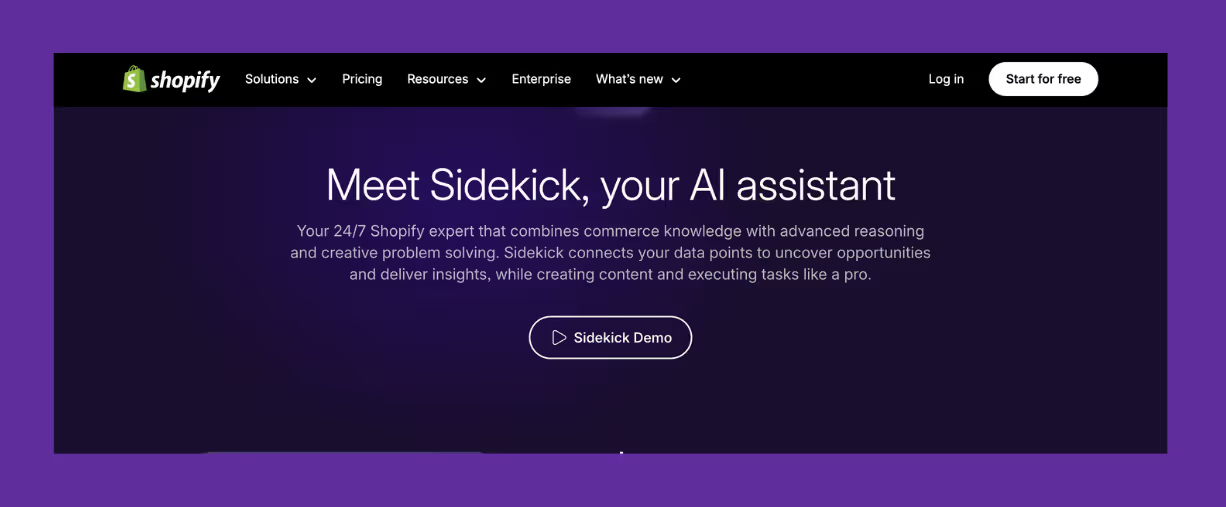
Sidekick is Shopify’s native AI assistant, built directly into the Shopify admin and designed to understand the full context of your store.
It serves as a 24/7 operational partner that can execute tasks, generate creative content, and surface insights through a conversational interface.
With direct access to your store’s backend data, Sidekick can instantly perform actions like “create a discount code for my summer sale” without relying on third-party tools or permissions.
What does Sidekick offer?
- Contextual task execution: Sidekick can modify your shop design, change theme settings, or create collections based on simple text prompts, reducing the technical barrier for complex admin tasks.
- Data analysis on demand: Merchants can ask complex questions like "Why did my sales drop last Tuesday?" and Sidekick will analyze store data to provide a summarized explanation, saving hours of manual reporting.
- Creative automation: It generates high-converting product descriptions, blog posts, and email subject lines that fit your brand voice, making the content creation process much faster.
Sidekick Pricing
Sidekick is included as part of standard Shopify plans (Basic, Shopify, Advanced, and Plus), though specific features may carry extra costs depending on the final release structure.
3. Gorgias: Best Shopify AI agent for customer service
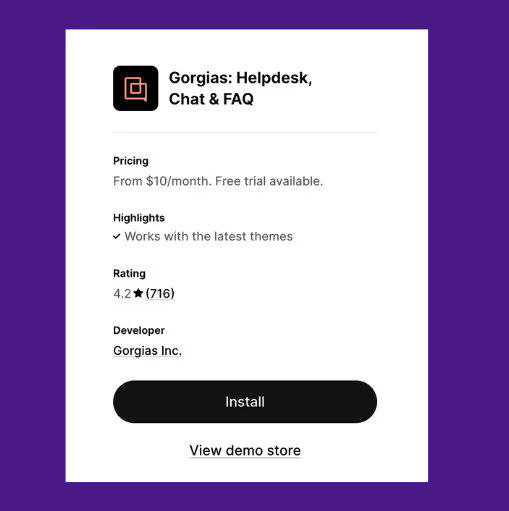
Gorgias is an e-commerce-focused helpdesk platform that includes two powerful AI agents: Shopping and Support.
The Shopping Assistant engages visitors with personalized greetings and product recommendations based on their behavior, while the Support Agent can resolve support tickets autonomously or route them to the appropriate teammate when needed.
What does Gorgias offer?
- Automation: Gorgias AI can automate up to 50% of incoming support tickets, specifically repetitive inquiries like order status and return requests, drastically lowering support costs.
- Revenue generation: The AI Shopping Assistant can detect pre-sales questions and sentiment, prioritizing high-value conversations or offering personalized discount codes to close sales, turning support into a profit center..
- Contextual responses: By pulling data directly from Shopify, the AI drafts responses that include specific order details, tracking numbers, and customer history, providing personalized service at scale.
Gorgias Pricing
Gorgias operates on a ticket-volume model. Plans start at $10/month for 50 tickets, scaling up to Enterprise levels for high-volume. The AI features are an add-on or included in higher-tier plans.
4. Allo: Best AI voice agent for Shopify customer service
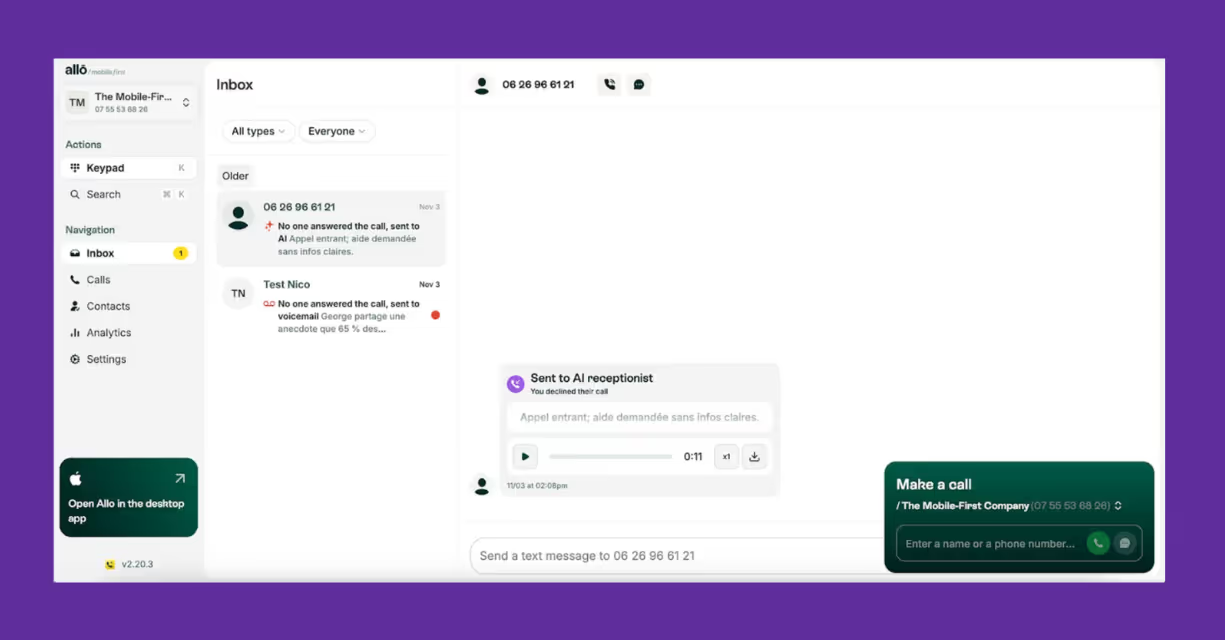
Allo is an AI phone system that offers a deep integration with Shopify.
While many brands shy away from phone support due to cost or time constraints, Allo allows merchants to get their incoming calls handled by an AI answering service.
It can answer common questions and transfer their call to an employee if necessary
What does Allo offer?
- Infinite scalability: Allo helps your teams scale phone discussions. The AI answering service reduces the number of incoming calls, the AI IVR routes your callers to the right person inside your team and the AI assistant generates handy call summaries.
- Complex issue resolution: The agent connects with Shopify to perform actions like checking order status, processing returns, or updating shipping addresses in real-time during the call.
- Brand voice customization: You can configure the AI's tone, speed, and personality to match your brand, creating a consistent auditory experience for customers.
Allo Pricing
Allo offers two plans:
- The Starter plan which costs $25/month. It includes 1 user max, unlimited calls, a local phone number, AI-generated call summaries, and an IVR.
- The Business plan at $45/month per user. It includes integrations (including Shopify), unlimited AI answering service, SMS and international calls.
5. YourGPT: Best AI agent platform for support, sales, and operations
YourGPT is an AI-first platform that help business to build and deploy autonomous agents across customer support, sales, and internal operations. Moving beyond the limitations of standard chatbots, it executes complex, performs multi-step actions and triggers direct API actions with full control over the agent’s autonomy.
It functions as a unified operational layer across Web, WhatsApp, Messenger, Telegram, Email, LINE, and more, centralizing conversations in a single inbox with complete context retention. Trained on your business data through multi-source inputs, it delivers accurate, action-driven outcomes, resolving up to 80 percent of routine queries before human intervention. When escalation is required, handoffs are seamless and fully contextual, eliminating information loss and maintaining continuity.
What does YourGpt offer?
- Complete AI Suite: It provides a complete AI suite for customer support, sales, and business operations, featuring a no-code builder, AI studio, helpdesk app, voice agents, email integration, and campaigns.
- Action-Oriented AI: AI that understands all modalities, including text, voice, and image, resolves issues and performs real-time actions rather than just deflecting them.
- Self-Learning Agents: AI agents that continuously adapt and improve over time.
YourGpt Pricing:
Starts at $39/month; Professional at $79, Advanced $349 (billed annually), and Enterprise plans are available.
6. Wisepops: Best Shopify AI agent for on-site engagement
Wisepops is an on-site marketing platform that uses AI to maximize visitor value through intelligent popups, bars, and notifications.
Its AI agent analyzes visitor behavior in real-time (such as scroll depth, mouse movement, and page history) to trigger the most relevant message at the exact moment a user is likely to convert.
What does Wisepops offer?
- AI wishlist & recommendations: The AI can suggest products or prompt users to save items to a wishlist based on browsing behavior, increasing session value.
- Smart targeting: Instead of generic popups, Wisepops uses predictive targeting to show offers only to users who need a nudge, preserving user experience for those who are already likely to buy.
- Goal-driven automation: You set a goal (e.g., "Grow email list" or "Increase AOV"), and the AI optimizes the timing and format of campaigns to achieve that specific metric.
Wisepops Pricing
Pricing is based on pageviews per month. Plans start at $49/month for up to 100,000 pageviews, making it accessible for growing brands, with enterprise tiers for high-traffic sites.
7. Klaviyo: Best Shopify AI agent for email marketing automation
Klaviyo is a leading marketing automation platform for Shopify, powered by its advanced K:AI engine.
It goes far beyond basic email sending by acting as an intelligent data scientist for your marketing team.
Klaviyo aggregates customer data to predict future behavior and automates smart segmentation and content creation.
What does Klaviyo offer?
- Predictive analytics: Klaviyo AI calculates Customer Lifetime Value (CLV), predicts next order date, and churn risk for every profile. This allows you to trigger flows exactly when a customer is ready to buy or at risk of leaving.
- Generative AI for content: The platform can generate high-performing email subject lines, SMS copy, and even build entire email templates based on your brand guidelines and campaign goals.
- A/B testing automation: AI automatically tests variations of your campaigns and shifts traffic to the winning version in real-time, maximizing revenue per recipient.
Klaviyo Pricing
Klaviyo has a tiered pricing model based on the number of active contacts in your database. There is a free tier for up to 250 contacts, with paid agent plans starting from $50 per month.
8. Eesel AI: Best Shopify AI agent for customer support
eesel AI helps Shopify stores answer product, shipping and order questions using their catalog, policies and live order data. It connects with existing helpdesks and passes complex cases to your support team. Pricing starts at $0.40 per support ticket or chat session.
What does eesel AI offer?
• Product answers grounded in your catalog, policies and FAQs.
• Live order tracking and support for return questions.
• Connections with helpdesks including Zendesk, Gorgias and Freshdesk.
• Multilingual replies, configurable tone and human escalation.
• $50 in free AI usage credits to test it right away, with no credit card required.
• A CLI for developers who want Claude Code, Codex or another coding agent to help set up and manage eesel from the terminal, with account access and integration approvals controlled by the user.
Pricing
Pay as you go: $0.40 per support ticket or chat session, covering all messages within that interaction. Standard usage has no platform fee or monthly minimum. New accounts receive $50 in free usage.
To Wrap It Up
While Generative AI often gets dismissed as experimental because of occasional hallucinations or odd outputs, ecommerce AI agents shouldn’t be viewed the same way.
Platforms like Prediko and Klaviyo didn’t appear overnight; they’re mature, purpose-built systems that existed long before the current AI hype.
By looking beyond the buzz and adopting the best Shopify AI agents now, merchants can gain a real competitive advantage and avoid falling behind as the industry accelerates.
Frequently Asked Questions About AI Agents for Shopify
.avif)
13+ Real-World AI Agents Examples and Use Cases to Try in 2026
AI agents can autonomously forecast demand, automate purchase orders, generate reports and analyse data across inventory, marketing, support and operations, helping Shopify brands reduce manual work, improve accuracy and scale workflows with intelligent, multi-step automation.
Yesterday, my manager built a full-fledged marketing asset using a ChatGPT agent. What normally takes a full day –research, structuring, and drafting– was wrapped up in just an hour.
The asset went live the same day and was already automating our tasks and streamlining processes. And it’s not just us. Adoption is accelerating fast; nearly 80% of organizations are using AI agents, and 96% plan to expand in 2026.
Inventory is no different. AI agents are now being trained to forecast demand, track stock health, and even generate purchase orders with almost no manual input.
Today, we’ll explore real-world AI agent examples and how they are changing the way brands plan, manage, and scale their operations.
What Are AI Agents? (And Why They Are Gaining Popularity in 2026)
An AI agent is an intelligent system that can think through tasks and act on its own. Instead of just following one command at a time, they can plan steps, remember what’s happened before, and work towards a goal.
For example, a chatbot might answer a customer’s shipping question, but an AI agent can check inventory, create a purchase order if stock is low, and notify the warehouse, all without being explicitly told each step.
Unlike traditional automation tools that follow pre-set rules, or chatbots that mainly answer questions, what makes AI agents different is their ability to
- Act autonomously: They don’t just wait for inputs; they decide the next steps
- Use memory: They recall past interactions and data, adjusting behavior over time
- Handle multi-step reasoning: They can break down complex goals (like planning inventory for a product launch) into smaller actions and execute them sequentially
This is exactly why businesses are turning to AI agents in 2026.
Instead of just automating repetitive tasks, companies are using them for complex decision-making —from competitor monitoring and handling customer queries to forecasting demand and reallocating resources.
How to Use These AI Agents Examples
Reading examples is one thing, and turning them into action is another. The real value of AI agent examples comes when you connect them to the specific bottlenecks in your business.
Start by mapping your daily workflows, where time gets wasted or decisions depend on instincts. That’s where AI agents can plug in.
If you spend hours adjusting forecasts, let a demand planning agent learn from your sales data. If customer queries slow you down, test a customer support agent to handle those automatically.
You don’t have to replace everything overnight. Begin with one high-impact process, measure the results, and expand from there.
The goal isn’t to add another tool. It’s to design a system where work gets done faster, data flows seamlessly, and your team focuses on growth instead of maintenance.
Types of AI Agents With Examples
Now, AI agents are showing up across every part of ecommerce. To make it simple, we’ve grouped these examples by key business functions.
1. AI Agents Examples for Inventory Operations
Inventory is where every brand feels the weight of growth; too much stock ties up cash, too little loses sales.
The following inventory AI agents automate the full cycle, from forecasting and reordering to supplier coordination, keeping inventory lean and responsive without manual checks.
1.1 Inventory management agent
Problem: As brands scale, tracking thousands of SKUs across channels becomes messy. Stockouts, overstocking, and inaccurate data waste cash and kill momentum.
What it does: An AI inventory management agent helps monitor stock levels, predict future demand using AI, identify when stock levels are at risk, and trigger reorders before stockouts happen.
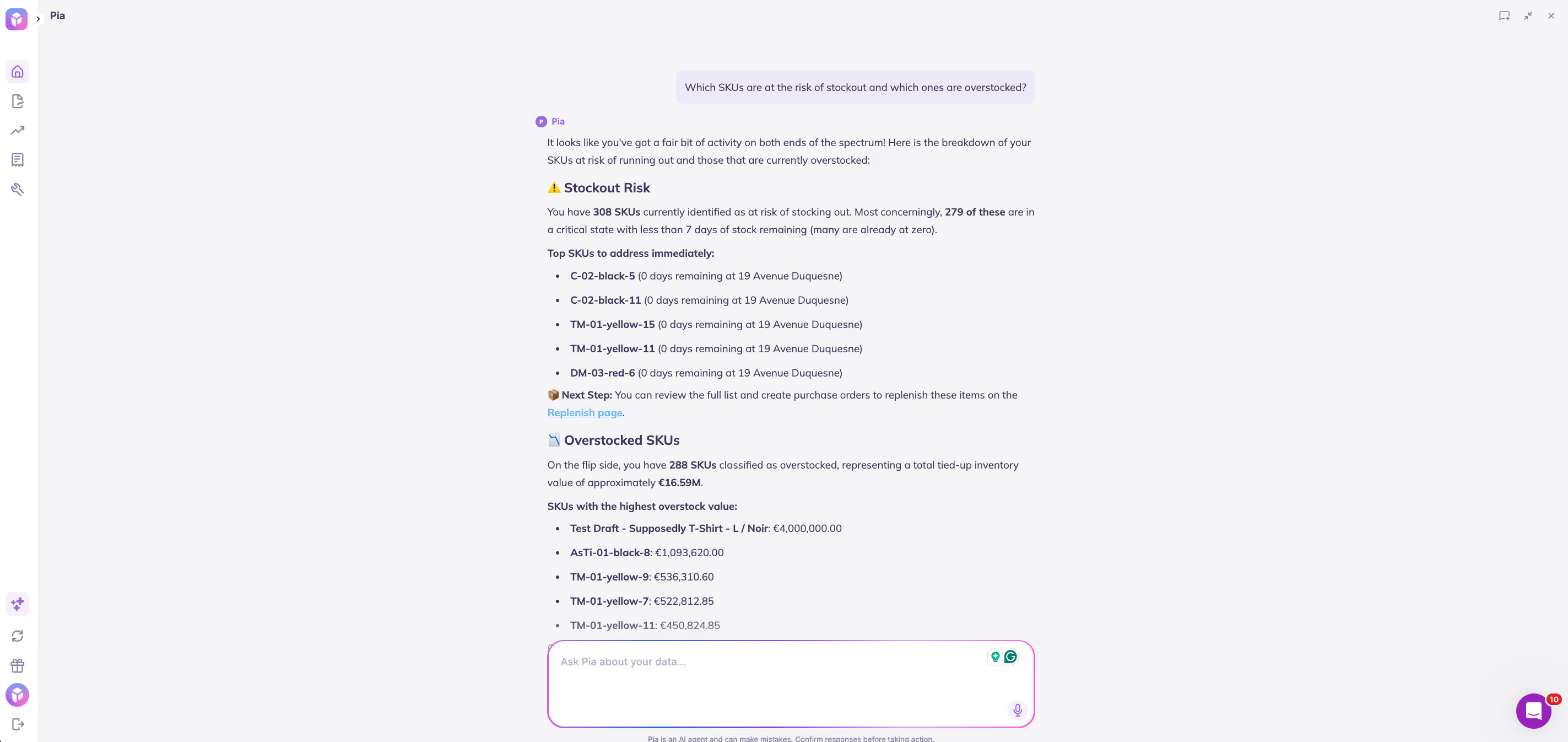
Prediko’s AI Agent allows Shopify brands to manage their entire inventory operation through simple natural language commands. You can ask it to “show me SKUs with less than 10 days of coverage”, and it responds instantly, pulling live data from your Shopify account and executing actions like creating draft POs.
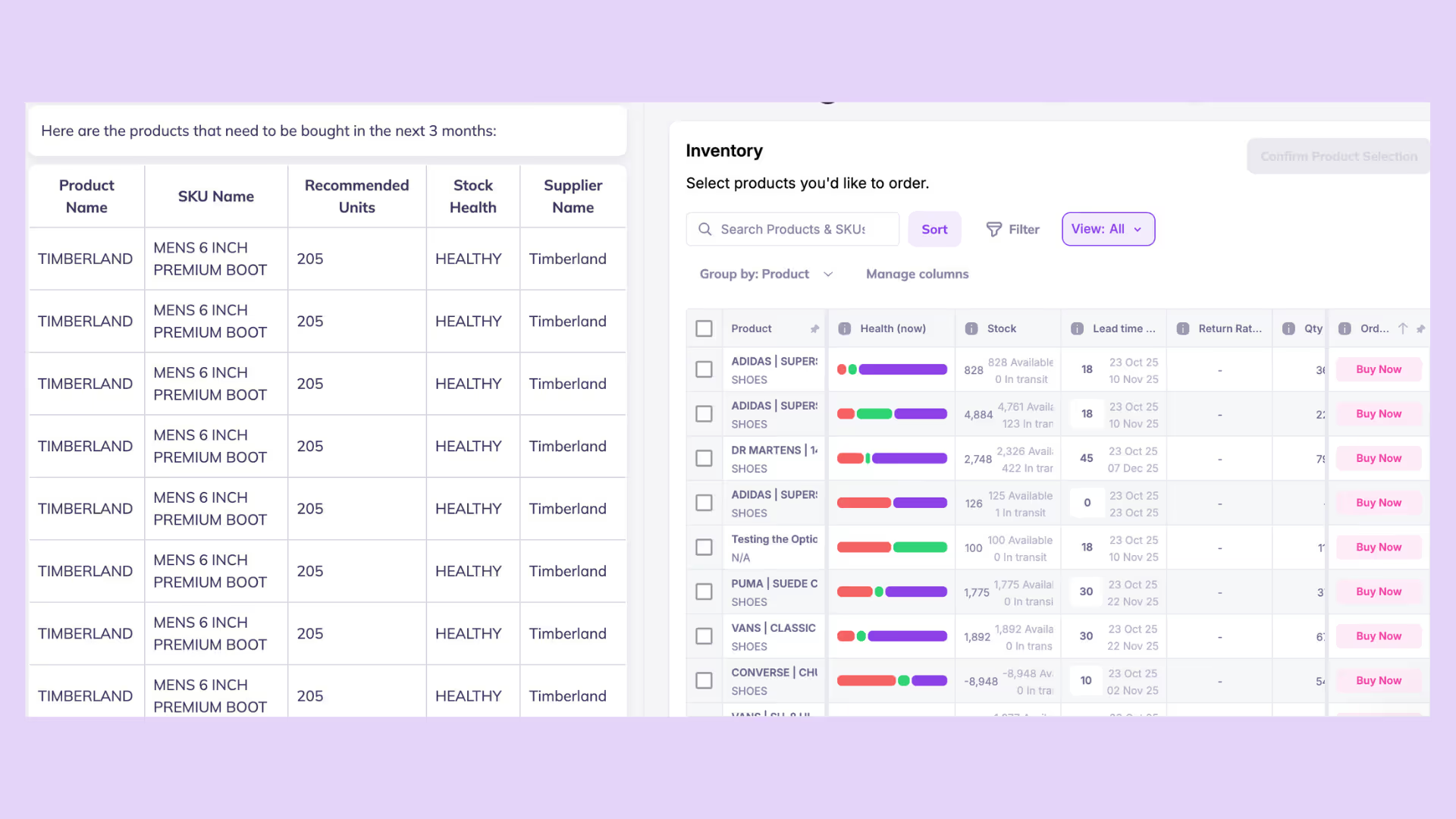
It even remembers the context of your session, so if you’ve been reviewing low-stock products, you can follow up instantly. These kinds of tools are reshaping how brands manage AI SKU optimisation at scale—automating decisions that used to take hours and improving SKU-level performance across channels.
Impact: This leads to faster decision-making, fewer stockouts, improved inventory turnover, and less cash locked in excess stock.
1.2 Purchase order automation agent
Problem: Manually creating and tracking purchase orders slows down operations and leads to missed supplier deadlines or duplicate orders.
What it does: A purchase order automation agent removes that burden with 1-click or automated generation of POs based on real-time stock and sales data.
If you’re using Prediko’s AI Agent, you can update delivery dates, switch PO statuses, or create new orders instantly through natural language commands.
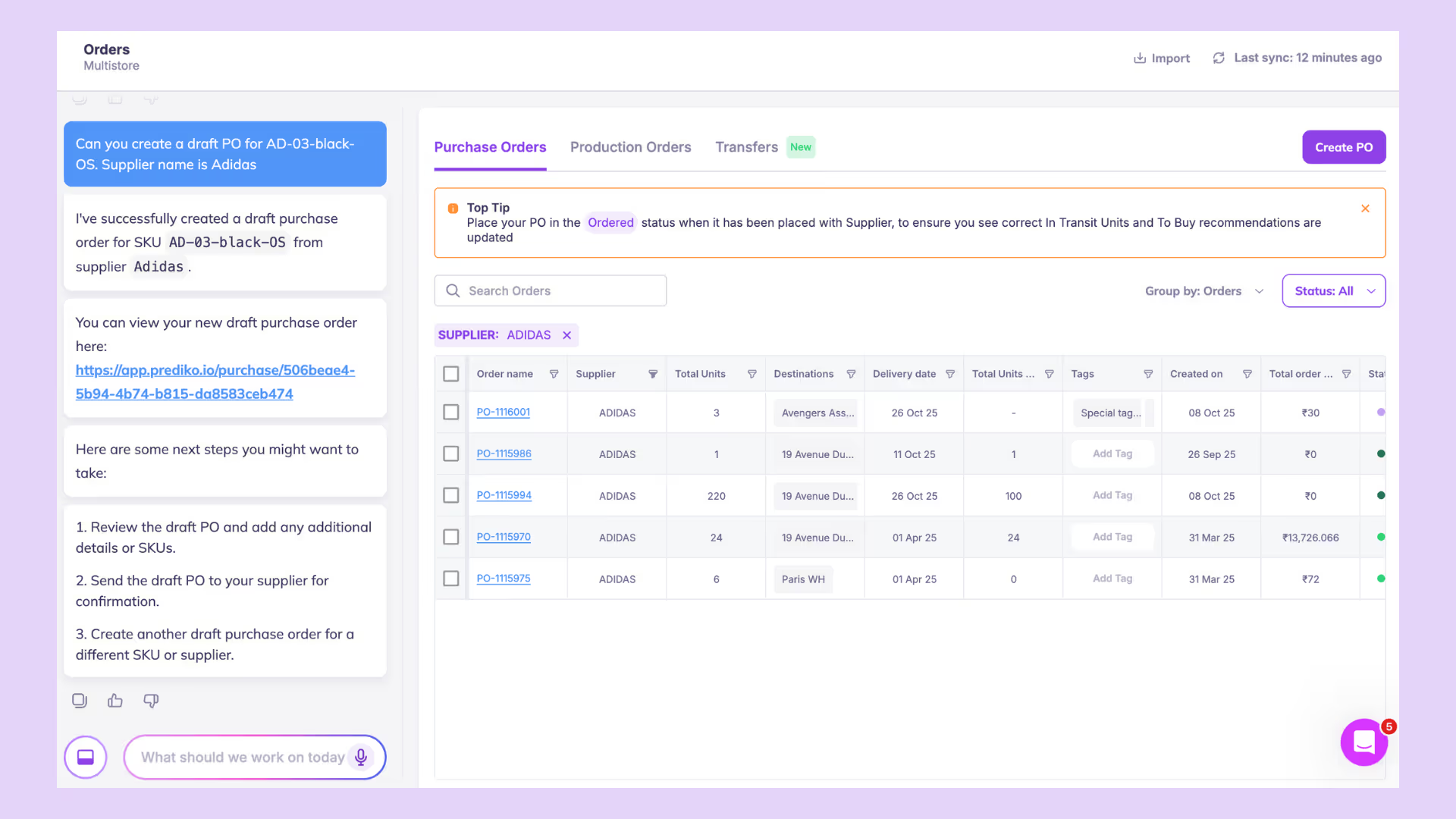
Impact: This eliminates manual tracking, keeping every PO accurate and on schedule. Your restocking becomes faster, more reliable, and scalable as order volume grows.
2. AI Agents Examples for Data and Analytics
With data pouring in from sales, marketing, and operations, the challenge isn’t access for ecommerce brands; it’s clarity.
AI agents turn scattered data into actionable insights, helping teams make faster, smarter decisions without waiting on manual reports or spreadsheet cleanup.
Some generative AI agent examples for data and analytics include.
2.1 Financial insights agent
Problem: Finance folks spend hours compiling spreadsheets to understand revenue trends, margins, or spend breakdowns. This prevents prompt action or course-correction.
What it does: A financial insights agent connects with Shopify, ad platforms, and accounting tools to deliver instant summaries and visual reports.
You can ask plain-language questions like “What was our gross margin last month?” and get real-time answers, without touching a spreadsheet.
Impact: Faster financial decisions and quicker reporting to the stakeholders.
2.2 Inventory forecasting agent
Problem: Forecasting inventory is time-consuming, data-intensive, and error-prone, especially when dealing with hundreds of SKUs across locations and fluctuating demand.
What it does: An AI forecasting agent uses sales, seasonality, and growth patterns to predict future demand and recommend reorder quantities. It adjusts forecasts automatically based on trends, promotions, or new launches.
For example, Prediko’s AI Agent generates SKU-level demand forecasts, refreshes plans based on new data, and factors in seasonality, promotions, or upcoming product launches.
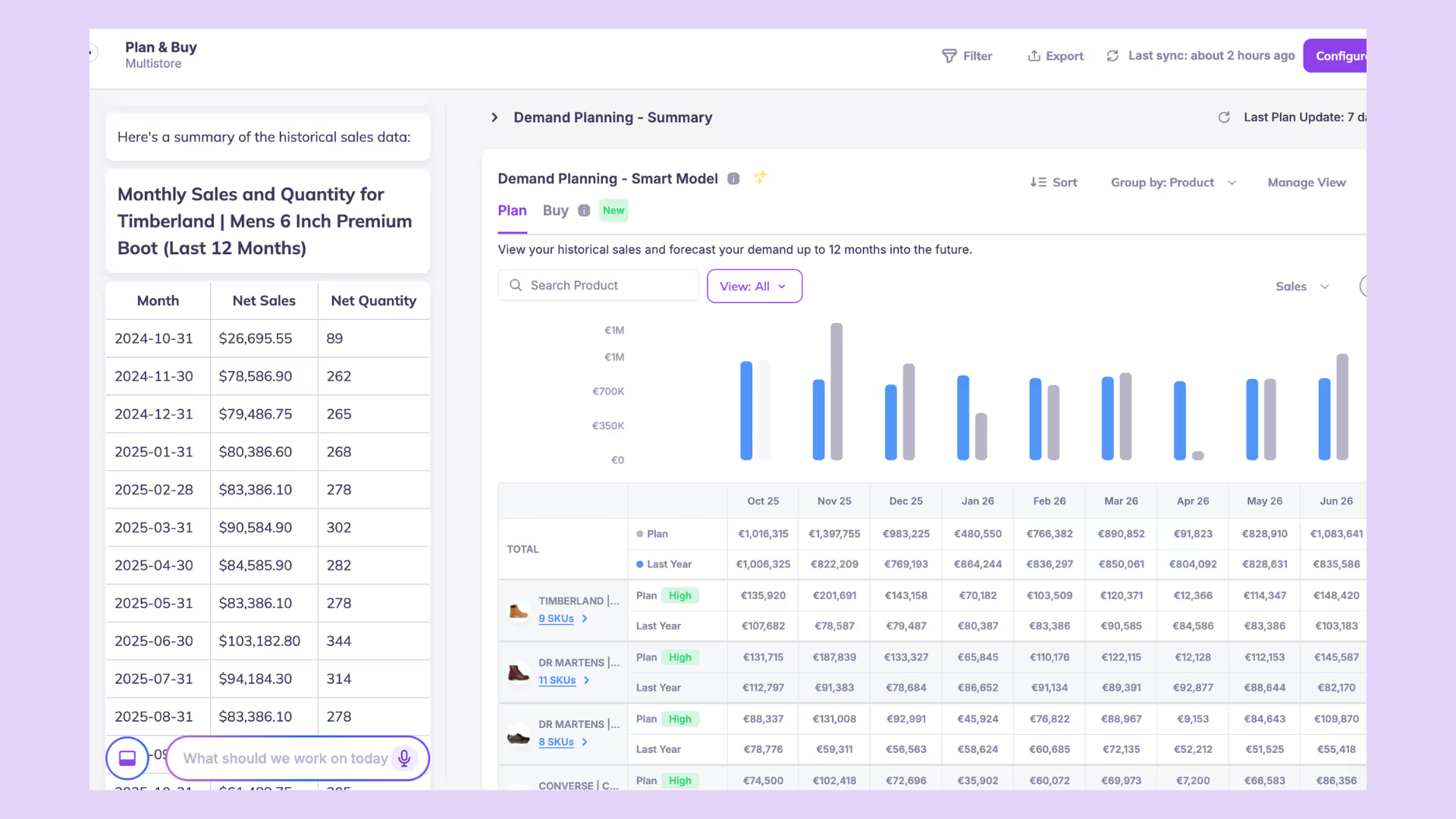
It even considers bundle or BOM demand to calculate total material needs. This places it among the most powerful AI demand planning tools available to fast-growing Shopify brands. You can adjust forecasts manually, run “what-if” scenarios, and review insights on which SKUs need attention, all through simple chat commands.
Impact: More accurate forecasts, fewer stockouts, and balanced inventory across channels.
2.3 Performance reporting agent
Problem: Reporting cycles can take days, with teams manually compiling updates from different systems or departments just to track KPIs or campaign performance.
What it does: A performance reporting agent automates report creation, visualization, and distribution. It gathers metrics across different functions to produce weekly or daily reports.e
Prediko’s AI Agent, for instance, can create, open, and schedule sales and inventory reports on demand or even send them to your inbox at fixed times every day or week. So instead of asking your team for updates, you just ask your agent.
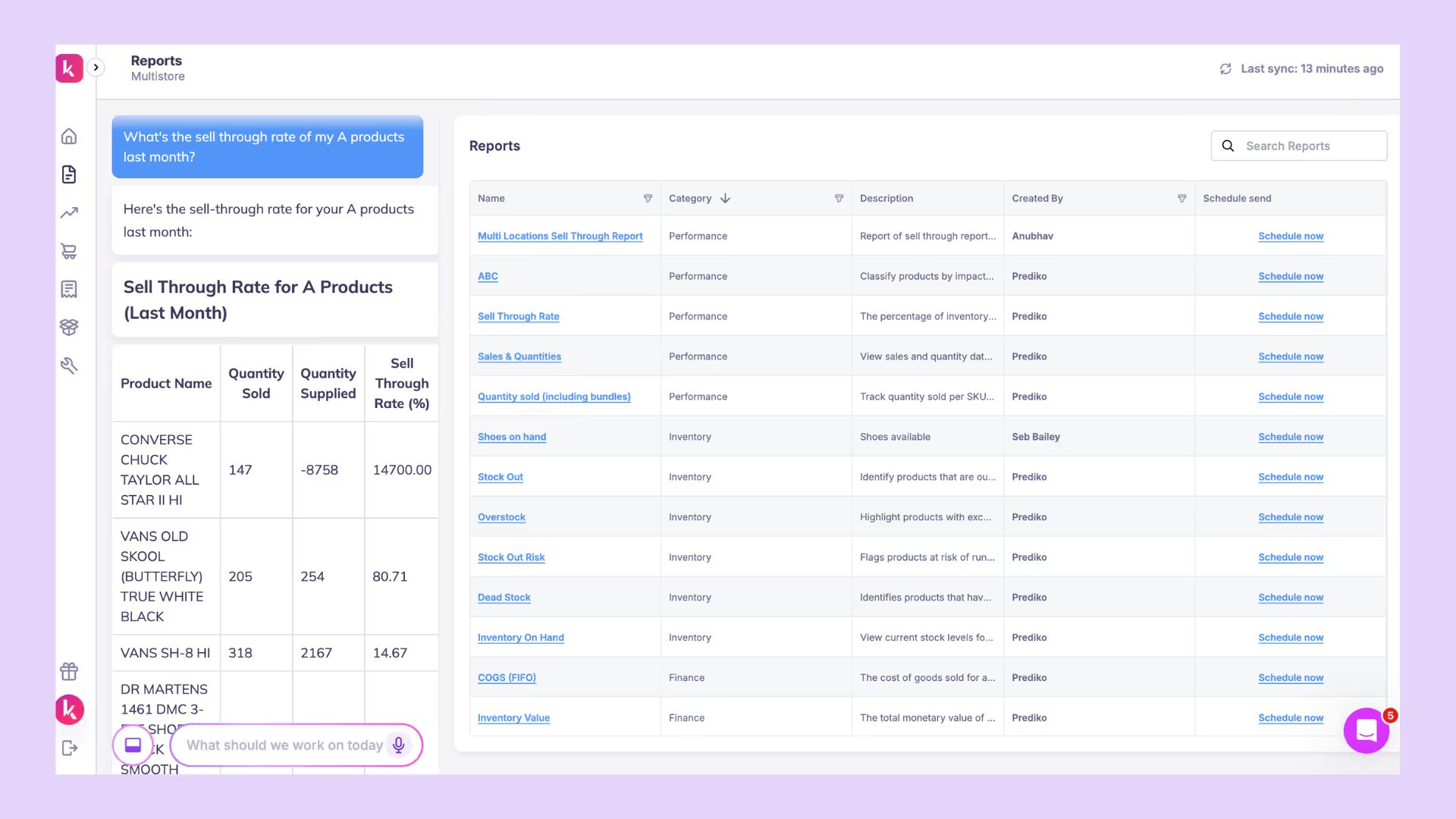
Impact: Consistent visibility, faster insights, and hours saved every week in manual reporting.
3. AI Agents Examples for Product and Catalog Management
Product and catalog management can easily become chaotic, especially when you’re juggling hundreds of SKUs across channels.
The following autonomous AI agent examples show how they can automate data cleanup, enrichment, and optimization.
3.1 Product attribute extraction agent
Problem: Managing large product catalogs often leads to missing details (like material, color, or size) which can hurt listing quality, SEO visibility, and ad performance.
What it does: This agent automatically scans product titles, descriptions, and images to identify and standardize key attributes. It cleans up messy data, enriches missing fields, and ensures every SKU is accurately categorized.
Delivery Hero, an online food ordering and delivery company uses agentic AI to automatically build and maintain its product knowledge base; extracting, cleaning, and updating catalog information in real time to keep data consistent across all platforms.
Impact: Improved catalog accuracy, cleaner product feeds, and fewer sync errors when pushing listings to Facebook, Google, or marketplaces.
3.2 Competitor monitoring agent
Problem: Manually tracking competitor pricing, promotions, and launches is time-consuming and reactive. By the time you notice a competitor’s price drop, you’ve already lost sales.
What it does: This agent automatically scans public competitor listings and pricing feeds, comparing them to your SKUs. It flags anomalies, price gaps, and promotional trends, then delivers a summary or alert straight to your inbox or Slack.
Crayon AI is one such tool that uses generative AI to automatically create ready-to-share summaries of news articles, blog posts, and press releases of competitors.
Impact: Real-time pricing intelligence, proactive promotional planning, and the ability to react quickly before your competition does.
3.3 Content optimization agent
Problem: Every platform and its audience behaves differently. Optimizing product titles, descriptions, blogs, and emails one-by-one is tedious and inconsistent. This affects both discoverability and conversion.
What it does: A content optimization agent reviews your listings or content and identifies opportunities for SEO and conversion improvement. It analyzes keywords, readability, and engagement patterns, then suggests optimized titles, meta descriptions, and other insights.
For instance, HubSpot’s AI agent personalizes every email using unified CRM data, gives feedback after each email delivery, and even recommends optimal send times for higher engagement.
Impact: Higher search visibility, improved click-through rates, and more consistent branding across all sales and marketing channels.
4. AI Agents Examples for Marketing and Customer Engagement
In marketing, personalization and timing play a crucial role.
The AI agents below help create tailored messages, optimize live campaigns, and respond to customer queries instantly.
4.1 Personalized outreach agent
Problem: Generic emails and outreach messages rarely convert. Teams spend hours segmenting lists and tweaking templates, yet it leads to low reply and conversion rates.
What it does: This AI agent analyzes CRM and website data to tailor each message automatically. It crafts unique versions of emails, DMs, or ad copies based on customer behavior, demographics, and past interactions.
Salesforce’s AI agent, for example, automatically captures and routes new leads, then uses CRM data to write personalized outreach messages. It decides when and how to follow up based on lead behavior.
Impact: More authentic conversations that drive stronger engagement and higher conversions.
4.2 Campaign optimization agent
Problem: Marketers often lose money running ads manually –adjusting bids, creatives, and targeting across Meta, Google, and TikTok ads. It takes time and makes it too late to make an impact.
What it does: This agent continuously monitors ad performance across platforms. It analyzes real-time data to adjust bids, pause underperforming ads, and reallocate budgets to top-performing campaigns.
Impact: Improved ROAS, lower cost per action, smarter budget allocation, and campaigns that actively adapt to performance instead of reacting after the results.
4.3 Customer support agent
Problem: Support teams get bogged down answering the same questions about orders, returns, or tracking updates, leaving little time for complex issues that need a human touch.
What it does: A customer support agent autonomously handles repetitive customer queries, pulling real-time data from Shopify or Helpdesk. It understands context, provides instant responses, and escalates to humans only when necessary.
Intercom’s Fin AI Agent and Zendesk AI agents are some examples of customer support agents. They use your existing help center and chat history to respond with accurate, brand-specific answers. They also know when to escalate, handing complex or sensitive queries to a human agent without losing context.
Impact: Faster response times, happier customers, and leaner support teams that can focus on high-value, human-first interactions.
According to Gartner, by 2029, agentic AI will autonomously resolve 80% of common customer service issues, reducing operational costs by up to 30%.
5. AI Agents Examples for Operations and Engineering
Behind every fast-moving brand is a web of processes and systems that need constant upkeep. AI agents simplify these backend workflows, and here are a few examples.
5.1 SOP generation agent
Problem: As teams grow, processes become harder to document. Critical know-how often lives in Notion pages, Slack messages, or people’s heads, making training and onboarding inconsistent.
What it does: This agent observes recurring workflows across tools like Slack, Asana, and Google Drive, then auto-generates SOPs and checklists. As processes evolve, it updates them automatically so teams always have the latest, most accurate answers.
Impact: Consistent execution, faster onboarding, and less time wasted documenting processes.
5.2 Research and insights agent
Problem: Manual research takes hours before any decision can be made, whether it’s comparing supplier pricing, tracking competitors, or analyzing market trends.
What it does: A research and insights agent scans credible web sources, company databases, and reports to surface relevant insights. It summarizes findings, cites references, and delivers key points directly into your workspace, like Slack or Notion, in minutes.
For instance, at Prediko, we use a Notion AI agent to instantly surface product-related details, from feature explanations to release notes, while creating marketing assets and content pieces.
Impact: Faster decision-making and better-informed strategy. Teams can move from research to action quickly, saving hours per week.
5.3 Code assistant agent
Problem: Engineering teams often lose time debugging repetitive issues or reviewing similar pull requests. These tasks slow releases and keep developers focused on maintenance instead of innovation.
What it does: A code assistant agent analyzes your codebase, detects bugs, and suggests fixes in real time. It can even auto-generate pull requests for routine changes so that best practices are followed across repositories.
Tools like GitHub Copilot, Amazon Q Developer, and Cursor are already leading in this space, acting as programmers that learn from your team’s coding style.
Impact: Shorter QA cycles, fewer production bugs, and reduced technical debt.
Build vs Buy: How to Choose the Right AI Agent
When adopting AI agents, one of the biggest questions is whether to build your own or buy an existing solution.
Both approaches can lead to strong outcomes, but the right choice depends on your technical depth, data availability, goals, and available resources.
Building an AI agent in-house gives you full control. You can train it on your proprietary data, create workflows for your exact needs, and ensure full compliance with your internal security standards.
However, this approach requires a data science team, ongoing maintenance, high costs, and time (months, not weeks) before you see results. It’s ideal for large enterprises with engineering resources and complex, unique use cases.
Buying or integrating a SaaS AI agent, on the other hand, means faster setup and lower upfront cost.
You get immediate access to proven architectures, pre-trained models, and product support, all without having to maintain infrastructure. Many options also let you customize with APIs or embed your data for semi-tailored outcomes.
Checklist for Choosing Right AI Agent
Before committing, evaluate each option on:
- Security & compliance: Does agent meet your data privacy, SOC2, or GDPR standards?
- Scalability: Can it handle your future data growth or new workflows without lag?
- Integration: How easily does it plug into your existing stack – Shopify ai integration, WMS, Slack, CRM, etc.?
- Transparency & human oversight: Can you audit its logic and intervene when needed?
- Adaptability: Does it learn from feedback and improve with your usage patterns?
Prediko’s AI Agent for Inventory Management
At Prediko, we chose the “build + integrate” route, combining our proprietary demand forecasting engine with an embedded AI co-pilot trained on Shopify inventory workflows.
Prediko’s AI Agent works inside the platform to help Shopify brands manage operations through natural language commands. You can ask, “Show me SKUs at risk of stockout next week” or “Create a PO for Product X”, and the agent instantly takes action. This kind of intelligent automation is part of a growing category of Shopify AI tools that streamline store management, boost accuracy, and unlock growth at scale.
It’s built on top of Prediko’s existing forecasting logic, enabling
- Demand and purchase order automation based on real-time sales and seasonality
- Report creation and scheduling for teams who need daily or weekly updates
- PO management with the ability to update delivery dates and statuses
- Session memory so the agent remembers your context and tasks within a session
- On-page context to ask questions and take actions directly where you’re working
The result: Faster decision-making, fewer stockouts, and inventory that’s always in sync with demand.
Prediko’s approach shows how purpose-built AI agents can deliver enterprise-grade intelligence without requiring teams to start from scratch; combining precision, scalability, and ease of use in one place.
KPIs & Metrics to Track for AI Agents
Adopting AI agents is only as valuable as the measurable impact they deliver. Whether your agents handle inventory, marketing, or support, tracking the right metrics helps you evaluate efficiency, accuracy, and ROI over time.
The most common KPIs for AI agents include:
- Accuracy: How often the agent performs a task correctly without human intervention
- Time saved: Reduction in manual hours spent on repetitive workflows
- Cost reduction: Operational savings achieved through automation or faster execution
- ROI: Tangible value gained compared to investment in the agent (software, setup, and training)
- Adoption rate: Percentage of team members actively using the agent in daily operations
These metrics together give a full picture of whether your AI agents are improving processes or just adding another layer of technology.
Here are some AI agents business impact examples that are typically seen after implementing them across operations.
Source: Prediko customers that use AI agent
Getting Started with Your First AI Agent
If you’re thinking about implementing your first AI agent, here’s a quick look at what that process typically involves, from setting up baseline and preparations to testing and scaling the agent within your existing stack.
For a deeper look at the key considerations behind a successful Agentic AI journey, from strategy to workforce readiness, Deloitte’s report outlines how leading companies are approaching adoption effectively.
And if you’re ready to try one today, start with Prediko. You can explore our AI Inventory agent with a 14-day free trial.
It acts as your in-app inventory co-pilot, helping you forecast demand, create purchase orders, and manage stock using simple natural language commands.
Frequently Asked Questions (FAQs)
Why Can't Claude Forecast Inventory For Your Ecommerce Brand? (And the Alternative)
Vibe coding is useful for quick dashboards, but inventory forecasting needs more than that. Learn how Claude compares to dedicated demand planning tools.
A Shopify founder pastes 18 months of order data into Claude and asks it to build a reorder model.
Two hours later, they have a working dashboard. It pulls Shopify data, calculates days of cover, and sends Slack alerts when stock dips.
It works. Genuinely. And it cost them nothing but an afternoon.
Six months in, they’re sitting on $40,000 of overstock because the model missed the real-world context outside Shopify, one spreadsheet stayed disconnected, and no one updated the lead times that changed four months ago.
That’s the problem with vibe-coded forecasting.
We cover where vibe-coded forecasting helps, where it fails, what's actually happening under the hood when you ask an LLM to forecast, and where purpose-built tools like Prediko handle it better.
Can Claude or ChatGPT forecast demand?
Short answer: it depends, definitely not in the way a buying decision needs. Not because the model isn't smart enough, but because of what it's mechanically built to do.
We will share our honest version of why, and then what to use instead.
Claude forecasting feels exciting at first. It is fast, flexible, and gives you something that looks useful. But there are moments when this shiny setup starts to show its limits.
1. It's the wrong kind of model for the job
Claude is a large language model. Its job is to predict the next piece of text, not future demand.
That creates two problems for inventory forecasting:
- It isn’t built for precise numerical forecasting. In a chat window, Claude handles numbers as tokens, not values, which makes raw arithmetic less reliable. (Hand it code to run instead, and that part gets fixed, but that just shifts the real problem to the point below.).
- It gives you an answer, not a risk range. Ask Claude for next quarter’s demand and you’ll usually get a single estimate. But buyers need to know the uncertainty around that number too.
There’s a big difference between forecasting 10,000 units and knowing demand could realistically land between 8,000 and 12,000 units. That range affects how much safety stock you carry and how aggressively you buy.
Forecasting with dedicated tools like Prediko runs at the SKU level and is built to express that range, so a buy plan can be set to the service level you actually want to carry, not to whatever single number a chat window happened to return.
2. It only knows what you've told it
A Claude-powered forecasting model trained on your last 18 months of Shopify data knows your store. It knows your average sell-through rate, your seasonal peaks, and your top SKUs. That's genuinely valuable.
What it doesn't know: how your category behaves across thousands of brands. Whether a demand dip in February is specific to you or universal across skincare DTC. What typical lead time variability looks like for your supplier category. How brands with similar SKU profiles navigate Black Friday without going into overstock.
That context doesn't live in your data. It lives in aggregated, cross-brand pattern data that no general-purpose AI has access to unless it's been specifically trained on it.
3. It reads your sales history, not your real demand
Another problem is that sales data isn’t always the same as demand data.
When a SKU sells out, sales drop to zero. But demand may still be there. If a forecasting tool reads that sales history at face value, it can mistake a stockout for weak demand and under-forecast your bestsellers for the next cycle.
A Claude script would need to be explicitly built to correct for that, and many aren’t until you've been burned by it once.
4. It has no answer for day-one launches
Ask a Claude-built model to forecast a brand-new SKU with zero sales history and you'll get either a refusal or a guess dressed up as a number. There's nothing in an 18-month CSV of your own sales to learn from for a product that's never existed before.
This matters because new launches are exactly when a bad buy hurts most; too little and you miss the launch window, too much and it's dead stock with no sell-through to justify it.
A forecasting system designed for this problem should be able to estimate demand for a new product using data from similar products, rather than making assumptions without any basis.
5. It can't build a system of record
Here's a quieter problem. Every time you start a new Claude session, the conversation starts fresh. Your historical forecasts, your PO decisions, your supplier notes, your past stockout events none of that is stored, tracked, or referenced in future planning cycles.
A forecasting system that doesn't accumulate history isn't getting smarter over time. It's starting from zero every session. For operational planning, that's not a tool. That's a very capable calculator that forgets every calculation.
As the Slack conversation shared above puts it: "Building with Claude on top of Shopify data, their data won't be stored anywhere and will continue to be siloed."
6. Every action is infrastructure you have to build and maintain yourself
Claude can execute. It can call the Shopify API, generate a PO, and send a supplier email only if you've built that integration. The capability exists.
Every action requires explicit engineering, and once built, you own it. Every Shopify API update, every new supplier, every channel you add is more surface area your script has to cover.
Purpose-built tools give you the capability and execution that's already built, maintained, and connected, without the ongoing tax of keeping it alive yourself.
7. It has no view of the messy middle
Claude’s Cowork cannot account for the fragmentation and complexity of a traditional inventory setup.
A real Shopify supply chain isn’t one clean data source. It’s stock split across a 3PL syncing on batch cycles, wholesale allocations sitting in a spreadsheet, supplier lead times buried in emails, bundles that aren’t tracked at the component level, and inbound POs that don’t exist in any system until someone manually enters them.
A custom Claude script handles the inputs you've thought to give it. The messy middle, the things you didn't think to account for until they caused a problem, is exactly what separates a forecasting model built on Claude from a real forecasting system.
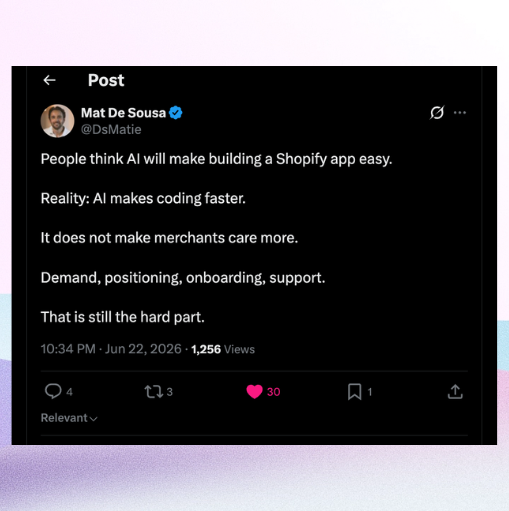
Big names in the Shopify ecosystem are saying it out loud now: AI can make coding faster, but it doesn’t make building a Shopify app easier.
Merchants still need clear positioning, real onboarding, strong support, and a product that solves an actual problem.
That’s exactly why Prediko isn’t just another AI layer. It’s built around the messy, operational work Shopify brands actually deal with every day.
The Three Things Vibe Coding (Claude) Gets Right for Inventory
For ecommerce operators, vibe coding opened a door as you no longer need a developer to connect to your Shopify API, calculate days-of-cover per SKU, or build a reorder alert system.
To be fair, vibe coding does solve real problems for Shopify brands.
1. It eliminates spreadsheet dependency
The most common inventory management setup for under $5M Shopify brands is still a combination of Shopify's built-in reports and an ever-growing Google Sheet.
Vibe coding replaces that with a proper automated system that reads live data and surfaces actionable alerts.
2. It compresses time to tool
What once required a developer, a Shopify API integration, and three weeks of back-and-forth now takes an afternoon.
Gartner predicts 60% of all new code will be AI-generated by the end of 2026, and the speed gains are real.
3. It handles structured, repeatable logic well
Calculating reorder points, tracking days of cover, flagging when stock drops below a threshold, all of these are straightforward tasks. You give AI the formula and it applies it reliably across your SKU catalogue. That part works.
Here’s the catch. Demand forecasting isn't a formula problem. It's a pattern recognition problem. And pattern recognition requires data that vibe coding, by definition, doesn't have access to.
Prediko's Pia vs Claude: Compare Why Brands Should Choose Prediko
This isn't a takedown of Claude. It's a clarification of what each tool is actually built for.
That's the distinction. Claude is a generalist that can narrate inventory. Prediko is a specialist built to run it.
What Good Inventory Forecasting Actually Requires
Let's be specific. Here's what separates Claude-based forecasting from a forecasting system that actually protects your margins.
1. A forecast that reconciles to both your revenue target and SKUs
A forecast on its own is a prediction. A plan is a decision and the two aren't the same thing. A SKU-level forecast tells you the granular truth of what's likely to sell.
But finance is holding you to a revenue and margin number for the season, and if those two views live in separate spreadsheets, they drift apart fast.
A good demand planning system connects both in one model, so every change to the SKU forecast immediately updates the wider revenue plan.
2. Cross-brand pattern data
Your own historical data is a starting point, not a training set.
Accurate demand forecasting draws on patterns across thousands of similar brands to account for category seasonality, demand volatility benchmarks, and supplier behaviour norms that your data alone can't surface.
3. A persistent system of record
Every forecast, every PO, every supplier note, every actual vs. predicted difference should be stored and feed into the next planning cycle.
If your forecasting system doesn’t learn from past decisions and outcomes, it doesn’t improve over time. It just keeps making the same level of guesses.
4. Closed-loop action capability
The forecast should connect directly to the replenishment action: a purchase order generated, sent, and tracked. It shouldn’t just be a recommendation that someone has to manually act on.
5. Continuous model improvement
AI forecasting reduces forecast errors by 20-50% compared to traditional methods.
But that improvement requires a model that learns from new data and improves over time not a static prompt that runs the same calculation regardless of what's changed in your market.
6. Ops that scale without rebuilding
A 4-person brand and a 40-person brand have fundamentally different planning needs. The tool that works today needs to grow with you not require a rebuild every time your operational complexity increases.
Where Claude Genuinely Helps and How It Plugs Into Prediko
Here's the part most vendor comparisons skip, and it's worth saying plainly: we're not anti-Claude. Claude is a genuinely excellent tool for language. The mistake isn't using it, it's asking it to be the forecasting engine instead of the interface on top of one.
Prediko is now available in Claude. That means you can connect Pia directly into Claude and ask questions about your actual Prediko data: forecasts, POs, supplier status, in plain language, from inside Claude or ChatGPT.
So you don't have to choose between the conversational interface you like and a forecasting engine that actually works. You get both: the interface powered by real inventory intelligence, not a spreadsheet you had to upload by hand.
Claude, on top of Prediko, is genuinely good at:
- Drafting supplier emails and PO communications - Claude is great at this.
- Explaining inventory reports to non-technical stakeholders.
- Ad hoc data analysis - asking "why did my sell-through drop in March?" on top of a Prediko export.
- Forecasting narratives - turning Prediko's numbers into a board update or a quarterly review.
- Custom integrations - brands have used the Prediko API plus the Claude MCP to build their own PO automation workflows on top of Prediko's data, rather than instead of it.
The pattern that works: Prediko runs the inventory logic. Claude handles the language, the communication, and the custom workflows on top.
How Does Prediko (and Pia) Stack Up Against Claude For Forecasting
Prediko is built specifically for Shopify DTC brands that have outgrown spreadsheets and do not want to maintain custom Claude dashboards that break every time an API changes, a spreadsheet gets missed, or someone forgets to update the data.
Here’s where Claude stops making sense and Prediko takes over.
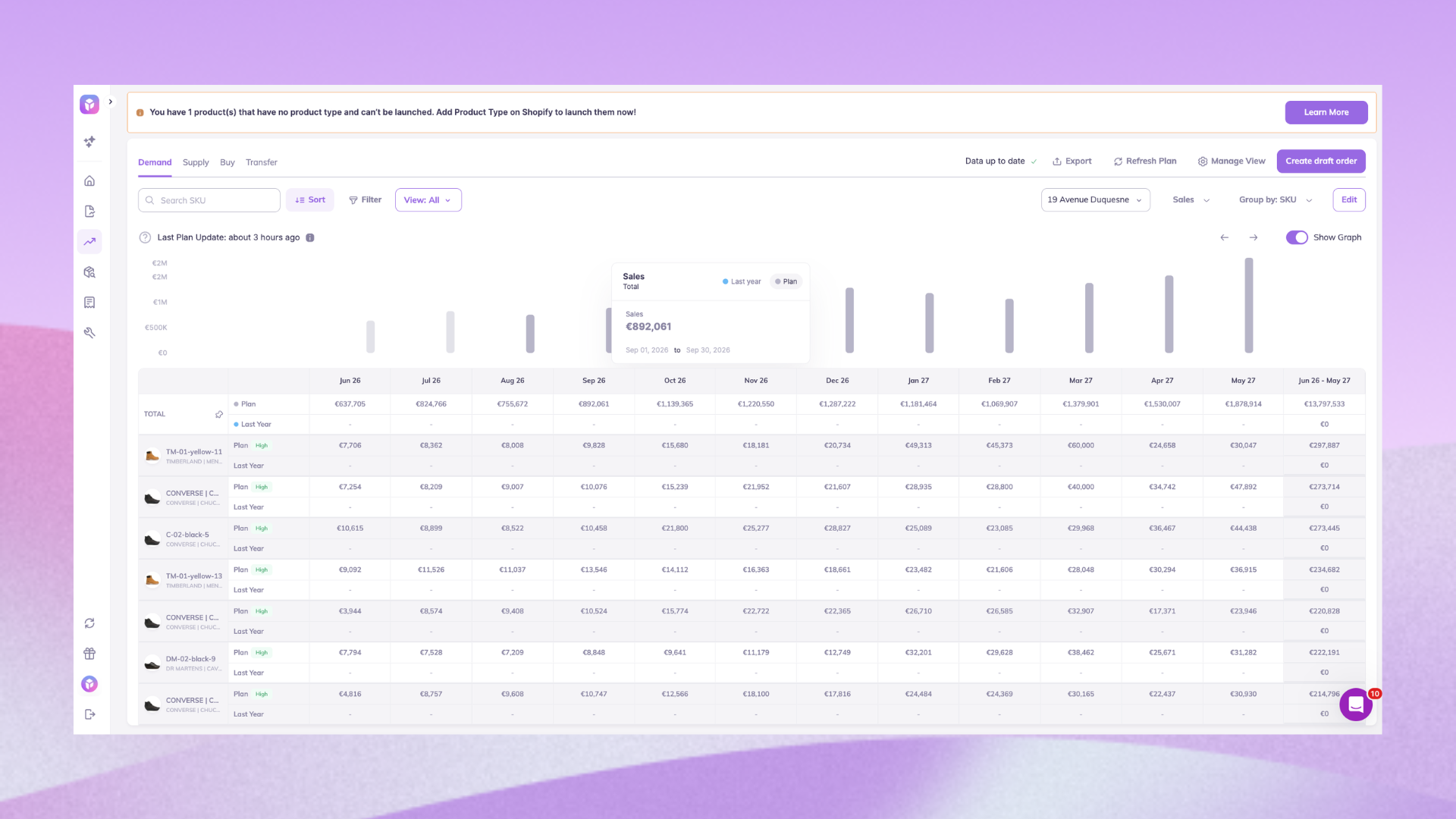
- AI demand forecasting that predicts sales at the SKU level up to 12 months out, factoring in seasonality, promotions, bundle demand, supplier lead times, and inbound stock. Trained on cross-brand data from 25 million SKUs across 15+ categories, not just your historical sales.
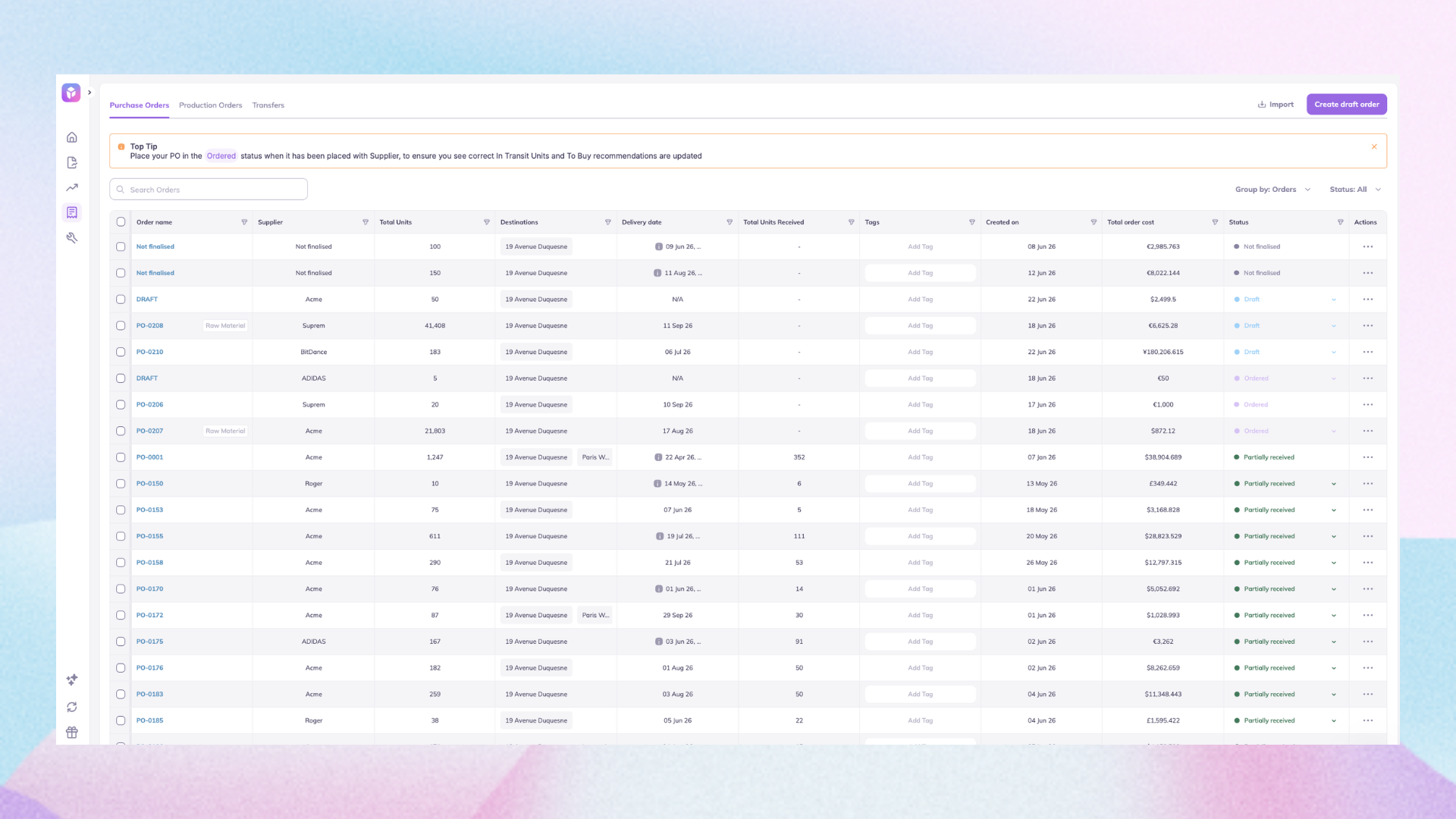
- One-click purchase order generation from forecast to PO to supplier in minutes. No manual translation from recommendation to action required.
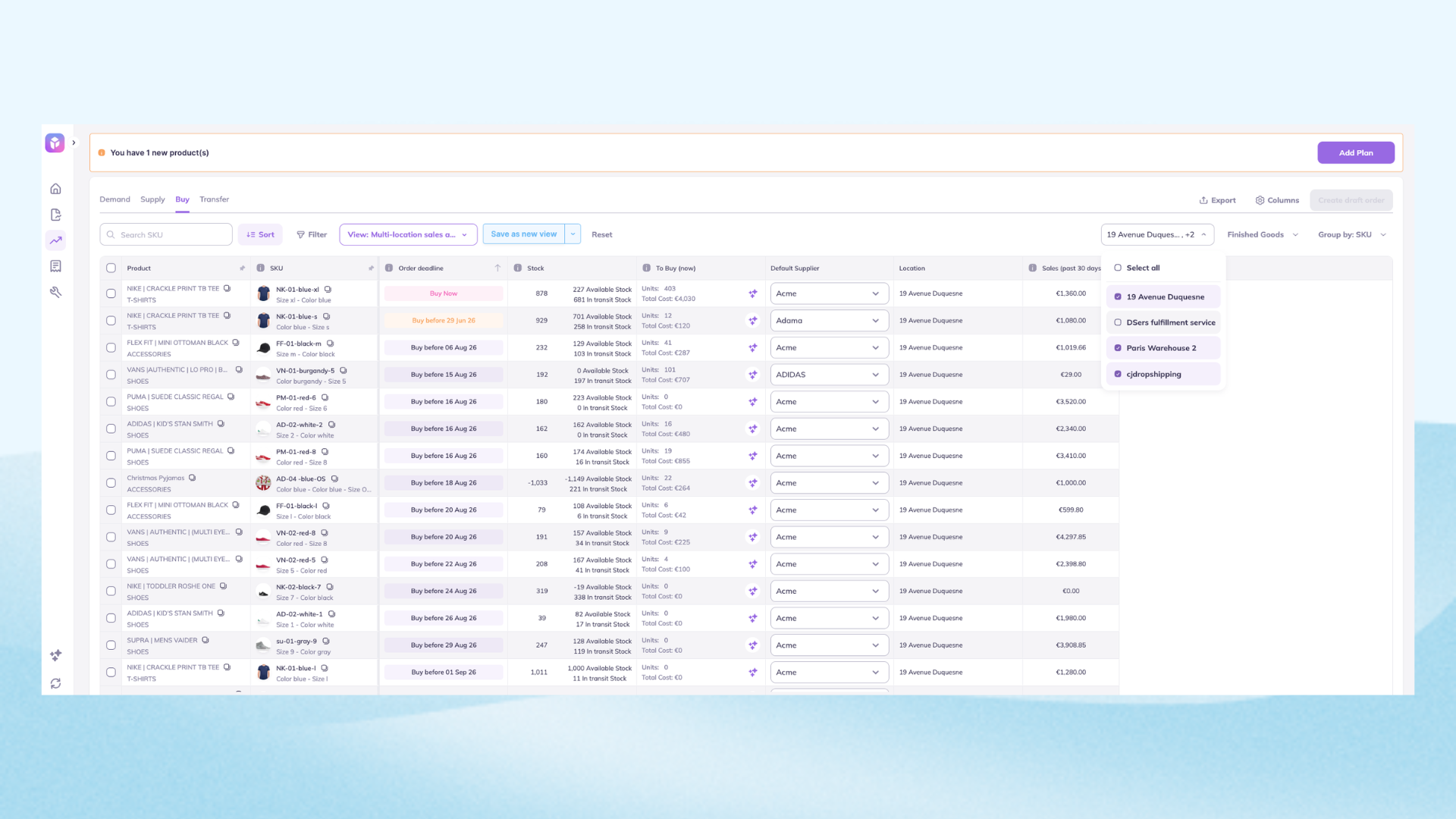
- Real-time multi-location stock visibility unified view across all warehouses, 3PLs, and Shopify locations that updates in real-time. Available-to-sell calculations are done automatically, accounting for what's actually available, not just what Shopify shows.
- A persistent system of record for every demand plan, PO, supplier note, and forecast variance is stored and accessible. Your inventory knowledge lives in the platform, not in someone's head or a session that resets.
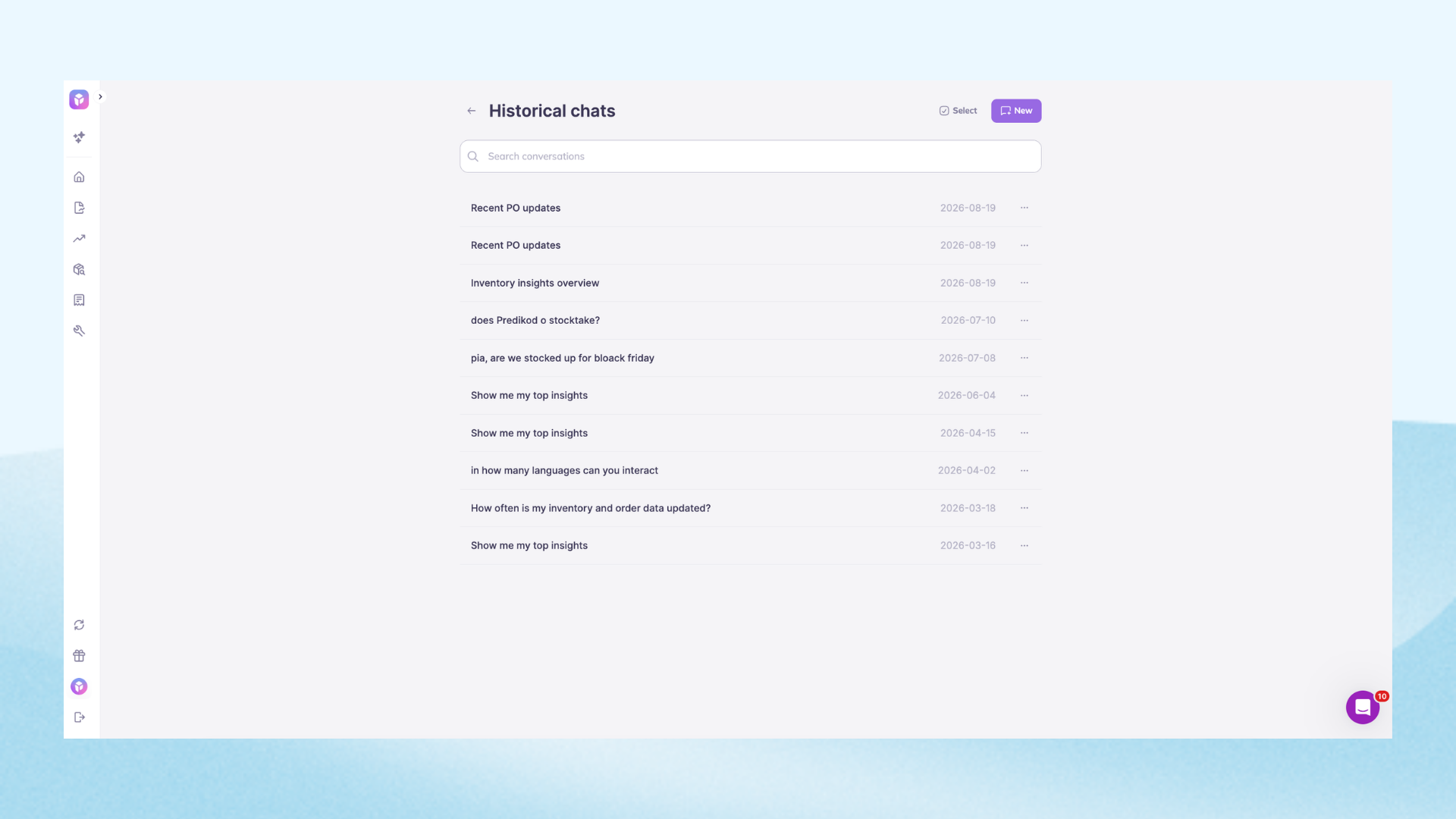
- Chat-based planning interface (Pia): Prediko's AI agent executes commands: refreshing demand plans, generating POs, flagging at-risk SKUs, surfacing insights. The difference from a general-purpose AI: Pia is trained on inventory-specific data and operates within a closed-loop system where actions have real consequences.
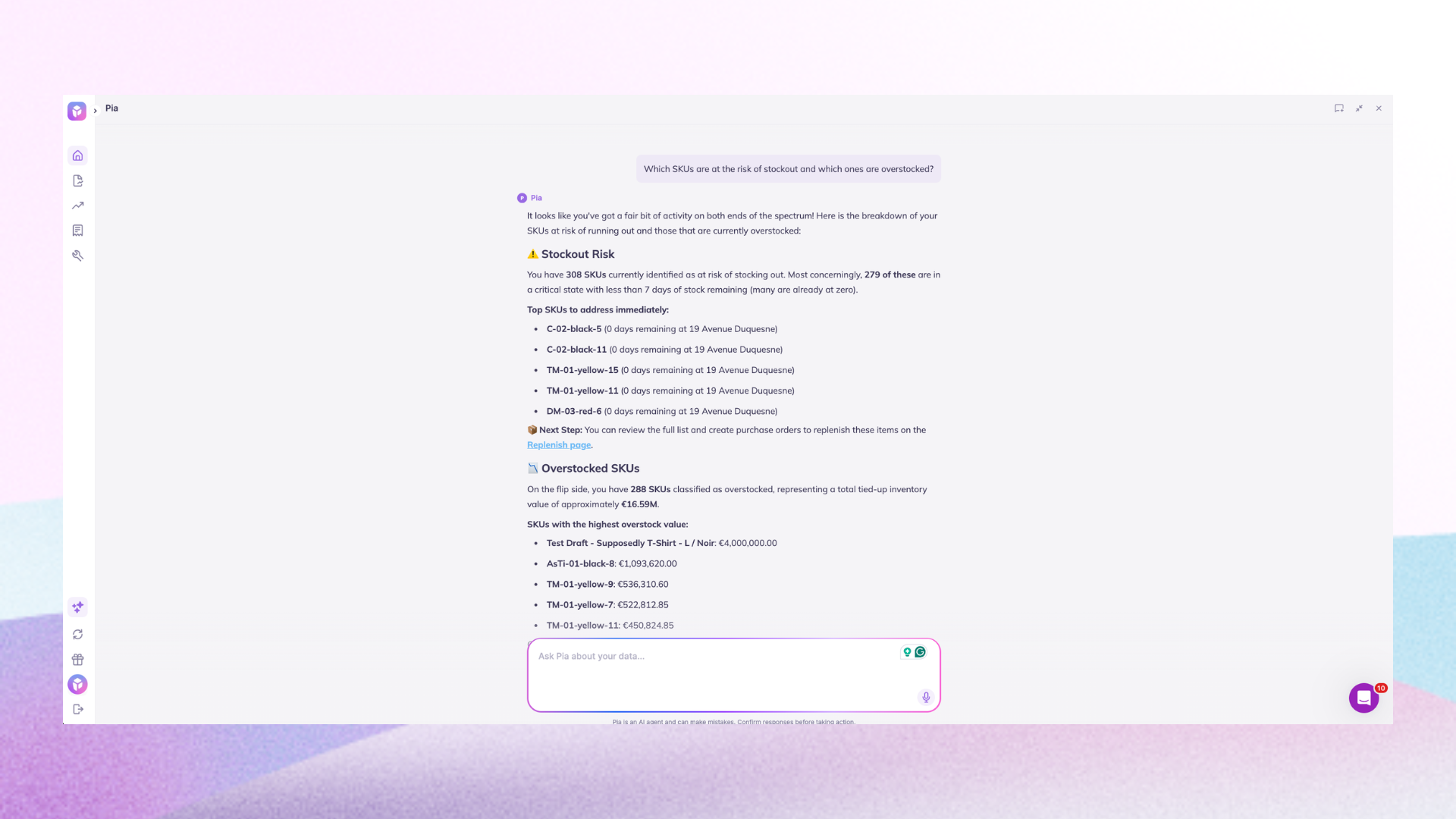
The result is less time maintaining a custom AI setup, more time making better inventory decisions. Prediko keeps the data connected, the planning history intact, and the next action clear.
Questions to Ask Before You Trust Any AI Tool With Your Inventory
Not just Prediko, any tool, including ones you build yourself.
These are the questions that separate a real forecasting engine from a chat window with a retail prompt:
- Does it correct for stockouts in your sales history? If it reads raw sales as demand, it will under-buy your winners without you ever seeing why.
- How does it handle a brand-new SKU with no sales history? "It needs a year of data first" is a real limitation to know about before launch season.
- Is there a persistent system of record? Or does every planning cycle start from a blank chat window and a spreadsheet you have to rebuild?
- Does the forecast connect to an action? A number in a CSV isn't a purchase order. Ask whether it actually generates and tracks the PO, or just hands you a recommendation to act on manually.
- Who maintains it as you grow? A script that works at 20 SKUs and 1 warehouse needs to be rebuilt by someone at 200 SKUs and 3 warehouses. Ask who that someone is.
Honest Take on Vibe Coding for Inventory
Vibe coding isn't wrong for inventory. It's a powerful starting point and for a brand early in its journey, a Claude-powered alert system is meaningfully better than a spreadsheet.
The mistake is confusing the prototype for the system.
At some point, your operations grow past what a custom-built script can handle reliably. Your team stops having the bandwidth to maintain it. The edge cases multiply. The forecasting errors get more expensive.
And you realise that what you built is a mirror of your own historical patterns useful, but blind to everything outside your own data.
That's the ceiling. Prediko is what comes after it. Start a free 14-day trial with Prediko and see the difference.
Frequently Asked Questions
What is vibe coding and why are ecommerce brands using it for inventory?
Vibe coding is when you describe what you want in plain English and AI generates the code. Ecommerce brands use it to build quick inventory dashboards, reorder alerts, and forecast scripts without a developer.
Can Claude do inventory forecasting for Shopify brands?
Claude can help analyze Shopify data, calculate days of cover, flag reorder points, and draft PO summaries. What it cannot do on its own is use cross-brand demand patterns, maintain a lasting system of record, send POs, or improve forecasting accuracy over time.
What’s the difference between Prediko and Claude-powered inventory forecasting?
Claude works from the data you give it. Prediko is built for Shopify inventory planning, with forecasting models trained across thousands of brands, plus persistent planning history, PO creation, supplier context, and replenishment workflows built in.
Can I use Claude and Prediko together?
Yes. Prediko's account data is available as a Claude MCP server, so you can ask Claude questions about your live Prediko data: forecasts, POs, supplier status, directly, without leaving Claude or ChatGPT.
What is a system of record in inventory planning and why does it matter?
A system of record is one place where forecasts, POs, supplier lead times, inbound stock, and forecast accuracy live. It matters because every planning cycle builds on the last instead of resetting across chats, spreadsheets, or exports.
When should a Shopify brand move from DIY AI tools to a purpose-built forecasting solution?
Move when planning takes too much time, stockouts or overstock keep slipping through, or your team spends more time fixing the tool than using it. That’s usually when a purpose-built system like Prediko starts making sense.
Is vibe coding secure enough for live ecommerce operations?
It can be fine for internal tools that read data, but anything that writes to your live Shopify store needs proper review and guardrails. AI-generated code can introduce bugs or security issues, so it should not run critical operations unchecked.
How to Prepare Your Shopify Inventory for Agentic Commerce
Agentic commerce is changing Shopify growth. Learn how to make your inventory readable, accurate, and ready for AI shopping channels.
A shopper opens ChatGPT and types: "Find me the best clean face wash under $35, shipped by Friday."
The agent doesn't scroll your product page. It doesn't browse your store. It queries structured data across merchant catalogs, checks real-time inventory and delivery windows, and shortlists the brands that pass the test.
Learn what agentic commerce means for Shopify brands, why inventory accuracy matters, and how to build inventory infrastructure AI can trust.
What Is Agentic Commerce and Why It's Moving Fast
Agentic commerce is a new model of shopping wherein AI agents act as autonomous shoppers on behalf of real consumers.
Instead of a human Googling, clicking, and comparing tabs, the AI agent handles the entire journey: interpreting intent, querying product catalogs, evaluating options, and completing the transaction.
A shopper says: "I need trail running shoes under $150, size 10, delivered by Thursday." The agent doesn't ask for clarification. It goes and finds them.
The numbers tell you how quickly this is becoming real
- Since January 2025, AI-driven traffic to Shopify stores has grown 8 times year-over-year, while orders from AI-powered searches have increased 15 times.
- According to McKinsey, agentic commerce could generate up to $1 trillion in US retail revenue by 2030, with global projections reaching $3-5 trillion.
- Bain forecasts the US agentic commerce market alone will be worth $300-500 billion by 2030, representing 15-25% of total eCommerce sales.
- AI-driven visits to US retail sites increased 393% year-over-year in Q1 2026, and those AI-referred shoppers converted 42% better than non-AI visitors.
The infrastructure is already in place. ChatGPT now enables US users to buy directly from Shopify merchants. Microsoft Copilot Checkout is live in the US with Shopify, PayPal, Stripe, and Etsy integrations.
Google launched the Universal Commerce Protocol (UCP) at NRF in January 2026, enabling AI agents to interact with merchant catalogs and complete purchases through a single open standard.
Why Inventory Is the New Storefront
Here's what most brands are getting wrong about agentic commerce: they're treating it as a marketing problem.
They're optimizing product descriptions. Cleaning up metadata. Making sure their catalog is fed into AI platforms. All of that matters, but it's only half the equation.
The other half? AI agents don't browse a store the way a human does. They read structured data: product titles, descriptions, images, pricing, inventory, shipping speeds, and use it to decide what to recommend.
The quality and completeness of that data determine whether a product surfaces in a conversation or gets passed over.
Inventory accuracy is a ranking signal.
An AI agent evaluating two merchants selling the same product at the same price will choose the one with faster, more reliable, cheaper delivery. That decision is made programmatically, based on structured fulfillment data. If your delivery data is not readable by an agent, your store is invisible.
The same logic applies to stock. If an agent can't verify that an item is actually available at the moment of purchase, not when it was last scraped, not when you last updated your admin, it will route the sale elsewhere.
Real-time data, in the context of AI commerce, refers to product information (pricing or inventory) that is accurate at the moment of the shopper's query, not at the moment the LLM last scraped your website.
Now, it's not just price and stock, either. When a shopper asks an agent "does this brand do free returns?" or "is this in stock in my size?", the AI answers from whatever data it can find. A wrong or stale answer costs you a sale you never even see happen, the shopper just moves on to whichever brand had the right answer ready.
One distinction worth keeping straight is discoverability and sellability aren't the same thing. Shopify Catalog is the syndication layer. It's what makes your products discoverable across AI platforms, and it's automatic. Agentic Storefronts is the selling layer, it's what lets checkout complete inside the AI conversation itself. You can be perfectly discoverable and still lose the sale if checkout can't close.
The Inventory Gaps That Get Brands Excluded
Most Shopify brands have some version of the same problem: inventory data that's accurate enough for humans, but not accurate enough for machines.
Here's what that looks like in practice.
1. Stale stock counts
You updated your stock levels last night. This morning, an agent queries your catalog. But between last night and now, you sold 40 units through your DTC site, your Amazon listing, and a wholesale order.
The agent sees stock that isn't there. It recommends you. The purchase goes through. Then your customer gets a cancellation email.
One cancelled agent-driven order is a trust signal sent directly back to the AI platform. Agents depend on accurate availability signals across every node to recommend what's actually purchasable.
If your availability data is unreliable, you get deprioritized. Quietly. Automatically. :(
2. No safety stock buffer for sales spikes
Agentic commerce introduces a new kind of demand pattern: sudden, multi-platform, simultaneous purchasing.
When an AI agent recommends your product across ChatGPT, Copilot, and Google AI Mode at the same time, you can get an order spike that looks nothing like your historical data.
For high-volume or frequently changing inventory, consider setting up automated inventory management or integrating with your warehouse management system to prevent overselling during busy periods when AI agents may be making multiple consumer purchasing decisions simultaneously.
If your safety stock is set according to your old demand patterns, it won't hold.
3. Replenishment that lags too far behind
If agents are shaping how shoppers discover products, inventory agents can help brands keep up behind the scenes.
Inventory agents can watch sell-through, safety-stock, and inbound signals to prompt earlier replenishment actions, reducing delayed cycles where stockouts trigger last-minute fixes instead of planned moves.
This is also where Best AI Agents for Inventory Forecasting becomes a useful next read, especially for brands looking at AI agents that can forecast demand, monitor stock risk, and support replenishment decisions before products go out of stock.
The problem is that most brands are still running replenishment cycles that are two to three weeks behind demand.
That was fine when your worst case was a missed restock email. In agentic commerce, a two-week gap between a stockout and a replenishment PO means two weeks of being invisible to AI-driven shoppers.
4. Fragmented multi-location visibility
If you're fulfilling from multiple warehouses, 3PLs, or retail locations, the agent needs to know what's available where, not just what's available in aggregate.
An agent promising a Friday delivery needs to know that the item is in a warehouse that can actually hit that window.
Without a unified real-time view across locations, your availability data is effectively lying to AI agents and to your customers.
What "Agentic-Ready" Inventory Looks Like
The good news: getting agentic-ready doesn't require a platform migration or a six-month implementation. It requires getting the fundamentals right.
Here's what the infrastructure should look like:
The brands that are already winning in agentic channels are the ones showing up consistently in AI recommendations. And they aren't necessarily the biggest. They're the ones whose operations are legible to machines.
Important note
If your store is still running Shopify's legacy checkout.liquid, you're structurally locked out of agent-initiated checkout. The layout isn't standardized enough for AI platforms to send it a structured purchase request.
Non-Plus stores have until August 26, 2026 to migrate to Checkout Extensibility, after which Shopify auto-upgrades you anyway. Check Settings > Checkout in your admin and if you see an "Upgrade" prompt, you're still on legacy. Fix this first; everything below assumes it's already handled.
How to Build It: 7 Steps to Inventory Readiness for Agentic Commerce
1. Make your product data readable to AI agents
Before your inventory can show up in agent-driven shopping, AI agents need to be able to find, read, and trust your product data.
First, check whether Agentic Storefronts are active in your Shopify admin. Go to Settings > Sales Channels and look for the Agentic Storefronts section. For eligible stores, ChatGPT may be on by default, while Copilot and Google AI Mode may need direct checkout toggled on manually per channel.
Remember, catalog eligibility has quiet failure points. A product with no image, a $0 price, unlisted status, or a missing product URL gets silently excluded from the feed and it doesn't show up. Run a quick audit of your top 20 SKUs against those criteria before assuming your whole catalog is syndicating.
2. Audit your real-time sync gaps
Start by mapping where your inventory data lives and how often it updates. If you're selling across Shopify, Amazon, wholesale, and any other channel, every sync delay is a window where your stock data is wrong.
Identify the gaps and close them either through native Shopify sync or a unified inventory layer.
Pay attention to the sync cadence, not just whether sync exists. Google Merchant Center's default feed sync runs hourly: fine for steady sellers, but it leaves a window where an AI agent can recommend a product that sold out 40 minutes ago. If you run flash sales or limited drops, that gap is where agent-driven cancellations come from.
3. Recalibrate your safety stock for multi-channel demand
Your safety stock formula needs to account for the new reality: demand spikes can now come simultaneously from multiple AI platforms.
Revisit your safety stock calculation using current lead times, current demand variability, and a buffer for agentic volume spikes. Even a modest increase, say, an extra 7 days of cover on your top 20 SKUs, can protect you during a sudden spike.
4. Move replenishment earlier in the cycle
If you're currently triggering purchase orders when you hit your reorder point, you're already behind. Agentic demand doesn't give you the same warning signs as traditional channels; the spike comes before the stockout signal.
Shift to forecast-led replenishment: instead of reacting to low stock, you're ordering based on what demand is projected to be 60-90 days out. A tool like Prediko can help with this (more on that in the next section)
This is the shift from reactive inventory management to proactive planning and it's the single biggest advantage you have for staying in stock across AI channels.
5. Unify your multi-location view
If your stock is split across locations, warehouses, or 3PLs, build toward a single real-time view. AI agents can choose fulfillment paths based on availability, proximity, promised delivery windows, split-shipment trade-offs, and costs.
But they can only do that if the data is there to query. A unified inventory layer, even a simple one, makes your operations readable to the agents that are routing orders.
In practice, this means every location should update stock in real time, stock should be tracked by location, inbound purchase orders should be visible with expected arrival dates, and reservations should update immediately when orders are placed.
6. Get your PO cycle time down
The faster you can generate and execute a purchase order, the faster you recover from a stockout. If your PO process involves spreadsheets, email chains, and manual approvals, that's three to four days of dead time every replenishment cycle.
Streamline it. Automate what you can. The goal is a PO that goes from "we need stock" to "supplier confirmed" in hours.
7. Test whether it's actually working
Don't assume readiness, check it. Search your own top products on ChatGPT, Gemini, and Copilot and see if they show up with accurate stock and pricing. Run a full purchase through an agent if the channel supports it.
Then keep watching: monitor your Catalog sync health for rejected products, and track AI-attributed orders in your Shopify analytics so you know if a fix actually moved the needle.
How Prediko Helps Shopify Brands Get Agentic-Ready
This is exactly the problem Prediko can help you solve.
Prediko's AI-powered demand forecasting predicts sales and quantities with high accuracy, factoring in seasonality, trends, stockouts, bundle demand, and incoming POs. This helps brands reduce stockouts by up to 35% and avoid tying up capital in overstock.
Where most inventory tools give you a dashboard and leave the thinking to you, Prediko acts more like your teammate with features including, but not limited to
- Forecast-led replenishment: smart "Buy Now" recommendations for up to 12 months out, based on AI-modelled demand, lead times, and safety stock targets.
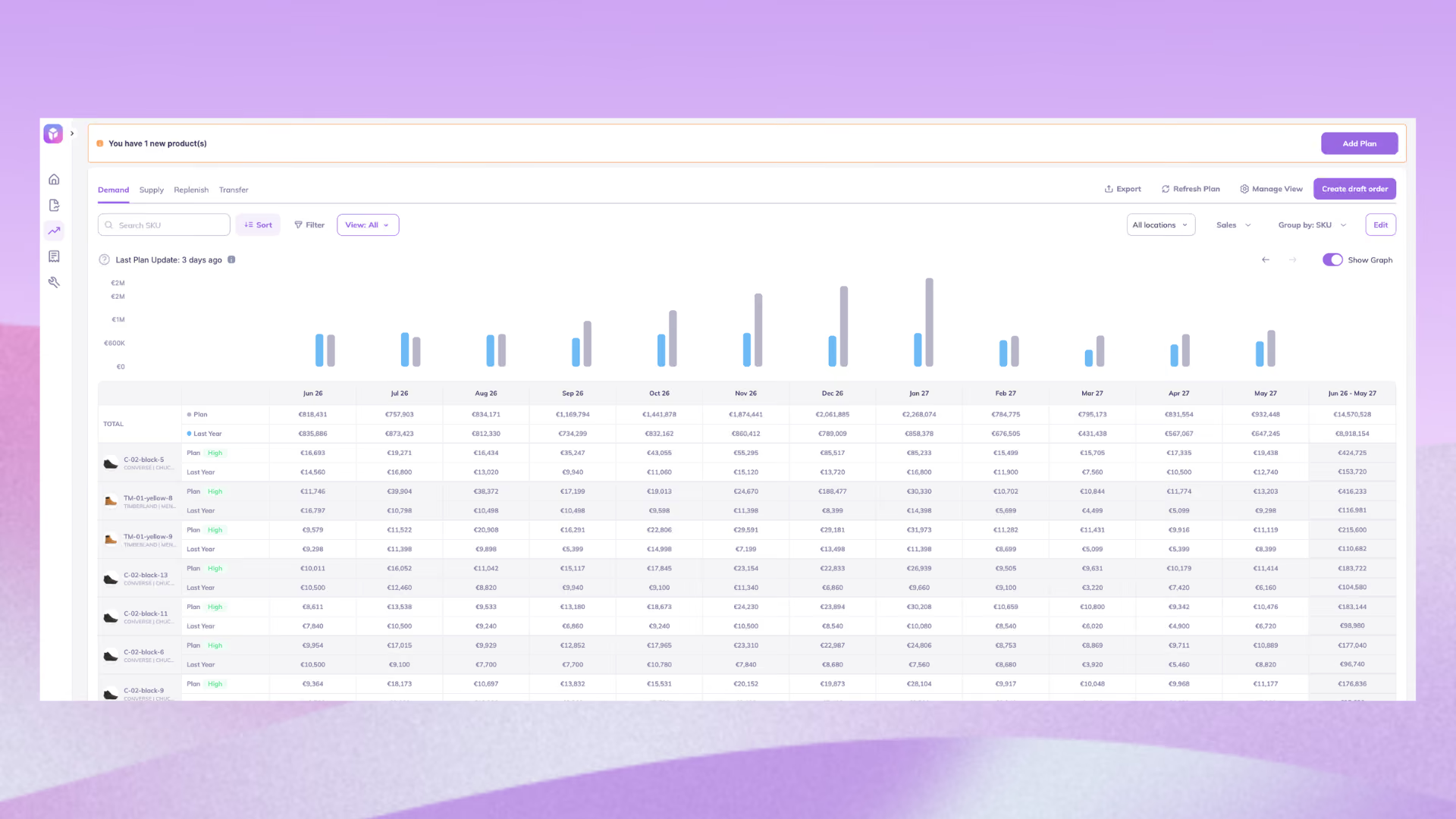
- Real-time multi-location visibility: track stock health across all SKUs, stores, and warehouses with automatically updated dashboards, so every channel (including AI agents) is working from accurate data.
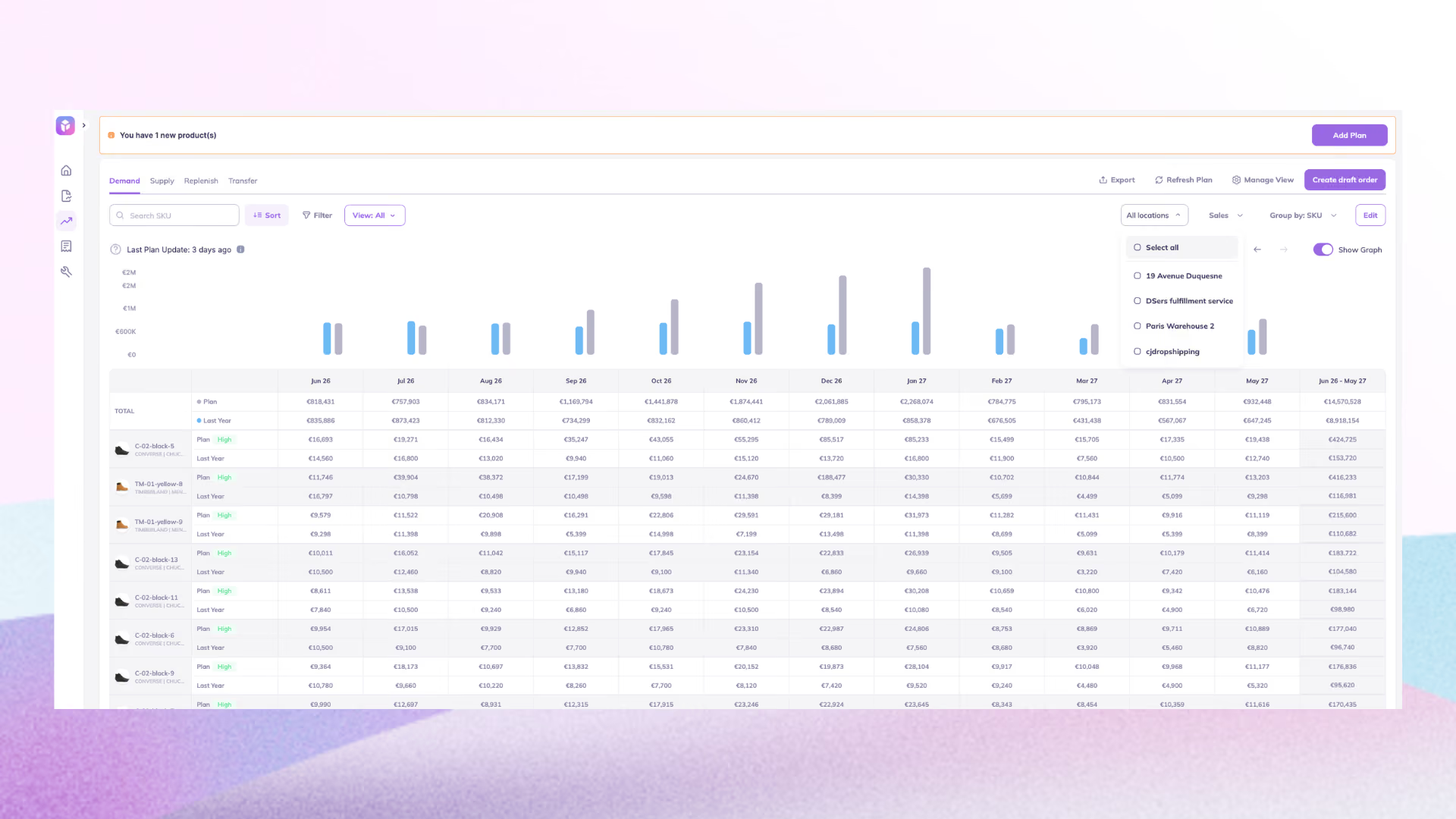
- One-click PO creation: generate and send purchase orders in minutes. When demand spikes from an AI-driven channel, you can respond fast.
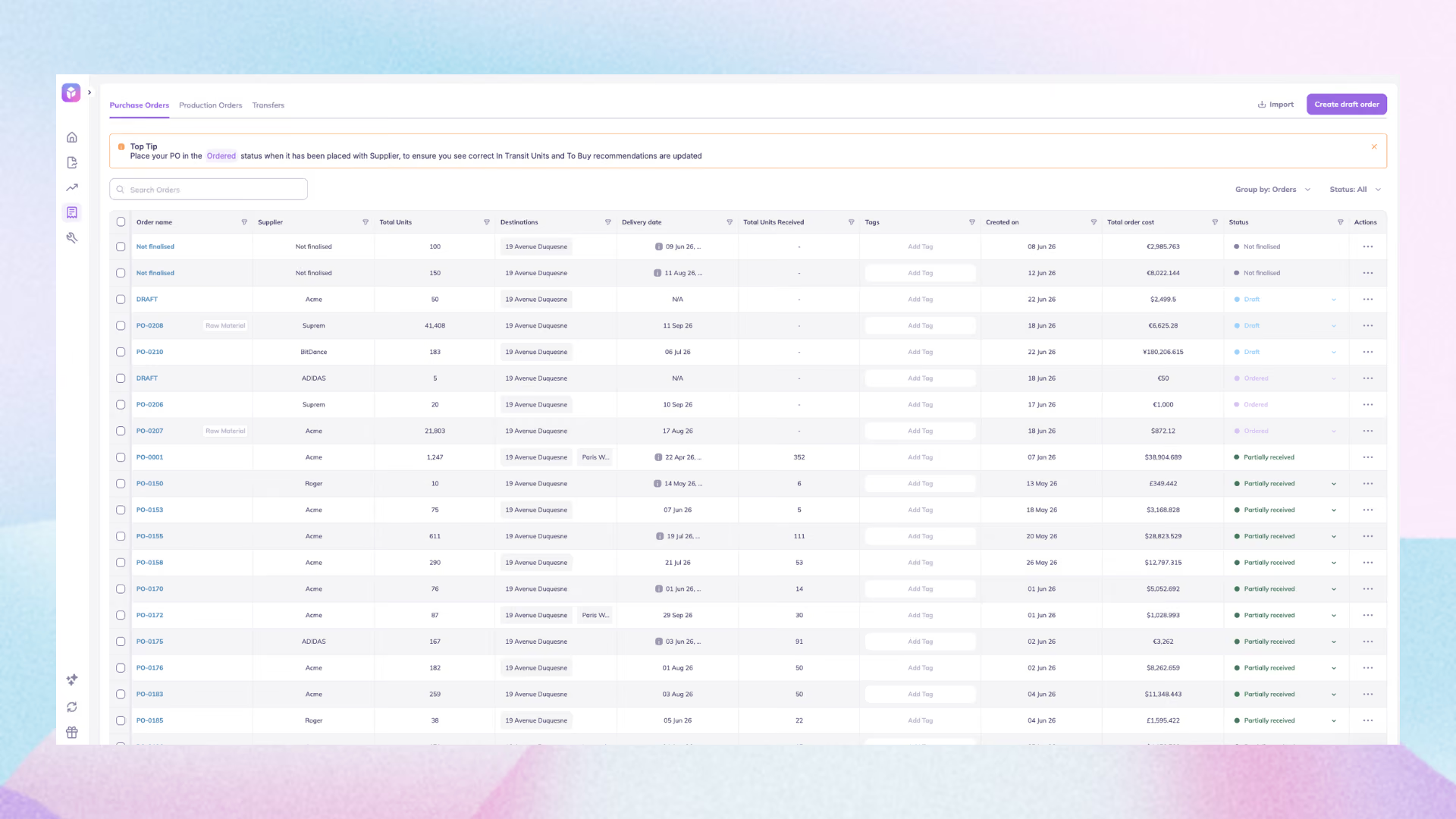
- Chat-based inventory operations: Prediko’s AI agent, Pia, executes commands like refreshing demand plans, selecting SKUs, and generating reports, reducing manual work so your team focuses on the decisions that matter.
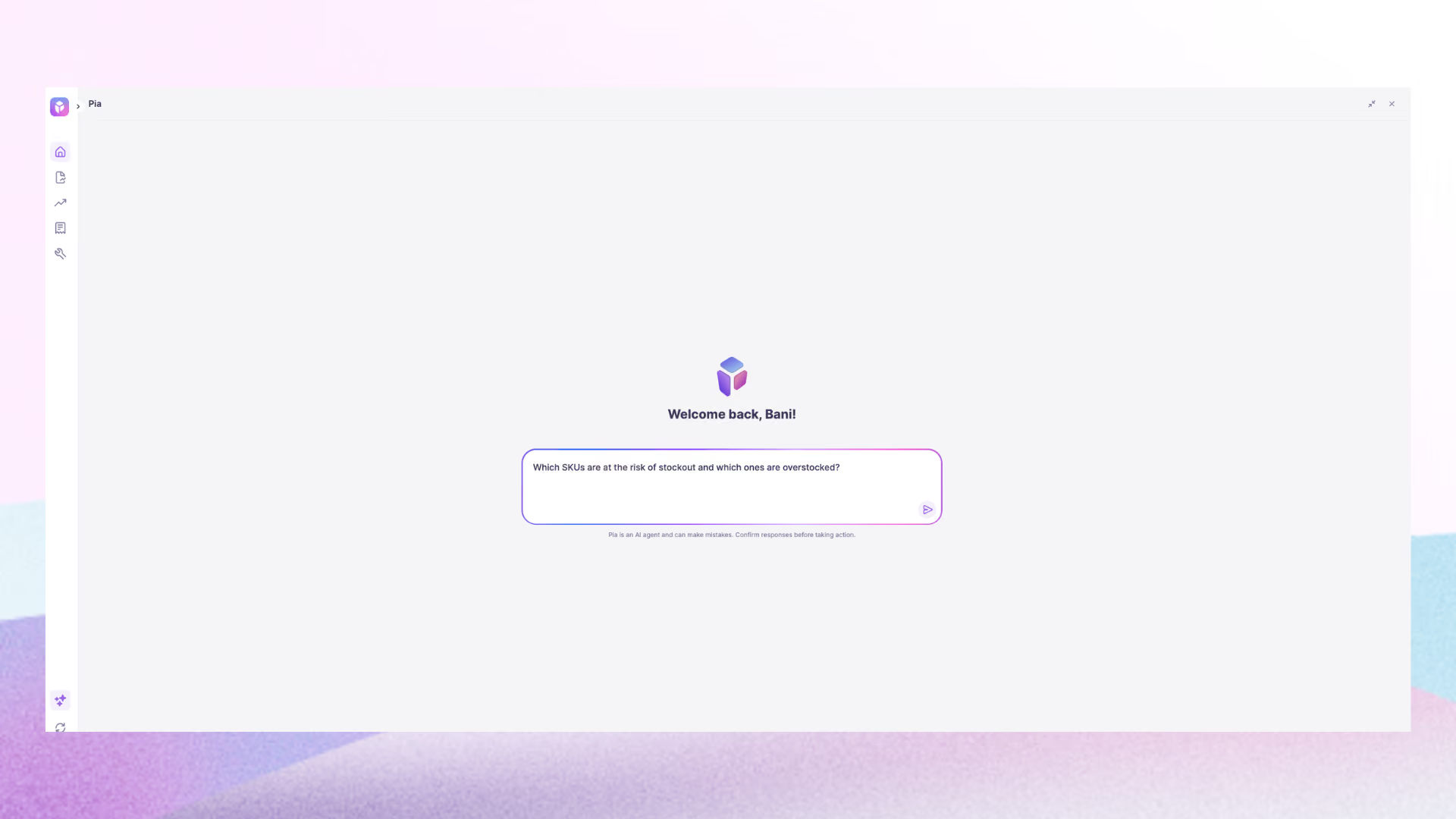
With that in place, you get an inventory that's always readable, always accurate, and always ready for whatever the next AI channel throws at it.
The Bigger Picture
Here's the thing about agentic commerce: it doesn't grade on a curve.
A human shopper who hits your out-of-stock page might bookmark you and come back. An AI agent won't. It routes the order to whoever has reliable availability right now and over time, that reliability score becomes a moat.
You don’t wanna lose a sale because your bestseller is out of stock. In agentic commerce, the stakes are even higher because you might not even know the sale was there to lose.
The next wave of Shopify growth is coming through AI channels and your inventory is what determines whether you're in or out.
Start a 14-day free trial of Prediko to see how it makes your inventory agentic-ready.
Frequently Asked Questions
What is agentic commerce?
Agentic commerce is when AI agents shop on behalf of customers. They browse catalogs, compare products, check stock and delivery timelines, and can complete purchases without the shopper manually clicking through every step.
Why does inventory accuracy matter so much for agentic commerce?
AI agents rely on real-time product data, including stock availability. If your inventory is stale or wrong, your product may get skipped, fail at checkout, or lose trust with the platform over time.
What’s the difference between conversational commerce and agentic commerce?
Conversational commerce helps shoppers make decisions through chat. Agentic commerce goes further: the AI agent can compare options, choose products, and complete the purchase based on the shopper’s preferences.
How can I tell if my Shopify store is agentic-ready?
Check three things: your inventory syncs in real time, you have enough safety stock for demand spikes, and your replenishment cycle can recover quickly from stockouts. If any answer is “not sure,” start there.
How does Prediko help with agentic commerce readiness?
Prediko helps Shopify brands forecast demand, see multi-location stock clearly, and create POs faster. That means fewer reactive stockouts and cleaner inventory data for AI shopping channels.





.avif)