Shopify Inventory Planning
Improve Shopify inventory planning by turning sales trends and stock signals into better buying decisions, so teams can prepare for demand changes without tying up too much cash in inventory.
Replenishment Planning for Shopify: Best Practices, Challenges, and Tools
Learn how to do replenishment planning for your Shopify store. Understand the basics, key components, challenges, and tools you can use.
Replenishment planning is the process of deciding when to reorder inventory and how much to buy based on demand forecasts, sales velocity, supplier lead times, and safety stock. The goal is to prevent stockouts without tying up cash in excess inventory.
Imagine your influencer campaign goes live on Tuesday. By Thursday, your bestseller is sold out, and the next shipment is three weeks away.
That's what happens when inventory planning can't keep up with demand.
This guide covers the inventory replenishment process, different replenishment methods, and best practices to keep the right products in stock at the right time.
What is Replenishment Planning?
Replenishment planning is the process of deciding when and how much stock to reorder so supply matches expected demand, without running out or overstocking.
These are the terms you'll see throughout:
- Reorder point (ROP): the stock level that triggers a new order.
- Lead time: the time from placing an order to receiving it, including internal processing.
- Order quantity: how much you order once the reorder point is hit, often set with EOQ (economic order quantity).
- Safety stock: extra stock that buffers against demand spikes or supplier delays.
- Service level: the percentage of demand you can fill without a stockout.
- Lot size: the units ordered in one batch, fixed or variable depending on supplier rules.
Reorder point formula
Reorder Point = (Average Daily Usage × Lead Time) + Safety Stock
Example: you sell 20 units a day, your supplier takes 15 days, and you hold 100 units of safety stock. Your reorder point is (20 × 15) + 100 = 400 units.
One warning before you plan anything: your inventory data has to be accurate. If the system says 200 units but only 160 are on the shelf, every order goes in late.
How is Replenishment Planning Different From Demand Planning and Procurement?
In short, demand planning predicts the need, replenishment planning times the order, and procurement decides where it comes from. Dedicated inventory planning software connects the first two in one workflow.
What is the Inventory Replenishment Process, Step by Step?
- Check what you actually have. Count on-hand, committed, in-transit and on-order stock
- Forecast demand. Use sales history, seasonality and upcoming promotions to estimate what each SKU will sell over the lead time.
- Set reorder points and safety stock. Use the reorder point formula above, per SKU, and size safety stock to the supplier's reliability.
- Raise the purchase order. When a SKU hits its reorder point, order the quantity that covers your target days of cover, adjusted for supplier MOQs.
- Receive the stock and update your records. Check delivered quantities against the PO, note shortages or damage, and update inventory so the next reorder starts from accurate numbers.
- Review performance. Track fill rate, stockouts and forecast accuracy, then adjust reorder points and lead times for the next cycle.
This loop repeats every cycle. The tighter you run steps 1, 5 and 6, the less safety stock you need.
Why Do You Need a Replenishment Process?
Cash flow. Every unit on a shelf is money that can't work anywhere else. A replenishment process ties orders to actual sales, so cash isn't locked up longer than it needs to be.
Customer loyalty. When a regular finds their go-to product out of stock, they don't always wait. They buy elsewhere and some don't come back.
Cost control. Get it wrong in either direction and you pay:
- Overstock ties up cash, raises storage costs and often ends in heavy discounting. Learn how to manage overstock inventory.
- Stockouts mean missed revenue, delayed orders and rushed restocks that cost more than planned.
What are the Key Components of Replenishment Planning?
1. Demand forecasting
You need a realistic baseline for what customers will order. It doesn't have to be perfect but has to be honest.
- Historical averages work when demand is steady.
- Moving averages, exponential smoothing or ARIMA catch trends and seasonal shifts.
- Demand planning tools like Prediko combine statistical forecasting with AI and real-time inputs such as promotions and seasonality.
2. Real-time inventory visibility
Forecasting tells you what's needed; inventory visibility tells you what's available right now: on hand, allocated, on order and in transit.
Regular cycle counts keep the data honest. A warehouse that counts weekly is far less likely to place an order based on stock that isn't there. If you manufacture, track raw materials as well as finished goods.
3. Lead time and safety stock
There's always a gap between ordering and receiving. Lead time is that gap; safety stock covers it when demand spikes or a supplier runs late.
Track actual delivery times, not promised ones. If a supplier says 10 days but usually takes 15, plan for 15. Here's how to choose reliable suppliers.
Which Replenishment Method Should You Use?
The right method depends on how steady demand is, how flexible your suppliers are, and whether you're replenishing finished goods, raw materials or both.
Supplier MOQs sit on top of whichever method you choose. Let the method decide what to reorder, then adjust the quantity to meet the minimum.
A few common pairings:
- FMCG brands - continuous replenishment with tight reorder points, because shelf life is short.
- D2C brands on Shopify - reorder point or continuous replenishment for bestsellers, min/max for steady long-tail SKUs.
- Seasonal brands - temporary reorder rules built from a seasonal demand forecast, then a clean sell-through after the peak.
How Do You Measure Replenishment Performance?
Fill rate
The share of orders fulfilled immediately from stock.
Fill Rate = (Orders Fulfilled from Stock ÷ Total Orders) × 100
A low fill rate means you're reordering too late or too little.
Stockout Rate
How often SKUs are unavailable when there's demand.
Stockout Rate = (SKUs Out of Stock ÷ Total SKUs) × 100
Inventory Turnover
How often you sell and replace inventory in a period.
Inventory Turnover = Cost of Goods Sold (COGS) ÷ Average Inventory Value
Average inventory = (beginning inventory + ending inventory) ÷ 2.
A falling ratio usually means reorder quantities are too high. Here's how to find inventory turnover for D2C brands.
Forecast accuracy
How close forecast demand was to actual sales, tracked by SKU or category over time. Here's the forecast accuracy formula to use.
What are The Best Practices For Replenishment Planning?
1. Plan from real-time data
Yesterday's numbers make today's orders wrong. Connect your store, POS, warehouse and supplier data in one place, set alerts for low stock and late shipments, and adjust POs as demand moves.
2. Plan across departments
Sales knows when demand will spike. Marketing has the promotion calendar. Procurement hears about supplier delays first. Finance sets the budget.
Put all four inputs into the plan, or it drifts away from what's actually happening.
3. Share forecasts with suppliers
Don't just send POs. Share your demand forecast so suppliers can plan production, and check in monthly or biweekly for critical items.
Talk to them before seasonal peaks so both sides can adjust shipping windows. Suppliers who trust you send early warnings.
4. Let the forecast drive purchasing
Build forecasts that include seasonality, campaigns and growth targets, then turn them into a buying plan by SKU. Fast movers may need weekly planning rather than monthly.
What are the Biggest Replenishment Challenges in 2026?
1. Supply chain disruption and trade uncertainty
Tariff changes, geopolitical tension and suppliers moving production all shift lead times and costs. It gets hard to know when stock will arrive and what it will cost.
The fix: work with suppliers in more than one region where you can, and plan in scenarios - what if lead times double, or tariffs rise 10%? Compare the actual lead time on every delivery with what's set in your system, and update the mismatches. Add buffer time for suppliers who are regularly late.
2. Balancing cash flow with availability
Buying early protects against shortages but ties up cash. Buying late protects cash but risks stockouts. Finance wants lean inventory; operations wants stock on hand.
The fix: tie reorder cycles to real-time demand instead of a fixed calendar, and agree with finance in advance which SKUs get priority for cash and which for availability.
3. Overreliance on historical data
Trends now rise and fade faster than last year's sales can predict. And when a system reorders from long-run averages, a one-off spike keeps triggering orders after demand is gone.
The fix: blend history with current signals, including recent sales velocity, social trends, upcoming campaigns and shorten your forecast cycle. Flag any SKU that hasn't sold in 30-60 days for a manual review before it's reordered.
4. Labor shortages and operational delays
Stock can arrive on time and still sit in a container because there aren't enough people to unload and receive it.
The fix: plan with operational lead time, not just transit time. Add days for unloading, receiving and putaway.
What Tools Help With Replenishment Planning?
There are three levels: spreadsheets, Shopify's built-in tools, and dedicated replenishment software. Which one fits depends on how many SKUs, suppliers and locations you're juggling.
If you're at the software stage, these are the tools Shopify brands most often compare:
- Prediko - AI demand & supply planning and replenishment built for Shopify, including raw materials
- Inventory Planner - forecasting and buying recommendations for mid-market brands
- Fabrikator - purchase order automation, backorders and pre-orders
- Assisty - forecasting across multiple stores and locations
- SKULabs - warehouse-heavy, barcode-based operations
- Cin7 Core - combined D2C and B2B inventory
- Katana - inventory plus manufacturing
We compare all seven, features, pros, cons and pricing, in our guide to the best inventory replenishment tools.
How Does Prediko Help With Replenishment Planning?
Prediko connects to your Shopify store and turns your forecast into a buying plan: what to reorder, how much, and when.
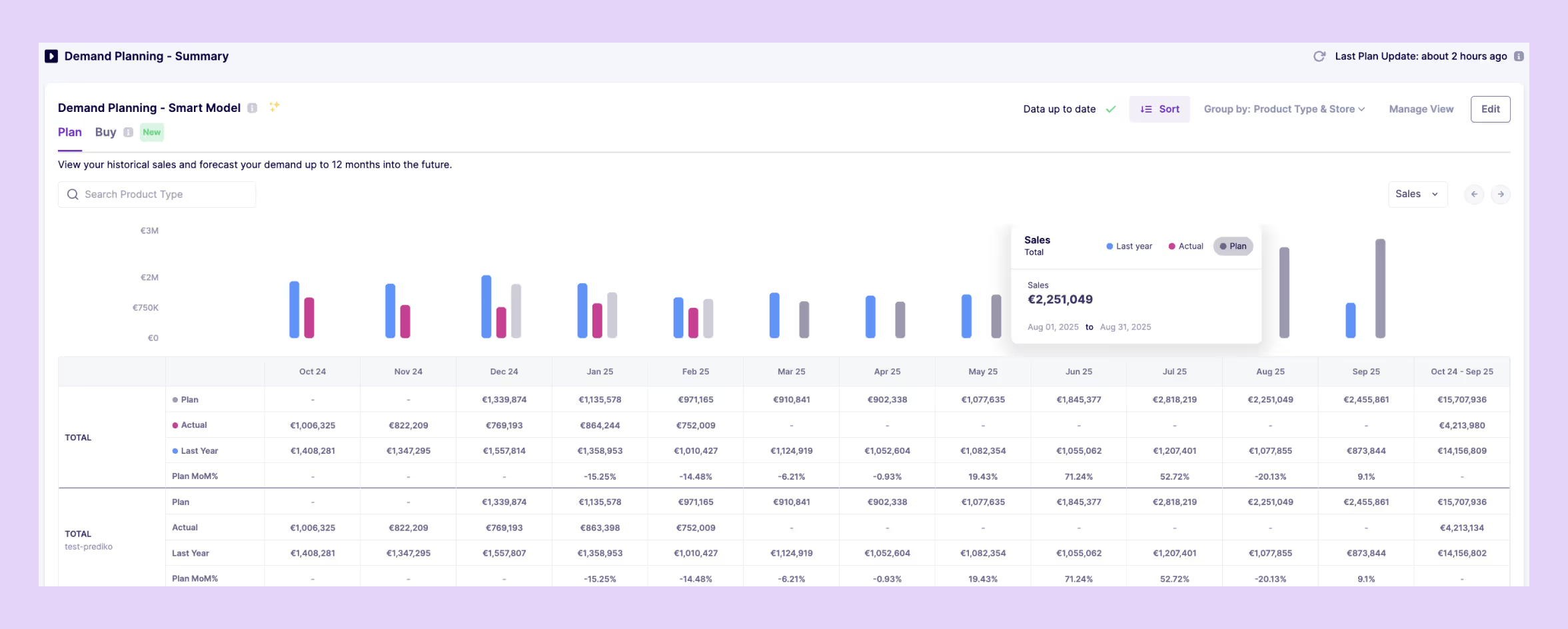
- AI Demand Planning and Supply Planning forecasts 12 months ahead from sales history, seasonality, growth trends and your revenue targets, broken down month by month. You also get a PO calendar for the upcoming year.
- The Buying Tab shows each SKU's days of cover, reorder date and recommended quantity, and tags it Healthy, At Risk, Stockout or Excess - for finished goods and raw materials.
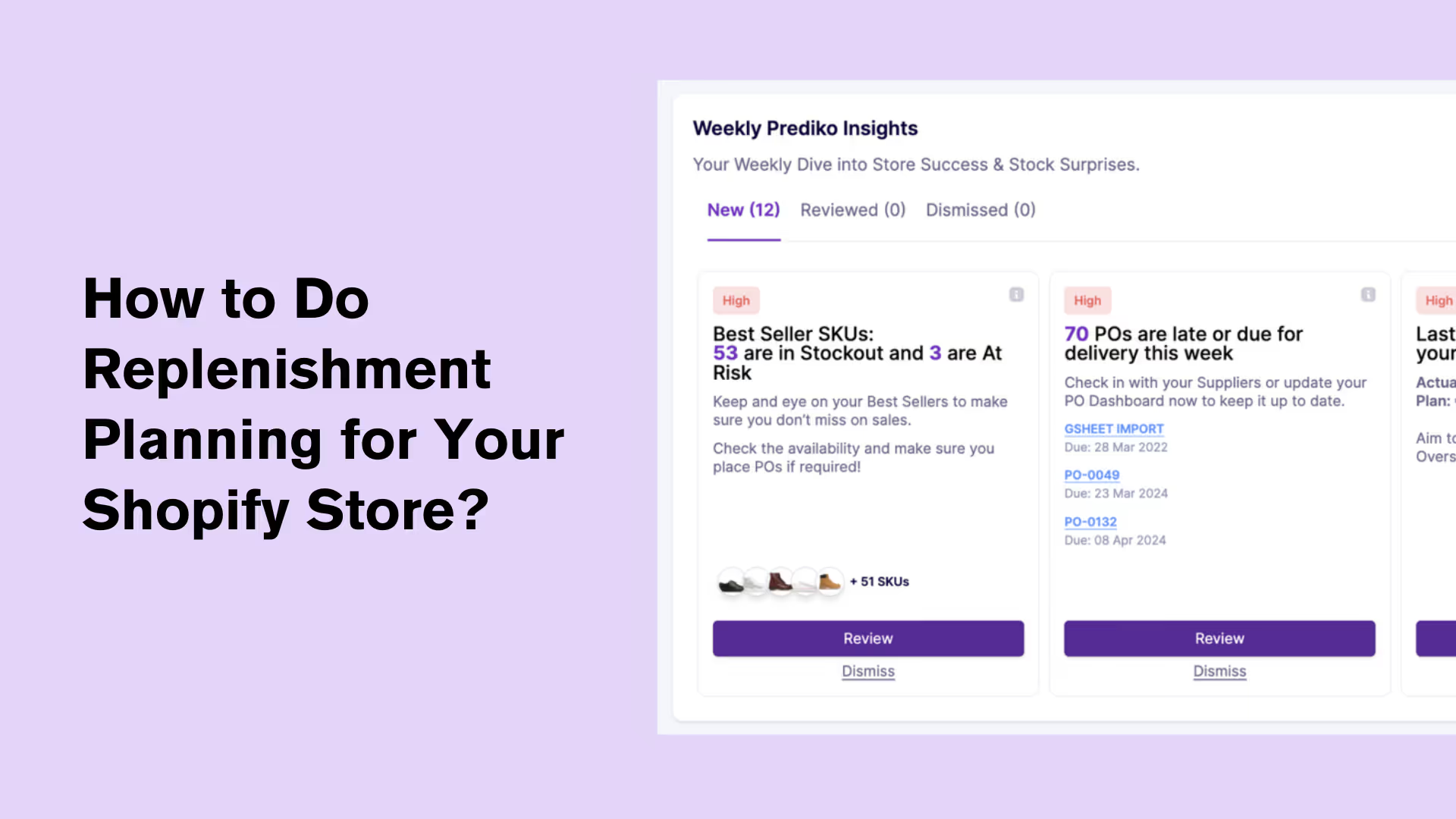
- Reports and Alerts flag late POs, SKUs at risk of stockouts and excess stock, so you catch problems before they cost you.
- Purchase Order Management lets you create, share and track POs, and leave notes for suppliers in one place.
- 150+ integrations with WMS, 3PLs and other tools give you one view of inventory.
- AI Inventory Agent and Automations: Ask Pia to create draft POs, check stockout risks, or monitor delayed deliveries. Set up alerts and recurring tasks and Pia delivers updates through Slack, WhatsApp, or email.
- Smart Inventory Transfers: Get recommendations on moving inventory between stores and warehouses based on stock needs, instead of purchasing more when another location already has excess stock.
The result is fewer stockouts and less cash stuck in slow stock.
Make Replenishment Proactive
Most inventory problems start when replenishment is reactive: you wait for stock to run low, then scramble. A clear process, the right method per SKU and a few honest metrics turn that into a plan you run ahead of time.
Start Prediko's 14-day free trial and see how your replenishment plan looks with real data behind it.
Frequently asked questions
What is the inventory replenishment process?
It's a repeating loop: check stock including in-transit units, forecast demand, set reorder points and safety stock, raise a purchase order when a SKU hits its reorder point, receive the stock and update records, then review performance and adjust.
What's the difference between replenishment and procurement?
Replenishment decides when and how much to reorder to keep stock at the right level. Procurement decides which suppliers to buy from and negotiates the terms.
How does replenishment planning improve inventory management?
It keeps enough stock to meet demand without overordering, so you avoid stockouts and don't tie up cash in excess inventory.
What are the key steps in creating a replenishment plan?
Analyze demand patterns, review current stock, factor in supplier lead times, then set reorder points and safety stock that you revisit regularly.
How do you calculate safety stock?
Safety stock = (maximum daily usage × maximum lead time) − (average daily usage × average lead time). It's the buffer that protects you when demand spikes or a supplier is late.
What tools help with replenishment planning?
Inventory management and demand forecasting software, such as Prediko, brings sales, stock and supplier data together so you can plan restocks accurately.
Why is replenishment planning important for Shopify brands?
Shopify brands deal with fast-changing demand, several sales channels and limited storage. A replenishment plan keeps bestsellers in stock, stops slow movers from piling up and protects cash flow.
How to Create An Inventory Plan Ahead of Holiday Season
Learn how to create an effective inventory plan for your holiday season.
As we enter into the second quarter of 2024, D2C businesses that want to succeed this year are already setting their sights on the holiday season in the last quarter of the year.
Planning effectively ahead of time makes sure that those orders make it to your customer’s doors on time. Effective inventory management for the peak period is not just about keeping shelves stocked; it’s about strategically planning to meet higher consumer demand and maximize profitability.
Why Should You Start Your Planning Early for Holiday Season?
Starting your inventory planning in Q2 allows for a more better and balanced approach to forecasting, supplier negotiations, and marketing strategy alignment.
The goal is to ensure that you are fully prepared for the surge in consumer activity that the holiday season brings.
Here are simple ways you can plan your inventory for a great holiday season
1. Forecasting Demand For Holiday Season
Forecasting demand is the first step to getting ready for the holiday season. Brands must analyze sales data from the previous years, take into consideration 2024 trends, and understand consumer behavior. These are crucial steps.
A detailed and early demand forecast is the best defense against overstocking or stockouts during the main holiday season.
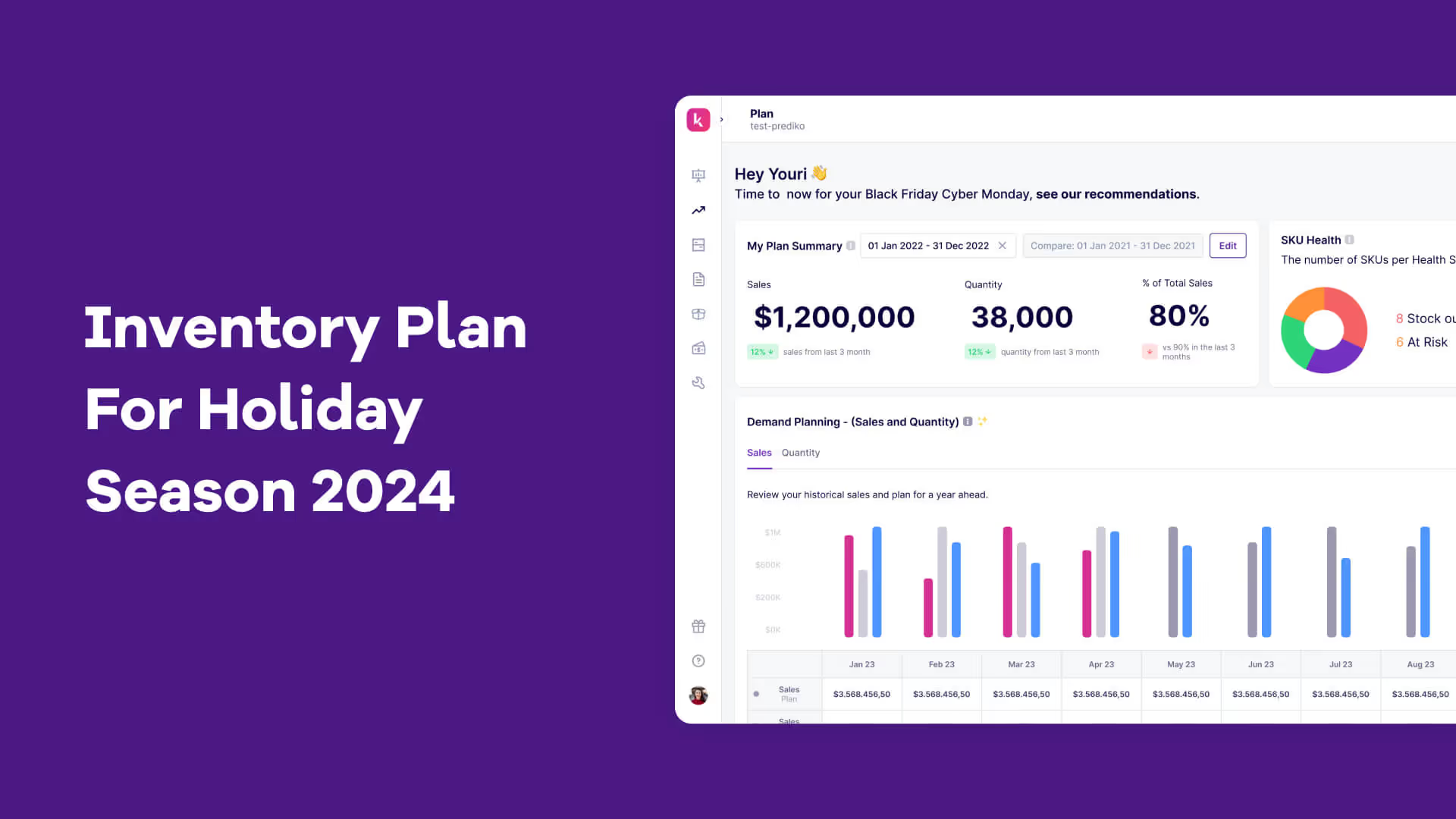
See how Prediko helps Shopify brands forecast seasonal demand and plan inventory before peak periods.
Learn from past holiday seasons
Maybe it’s your first holiday season, in which case this you might not have learnings to apply, but if you have experiences to reflect on look back on those in detail. Perhaps there are lessons to improve internal organisation as well as inputs for your supply chain, and if necessary think about hiring extra support if it will relieve stress. Think about placing orders earlier with suppliers, make sure you’ve explained new packaging to your warehouse, as well as perhaps sales forecast for December 2025.
2. Build Supplier Relationships and Better Lead Times
Build a strong relationship with your suppliers is critical. Learn how to choose the right supplier for your brand.
Early planning allows for discussions about lead times, bulk purchasing discounts, and any contingency plans for supply chain disruptions for the holiday season. The aim is to secure your supply chain well before the holiday rush begins.
3. Supporting your warehouse
During the holiday season, think of your business and warehouse as one, working in sync to meet shared goals. Make sure you sign up to round-the-clock fulfilment if needed, and explain in detail the customer service processes you want implemented.
Within Prediko, brands are able to generate an easy and shareable Buying Table, that is custom-made for your expected demand.
Treat this as if how you can create your procurement plan. You can easily share this with your inventory partners to ensure greater visibility and this definitely includes your warehouse team
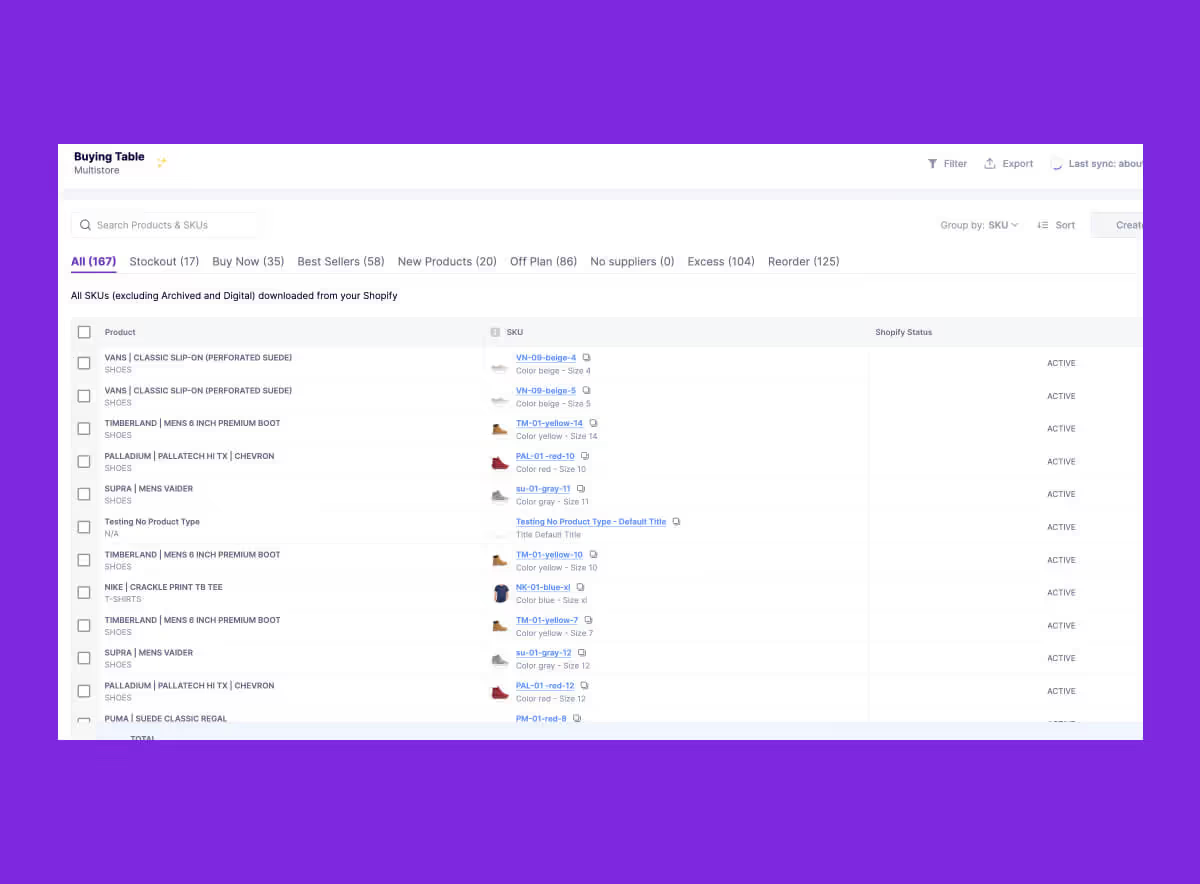
You can easily share this with your inventory partners to ensure greater visibility and this definitely includes your warehouse team.
Optimizing Your Stock For Holiday Demand
Optimizing your inventory for the holiday season involves balancing a variety of factors. Embrace a multi-channel strategy to ensure your inventory is positioned to meet demand across all sales platforms.
4. Bank on your bestsellers
During the holiday season, people don't buy new products as they want to feel like they are putting their money to good use. Bestselling products feel like safer purchases to the consumer and are easier to market. During the holiday season, WhatsApp marketing is very popular amongst D2C brands
Pro tip: Having extra stock of your bestselling product is always a good thing.
5. Managing Overstock and Stockouts
Even with the best planning, overstock and stockouts tend to occur. Implement strategies such as dynamic pricing promotions, and cross-selling to manage excess stock. Dynamic pricing apps can adjust prices against competitors while respecting a minimum margin you set.
You can also use demand planning tools to reduce overstock by aligning purchase quantities more closely with actual sales velocity
Conversely, have a rapid replenishment strategy in place to quickly address stockouts without losing sales. When you are out of stock especially during the holiday season, it's important to let your customers know that you are out of stock and the order might be delayed. In case you need help in setting up an out of stock in Klaviyo or other marketing campaign tool, then there are a couple of top email marketing agencies.
6. Utilise your inventory streams
Position retailers to fill gaps in a worst case scenarios. Understand where their stock is held, how easy it would be to access and what you would offer in return for claiming it if needed.
Leveraging Technology & Prepare Your Team
The right tech infrastructure can provide a big competitive edge when it comes to inventory management. From AI-driven forecasting to real-time analytics, technology enhances accuracy in planning and decision-making. That's why it is important to invest in an app or tool that will integrate natively with your current operations, tech stack, and quickly provide actionable insights.
7. Use data for holiday inventory trends
Do a deep dive into the patterns predicted through data along with your supply chain. Increased visibility in your inventory trends will allow you to build systems to combat potential hurdles. With Prediko you can easily build accurate revenue and inventory plans using our demand forecasting software for eCommerce.
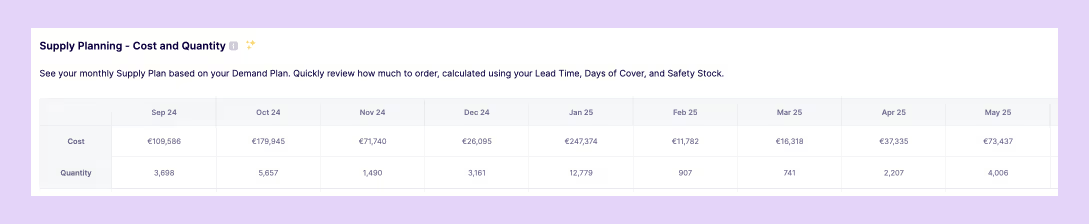
We have also compiled a list of the top inventory forecasting software in the market.
8. Prepare Your Team
Your team plays an important role in the success of your holiday inventory strategy. Ensure that all your operators are trained on your current inventory management tool and protocol. Communication is key—keep your team informed about inventory levels, product launches, and any adjustments to the plan.
9. Make shipping easy & simplify payments
Although insured shipping methods are an investment they will allow you further visibility to know inventory will make it on time once it has left your manufacturer. Make sure that you provide live updates to your customer. Such feature enablement let you take a breath amongst the end of year craziness.
Late payments make brand's life more difficult, and during the holiday period everyone wants to see their money ahead of the year end. Ensure your banking systems are optimised to make payments on time and efficiently.These are some of the best practices and pro tips that you need to follow to manage your inventory efficiently and successfully during the holiday season.
How to Create A Procurement Plan
Learn the process and importance of creating an effective procurement plan.
We aren’t fans of giving any credit to COVID-19 but it did teach our industry some valuable lessons; one of these being the importance of supply chain visibility. True transparency can be achieved when e-commerce businesses are able to access and gain insights into not only their data but connected data from manufacturers all the way through to the systems handling product delivery.
Laying out a procurement plan is key to this visibility and to be clear, a procurement plan is a process of finding and selecting a vendor.
Elements of a proper procurement plan
A robust procurement plan is made up of the following parts:
- A contract
- A selected metric to judge supplier performance (Learn how to choose the right supplier)
- Clear organisational standards
- Planned delivery and implementation dates for products to go live
- Identified number of suppliers and the assigned manager for these
- Awareness of potential constraints and hazards
- Fully cleared list of vendors
- Lead times measured against each stage of the project
All of these features are present in a really good demand forecasting software and tool available online.
A robust procurement plan allows for e-commerce businesses to more effectively withstand economic shifts such as recession and inflation but additionally, environmental shocks such as a material shortage.
A good procurement plan also helps in planning inventory for the holiday season as well.
Here are the challenges that a procurement plan must mitigate
Feeling confident in your procurement plan should allow you to tackle whatever might come your way. Here are the risks a procurement plan should allow you to mitigate (meteor landing on earth is not included:P) :
- Incorrect product delivery times
- Low quality goods
- Inability to react quickly change
- Siloed systems
- Environmental or economic crises
At Prediko, we not only have an easy way to map all your products to suppliers and log all the information about them in one place, but we also calculate deadlines for delivery taking all this information into account.

No more calculations, re-calculations and last minute changes. You know when you need to order, how much and till when it will last you. All the lead times included.
If you have a question concerning your procurement plan, DM us on any of our social media channels and a team member will be sure to respond.