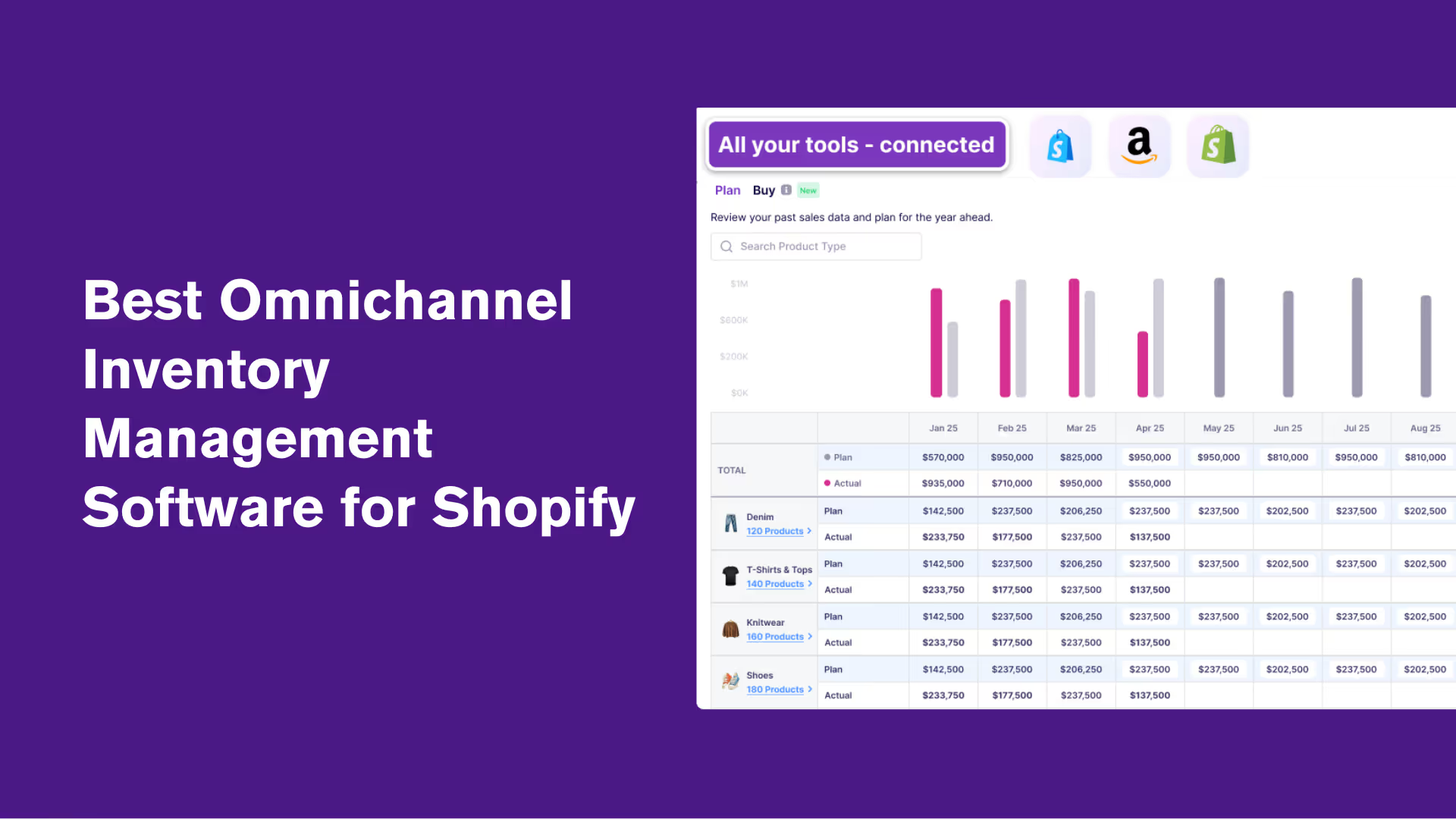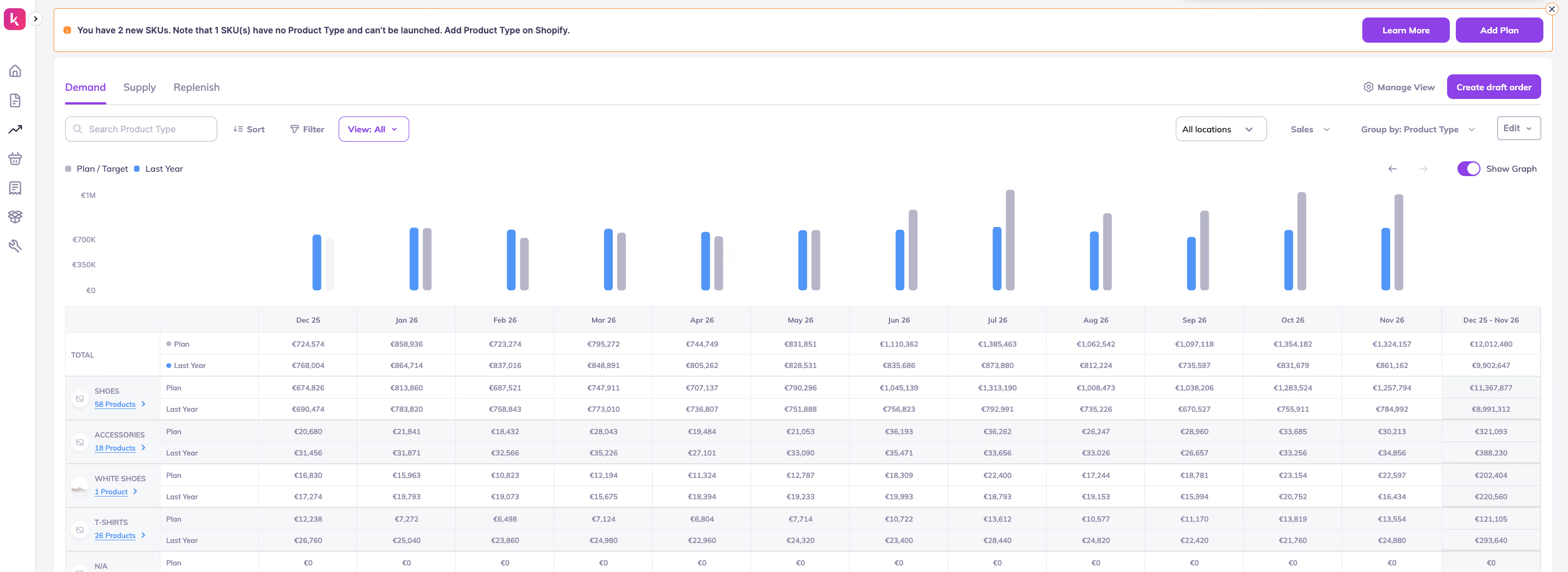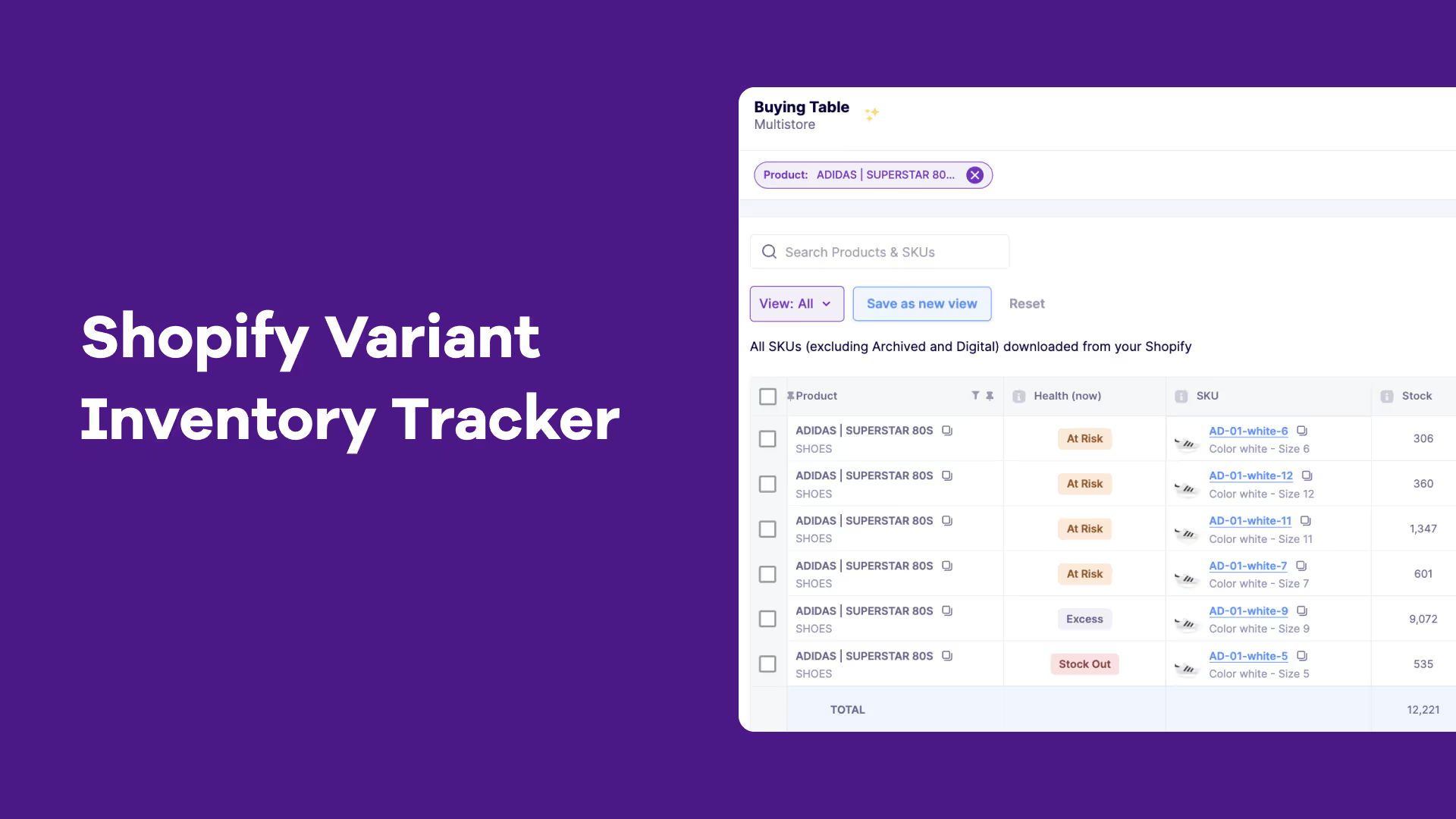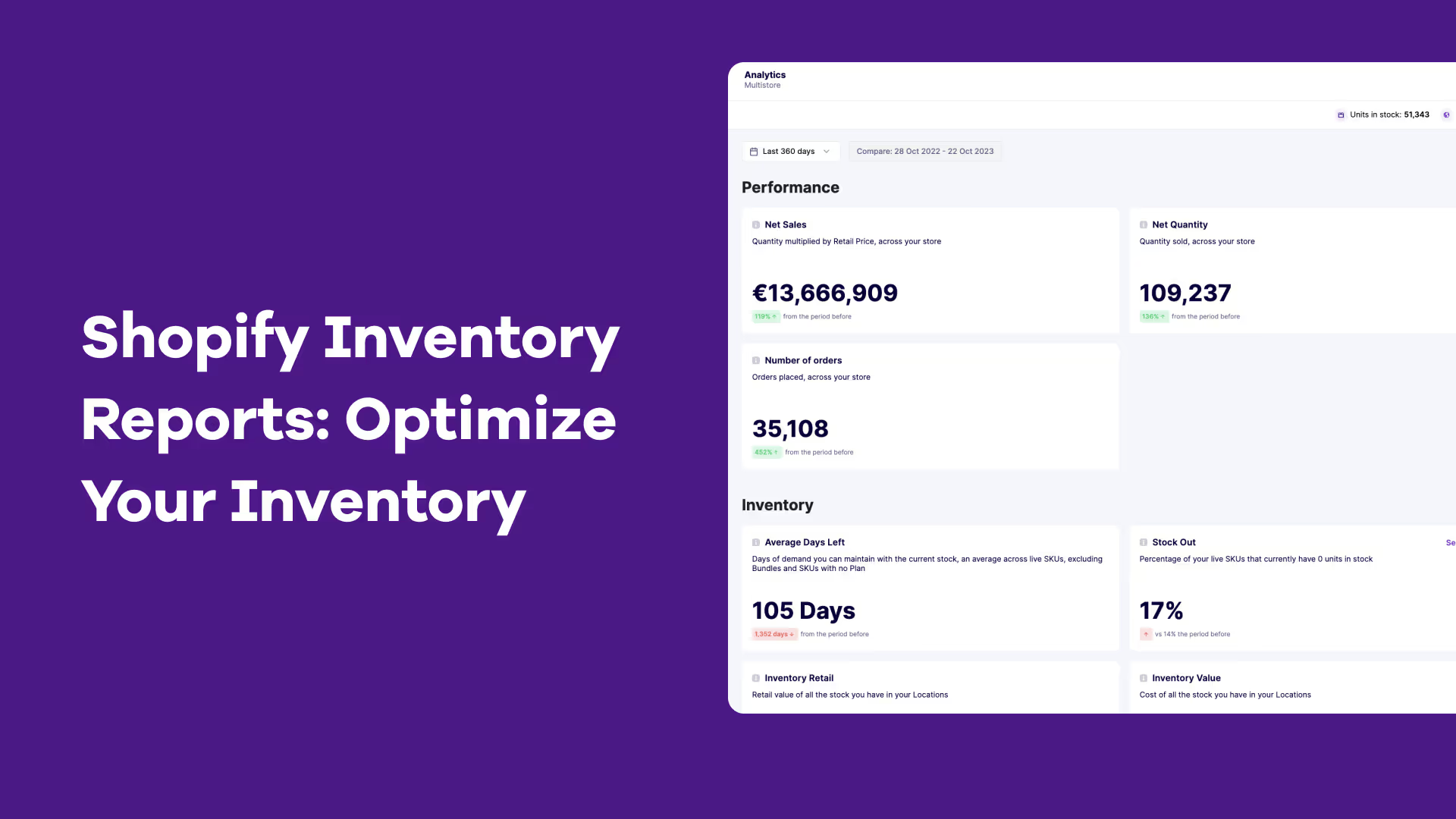




Fully Stocked
by Prediko

Your Go-To Hub for Learning Inventory Management & Forecasting

Get A Demo

Latest Articles

6 best shopify AI agents
5 min
Sep 10, 2026

7 Best Shopify AI agents to Automate Your Shopify Store

Learn how AI agents can increase productivity and your Shopify sales. Detailed review of Prediko, Gorgias, Allo, Wisepops, and more.

Read Blog

A few years ago, AI tools still felt experimental. 

Today, AI agents are running real parts of real Shopify businesses—predicting demand, tagging tickets, segmenting customers, and responding to support messages instantly.

And modern AI agents go far beyond simple scripted chatbots; they’re capable of executing complex workflows with remarkable precision. In fact, it is expected that by 2030, AI will handle 80% of all customer interactions.

For Shopify merchants, the right AI agent can turn a static storefront into a dynamic, self-optimizing operation that runs intelligently around the clock.

In the list below, we break down the best Shopify AI agents and how each one can change your day-to-day workflows.  

Top Benefits of AI Agents for Shopify Merchants

With Shopify stores handling more data than ever, AI agents help turn that information into faster decisions and smoother operations. Their biggest benefits are

  • Operational scalability: AI agents handle repetitive tasks for Shopify stores, such as tagging tickets, updating inventory counts, or segmenting customers at a volume impossible for human teams.
  • Better decision accuracy: By analyzing historical data and real-time trends, AI agents remove guesswork. For instance, inventory agents can analyze thousands of SKU sales to predict stockouts weeks in advance, while marketing agents determine the precise send time for maximum open rates.
  • 24/7 customer experience: AI customer service agents provide instant responses to inquiries, reducing First Response Time (FRT) to just few mins or even seconds.
  • Cost Reduction: Automating Tier 1 support tickets and manual data entry can reduce operational costs, freeing up capital to reinvest in product development or acquisition channels.

7 Best AI Agents for Shopify Stores in 2026

Choosing the right AI agent comes down to mapping your specific business needs to the right capabilities. 

Below is a comparison of the top AI agents for Shopify operations today.

AI Agent Best for Key features Pricing
Prediko Inventory management
  • AI-powered demand forecasting
  • Recommends reorder quantity and timing
  • Refreshes demand plans up to 12 months
  • Creates and updates draft purchase orders
  • Creates, filters, and schedules reports
  • Understands and remembers session context
  • Answers platform questions and guides workflows
Plans start at $49/month
Sidekick Overall store management
  • Contextual task execution across Shopify
  • Store and demand data analysis
  • Creative automation (blogs, meta descriptions)
Included in Shopify plans
Gorgias Customer support
  • Automates incoming support tickets
  • AI shopping assistant for pre-sales questions
  • Sentiment-aware, contextual responses
  • Pulls customer and order data directly from Shopify
Plans start at $10/month
Allo Voice support
  • AI-powered voice answering and IVR
  • Call summaries and issue categorization
  • Complex issue resolution via Shopify data
  • Brand voice customization
Plans start at $25/month
YourGPT Business Automation
  • Integrates with Shopify to manage real-time orders
  • Automates multi-step workflows like returns and tracking
  • Engages customers across WhatsApp, web, and email
  • Trains AI using your website and policies
  • Supports human handoff and collaboration
Plans start at $39/month
Wisepops On-site engagement
  • AI-driven wishlist and product recommendations
  • Smart targeting to nudge high-intent users
  • Goal-based automation for on-site offers
Plans start at $49/month
Klaviyo Email marketing
  • Predictive AI analytics for customer behavior
  • Generative AI for email and SMS content
  • Automated A/B testing and optimization
Plans start at $50/month

1. Prediko: Best AI agent for Shopify inventory planning & management

Prediko: Best AI agent for Shopify

Prediko is one of the smartest Shopify AI agents for inventory management and planning designed specifically for brands that need to move beyond spreadsheets.

It serves as an intelligent layer for your supply chain, using advanced AI to plan inventory, manage purchase orders (POs), and optimize cash flow. 

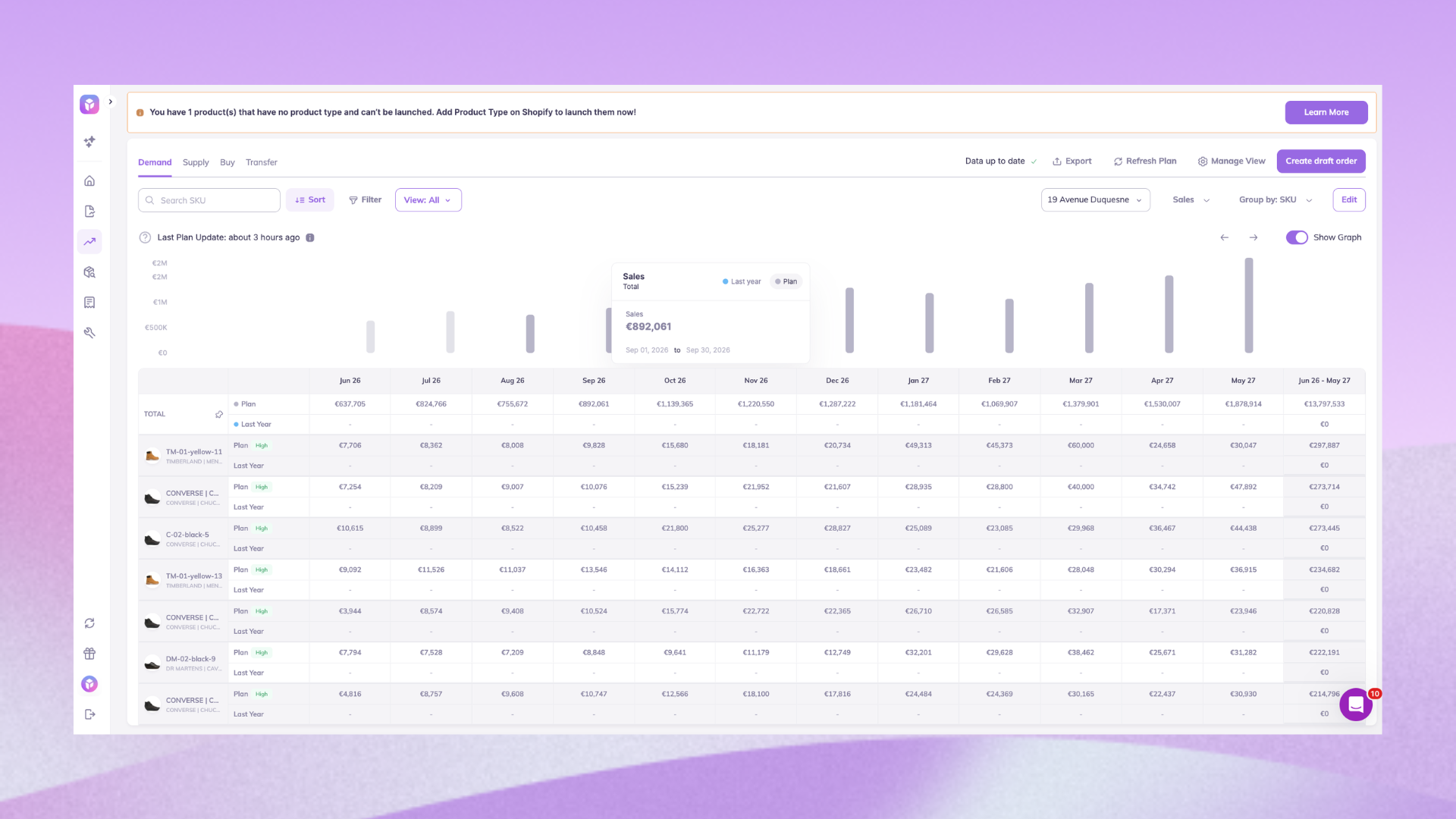
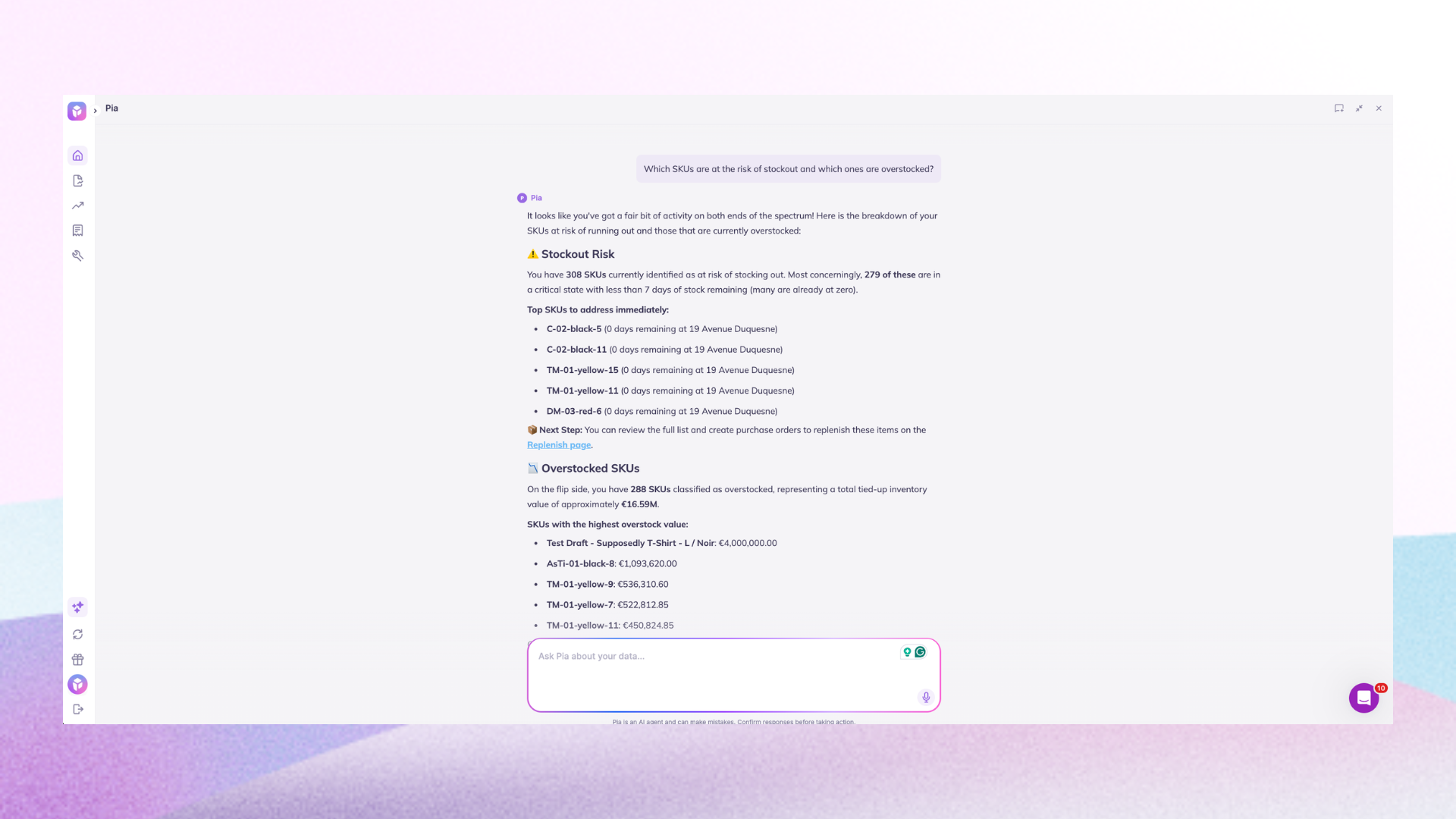
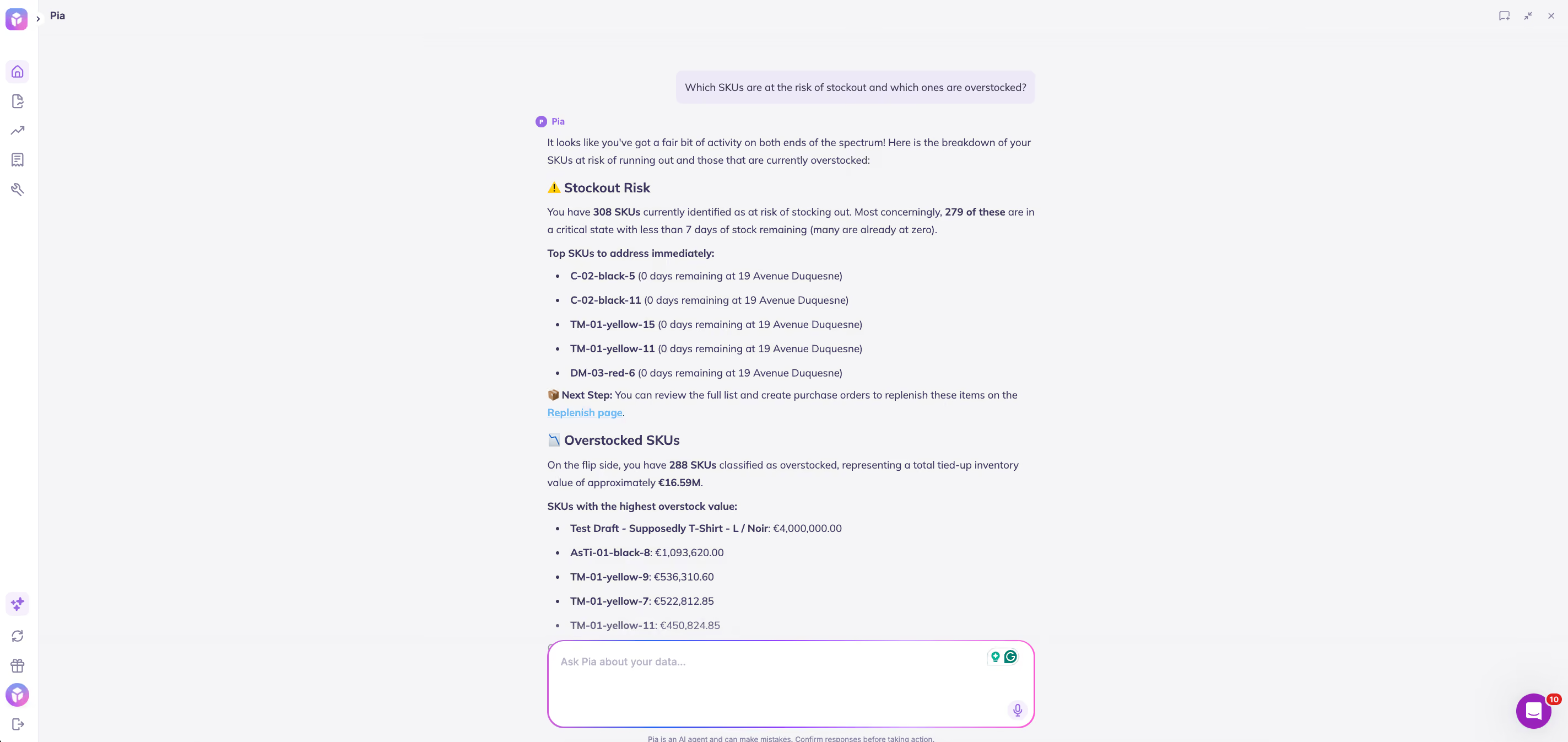
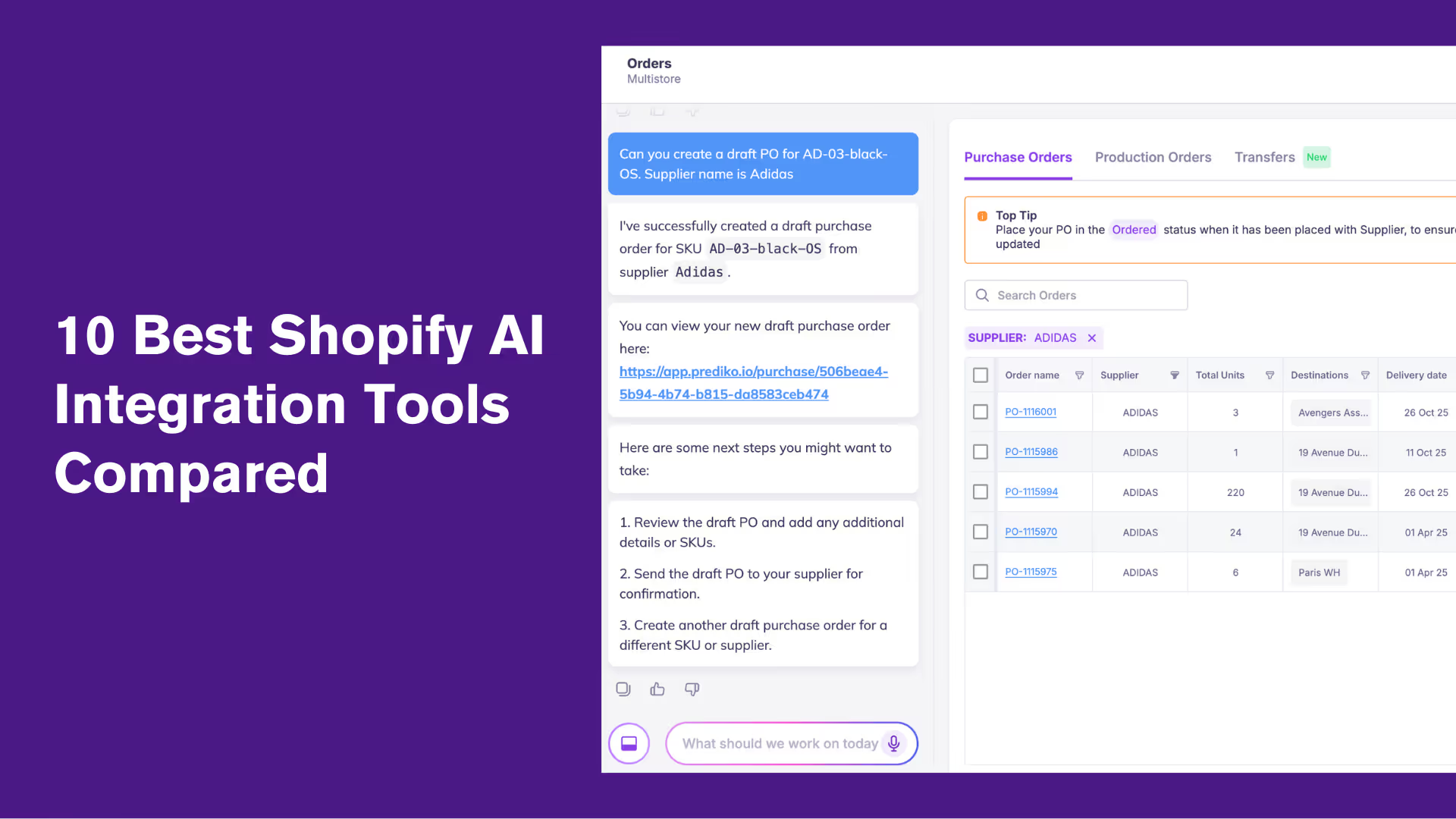
What sets Prediko apart is execution. Instead of navigating multiple screens, teams can use the AI agent to refresh forecasts, create and update purchase orders, manage incoming stock, and generate reports through simple, chat-based commands. 

Forecasting and operations stay tightly linked, so planning doesn’t break down at execution.

What does Prediko offer?

  • AI-powered demand forecasting: AI to predict sales and quantities with high accuracy, factoring in seasonality, trends, stockouts, bundle demand, and incoming POs. This helps brands reduce stockouts by up to 30% and avoid tying up capital in overstock.
  • Chat-based inventory operations: The AI agent executes commands like refreshing demand plans, selecting SKUs, generating reports, and scheduling updates, all while reducing manual work. You can also connect Prediko to ChatGPT, Claude, or any MCP-capable tool and run these same commands from the AI assistant you already use.
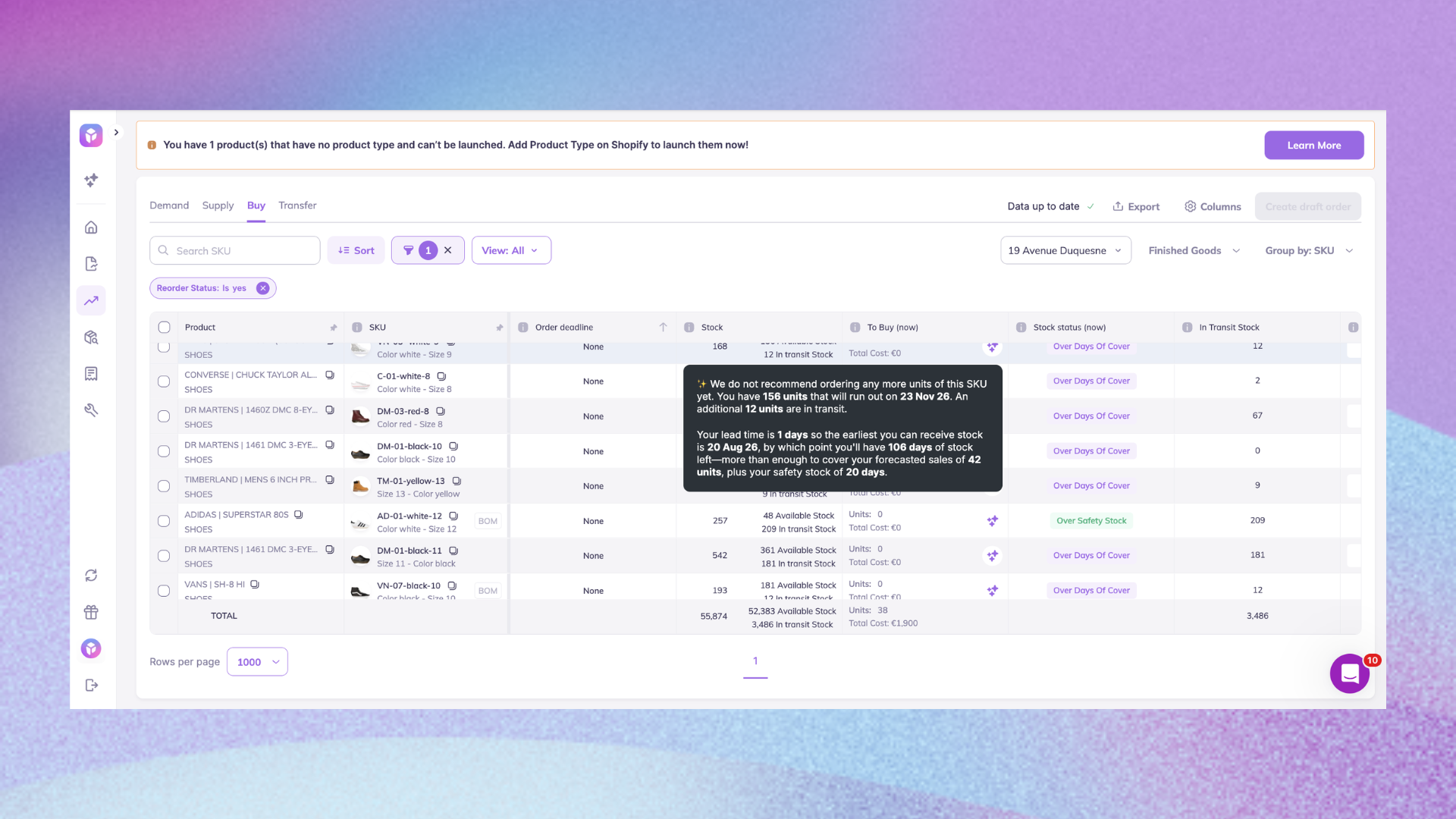
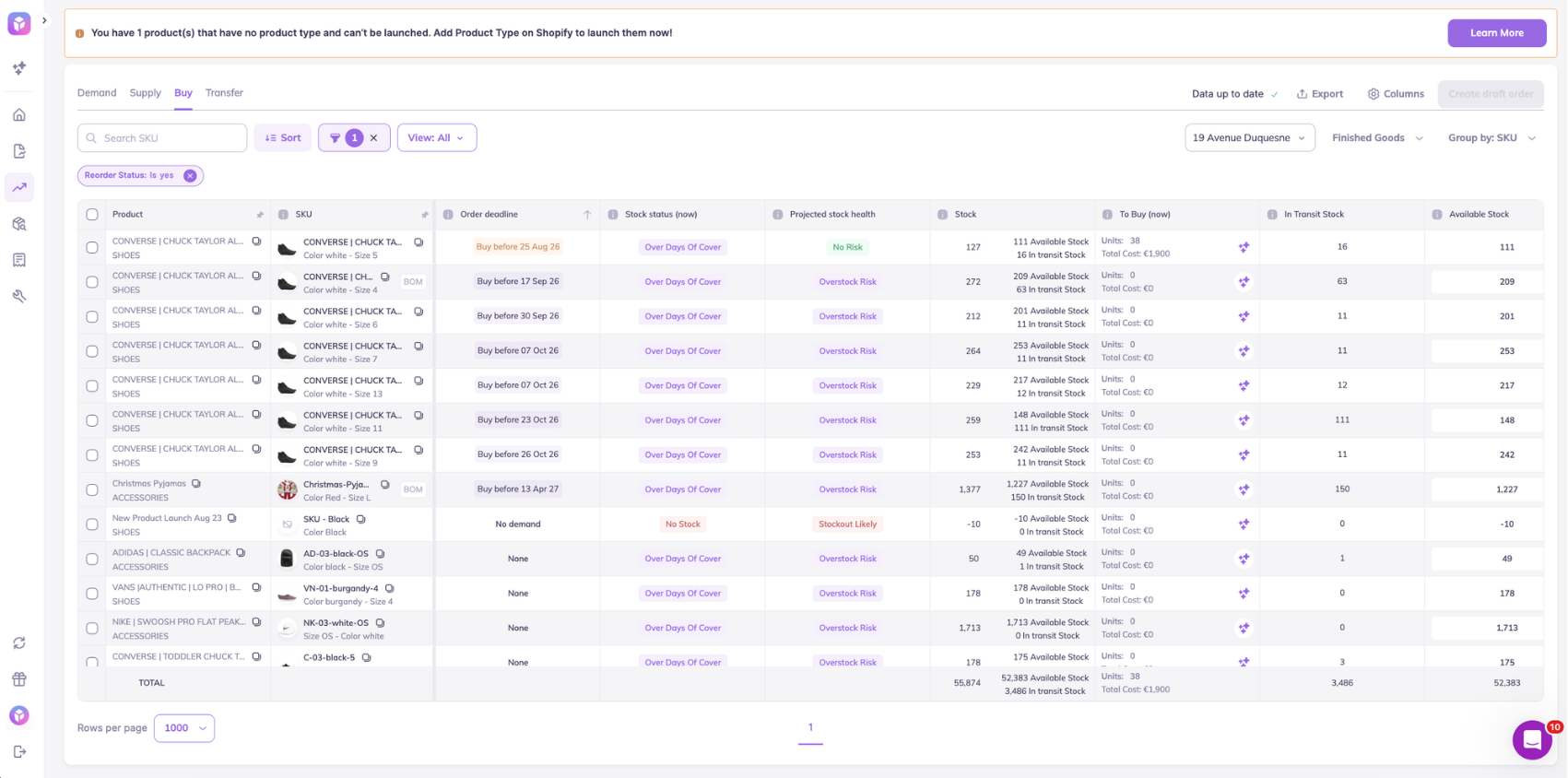
  • Automated replenishment suggestions: Receive smart “Buy Now” recommendations for finished goods and raw materials for up to one year based on forecasted demand, lead times, and safety stock levels.
  • Context-aware AI assistance: The agent remembers context within a session and uses Prediko’s documentation to guide workflows and answer platform questions.
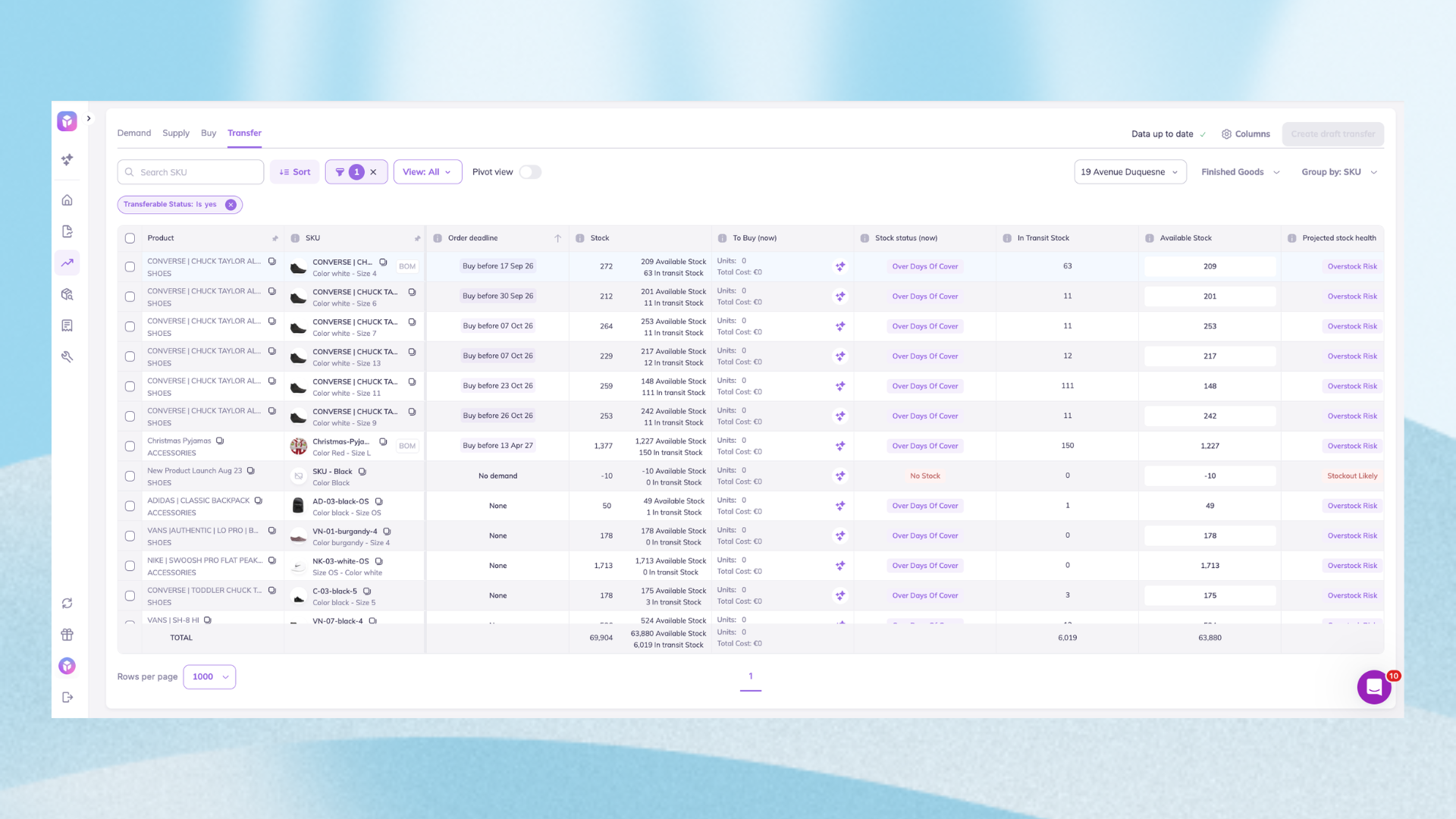
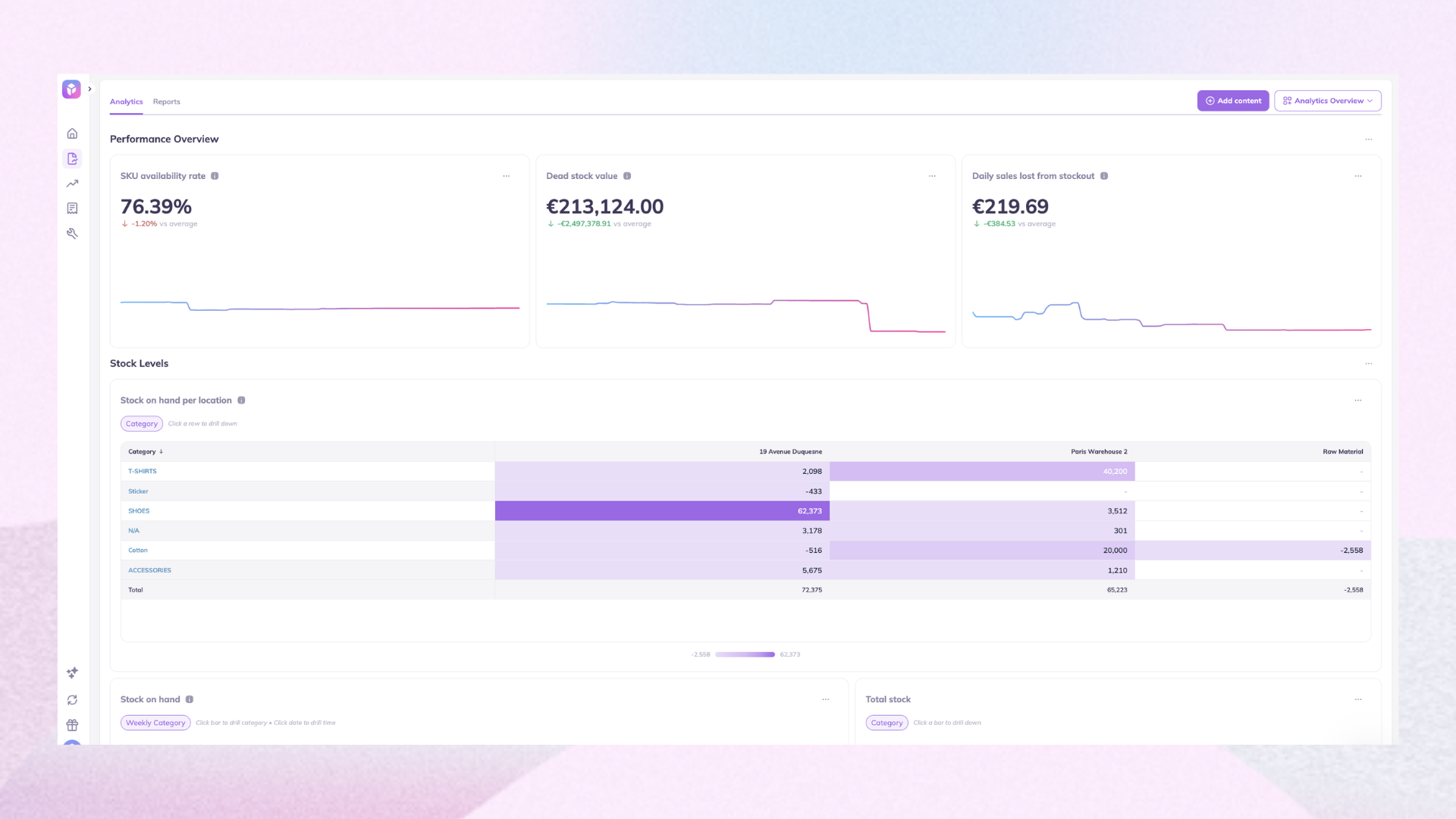
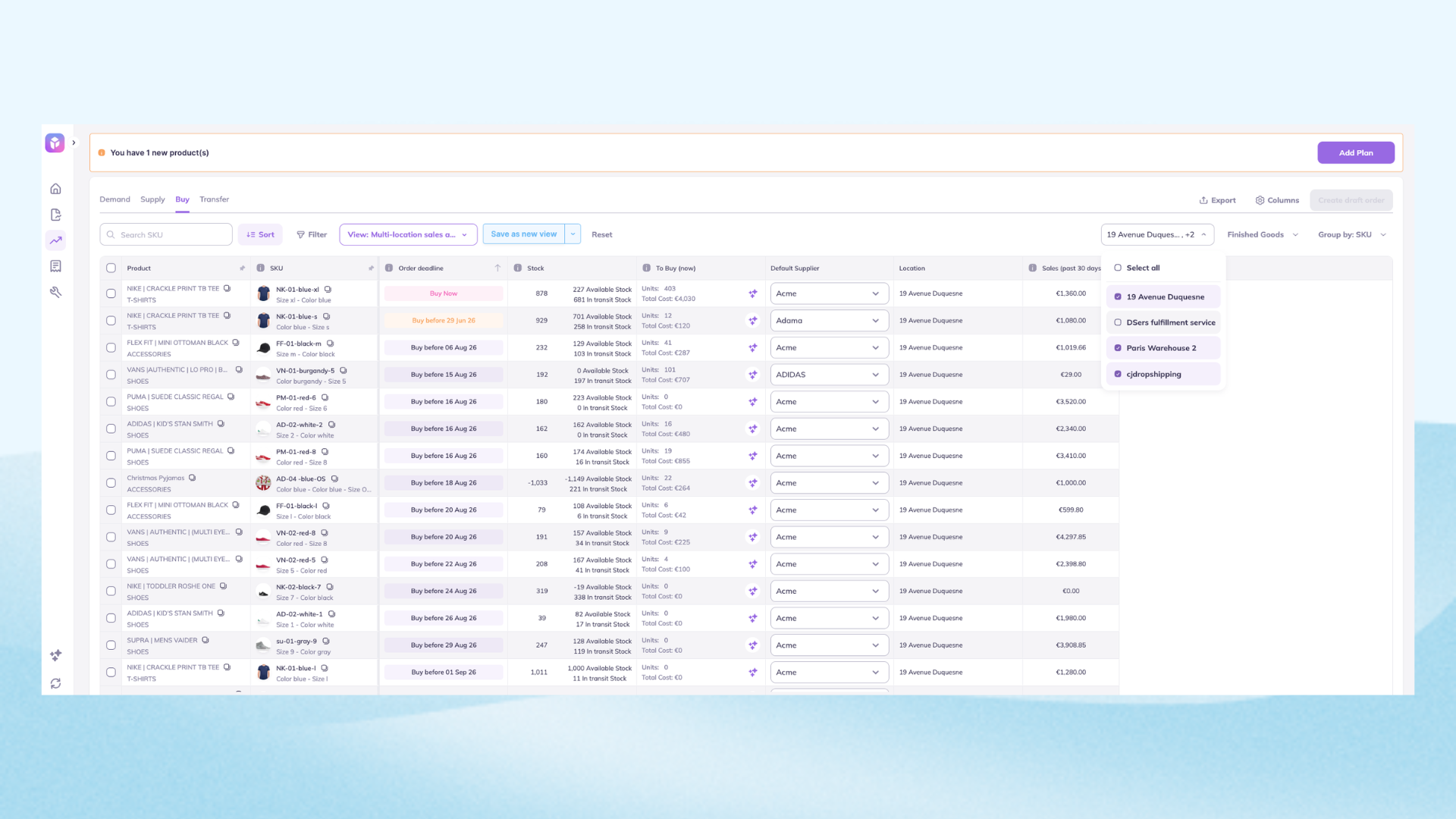
  • Real-time multi-location inventory visibility: Track stock health across all SKUs, stores, and warehouses with automatically updated dashboards.
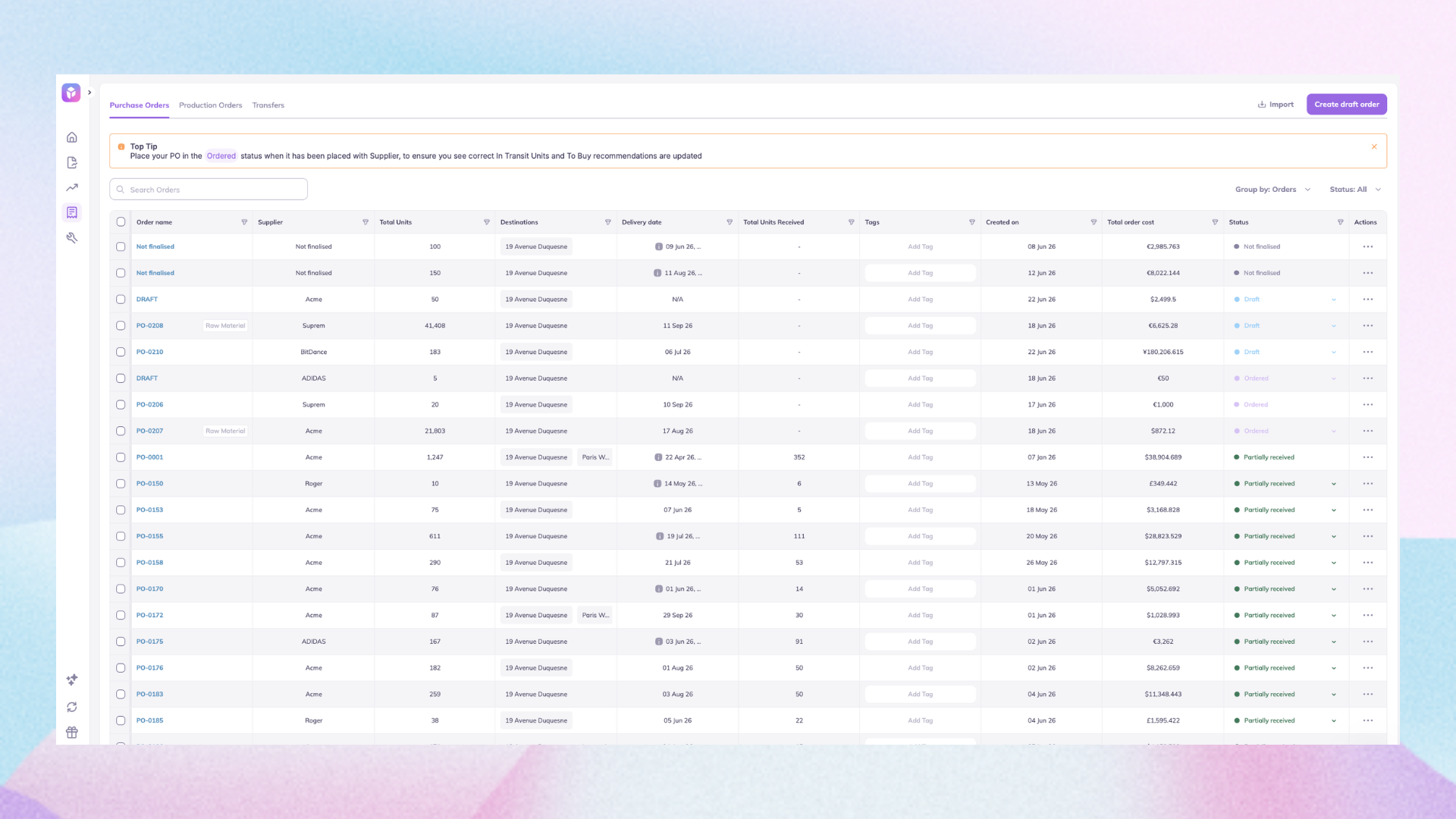
  • Centralized purchase order management: Create, manage, and track POs seamlessly with built-in forecasting logic guiding quantities.
  • Collaborative workflows: Give teams shared access to forecasts, stock insights, and POs, ensuring one source of truth across operations.
  • Connected ecosystem: With 100+ integrations, Prediko connects effortlessly with Shopify, ERPs, 3PLs (like ShipBob), and WMS systems. This means your inventory data is synced in real-time across your entire tech stack.

Prediko Pricing

Prediko offers tiered pricing based on your store’s revenue. Plans start at just $49/month for small businesses and scale up with the revenue of the business. All plans include unlimited SKUs, purchase orders, and users. Try Prediko with a 14-day free trial.

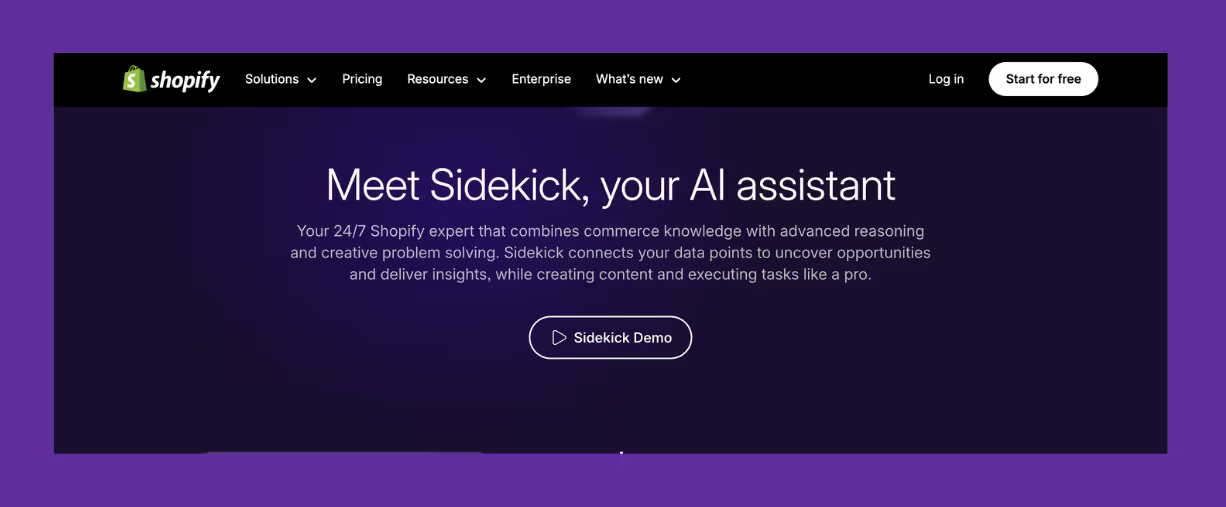
2. Sidekick: Best Shopify AI agent for store management
2. Sidekick: Best Shopify AI agent for store management

Sidekick is Shopify’s native AI assistant, built directly into the Shopify admin and designed to understand the full context of your store. 

It serves as a 24/7 operational partner that can execute tasks, generate creative content, and surface insights through a conversational interface.

With direct access to your store’s backend data, Sidekick can instantly perform actions like “create a discount code for my summer sale” without relying on third-party tools or permissions.

What does Sidekick offer?

  • Contextual task execution: Sidekick can modify your shop design, change theme settings, or create collections based on simple text prompts, reducing the technical barrier for complex admin tasks.
  • Data analysis on demand: Merchants can ask complex questions like "Why did my sales drop last Tuesday?" and Sidekick will analyze store data to provide a summarized explanation, saving hours of manual reporting.
  • Creative automation: It generates high-converting product descriptions, blog posts, and email subject lines that fit your brand voice, making the content creation process much faster.

Sidekick Pricing

Sidekick is included as part of standard Shopify plans (Basic, Shopify, Advanced, and Plus), though specific features may carry extra costs depending on the final release structure.

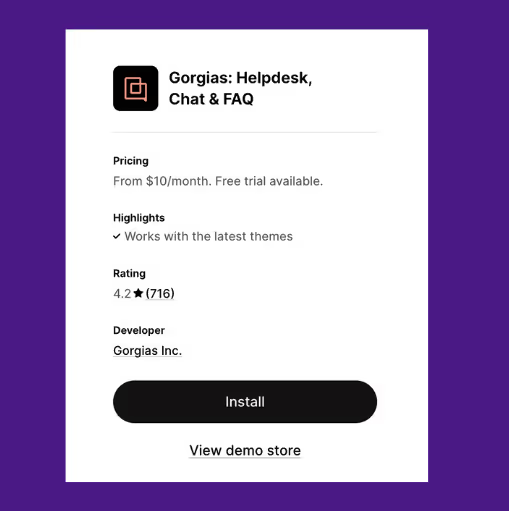
3. Gorgias: Best Shopify AI agent for customer service
3. Gorgias: Best Shopify AI agent for customer service

Gorgias is an e-commerce-focused helpdesk platform that includes two powerful AI agents: Shopping and Support.  

The Shopping Assistant engages visitors with personalized greetings and product recommendations based on their behavior, while the Support Agent can resolve support tickets autonomously or route them to the appropriate teammate when needed.

What does Gorgias offer?

  • Automation: Gorgias AI can automate up to 50% of incoming support tickets, specifically repetitive inquiries like order status and return requests, drastically lowering support costs.
  • Revenue generation: The AI Shopping Assistant can detect pre-sales questions and sentiment, prioritizing high-value conversations or offering personalized discount codes to close sales, turning support into a profit center..
  • Contextual responses: By pulling data directly from Shopify, the AI drafts responses that include specific order details, tracking numbers, and customer history, providing personalized service at scale.

Gorgias Pricing

Gorgias operates on a ticket-volume model. Plans start at $10/month for 50 tickets, scaling up to Enterprise levels for high-volume. The AI features are an add-on or included in higher-tier plans.

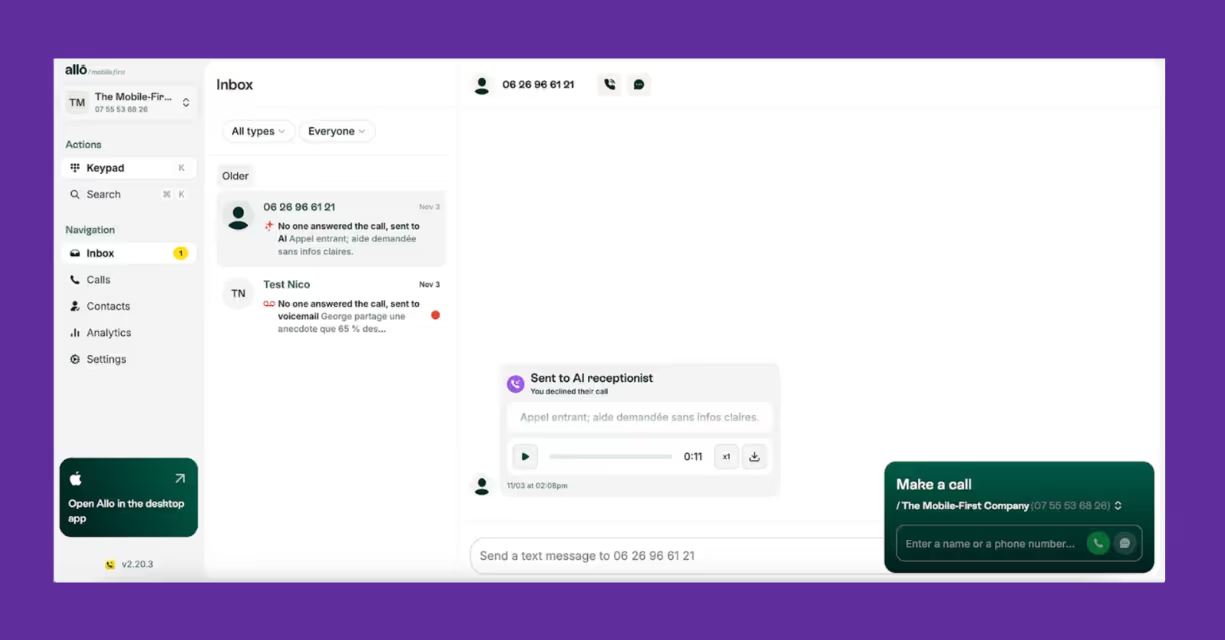
4. Allo: Best AI voice agent for Shopify customer service
4. Allo: Best AI voice agent for Shopify customer service

Allo is an AI phone system that offers a deep integration with Shopify.

While many brands shy away from phone support due to cost or time constraints, Allo allows merchants to get their incoming calls handled by an AI answering service. 

It can answer common questions and transfer their call to an employee if necessary

What does Allo offer?

  • Infinite scalability: Allo helps your teams scale phone discussions. The AI answering service reduces the number of incoming calls, the AI IVR routes your callers to the right person inside your team and the AI assistant generates handy call summaries.
  • Complex issue resolution: The agent connects with Shopify to perform actions like checking order status, processing returns, or updating shipping addresses in real-time during the call.
  • Brand voice customization: You can configure the AI's tone, speed, and personality to match your brand, creating a consistent auditory experience for customers.

Allo Pricing

Allo offers two plans:

  • The Starter plan which costs $25/month. It includes 1 user max, unlimited calls, a local phone number, AI-generated call summaries, and an IVR.
  • The Business plan at $45/month per user. It includes integrations (including Shopify), unlimited AI answering service, SMS and international calls.

5. YourGPT: Best AI agent platform for support, sales, and operations

YourGPT is an AI-first platform that help business to build and deploy autonomous agents across customer support, sales, and internal operations. Moving beyond the limitations of standard chatbots, it executes complex, performs multi-step actions and triggers direct API actions with full control over the agent’s autonomy.
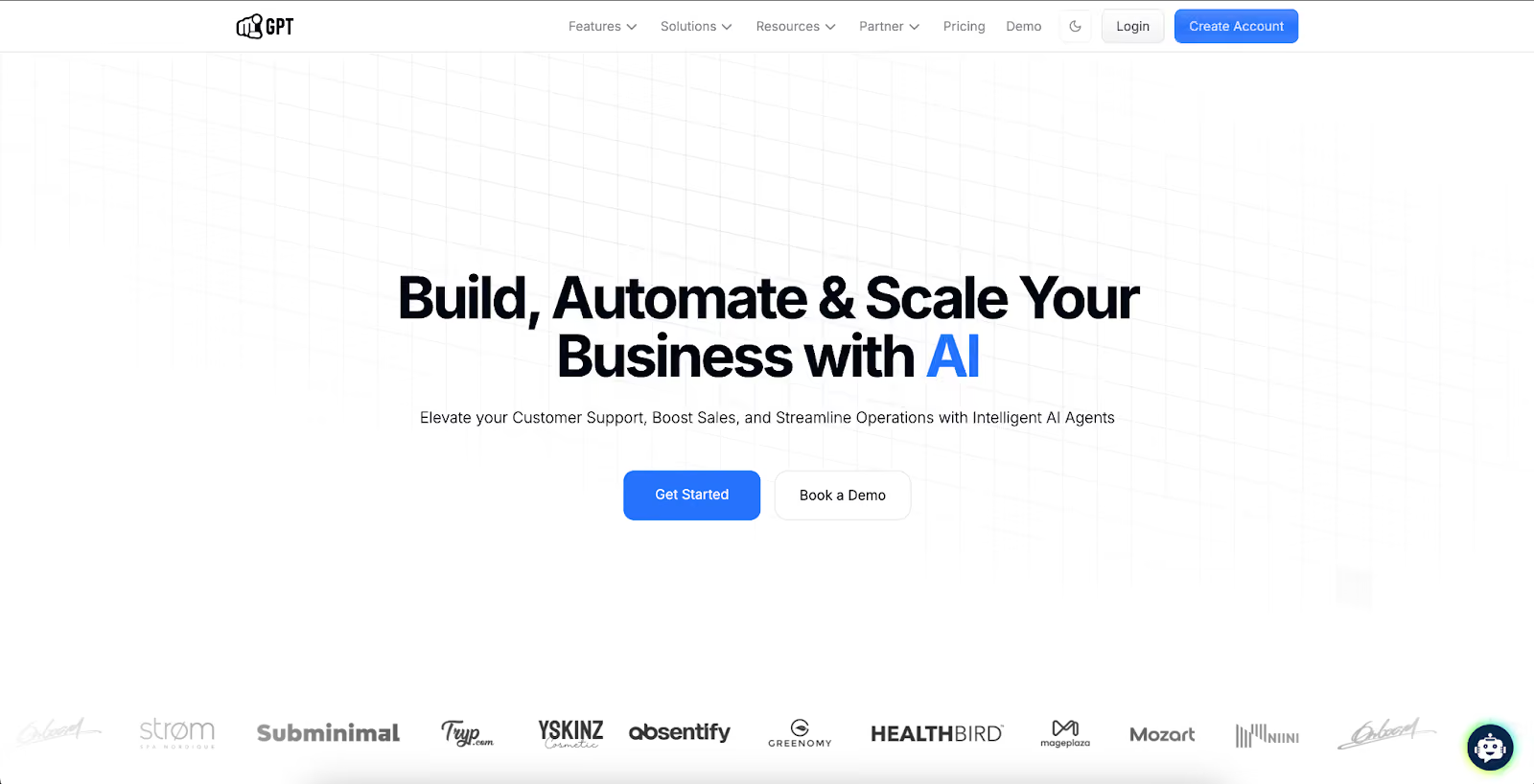
It functions as a unified operational layer across Web, WhatsApp, Messenger, Telegram, Email, LINE, and more, centralizing conversations in a single inbox with complete context retention. Trained on your business data through multi-source inputs, it delivers accurate, action-driven outcomes, resolving up to 80 percent of routine queries before human intervention. When escalation is required, handoffs are seamless and fully contextual, eliminating information loss and maintaining continuity.

What does YourGpt offer?

  • Complete AI Suite: It provides a complete AI suite for customer support, sales, and business operations, featuring a no-code builder, AI studio, helpdesk app, voice agents, email integration, and campaigns.
  • Action-Oriented AI: AI that understands all modalities, including text, voice, and image, resolves issues and performs real-time actions rather than just deflecting them.
  • Self-Learning Agents: AI agents that continuously adapt and improve over time.

YourGpt Pricing:

Starts at $39/month; Professional at $79, Advanced $349 (billed annually), and Enterprise plans are available. 

6. Wisepops: Best Shopify AI agent for on-site engagement

5. Wisepops: Best Shopify AI agent for on-site engagement

Wisepops is an on-site marketing platform that uses AI to maximize visitor value through intelligent popups, bars, and notifications. 

Its AI agent analyzes visitor behavior in real-time (such as scroll depth, mouse movement, and page history) to trigger the most relevant message at the exact moment a user is likely to convert.

What does Wisepops offer?

  • AI wishlist & recommendations: The AI can suggest products or prompt users to save items to a wishlist based on browsing behavior, increasing session value.
  • Smart targeting: Instead of generic popups, Wisepops uses predictive targeting to show offers only to users who need a nudge, preserving user experience for those who are already likely to buy.
  • Goal-driven automation: You set a goal (e.g., "Grow email list" or "Increase AOV"), and the AI optimizes the timing and format of campaigns to achieve that specific metric.

Wisepops Pricing

Pricing is based on pageviews per month. Plans start at $49/month for up to 100,000 pageviews, making it accessible for growing brands, with enterprise tiers for high-traffic sites.

7. Klaviyo: Best Shopify AI agent for email marketing automation

Klaviyo

Klaviyo is a leading marketing automation platform for Shopify, powered by its advanced K:AI engine. 

It goes far beyond basic email sending by acting as an intelligent data scientist for your marketing team. 

Klaviyo aggregates customer data to predict future behavior and automates smart segmentation and content creation.

What does Klaviyo offer?

  • Predictive analytics: Klaviyo AI calculates Customer Lifetime Value (CLV), predicts next order date, and churn risk for every profile. This allows you to trigger flows exactly when a customer is ready to buy or at risk of leaving.
  • Generative AI for content: The platform can generate high-performing email subject lines, SMS copy, and even build entire email templates based on your brand guidelines and campaign goals.
  • A/B testing automation: AI automatically tests variations of your campaigns and shifts traffic to the winning version in real-time, maximizing revenue per recipient.

Klaviyo Pricing

Klaviyo has a tiered pricing model based on the number of active contacts in your database. There is a free tier for up to 250 contacts, with paid agent plans starting from $50 per month. 

8. Eesel AI: Best Shopify AI agent for customer support

eesel AI helps Shopify stores answer product, shipping and order questions using their catalog, policies and live order data. It connects with existing helpdesks and passes complex cases to your support team. Pricing starts at $0.40 per support ticket or chat session.

What does eesel AI offer?

• Product answers grounded in your catalog, policies and FAQs.

• Live order tracking and support for return questions.

• Connections with helpdesks including Zendesk, Gorgias and Freshdesk.

• Multilingual replies, configurable tone and human escalation.

• $50 in free AI usage credits to test it right away, with no credit card required.

• A CLI for developers who want Claude Code, Codex or another coding agent to help set up and manage eesel from the terminal, with account access and integration approvals controlled by the user.

Pricing

Pay as you go: $0.40 per support ticket or chat session, covering all messages within that interaction. Standard usage has no platform fee or monthly minimum. New accounts receive $50 in free usage.

To Wrap It Up

While Generative AI often gets dismissed as experimental because of occasional hallucinations or odd outputs, ecommerce AI agents shouldn’t be viewed the same way. 

Platforms like Prediko and Klaviyo didn’t appear overnight; they’re mature, purpose-built systems that existed long before the current AI hype. 

By looking beyond the buzz and adopting the best Shopify AI agents now, merchants can gain a real competitive advantage and avoid falling behind as the industry accelerates.
Frequently Asked Questions About AI Agents for Shopify

What are the key benefits of using AI agents for Shopify?

AI agents automate repetitive tasks, improve decision accuracy, speed up customer support, reduce operational costs, and help merchants scale without increasing manual workload.

What is the best AI agent to increase sales on Shopify?

Tools like Shopify Sidekick, Prediko, and Klaviyo help increase sales by optimizing inventory, personalizing product recommendations, and improving on-site and email engagement.

What is the best AI agent for customer service in Shopify?

Gorgias is widely considered the best AI agent for text-based customer service. For voice-based support, Allo is the leading choice, offering human-like phone interactions that can resolve complex order queries in real-time.

5 min
Sep 8, 2026

Shopify Black Friday Inventory Checklist to Maximize Sales in 2026

Use Black Friday Cyber Monday Inventory Checklist to manage inventory smartly, prevent stockouts, and maximize holiday profits.

Read Blog

Black Friday & Cyber Monday (BFCM) are periods when everyone is on the hunt for deals, creating both a huge opportunity and a major challenge for ecommerce brands.

While this means a massive jump in demand, it also calls for careful planning and flawless execution.

With so many moving parts during Black Friday and Cyber Monday, it's easy for things to slip through the cracks.

That's why we put together a Black Friday inventory checklist to help brands make 2026 their most successful holiday season yet.

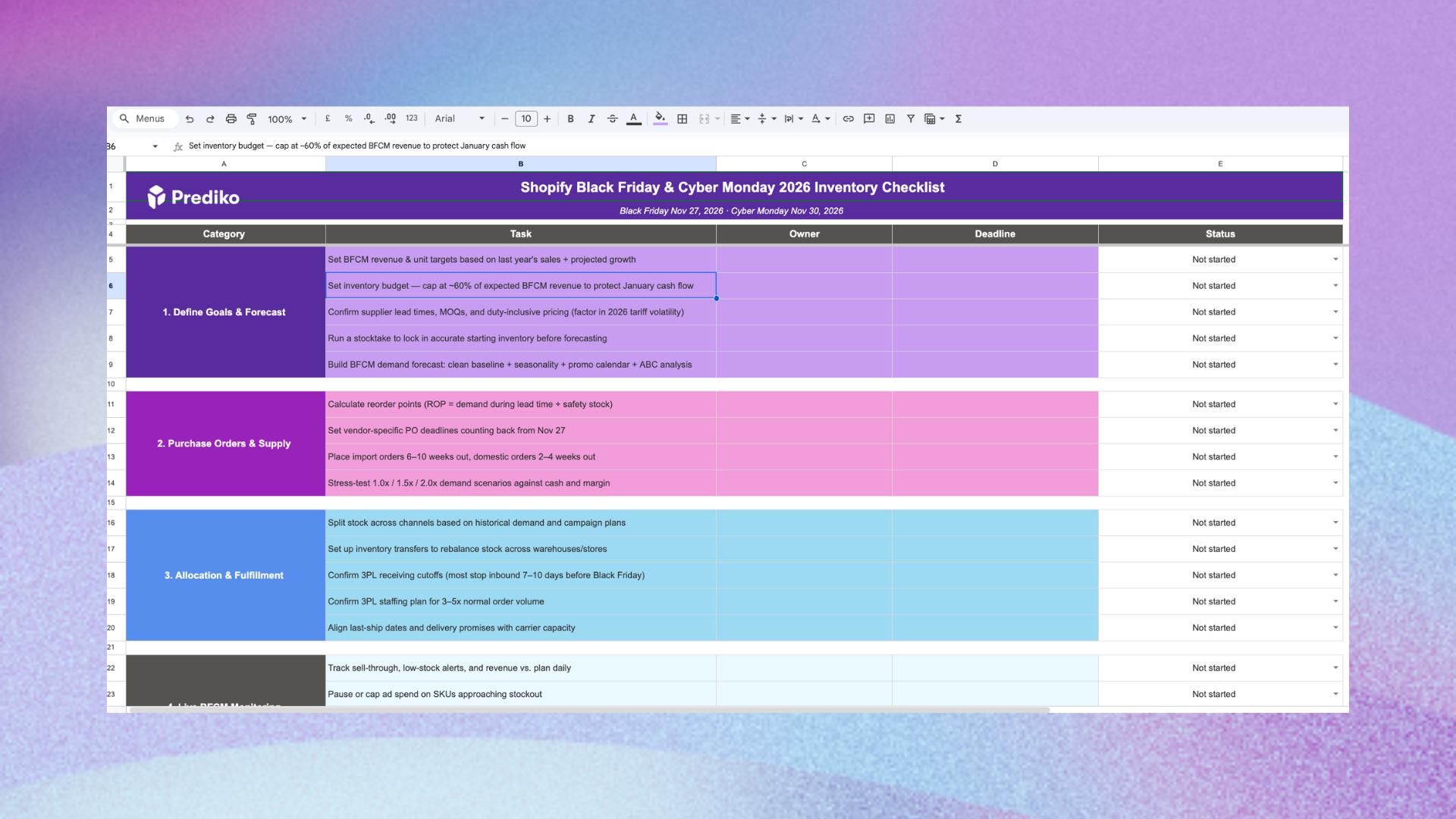
Your Free BFCM Inventory Checklist

Keep every BFCM task in one place: from demand forecasting and PO deadlines to 3PL preparation, live monitoring, and your post-sale review.

Use it to assign tasks, track progress, and make sure nothing gets missed before November 27.

Download the Free Checklist

Why Early Inventory Planning Is Critical for Black Friday 2026

Black Friday and Cyber Monday (BFCM) bring the biggest demand storms of the year for Shopify and ecommerce brands.

U.S. online holiday sales continue to break records. Last year, Shopify merchants did a record $14.6 billion in BFCM sales, with Black Friday capturing a major share of that revenue. Millions of shoppers are active over the Thanksgiving–Cyber Monday weekend, making it a high-stakes period for inventory management.

Black Friday 2026 falls on November 27, and Cyber Monday falls on November 30; this should serve as your anchor date for planning everything.

Align purchase order cutoffs, supplier lead times, and inbound shipments well in advance so your shelves are stocked and ready.

Early preparation helps prevent stockouts, missed sales opportunities, and last-minute logistics chaos, so your store captures the holiday surge effectively.

We share actionable tips to help you get fully prepared in the section below.

Your 7-Point Black Friday Inventory Checklist for 2026

To get ahead of Black Friday and Cyber Monday sales surges, we've compiled a list of 7 actionable steps to make you BFCM-ready.

1. Define goals and constraints before you forecast

First and foremost, set clear targets for what you want to achieve this Black Friday Cyber Monday.

  • Set your BFCM target

Look at last year's sales, factor in your projected growth, and estimate lift from promotions. This gives you a concrete revenue and unit goal to aim for.

  • Set your inventory budget

Next, determine your maximum inventory investment by setting a working capital limit you're comfortable carrying into January's slower period.

A safe rule: don't invest more than 60% of your expected BFCM revenue in additional inventory, as you'll need cash flow for January operations when sales typically drop 40-50%.

  • Confirm supplier constraints

Factor in 2026 tariff volatility, too. Shifting tariff rates are adding weeks of uncertainty to import lead times and landed costs this year. 

Ask suppliers for their 

  • current duty-inclusive pricing
  • manufacturing deadlines
  • Minimum order quantities  
  • Updated lead times 

Build extra time into your PO deadlines for imported products instead of assuming last year’s lead times still apply. Some factories may also reduce or stop production ahead of Chinese New Year, making last-minute restocks difficult.

  • Check your starting inventory

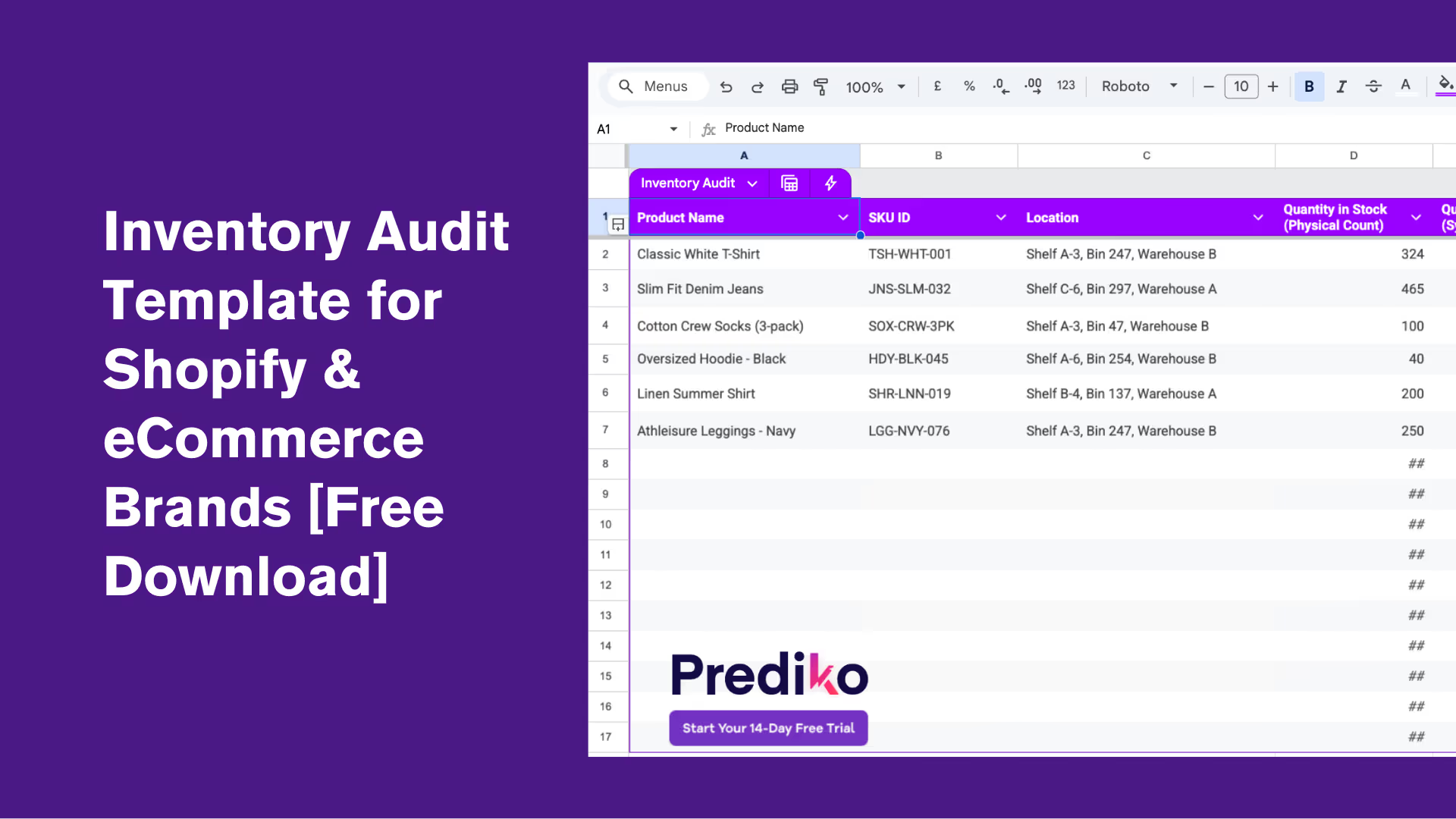
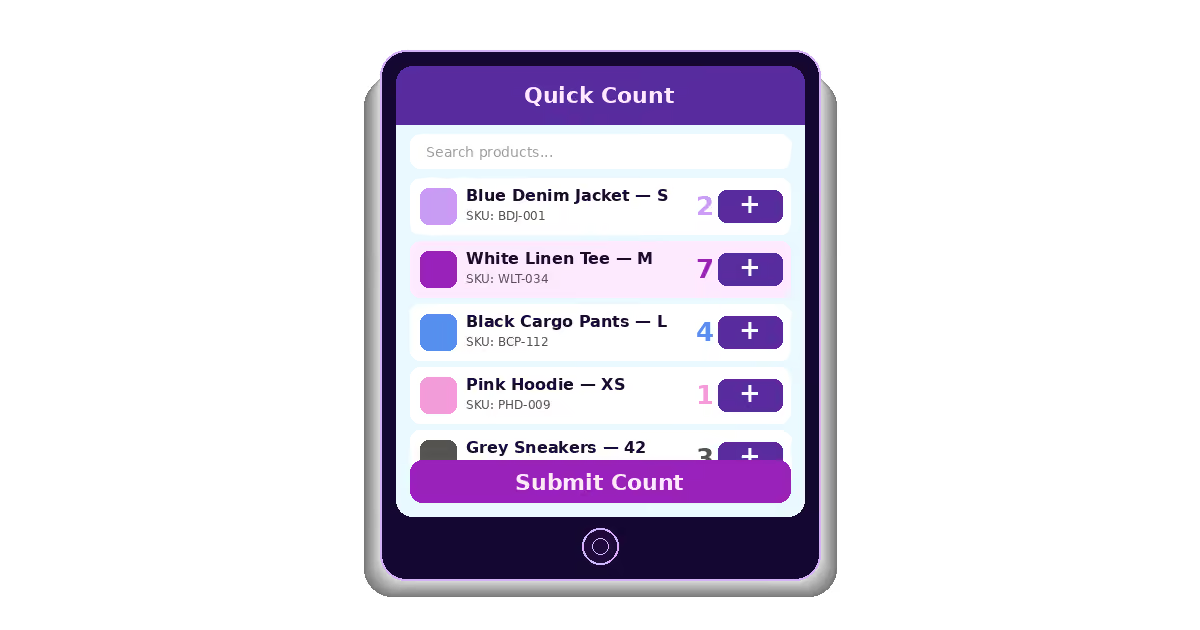
Before you forecast, run a quick stocktake so you're working from real numbers, not last quarter's guesswork. Prediko's Stocktakes let you count by barcode scan, spreadsheet import, or manual entry, and push the corrected counts straight to Shopify.

Lock in these constraints now, then forecast within these boundaries rather than creating unrealistic demand projections that exceed your operational or financial capabilities.

2. Build a demand forecast that fits BFCM behavior

The Black Friday Cyber Monday period doesn't follow the patterns of a regular week. A standard forecast won't cut it; you need one built for BFCM dynamics.

Here's how to make your demand forecast as accurate as possible:

  • Start with a clean baseline: Normalize last year's sales data by adjusting for irregularities like stockouts, price changes, etc. BFCM shoppers often start their deal hunting before Cyber Week, so factor in early demand as well.
  • Layer promo and seasonality factors: Once your baseline is clean, add in the effects of promotions and seasonal demand. Use category-specific past data and adjust for your promo calendar to anticipate spikes accurately.
  • Prioritize with ABC Analysis: Not all products perform equally during BFCM. Classify SKUs by sales contribution and velocity. Focus inventory buffers and budget on A-items. B and C items can follow.
  • Account for returns and cancellations: BFCM doesn't end when the weekend is over. Returns and cancellations create hidden demand shifts. Account for post-BFCM returns to avoid tying up cash in excess inventory.

How does this work inside Prediko

Prediko's AI makes forecasting easy by using the same period from last year's sales, then layering growth trends, ABC analysis, seasonality, and promotional factors to create accurate predictions. 

From there, you can move into Supply Planning to check the forecast against your actual supplier capacity and a 12-month PO calendar, so you know it's achievable. You can also manually fine-tune the Black Friday numbers at any time.

3. Translate forecast into purchase quantities

To turn forecasts into action, convert them into precise purchase quantities.

  • Start by calculating your reorder point 

Use this formula: ROP = Demand during lead time + Safety Stock.

Safety stock should reflect Q4's higher variability and longer lead times, with an extra buffer for top-selling SKUs.

With Prediko, you don't need to manually calculate ROPs. Simply set safety stock and order frequency, and receive automated alerts for when and how much to reorder based on demand and lead times.

  • Set PO deadlines

Next, set vendor-specific PO deadlines by counting backward from November 27, factoring in port congestion, customs, and 3PL intake to keep inventory flowing smoothly.

  • Test different demand scenarios

Finally, plan for uncertainty with demand scenarios: 1.0x (baseline), 1.5x (moderate surge), and 2.0x (extreme surge), assessing the impact on cash, margins, and risk.

Prediko lets you edit demand plans instantly to see how changes affect inventory and finances.

4. Allocation, fulfillment, and 3PL readiness

Smart inventory allocation is what separates a successful BFCM campaign from a stockout disaster.

  • Start with omnichannel allocation. 

Split stock between channels based on historical demand and marketing campaigns. This prevents overselling or stockouts and maintains a consistent customer experience across channels.

If you sell across multiple warehouses or store locations, don't just guess where demand will spike. Use inventory transfers to move stock based on real demand signals. 

  • Coordinate early with 3PL partners to prevent fulfillment issues. 

Confirm receiving cutoffs for new shipments. Most 3PLs stop accepting stock 7–10 days before Black Friday to focus on outbound orders.

Make sure they have staffing for 3–5x normal volumes and are clear on wave-picking schedules, so orders flow smoothly.

  • Finally, tie your fulfillment plan to your marketing commitments. 

Align pack-and-ship SLAs and delivery promises with carrier capacity and promotional deadlines. Accurately communicate last-ship dates to customers to manage expectations, reduce cancellations, and maintain trust.

5. Operate live during BFCM

It's essential to monitor your store in real time throughout BFCM. Keep a close eye on sell-through rates, low-stock alerts, and revenue versus plan.

Track how ad spend aligns with available inventory to avoid promoting items you can't fulfill.

If a SKU is at risk of stockout, pause or cap promotions immediately to prevent overselling and customer frustration.

Take an inventory-aware approach to merchandising. When top-selling SKUs hit thresholds, promote adjacent substitutes to capture demand without losing sales. Use bundles and kits to move B- and C-tier inventory strategically, maintaining margins while maximizing sales.

If you're using Prediko, it sends low-stock alerts factoring in safety stock and lead times so you're stocked before the demand hits. And if you don't have time to dig through tables during the rush, you can just ask Pia, their AI inventory agent. 

6. Prevent stockouts without overbuying

When your bestsellers approach stockout, don't panic-order expensive inventory that might arrive too late. Instead, set up preorders and waitlists that capture customer demand while maintaining cash flow.

Set up preorders only when you have confirmed restock dates from suppliers. Customers will accept 2–3 week delays if you're transparent about timing, but they'll abandon orders if you keep pushing back delivery dates.

Create waitlists for uncertain restocks. Capture emails and phone numbers to retarget these high-intent customers with substitute products or future launches.

Deploy messaging to steer demand toward available products. For example, when your top-selling black hoodie hits low stock, send targeted emails/SMS to interested customers with your navy and gray options.

For financial safety, make it a habit to track Gross Margin Return on Investment (GMROI) daily, i.e., Gross Margin / Average Inventory Investment. Aim for a GMROI above 3.0. Track cash burn versus plan; if it's 20% over plan, tighten promos and pause non-essential POs.

7. Post-Black Friday Cyber Monday exit and debrief

After BFCM, it's critical to review what worked and what didn't. A clear post-BFCM debrief helps you manage leftover stock, process returns quickly, and gather insights to improve next year's strategy.

  • Lay down a markdown and liquidation plan. Predefine markdown triggers based on sales velocity and remaining stock levels. For example, reduce price by 15% if 30% of stock remains 3 days post-BFCM.

    Assign specific channels for liquidation and decide which SKUs can be bundled or offered as gifts to clear excess. Track performance to inform your strategy next year.

  • Set up a returns and refurb flow. First, separate return-prone SKUs and fast-track resellable items. Inspect returns immediately for damage, refurbishment, or repackaging, and restock quickly.

    For unsellable items, decide whether to donate, recycle, or liquidate. Track high-return SKUs to guide future inventory planning and supplier negotiations.

  • Maintain a post-mortem template. Run a post-mortem within a week of BFCM. Record top and underperforming SKUs, lead-time deviations, and promotion impact on margin.

    Note operational bottlenecks like stockouts or fulfillment delays. Use this template to refine forecasting, marketing, and operations for 2027.

Common Black Friday Inventory Questions, Answered by Prediko

You've got the checklist. Here are the practical questions that come up once you actually start executing it.

How much extra inventory buffer should you keep for Black Friday and Cyber Monday?

There's no single universal number; it actually depends on your sell-through history and how volatile your demand is. But a common range is 20-40% above your baseline forecast for proven bestsellers, tighter for anything new or untested.

Adjust the final buffer by SKU based on lead times, supplier reliability, and the cost of stocking out versus overbuying.

What's the best financing option for Black Friday inventory?

It depends on how fast you need the cash and how predictable your sales are:

  • Shopify Capital: Fixed Funding gives a lump sum upfront, repaid as a fixed percentage of daily sales (no fixed due date, so it flexes with a slow week). Capital Flex is a revolving line of credit (US stores), you pay a monthly fee only on what you draw, redraw after repaying.
  • Revenue-based financing (Wayflyer, Clearco, 8fig, Onramp Funds): approval is based mostly on your Shopify sales history, and repayment scales down automatically after BFCM instead of hitting you with a flat payment in a slower January.
  • Supplier/PO financing: some partners pay your supplier directly against a confirmed purchase order, worth asking about if MOQs, not product cost, are your real bottleneck.

The goal isn’t to take on more debt. It’s to avoid buying too little simply because cash is tight. Before ruling out financing, calculate how much extra revenue that inventory could generate during Q4.

What if my 3PL can't handle Black Friday volume?

This happens more often than merchants expect. A 3PL that handles normal order volumes well may struggle when orders jump 5x and you might not know until shipments are already delayed.

Build the backup plan now, not on November 27th:

  1. Line up a secondary 3PL or overflow warehouse ahead of peak season, even just a signed agreement for emergency capacity, not a relationship you're paying for year-round.
  2. Diversify carriers. If your primary carrier hits a capacity or surcharge wall, a regional or last-mile carrier can absorb overflow without stalling your whole fulfillment chain.
  3. Consider a hybrid model. In-house fulfillment for bestsellers, 3PL for the long tail, co-warehousing in reserve. More moving parts, but no single point of failure.
  4. Start the conversation 3-4 months out. Backup 3PLs need lead time to forecast your volume and staff for it.

How can sellers prepare for Black Friday shipping surges?

A successful sale creates a second problem right behind the first: getting everything out the door on time.

  • Confirm carrier peak-season cutoffs for guaranteed delivery and update your site's shipping estimates to match, so "arrives by Christmas" is a promise you can keep.
  • Add extra time to your delivery promise, along with extra stock. A 3PL that ships the same day in October may take 48 hours during peak season, so set customer expectations before the sale begins.
  • Ask your 3PL to prioritize fast-selling SKUs so your bestsellers do not get stuck behind slower-moving orders.

What do I do if I overstock after Black Friday?

Some SKUs will not sell through, even with a solid forecast. Use an excess/overstock inventory view to identify slow-moving inventory. Act early, because waiting until January ties up more cash and often forces deeper discounts.

  • Run the GMROI check first. If a SKU's return on the shelf space it occupies has dropped below your threshold, it's a clearance candidate now.
  • Bundle, don't just discount. Pairing slow movers with a bestseller (an ABC-analysis move) protects margin better than a blanket markdown.
  • Clear through a separate channel: outlet collection, email-only flash sale, wholesale/liquidation partner, so discounting overstock doesn't train regular customers to wait for markdowns.
  • Feed it back into next year's forecast. Log which SKUs overstocked and why (wrong size curve, over-forecast trend, weak creative) so it doesn't repeat.

What features should I look for in a managed webhook platform so no Black Friday orders slip through?

"100+ integrations" sounds reassuring until an order's placed and your inventory count doesn't move for twenty minutes. During BFCM, that's long enough to oversell a bestseller a dozen times over. Look past the integration count and check for:

  • Real webhook coverage: orders/create, inventory_levels/update, and products/update should trigger an instant push in real time.
  • A queue with retry logic: If an event fails during a traffic spike, it should be queued and processed again, not lost.
  • Rate-limit handling: Shopify's API has hard request limits, and BFCM traffic is exactly when you'll hit them. The platform should manage that automatically instead of dropping updates.
  • One inventory record: Shopify, your WMS, and your 3PL should all work from the same stock count.

Prediko syncs with Shopify in real time, updating your inventory whenever an order comes in. This keeps your buying plan and stockout alerts based on the latest stock levels.

How Prediko Helps You Nail Black Friday Inventory

Black Friday and Cyber Monday can make or break your year. Too little stock, and you miss sales. Too much, and cash gets tied up in inventory that may never move. 

Here's how Prediko fits into your BFCM timeline, from the first forecast to the final debrief.

Brands using Prediko have cut stockouts from 4% to 1% in two months, reduced stockouts by 35%, and achieved 93% SKU availability while reaching their sales target.

Weeks before: build a forecast you can trust 

Before you commit to a number, run a quick Stocktake so your starting counts are accurate. From there, AI-Powered Demand Forecasting turns last year's sales, seasonality, and growth trends into a SKU-level target. 

AI Supply Planning checks that target against a 12-month PO calendar and your real supplier capacity, so you know it's achievable before you spend a dollar on stock.

Days before: get stock to the right locations

As POs land, multi-location inventory management keeps Shopify, warehouses, 3PLs, and POS locations in sync, with location-based restock suggestions so no site runs dry. 

If demand is shifting toward specific warehouses or stores, AI-recommended Inventory Transfers tell you what to move and where, before you have to ask.

During BFCM: react before customers notice

Plan tracking & alerts flag when sales or inventory start drifting from your plan, giving you time to adjust.

Actionable Views surface at-risk SKUs, slow movers, and bundle opportunities across 100+ metrics. Prediko also tracks inventory at the component level, showing exactly how many units of each SKU a bundle requires. This helps you pair slow-moving C-tier stock with bestsellers and clear excess inventory without guessing quantities.

If you already work in Claude, connect it to Prediko through MCP to access your live inventory, forecasts, and purchase orders without switching tabs. Ask what is at risk, check what changed, or take action directly from the conversation.

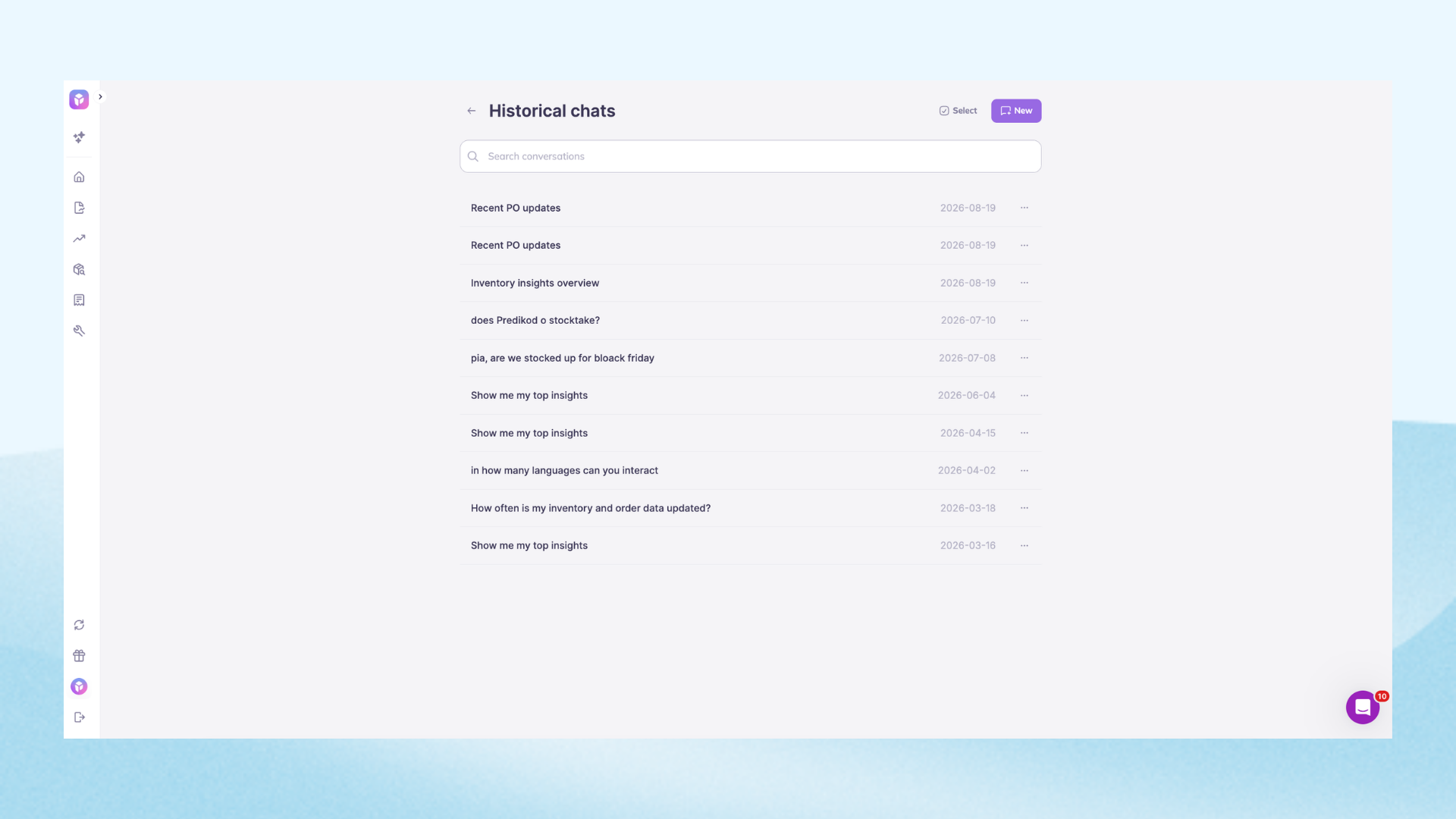
You can also ask Pia, Prediko’s AI inventory agent, for instant answers, task handover, and proactive alerts inside Prediko, Slack, or WhatsApp.

For brands running production, Raw Materials Management keeps the right materials on hand throughout, so manufacturing doesn't become the bottleneck.

After BFCM: review what actually happened

Once the dust settles, Granular Reports & Analytics give you 20+ ready-made reports and custom dashboards on sales performance, SKU profitability, and inventory tied up, scheduled straight to your inbox if you'd rather not go looking for them.

With Prediko, you get precision, visibility, and control over your inventory, so you can focus on growing revenue and delighting customers, rather than just trying to catch up;

Begin Your Black Friday Inventory Planning Today

Black Friday and Cyber Monday can be the most profitable period for your Shopify store. However, success comes down to how well you plan, execute, and adapt in real time.

By following this 7-point Black Friday inventory checklist- from pre-BFCM planning and allocation to live monitoring, stockout prevention, and post-BFCM debrief- you can stay ahead of demand, protect margins, and keep customers happy.

Prediko supports every step of the process, using AI to forecast demand and plan supply, track revenue against targets, manage multi-location inventory and transfers, streamline purchase orders, count stock accurately, and generate actionable insights for future peak seasons.

With the right preparation and tools in place, you can beat all your past BFCM sales records. Start your free 14-day trial of Prediko and take the first step today.

Other Frequently Asked Questions

When should I place purchase orders for imports vs. domestic?

Place import orders 6–10 weeks before BFCM, domestic 2–4 weeks prior, factoring in lead times and supplier reliability.

Should I manage BFCM inventory with a spreadsheet or dedicated software?

Spreadsheets can work at low order volume, but they don't update in real time and are error-prone at BFCM scale. Dedicated software that syncs live with Shopify (and your WMS) is what actually prevents overselling once volume spikes.

How do I forecast BFCM demand for a brand-new product with no sales history?

Use category or comparable-SKU benchmarks as a proxy, start with a conservative demand scenario, and plan for manual monitoring during Cyber Week so you can reorder quickly if it outperforms. Forecasting accuracy naturally improves once you have a few weeks of real sales data.

5 min
Sep 7, 2026

Why Can't Claude Forecast Inventory For Your Ecommerce Brand? (And the Alternative)

Vibe coding is useful for quick dashboards, but inventory forecasting needs more than that. Learn how Claude compares to dedicated demand planning tools.

Read Blog

A Shopify founder pastes 18 months of order data into Claude and asks it to build a reorder model.

Two hours later, they have a working dashboard. It pulls Shopify data, calculates days of cover, and sends Slack alerts when stock dips.

It works. Genuinely. And it cost them nothing but an afternoon.

Six months in, they’re sitting on $40,000 of overstock because the model missed the real-world context outside Shopify, one spreadsheet stayed disconnected, and no one updated the lead times that changed four months ago.

That’s the problem with vibe-coded forecasting.

We cover where vibe-coded forecasting helps, where it fails, what's actually happening under the hood when you ask an LLM to forecast, and where purpose-built tools like Prediko handle it better.

Can Claude or ChatGPT forecast demand?

Short answer: it depends, definitely not in the way a buying decision needs. Not because the model isn't smart enough, but because of what it's mechanically built to do.

We will share our honest version of why, and then what to use instead.

Claude forecasting feels exciting at first. It is fast, flexible, and gives you something that looks useful. But there are moments when this shiny setup starts to show its limits.

1. It's the wrong kind of model for the job

Claude is a large language model. Its job is to predict the next piece of text, not future demand.

That creates two problems for inventory forecasting:

  • It isn’t built for precise numerical forecasting. In a chat window, Claude handles numbers as tokens, not values, which makes raw arithmetic less reliable. (Hand it code to run instead, and that part gets fixed, but that just shifts the real problem to the point below.).
  • It gives you an answer, not a risk range. Ask Claude for next quarter’s demand and you’ll usually get a single estimate. But buyers need to know the uncertainty around that number too.

There’s a big difference between forecasting 10,000 units and knowing demand could realistically land between 8,000 and 12,000 units. That range affects how much safety stock you carry and how aggressively you buy.

Forecasting with dedicated tools like Prediko runs at the SKU level and is built to express that range, so a buy plan can be set to the service level you actually want to carry, not to whatever single number a chat window happened to return.

2. It only knows what you've told it

A Claude-powered forecasting model trained on your last 18 months of Shopify data knows your store. It knows your average sell-through rate, your seasonal peaks, and your top SKUs. That's genuinely valuable.

What it doesn't know: how your category behaves across thousands of brands. Whether a demand dip in February is specific to you or universal across skincare DTC. What typical lead time variability looks like for your supplier category. How brands with similar SKU profiles navigate Black Friday without going into overstock.

That context doesn't live in your data. It lives in aggregated, cross-brand pattern data that no general-purpose AI has access to unless it's been specifically trained on it.

3. It reads your sales history, not your real demand

Another problem is that sales data isn’t always the same as demand data.

When a SKU sells out, sales drop to zero. But demand may still be there. If a forecasting tool reads that sales history at face value, it can mistake a stockout for weak demand and under-forecast your bestsellers for the next cycle.

A Claude script would need to be explicitly built to correct for that, and many aren’t until you've been burned by it once.

4. It has no answer for day-one launches

Ask a Claude-built model to forecast a brand-new SKU with zero sales history and you'll get either a refusal or a guess dressed up as a number. There's nothing in an 18-month CSV of your own sales to learn from for a product that's never existed before.

This matters because new launches are exactly when a bad buy hurts most; too little and you miss the launch window, too much and it's dead stock with no sell-through to justify it. 
A forecasting system designed for this problem should be able to estimate demand for a new product using data from similar products, rather than making assumptions without any basis.

5. It can't build a system of record

Here's a quieter problem. Every time you start a new Claude session, the conversation starts fresh. Your historical forecasts, your PO decisions, your supplier notes, your past stockout events none of that is stored, tracked, or referenced in future planning cycles.

A forecasting system that doesn't accumulate history isn't getting smarter over time. It's starting from zero every session. For operational planning, that's not a tool. That's a very capable calculator that forgets every calculation.

As the Slack conversation shared above puts it: "Building with Claude on top of Shopify data, their data won't be stored anywhere and will continue to be siloed."

6. Every action is infrastructure you have to build and maintain yourself

Claude can execute. It can call the Shopify API, generate a PO, and send a supplier email only if you've built that integration. The capability exists.

Every action requires explicit engineering, and once built, you own it. Every Shopify API update, every new supplier, every channel you add is more surface area your script has to cover.

Purpose-built tools give you the capability and execution that's already built, maintained, and connected, without the ongoing tax of keeping it alive yourself.

7. It has no view of the messy middle

Claude’s Cowork cannot account for the fragmentation and complexity of a traditional inventory setup.

A real Shopify supply chain isn’t one clean data source. It’s stock split across a 3PL syncing on batch cycles, wholesale allocations sitting in a spreadsheet, supplier lead times buried in emails, bundles that aren’t tracked at the component level, and inbound POs that don’t exist in any system until someone manually enters them.

A custom Claude script handles the inputs you've thought to give it. The messy middle, the things you didn't think to account for until they caused a problem, is exactly what separates a forecasting model built on Claude from a real forecasting system.

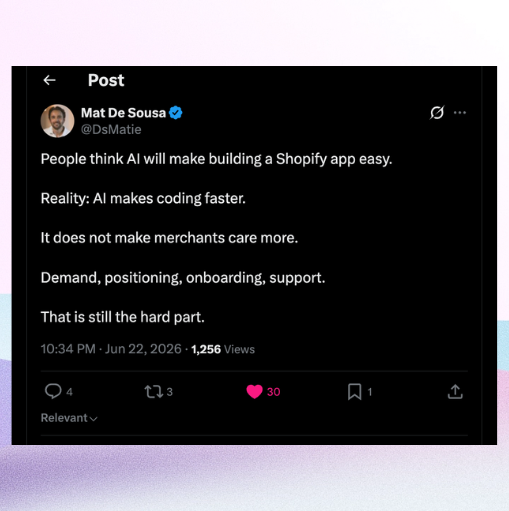
Source: https://x.com/DsMatie/status/2069104126668243230 

Big names in the Shopify ecosystem are saying it out loud now: AI can make coding faster, but it doesn’t make building a Shopify app easier.

Merchants still need clear positioning, real onboarding, strong support, and a product that solves an actual problem.

That’s exactly why Prediko isn’t just another AI layer. It’s built around the messy, operational work Shopify brands actually deal with every day.

The Three Things Vibe Coding (Claude) Gets Right for Inventory

For ecommerce operators, vibe coding opened a door as you no longer need a developer to connect to your Shopify API, calculate days-of-cover per SKU, or build a reorder alert system. 

To be fair, vibe coding does solve real problems for Shopify brands.

1. It eliminates spreadsheet dependency

The most common inventory management setup for under $5M Shopify brands is still a combination of Shopify's built-in reports and an ever-growing Google Sheet. 

Vibe coding replaces that with a proper automated system that reads live data and surfaces actionable alerts.

2. It compresses time to tool

What once required a developer, a Shopify API integration, and three weeks of back-and-forth now takes an afternoon. 

Gartner predicts 60% of all new code will be AI-generated by the end of 2026, and the speed gains are real.

3. It handles structured, repeatable logic well

Calculating reorder points, tracking days of cover, flagging when stock drops below a threshold, all of these are straightforward tasks. You give AI the formula and it applies it reliably across your SKU catalogue. That part works.

Here’s the catch. Demand forecasting isn't a formula problem. It's a pattern recognition problem. And pattern recognition requires data that vibe coding, by definition, doesn't have access to.

Prediko's Pia vs Claude: Compare Why Brands Should Choose Prediko

This isn't a takedown of Claude. It's a clarification of what each tool is actually built for.

Feature Claude (vibe-coded) Prediko
Understands supply chain fragmentation No; sees Shopify data only Yes, built for multi-system, multi-channel inventory environments
Data source Your store only Your store + patterns from thousands of Shopify brands
Handles bundles and component SKUs Only if explicitly built Native
Sees inbound POs in forecasts Only if you pipe the data Yes, POs are part of the planning model
Accounts for 3PL batch lag No Yes
Corrects for stockout-distorted sales history No, unless explicitly built Yes, out-of-stock periods are accounted for in the forecast
System of record None; resets each session Yes, all forecasts, POs, and supplier data are stored and accessible
Purchase order generation Possible if you build the integration and maintain it Native one-click generation and supplier send, maintained by Prediko
Improves over time No; static logic Yes, the model learns from every cycle
Maintenance required Yes, you build, fix, and upgrade No; Prediko ships improvements continuously
Cross-brand pattern data No Yes, trained on thousands of DTC brands

That's the distinction. Claude is a generalist that can narrate inventory. Prediko is a specialist built to run it. 

What Good Inventory Forecasting Actually Requires

Let's be specific. Here's what separates Claude-based forecasting from a forecasting system that actually protects your margins.

1. A forecast that reconciles to both your revenue target and SKUs

A forecast on its own is a prediction. A plan is a decision and the two aren't the same thing. A SKU-level forecast tells you the granular truth of what's likely to sell. 

But finance is holding you to a revenue and margin number for the season, and if those two views live in separate spreadsheets, they drift apart fast. 

A good demand planning system connects both in one model, so every change to the SKU forecast immediately updates the wider revenue plan.

2. Cross-brand pattern data

Your own historical data is a starting point, not a training set. 

Accurate demand forecasting draws on patterns across thousands of similar brands to account for category seasonality, demand volatility benchmarks, and supplier behaviour norms that your data alone can't surface.

3. A persistent system of record

Every forecast, every PO, every supplier note, every actual vs. predicted difference should be stored and feed into the next planning cycle. 

If your forecasting system doesn’t learn from past decisions and outcomes, it doesn’t improve over time. It just keeps making the same level of guesses.

4. Closed-loop action capability

The forecast should connect directly to the replenishment action: a purchase order generated, sent, and tracked. It shouldn’t just be a recommendation that someone has to manually act on.

5. Continuous model improvement

AI forecasting reduces forecast errors by 20-50% compared to traditional methods. 

But that improvement requires a model that learns from new data and improves over time not a static prompt that runs the same calculation regardless of what's changed in your market.

6. Ops that scale without rebuilding

A 4-person brand and a 40-person brand have fundamentally different planning needs. The tool that works today needs to grow with you not require a rebuild every time your operational complexity increases.

Where Claude Genuinely Helps and How It Plugs Into Prediko

Here's the part most vendor comparisons skip, and it's worth saying plainly: we're not anti-Claude. Claude is a genuinely excellent tool for language. The mistake isn't using it, it's asking it to be the forecasting engine instead of the interface on top of one.

Prediko is now available in Claude. That means you can connect Pia directly into Claude and ask questions about your actual Prediko data: forecasts, POs, supplier status, in plain language, from inside Claude or ChatGPT.

So you don't have to choose between the conversational interface you like and a forecasting engine that actually works. You get both: the interface powered by real inventory intelligence, not a spreadsheet you had to upload by hand.

Claude, on top of Prediko, is genuinely good at:

  • Drafting supplier emails and PO communications - Claude is great at this.
  • Explaining inventory reports to non-technical stakeholders.
  • Ad hoc data analysis - asking "why did my sell-through drop in March?" on top of a Prediko export.
  • Forecasting narratives - turning Prediko's numbers into a board update or a quarterly review.
  • Custom integrations - brands have used the Prediko API plus the Claude MCP to build their own PO automation workflows on top of Prediko's data, rather than instead of it.

The pattern that works: Prediko runs the inventory logic. Claude handles the language, the communication, and the custom workflows on top.

How Does Prediko (and Pia) Stack Up Against Claude For Forecasting

Prediko is built specifically for Shopify DTC brands that have outgrown spreadsheets and do not want to maintain custom Claude dashboards that break every time an API changes, a spreadsheet gets missed, or someone forgets to update the data.

Here’s where Claude stops making sense and Prediko takes over.

  • AI demand forecasting that predicts sales at the SKU level up to 12 months out, factoring in seasonality, promotions, bundle demand, supplier lead times, and inbound stock. Trained on cross-brand data from 25 million SKUs across 15+ categories, not just your historical sales.
  • Real-time multi-location stock visibility unified view across all warehouses, 3PLs, and Shopify locations that updates in real-time. Available-to-sell calculations are done automatically, accounting for what's actually available, not just what Shopify shows.
  • A persistent system of record for every demand plan, PO, supplier note, and forecast variance is stored and accessible. Your inventory knowledge lives in the platform, not in someone's head or a session that resets.
  • Chat-based planning interface (Pia): Prediko's AI agent executes commands: refreshing demand plans, generating POs, flagging at-risk SKUs, surfacing insights. The difference from a general-purpose AI: Pia is trained on inventory-specific data and operates within a closed-loop system where actions have real consequences.

The result is less time maintaining a custom AI setup, more time making better inventory decisions. Prediko keeps the data connected, the planning history intact, and the next action clear.

Questions to Ask Before You Trust Any AI Tool With Your Inventory

Not just Prediko, any tool, including ones you build yourself.

These are the questions that separate a real forecasting engine from a chat window with a retail prompt:

  1. Does it correct for stockouts in your sales history? If it reads raw sales as demand, it will under-buy your winners without you ever seeing why.
  2. How does it handle a brand-new SKU with no sales history? "It needs a year of data first" is a real limitation to know about before launch season.
  3. Is there a persistent system of record? Or does every planning cycle start from a blank chat window and a spreadsheet you have to rebuild?
  4. Does the forecast connect to an action? A number in a CSV isn't a purchase order. Ask whether it actually generates and tracks the PO, or just hands you a recommendation to act on manually.
  5. Who maintains it as you grow? A script that works at 20 SKUs and 1 warehouse needs to be rebuilt by someone at 200 SKUs and 3 warehouses. Ask who that someone is.

Honest Take on Vibe Coding for Inventory

Vibe coding isn't wrong for inventory. It's a powerful starting point and for a brand early in its journey, a Claude-powered alert system is meaningfully better than a spreadsheet.

The mistake is confusing the prototype for the system.

At some point, your operations grow past what a custom-built script can handle reliably. Your team stops having the bandwidth to maintain it. The edge cases multiply. The forecasting errors get more expensive. 

And you realise that what you built is a mirror of your own historical patterns useful, but blind to everything outside your own data.

That's the ceiling. Prediko is what comes after it. Start a free 14-day trial with Prediko and see the difference.

Frequently Asked Questions

What is vibe coding and why are ecommerce brands using it for inventory?

Vibe coding is when you describe what you want in plain English and AI generates the code. Ecommerce brands use it to build quick inventory dashboards, reorder alerts, and forecast scripts without a developer. 

Can Claude do inventory forecasting for Shopify brands?

Claude can help analyze Shopify data, calculate days of cover, flag reorder points, and draft PO summaries. What it cannot do on its own is use cross-brand demand patterns, maintain a lasting system of record, send POs, or improve forecasting accuracy over time.

What’s the difference between Prediko and Claude-powered inventory forecasting?

Claude works from the data you give it. Prediko is built for Shopify inventory planning, with forecasting models trained across thousands of brands, plus persistent planning history, PO creation, supplier context, and replenishment workflows built in.

Can I use Claude and Prediko together?

Yes. Prediko's account data is available as a Claude MCP server, so you can ask Claude questions about your live Prediko data: forecasts, POs, supplier status, directly, without leaving Claude or ChatGPT.

What is a system of record in inventory planning and why does it matter?

A system of record is one place where forecasts, POs, supplier lead times, inbound stock, and forecast accuracy live. It matters because every planning cycle builds on the last instead of resetting across chats, spreadsheets, or exports.

When should a Shopify brand move from DIY AI tools to a purpose-built forecasting solution?

Move when planning takes too much time, stockouts or overstock keep slipping through, or your team spends more time fixing the tool than using it. That’s usually when a purpose-built system like Prediko starts making sense.

Is vibe coding secure enough for live ecommerce operations?

It can be fine for internal tools that read data, but anything that writes to your live Shopify store needs proper review and guardrails. AI-generated code can introduce bugs or security issues, so it should not run critical operations unchecked.

5 min
Sep 2, 2026

We Narrowed 1000 to 10 Best Shopify Inventory Management Apps

Shopify App Store has 1000+ inventory management apps. See which one makes it to No.1 of our best apps list.

Read Blog

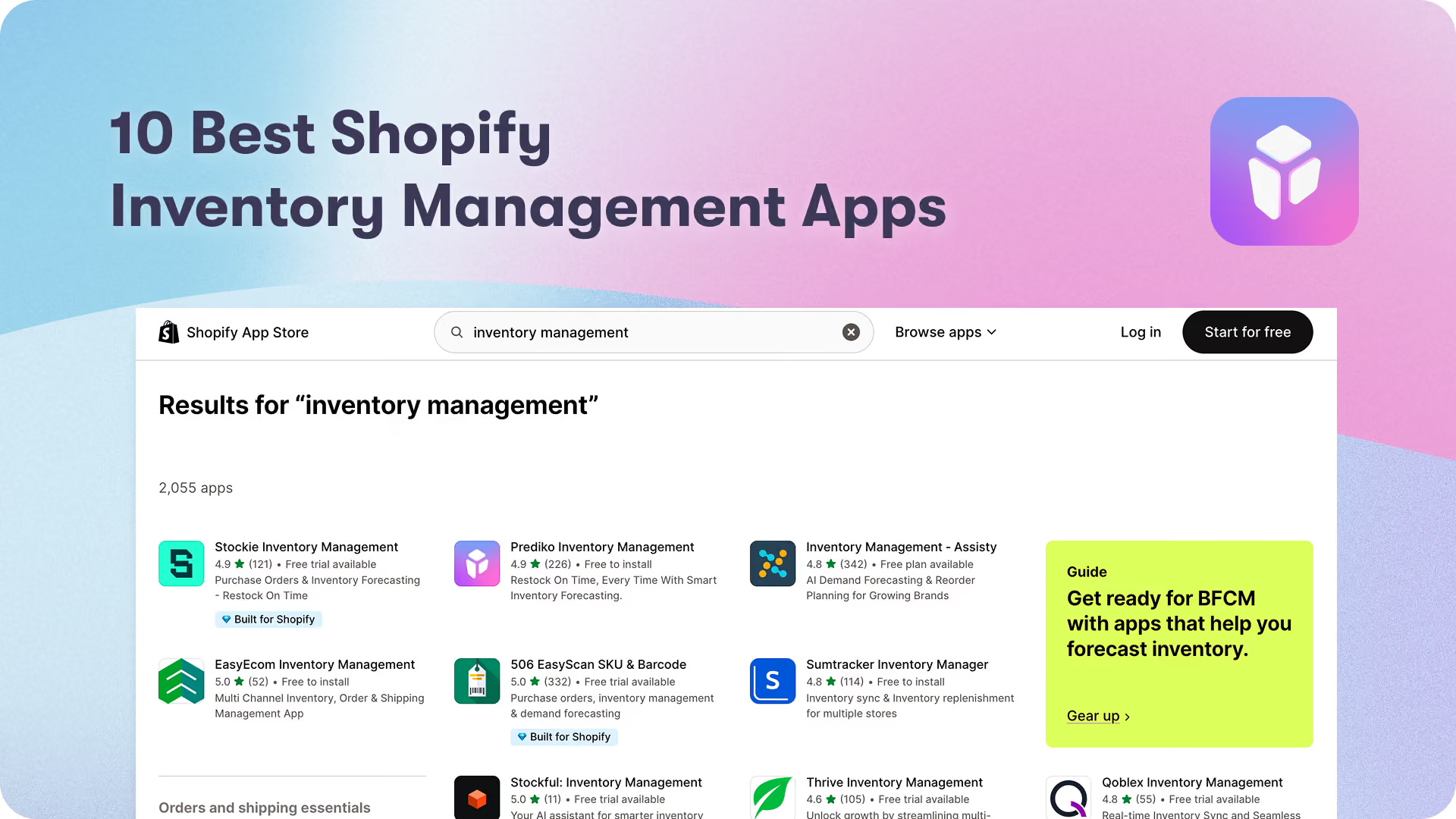
A simple search on Shopify App store for “inventory management” gives a result of 1000+ apps. We have narrowed down those 1000 apps to the ones that have the best combination of features, pricing, support & onboarding.

All the inventory management apps listed in this blog have most of these features and are very good in their capabilities. However we have kept ourselves at the top of this list because we believe that we have created an app that truly caters to all inventory management and operational needs of a modern Shopify D2C brand.

Our goal at Prediko is to help brands stay on top of stock levels, improve cash flow and to restock on time, every time.

Comparison of Best Shopify Inventory Management Apps

Software Main Features Pricing Best For
Prediko
  • AI-driven demand planning
  • Smart inventory planning with alerts
  • Streamlined PO management
  • Detailed inventory reports
  • Tracks raw materials
14-day Free Trial Brands of all sizes
Stock Sync
  • App is compatible with CSV, XML, Google Sheets
  • Ensures stock accuracy
  • Supports transfer of products to your Shopify store
Starts at $7/month Small brands looking to solve sync issues
Cogsy
  • Demand planning for existing and new products
  • Replenishment alerts and purchase orders workflows
  • Real-time reports for all warehousing locations
Starts at $199/month Multichannel Brands
Katana Manufacturing ERP
  • Keep track of inventory
  • Create a visual production plan
  • Import incoming orders from Shopify automatically
Starts at $399/month Manufactures that need production planning
Inventory Planner
  • Forecasting and analysis
  • Sync with Sales
  • Make Purchase Orders
Starts at $119/month Enterprise Brands
SKULabs
  • Consistency in stockroom inventory
  • Complete counting of orders
  • Streamline shipping process
Starts at $299/month Small and medium sized brands
Fabrikator
  • Make inventory predictions
  • Work with out-of-stock products
  • Tailored insights & reports
Pricing starts from $199/month D2C brands of different revenue size
Oracle NetSuite ERP
  • Demand-based stock planning
  • Company-wide inventory visibility
  • Reduced COGS
  • Surplus stock prevention
  • Efficient stock allocation
Contact Oracle NetSuite for a quote
Fabrikator
  • Make inventory predictions
  • Work with out-of-stock products
  • Tailored insights & reports
Pricing starts from $199/month D2C brands of different revenue size
NetStock
  • Demand forecasting
  • Stock-out prevention
  • Order placement automation
  • Reduces excess inventory
Contact Netstock for pricing Best for Enterprise Brands
Linnworks Inventory Management
  • Multi-channel software
  • Consolidate entire inventory operation into one central hub
  • Integrated warehouse management system
Free to install Medium sized to Enterprise brands
Cin7 Core
  • Comprehensive and complete picture of production expenses
  • Use real-time updates to streamline inventory
  • Manage sales of many channels
Starts from $349/month Small to medium sized brands.

No. 1 👉 Prediko's AI Inventory Management App

Overall: Best overall for Shopify brands. AI-driven demand forecasting, advanced inventory reporting, and deep Shopify integration.

4.9 ⭐ (200+ Reviews on Shopify Store)

Key Features

What makes Prediko better than rest of the inventory management apps in the Shopify ecosystem👇

  1. AI-driven sales forecasting for precise demand planning at SKU, category, and company levels
  2. Smart inventory planning with automated out-of-stock alerts and buying recommendations
  3. Streamlined purchase order management for easy creation, tracking, and bulk editing
  4. 20+ customizable inventory reports with over 100+ customizable filters (CSV or PDF)
  5. Integrated bill of materials (BOM) and raw material components for finished products.
  6. Multi-supplier support to assign multiple suppliers to the same SKU, each with its own lead time, pricing, and MOQ

Prediko also has a big advantage over other inventory management apps. We are able to accurately forecast demand for Shopify brands running subscriptions.

Learn about these leading eCommerce brands that have operationalised their Shopify inventory with Prediko

Pricing

Plans starting at just $49/Month

Best For

For brands of all sizes especially fashion & apparel, beauty, retail & manufacturing and CPG.

A quick demo of Prediko 👇


Guide: Learn everything about Shopify Inventory Management

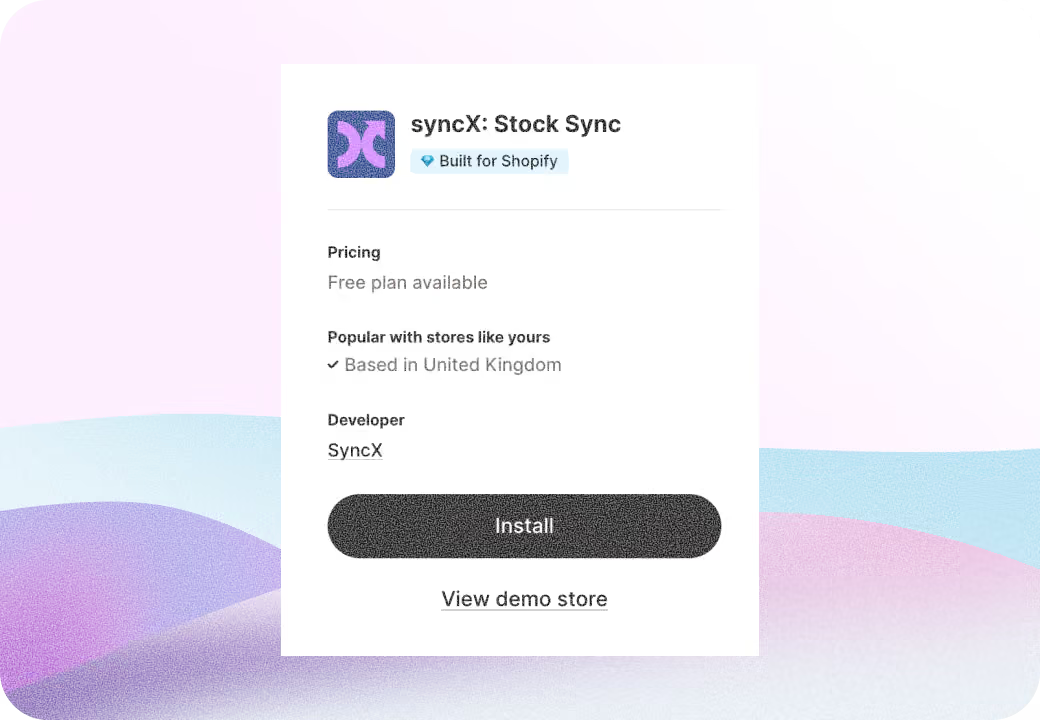
2. Stock Sync: Inventory Sync

Overall: Ideal for syncing inventory across multiple sources and formats (CSV, XML, Google Sheets), with automation and ease of use. Stock Sync is an app that can be used for handling inventory from multiple sources.

Key Features & Pros

  1. This app enables updation of product information and inventory quantities. It also supports transfer of products to your Shopify store. 
  2. Ensures stock accuracy from all inventory sources
  3. App is compatible with CSV, XML, Google Sheets, and API, making the import and export of inventory data a straightforward process.

Pricing

Starts from $7/month. Free plan available on App store.

Best For

Small brands that are looking to fix sync issues.

3. Cogsy

Overall: Designed to streamline operations, prevent stockouts, and optimize stock levels.

Key Features & Pros

  1. Real-time reports for all warehousing locations
  2. Replenishment alerts and purchase orders workflows
  3. Demand planning for existing and new products

Pricing

Starting from $199/month. Free plan available on App store.

Best For

Multichannel Brands

4. Katana Manufacturing ERP

Overall: Designed for makers and manufacturers needing production planning and Shopify order syncing with warehouse control.

Oversee & track your Shopify inventory and orders with Katana ERP.

Key Features & Pros

  1. Import incoming orders from Shopify automatically and maintain synchronisation of fulfilment status and inventory.
  2. Create a visual production plan. Stay informed about the status of each order in your production timeline.
  3. Keep track of your inventory and also update inventory with easy sync.

Pricing

Pricing starts from $399/month. Free plan available

Best For

Manufactures that need production planning

We have also compiled a list of the best raw materials management apps that you can find on Shopify app store

5. Inventory Planner

Overall: Excellent for forecasting and smart replenishment using sales history, lead times, and vendor data. Inventory Planner is a Shopify forecasting app for eCommerce and multichannel retailers.

Key Features & Pros

  1. Forecasting and analysis helps merchants to make restocking decisions.
  2. Sync with Sales: After installation, Inventory Planner syncs with sales history. It uses this data, along with additional information like vendor lead time, to generate forecast.
  3. Make Purchase Orders and save a lot of time on buying. Share merchant essentials, case sizes, and other provider explicit information.

If you are looking beyond these then there are plenty of great Inventory Planner alternatives.

Pricing

Pricing starts from $119.99/month

Best For

Enterprise Brands

We have also compiled a list of the top purchase order management apps that you can find in the Shopify app ecosystem.

6. SKULabs

Overall: Best for simple inventory environments with barcode-based fulfillment and shipping rate comparisons across carriers.

SKULabs is a Shopify app for managing inventory, warehouse, and orders across multiple channels.

Key Features & Pros

  1. Ensure consistency in stockroom inventory and maintain it across all sales channels.
  2. Ensure complete counting of orders by scanning barcodes to check and select stock.
  3. Streamline shipping process and costs by comparing rates from different carriers.

Pricing

Pricing starts from $299/month

Best For

Small and medium sized brands

7. Fabrikator Inventory Assistant

Overall: Optimized for predictive insights and pre-order/backorder management with tailored inventory analytics.

Fabrikator helps you to attain predictions, streamline procurement orders, and manage backorders.

Key Features & Pros

  1. Make inventory predictions to empower you to make more informed choices.
  2. Work with out-of-stock products & pre-orders and backorders
  3. Tailored insights & reports to analyze data and make informed choices.

We have also done an in-depth comparison of Inventory Planner vs Fabrikator

Pricing

Free plan available.

Best For

Most type of D2C brands.

8. Netsuite Inventory Management

Overall: Best for enterprise-level sellers needing multi-location tracking, demand planning, and marketplace integrations.

NetSuite Inventory Management provides access & analysis of inventory across locations and sales channels of a brand.

Key Features & Pros

  1. Netsuite integrates with eBay and Etsy.
  2. Get inventory visibility across warehouses, 3PLs, drop shippers
  3. Make demand-based plans using historical demand, sales forecasts and seasonality

Orcale Netsuite ERP also appears in the list of the top 10 Fashion inventory software for apparel brands.

Using NetSuite with Shopify? See how Shopify NetSuite integration works and what to consider before connecting the two platforms.

Pricing

Pricing starts from $199/month

Best For

Enterprise Brands

9. Linnworks Inventory Management

Overall: Ideal for centralizing inventory across all sales channels with built-in warehouse management features.

Gain visibility over online sales, as Linnworks unifies the whole process across multiple channels.

Key Features & Pros

  1. Multi-channel software helps retailers streamline entire online selling
  2. Consolidate entire inventory operation into one central hub
  3. Get an integrated warehouse management system

Pricing

Free to install.

Best For

Medium sized to Enterprise brands

10. Cin7 Core

Overall: All-in-one inventory and manufacturing management system with real-time updates for growing Shopify operations.

Cin7 Core gives all brands features to manage manufacturing, inventory management, and automation.

Key Features & Pros

  1. Comprehensive and complete picture of production expenses and stock levels
  2. Use real-time updates to streamline inventory
  3. Manage sales of many channels through a single platform

We have also covered the list of all Cin7 alternatives.

Get an in-depth comparison of Cin7 vs Inventory Planner

Pricing

Starts from $349/month

Best For

Small to medium sized brands.

For Shopify brands that have multiple stores, we have also compiled a list of the best apps and software for multi-store inventory management.

We understand that selecting the right Shopify inventory management tool for managing operations is a big ask.

At Prediko, we offer a full featured 14-day trial and guided onboarding to help you understand why we tackle most of the inventory management challenges that modern D2C brands face.

How to Choose the Right Inventory Management App for Your Store?

To determine which Shopify inventory app is worth the investment, use this “SMART” criteria

  1. S - Specific needs: Identify exact blockers you are facing and align features.
  2. M - Multi-channel integration: Opt for software that integrates with Shopify, marketplaces, accounting tools, and shipping platforms
  3. A - Automation: Look for tools that automate repetitive tasks like replenishment, purchase order creation, forecasting, or inventory counting.
  4. R - Reporting & analytics: Prioritize platforms that offer reports and insights beyond what Shopify offers
  5. T - Training & support: Choose software that is backed by excellent customer support and onboarding assistance.

Frequently Asked Questions

1. What is the best inventory management app for Shopify?

The best inventory management app for Shopify is Prediko for most modern D2C brands, thanks to its AI-driven demand forecasting, automated replenishment, and deep Shopify integration. It helps brands avoid stockouts, improve cash flow, and scale operations efficiently.

Top alternatives by use case:

  • Katana – best for manufacturing & production planning
  • Stock Sync – best for syncing inventory across multiple sources
  • Inventory Planner – strong for forecasting using historical data
  • NetSuite / Cin7 – best for enterprise, multi-location operations

Bottom line:

If your priority is accurate forecasting + smarter purchasing decisions, Prediko is the strongest all-around choice.

2. Does Shopify have an inventory management tool?

Yes! Shopify provides basic inventory tracking. But if you're looking for AI-powered forecasting, BOM, or advanced inventory control, apps like Prediko offer more robust features.

3. How do you manage inventory in Shopify?

Shopify allows you to update stock quantities manually. To automate forecasting, purchase orders, and avoid stockouts, Prediko integrates seamlessly with Shopify.

4. What is the best app for keeping inventory?

Prediko is one of the top-rated inventory apps for Shopify brands. It offers accurate demand forecasts, PO automation, and inventory analytics in one dashboard.

5. How much does Shopify inventory management cost?

Pricing ranges from free to $300+/month. Prediko offers revenue-based pricing, so smaller brands can get started without large upfront costs.

6. Are there any AI-driven inventory management apps for Shopify that can help with demand forecasting?

Yes. Prediko is an AI-powered app trained on 25,000+ SKUs across industries. It forecasts based on trends, marketing campaigns, and historical data, helping avoid overstock or stockouts.

7. Which Shopify inventory management apps have recently shut down or changed direction?

Several inventory management apps in the Shopify ecosystem have recently shut down or changed their product direction:

  • Settle: Settle remains active, but its Shopify offering has shifted toward procurement, vendor payments, landed costs and working capital rather than dedicated demand forecasting and inventory planning.
  • Genie: Genie joined Doss and officially sunset its inventory management platform on August 31, 2025.
  • Stocky: Shopify delisted Stocky from the Shopify App Store on February 2, 2026 and discontinued the app on August 31, 2026. Existing users have limited read-only access to export their data.

Brands affected by these updates should export their historical inventory data and move to an active Shopify inventory management app. Prediko provides demand forecasting, replenishment recommendations, purchase orders, inventory transfers and migration support in one app.

5 min
Sep 2, 2026

How to Do Amazon Shopify Inventory Sync: Step-by-Step Guide

Looking for an easy way to manage Amazon Shopify Inventory sync? Follow this step-by-step guide to keep stock updated in real-time across both platforms.

Read Blog

A customer finds your product on Amazon, adds to their cart, and checks out. 

At the same time, another shopper buys the exact same item from your Shopify store. But only one unit was left in stock.

Now you’re forced to cancel the order, issue a refund, and risk a negative review that damages your seller rating. All because your systems weren’t in sync.

If you, like many other multichannel sellers, are tired of dealing with stock mismatches, canceled orders, and unhappy customers, this is for you.

We break down why you need Amazon Shopify inventory sync, the steps to set it up correctly, and the best practices that keep your operations running smoothly.

Why Amazon Shopify Inventory Sync Matters

Selling on both Amazon and Shopify opens up more opportunities, but it also makes stock management more complex. Here’s how: 

1. Overselling risk

Imagine you have three units of a trending product. A burst of Amazon sales wipes out your stock, but Shopify still shows it as available. 

Multiple customers place orders you can’t fulfill, and now you’re facing an avoidable mess.

When stock levels are not updated across platforms in real time, the same product can sell twice before it’s marked as unavailable. This can lead to:

  • Order cancellations that frustrate buyers and make them less likely to purchase from you again.
  • Refund processing that ties up time and resources, which could be spent fulfilling valid orders.
  • Negative reviews that damage your seller ratings and lower your visibility on both platforms.

To avoid this, you need an automated inventory sync so that both platforms update instantly after every sale. 

It ensures you only sell products that are actually in stock, protecting your reputation and keeping customers happy.

2. Customer dissatisfaction 

Unsynced inventory across channels can turn an eager buyer into a lost customer. They place an order expecting quick delivery, only to find out days later that the product is not available.

Research from PwC shows that 32% of customers stop doing business with a brand they love after just one such bad experience.

Real-time, centralized inventory visibility allows customers to only purchase what is available. This helps you deliver on expectations, maintain positive ratings, and encourage repeat business.

3. Operational delays

Inventory errors do not just cause lost sales. They slow down everything behind the scenes. 

Teams end up pausing fulfillment to sort through incorrect orders, verify stock, and contact customers about changes. Every extra step adds hours or even days to delivery timelines.

During busy periods like promotions or Black Friday, these delays can pile up quickly. 

A single stock mismatch can disrupt multiple orders and push shipping back for dozens of customers.

4. Efficiency gains from fewer manual updates

Every order that comes in on Shopify or Amazon needs an inventory adjustment. Without automation, that means logging into both platforms and updating stock by hand, over and over again. 

It’s slow, repetitive work, and even a single missed change can create a mismatch that leads to bigger problems later.

With real-time sync, stock updates happen automatically the moment a sale is made. Your team no longer spends hours chasing numbers, and you reduce the risk of human error entirely. 

The time saved can be used for marketing, launching new products, or improving customer service.

Methods for Amazon Shopify Inventory Sync: Official Integrations and Beyond

Shopify offers official integrations and apps that connect directly with Amazon, covering everything from product listings to fulfillment management. Here are the key ones.

1. Marketplace connect

Marketplace Connect links your Shopify catalog to Amazon, allowing you to manage listings and pricing from one place. It provides a two-way sync of inventory and orders.

When a sale happens on Amazon, the product count is updated in Shopify automatically, and orders placed on Amazon appear in your Shopify admin for processing.

2. Amazon MCF app

Next is Amazon Multi-Channel Fulfillment (MCF) that connects Shopify orders directly to Amazon’s logistics network. 

With this integration, your inventory is stored in Amazon’s fulfillment centers, and when an order is placed on Shopify, it is automatically sent to Amazon for picking, packing, and shipping.

3. CED Commerce

CED Commerce is an integration app that connects Shopify with Amazon while giving merchants more flexibility than Shopify’s native integrations.

Beyond syncing inventory and orders, it supports bulk product uploads, advanced pricing rules, and multi-account management. 

For brands selling on multiple Amazon marketplaces (like US, UK, or Canada), the app helps centralize operations inside Shopify, making it easier to stay in sync and scale globally.

📢 Coming soon: Prediko is rolling out native integrations that go beyond Shopify, direct connections to WMS platforms like ShipHero, with sales channels like Amazon and other marketplaces so you get one synced view of stock, sales, and product data, not just inventory counts.

Third‑Party Amazon Shopify Inventory Sync Tools

Syncing inventory across Amazon and Shopify requires more than just built-in integrations. 

Many merchants rely on third-party tools to handle complex workflows, such as managing large catalogs, syncing across multiple warehouses, or reconciling high order volumes during sales spikes. 

These apps go beyond the basics by offering features like

  • Real-time sync across multiple marketplaces and sales channels
  • Advanced channel-wise inventory forecasting to predict demand and prevent stockouts
  • Bulk listing and catalog management for larger product ranges
  • Multi-warehouse support to allocate inventory across different fulfillment centers
  • Granular analytics and reporting for smarter decision-making

See a complete breakdown of all the available Shopify sync apps.

How Prediko supports Amazon Shopify inventory sync

If you want a tool that not only syncs inventory but also helps you plan and manage stock across both platforms, Prediko should be your choice.

For now, to make Prediko work with Amazon and other marketplaces, you’ll first need to route those orders into Shopify using an app like CED Commerce.

CED Commerce centralizes your Amazon inventory and sales data in Shopify, allowing Prediko to capture the full picture. Once that’s in place, here’s how Prediko supports you.

  • Real-time multi-location inventory tracking: Prediko continuously monitors inventory across Shopify and Amazon, updating quantities automatically whenever a sale is made. Even if you store stock across multiple warehouses or fulfillment centers, Prediko keeps both platforms aligned so product availability is always accurate.
  • AI demand planning: Selling on both Amazon and Shopify can make forecasting demand tricky. Prediko analyzes your historical data, seasonality, and sales patterns across both platforms to predict how much stock you’ll need. 
  • AI supply planning: When Amazon and Shopify orders come in at the same time, Prediko creates smart buying plans that combine demand from both channels. It tells you what to order, when to order, and in what quantities, keeping your supply chain balanced.
  • Purchase order management: Prediko makes replenishment easier by automating purchase orders linked directly to your Amazon and Shopify demand. Create, update, and track POs automatically, including supplier lead times and delivery schedules. You can also assign multiple suppliers to the same SKU and split POs between them.
  • Analytics and reports: Prediko provides 20+ report templates designed for multichannel sellers. You can track Amazon and Shopify sales trends, monitor inventory turnover, and set low-stock alerts. This visibility helps you spot sync issues quickly and make decisions before they impact your customers.

Note: Prediko will soon launch native integration with channels like Amazon and TikTok Shop, as well as WMS platforms like ShipHero. This means you’ll be able to view, forecast, and report on inventory across all your channels in one place.

If TikTok is one of those channels, here’s how to sync Shopify products to TikTok Shop while keeping product data, variants, inventory, and orders aligned.

Step‑by‑Step Setup for Amazon Shopify Inventory Sync

To set up inventory sync, you’ll need to meet a few key requirements and follow the steps below to ensure the process runs smoothly and error-free

1. Set up your Amazon Pro Seller account

To sync inventory between Shopify and Amazon, you must have an Amazon Professional Seller account. The Individual Seller plan does not allow access to the necessary APIs that make real-time updates possible. 

If you already have an Individual account, log in to Amazon Seller Central and upgrade to the Professional plan. This requires a monthly subscription fee but gives you the technical permissions needed for integration.

Once your Professional account is active

  • See if your business information, bank details, and tax information are fully verified in Seller Central
  • Check that your products comply with Amazon’s listing requirements, including UPC/EAN/ISBN identifiers
  • Ensure you have access to the Marketplace Web Service (MWS) APIs or the newer Selling Partner API (SP-API), since these are what sync apps use to exchange data between Amazon and Shopify.

Completing this step makes your Amazon account eligible for integration so that inventory updates can flow through without disruptions.

2. Clean up product data in Shopify 

Before connecting Shopify to Amazon, your product data needs to be standardized. The sync relies on identifiers like SKUs, variants, and barcodes to match products between platforms.

If these are inconsistent, the integration will fail or create duplicate listings.

Key actions to take

  • Verify SKU naming: Every product and variant in Shopify must have a unique SKU. Use the same SKU in Amazon so the system can map inventory correctly. Even small differences (extra characters, dashes, or spaces) will break the sync.

    For example, if a SKU in Shopify is “TSHIRT-BLK-M” but on Amazon it is “TSHIRT-BLK-M-01,” the two will be treated as separate products.

  • Check variants: Make sure all size, color, or style variants are set up properly in Shopify. Each variant should have its own SKU and barcode.

  • Add valid barcodes: Assign UPC, EAN, or ISBN codes where required. Amazon uses these to validate listings, and many sync apps need them to connect products.

Cleaning up product data at this stage prevents mismatched inventory counts later. A short audit now saves hours of fixing errors after the sync is live.

3. Install and configure the sync app or integration

Once your product data is cleaned up, the next step is to set up the integration between Shopify and Amazon. Shopify’s official options are Marketplace Connect and the Amazon MCF app, but you can also use third-party apps like CED Commerce if they better fit your workflow.

To install

  1. Go to Shopify App Store and search for the app you want to use (e.g., “CED Commerce”, “Marketplace Connect”, or “Amazon MCF”)
  2. Click Add app and follow the prompts to install it in your Shopify admin
  3. Connect your Amazon Professional Seller account by logging in when prompted and granting the required API permissions

After installation, configure the app:

  • Map your SKUs so the system knows which Shopify products correspond to which Amazon listings
  • Set pricing and listing rules if you want Amazon prices to match or differ from Shopify
  • Enable order sync so sales on Amazon flow into Shopify for centralized fulfillment tracking

Proper configuration ensures the two platforms exchange accurate product, price, and order data without duplication or mismatches.

4. Enable inventory tracking and sync rules

Inventory tracking must be turned on in Shopify for every product you plan to sync. Without tracking turned on, Shopify cannot monitor stock levels or send updates when items are sold.

Next, configure sync rules inside your app. Decide how frequently inventory should be updated, whether prices will be synced, and how orders from Amazon should appear in Shopify. Setting these rules clearly avoids surprises later. 

5. Add buffer stock logic to reduce overselling

Even with real-time syncing, delays of a few minutes can cause overselling during peak traffic. To protect against this, set up a buffer stock.

This means reserving a small portion of inventory (e.g., 2–5 units) that will not be published to either channel. 

For example, if you have 50 units, you might only list 47 as available. Most integration apps include buffer stock settings you can enable.

This small safeguard gives you room to handle sync delays, cancellations, or last-minute adjustments without letting customers order products you can’t ship.

6. Test sync with manual changes and order simulations

Before going live, test your sync thoroughly. Start by adjusting stock levels in Shopify and confirm that the changes appear correctly in Amazon.

Then do the same in reverse. Next, place test orders from both platforms and verify that inventory updates accurately and orders flow into Shopify without errors. 

Check fulfillment workflows so that Amazon or your chosen method processes them correctly.

Testing helps catch SKU mismatches, sync delays, or incorrect rules before they affect real customers. A short testing phase builds confidence in the system once it’s live.

How to Avoid Shopify Amazon Inventory Sync Problems in 2026?

By now, you’ve learned how to set up Shopify Amazon inventory sync. Once the system is running, it’s important to follow a few best practices to prevent any disruptions. 

1. Always enable "Track quantity" for products

Inventory sync will not work if “Track quantity” is turned off in Shopify. Without it, stock levels cannot be monitored or updated automatically, which means sales on Amazon will not reduce counts in Shopify. 

Go into each product’s settings and confirm that “Track quantity” is selected for all synced products. It’s a small step, but forgetting it is one of the most common causes of sync failures. 

Making it part of your product setup routine ensures that every new listing is always connected to real-time inventory updates.

2. Maintain buffer stock and monitor sync logs

Even with automated syncing, there can be slight delays during high traffic periods. To protect against overselling, maintain a small buffer stock.

This means holding back a few units from being listed so you can handle last-minute orders or sync lags. 

Most apps allow you to set buffer stock rules. 

In addition, make a habit of checking sync logs in your app’s dashboard. Logs show when updates are pushed and flag any failed attempts.

Regular monitoring helps you catch problems before they reach customers, giving you time to fix errors without impacting orders.

3. Audit SKUs regularly for mismatches

SKU mismatches are one of the most common reasons inventory sync breaks down. A small difference, such as an added dash, space, or character, can cause Shopify and Amazon to treat two listings as separate products. 

To prevent this, schedule regular SKU audits. At least once a month, compare your product catalog in Shopify with your Amazon listings and look for discrepancies. 

Correcting these early avoids bigger issues like duplicate listings or untracked stock. A simple, ongoing SKU audit process keeps your data consistent, and your sync continues working as expected.

4. Check sync latency and accuracy periodically

Different apps push updates at different speeds, and performance can vary depending on sales volume. To avoid surprises, test your system regularly.

Make a small stock adjustment in Shopify and track how long it takes to appear in Amazon, and then do the reverse. 

Periodic checks confirm that your sync is not only working but also updating quickly enough to meet customer demand. 

If latency is too high, you may need to adjust your app’s settings or switch providers. Monitoring accuracy and speed gives you confidence that your inventory is always aligned.

Read More: Best Amazon Inventory Forecasting Tools for Amazon Sellers

Start Multichannel Selling with Amazon Shopify Inventory Sync

Keeping your Shopify and Amazon inventory in sync is crucial for preventing overselling, reducing customer frustration, and eliminating manual fixes. This way, you can maintain accurate stock counts, faster fulfillment, and smoother operations.

This guide walks through everything you need to know about Amazon Shopify Inventory Sync, from account setup and product data cleanup to installing integrations, enabling sync rules, and testing your system.

With the right process and tools in place, inventory sync becomes the backbone of multichannel growth.

Prediko helps Shopify brands gain complete control and visibility over multi-channel inventory, so you spend less time troubleshooting and more time scaling your business.

Start your 14-day free trial and see how Prediko can help you with multi-channel inventory management.

Frequently Asked Questions (FAQs)

1. How can I sync my Shopify inventory with Amazon in real-time?

You can use Prediko, CED Commerce, Shopify’s Marketplace Connect, or Amazon MCF to update stock automatically across both platforms.

2. What are the best tools or apps for Amazon and Shopify inventory synchronization?

Prediko is built for Shopify sellers who want unified control over their inventory. Other options include CED Commerce, Marketplace Connect, Amazon MCF, and other third-party apps.

3. How does syncing inventory between Shopify and Amazon prevent stockouts or overselling?

Real-time sync updates inventory the moment an order is placed, ensuring items are instantly marked as unavailable on other channels so customers never purchase products that are already sold out.

4. Is it possible to automate inventory updates between Shopify and Amazon?

Yes. Prediko and other integrations automatically push inventory updates between Shopify and Amazon, removing the need for manual adjustments.

5. What are the steps to set up inventory sync between Shopify and Amazon?

Set up an Amazon Pro Seller account, clean up SKUs and barcodes in Shopify, install a sync app like Prediko, enable tracking, add buffer stock, and test.

5 min
Sep 2, 2026

Best Inventory Allocation Strategies for eCommerce Businesses

Struggling with stock imbalances on Shopify? Poor inventory allocation could be the reason. Learn how to fix it with proven methods and the right tools.

Read Blog

“Sorry, this item is out of stock in your area.”

Meanwhile, another warehouse is overflowing with the same product.

This isn’t just an inconvenience; it’s poor inventory allocation. And it leads to lost sales, stock lying in the wrong locations, and disappointed customers.

For Shopify brands, the challenge only grows with multiple sales channels and fast-moving demand.

We break down how inventory allocation works, the key concepts behind it, and how to do it effectively using the right tools.

Understanding Inventory Allocation

Inventory allocation is the process of strategically distributing available stock across different locations, sales channels, or customer orders to meet demand efficiently. 

The goal is to make sure the right products are in the right place at the right time to meet demand without excess or shortages.

The process gives you a clear framework for managing inventory across regions and channels, so that your supply chain can easily respond to fluctuating demand and shifting customer behaviors.

Benefits of Effective Inventory Allocation for Shopify Stores

Inventory allocation optimization can make a big difference in the operations of Shopify businesses. Here’s a closer look at the key benefits.

1. Optimized inventory levels

What happens when one warehouse is overflowing while another runs dry? You lose sales in one location and increase carrying costs in another.

Effective inventory allocation solves this by distributing stock based on real demand across regions and sales channels. 

It ensures products are available where they're needed most, so you can fulfill orders faster, avoid costly overstock, and prevent stockouts before they happen.

2. Improved cash flow

When too much cash gets used up in slow-moving stock and unwanted expenses, you are not left with enough to spend on marketing, new product launches, or scaling your Shopify store. 

Effective inventory allocation ensures your products are placed where they’re most likely to sell, freeing up cash and reducing waste. 

It helps you avoid unnecessary costs like warehousing, insurance, and discounting unsold items, while also minimizing expenses tied to emergency restocking, expedited shipping, and missed sales from out-of-stock SKUs.

For Shopify sellers, this financial flexibility is critical for staying agile in a competitive market.

3. Enhanced customer satisfaction

Imagine a shopper placing an order only to see “out of stock” at checkout or face long delivery delays.

That’s the kind of experience that drives customers away. In fact, 40% consumers in a 2023 KPMG survey expressed concerns about stockouts when shopping online. 

Effective allocation makes sure popular products are available where and when they’re needed. This leads to faster fulfillment, fewer backorders, and accurate stock visibility across channels that helps build trust and increase repeat purchases.

Important Concepts in Inventory Allocation

Successful inventory allocation relies on a few key concepts. Here are some of the important ones to consider

1. Demand forecasting

Demand forecasting is the process of predicting how much of each SKU customers will buy over a specific period. For inventory allocation, it provides the baseline numbers that guide where and when to send stock.

Without accurate forecasts, you run the risk of two major issues: stockouts in high-demand areas and overstock in low-performing ones; both symptoms of poor allocation.

In ecommerce, forecasting also impacts inventory cost allocation. Inaccurate predictions can lead to higher storage costs, unnecessary markdowns, and expensive rush shipping as you scramble to move stock to meet unexpected demand.

If you're struggling to predict where and when to stock, our demand planning guide is a great place to start.

2. Safety stock 

Safety stock is the buffer inventory you maintain to protect against demand spikes and supplier delays. It plays a key role in inventory allocation by ensuring high-demand locations stay stocked, even when forecasts aren’t perfect.

To set the right safety stock levels, businesses factor in demand variability and supplier lead times. This helps allocate inventory where it's truly needed, without overcommitting to slower-moving locations.

Common strategies include

  • Calculating buffer stock based on average demand during lead time
  • Adjusting safety stock for high-priority locations or sales channels
  • Balancing availability with carrying costs to avoid overstocking

To accurately calculate safety stock for your Shopify stores, check out this article

3. Lead time considerations

Lead time is the time between placing a purchase order and receiving the stock. It directly affects how inventory is allocated because longer or inconsistent lead times make it harder to keep stock where it’s needed.

To avoid stockouts, businesses often adjust allocation strategies by

  • Holding extra stock in high-demand regions with longer lead times
  • Prioritizing faster-moving SKUs for warehouses closer to key markets
  • Factoring in supplier lead time variability when planning replenishment

Understanding and planning for lead times help ensure stock reaches the right locations at the right time.

Key Inventory Allocation Methods

There are different ways to allocate inventory across locations and channels. Each approach has its own strengths and is suited for specific business needs.

Let’s quickly look at some of the common inventory allocation methods 

1. Rule-based allocation

This allocation method uses predefined rules to decide how stock is distributed. These rules can be based on factors like sales volume, location priority, or customer type.

Here’s a rule-based inventory allocation example.

So, you might set a rule to send 50% of the inventory to your top-performing warehouse and divide the rest evenly across the others. Or you could prioritize high-value customers during limited stock situations.

It works well for businesses that have predictable patterns and want control over how inventory flows without relying on complex systems.

This approach is most effective when

  • Demand is relatively stable across locations
  • You need a simple and transparent system for allocation
  • Business priorities are clear and don’t shift frequently

The method is easy to set up, but it may struggle when demand becomes highly dynamic or unpredictable.

2. Demand-based inventory allocation

Demand-based allocation distributes inventory according to historical or forecasted demand at each location. Locations with higher expected sales get a larger share of stock.

This method uses sales data and demand forecasts to guide allocation decisions. It ensures high-performing stores or channels stay stocked while slower locations receive only what they can sell.

It’s a good fit when:

  • You have reliable sales data or accurate demand forecasts
  • Demand varies significantly between locations
  • Avoiding stockouts in high-demand areas is a priority

The downside is that it depends heavily on forecast accuracy. Errors in projections can lead to overstocking or shortages. 

Want to learn how to achieve accuracy in your demand forecasts? Here’s a complete guide. 

If you use demand-based allocation technique, Prediko is a perfect fit. It automates stock distribution based on real-time demand and sales data.

3. Location-based allocation

Location-based allocation assigns inventory based on geographic or logistical factors. It might prioritize warehouses closer to key markets or allocate more stock to locations with higher foot traffic.

This approach is especially valuable for Shopify stores with multiple fulfillment locations, as it keeps inventory closer to customers, enabling faster, more efficient fulfillment.

Best suited for situations where

  • Proximity to customers impacts delivery times and costs
  • Certain regions consistently show stronger sales
  • You’re optimizing for logistics and fulfillment speed

While straightforward, it can miss sudden changes in demand across different regions. 

4. First-come-first-served (FCFS)

FCFS allocation fulfills orders in the order they’re received, regardless of region, priority, or channel. It’s straightforward and works well when inventory is limited and needs to be distributed fairly.

This approach is straightforward and works in scenarios with limited stock or emergency restocks. However, it can disadvantage high-priority customers, key retail partners, or fast-moving sales channels

It works best when

  • Stock levels are tight, and immediate distribution is needed
  • Demand is unpredictable and fairness is a priority
  • There’s no clear historical data to guide allocation

FCFS is fast to implement but offers little strategic control over inventory flow.

5. Priority inventory allocation

Priority allocation assigns stock based on predefined tiers or rankings. High-priority customers, sales channels, or locations get inventory first, with remaining stock distributed to others.

This method is often used during product launches or when supply is limited. For example, premium customers may get early access to popular products while other customers wait for restocks.

It’s ideal when

  • Certain customers or channels generate higher revenue
  • Supply constraints require careful stock distribution
  • You want to strengthen relationships with top-tier buyers

The challenge lies in setting fair and transparent priorities to avoid alienating lower-tier customers.

Effective Inventory Allocation Strategies You Must Implement

Now, we’ll walk you through some tried-and-tested inventory allocation strategies, how they work, and when to use each one.

1. Choose centralized over decentralized inventory systems

Shopify brands managing multiple SKUs, fulfillment locations, or channels need clear, real-time visibility to allocate inventory effectively. 

One of the smartest moves for growing Shopify brands is to centralize your inventory management through a single platform, rather than juggling data across disconnected systems, spreadsheets, or apps.

With a centralized inventory system (like Prediko), you can see all your stock, sales, and orders across every channel, warehouse, and location in one unified dashboard.

That means smarter, faster decisions about where inventory should go and how much to allocate.

If you're managing inventory through separate tools for each warehouse, store, or sales channel, you're more likely to face data silos, overstock in some areas, stockouts in others, and wasted time reconciling fragmented data.

2. Use real-time inventory tracking

Real-time inventory tracking gives you instant visibility into stock levels across all locations and sales channels. For Shopify stores, this is critical for preventing stockouts, allocating inventory accurately, and maintaining smooth fulfillment.

When inventory data is delayed or inaccurate, it can lead to overselling, missed orders, and frustrated customers. 

Real-time systems reduce these risks by keeping your stock data perfectly synced across your Shopify store, marketplaces, and warehouses, so you always know what’s available, where, and when.

3. Prioritize allocation for perishable or time-sensitive products

Not all products should be treated equally when it comes to inventory allocation. Items with shorter shelf lives or seasonal relevance should take top priority.

For example, skincare products with expiry dates, food and beverage items, or even trend-driven fashion SKUs need to move faster. 

Allocating these products to high-demand or faster-turnover locations ensures they don’t sit idle, expire, or become obsolete before they’re sold.

By prioritizing these SKUs in your allocation strategy, you can

  • Minimize write-offs and markdowns
  • Improve inventory turnover
  • Reduce the risk of waste or outdated stock hitting your shelves

This strategy is especially important for Shopify brands in categories like beauty, wellness, and CPG, where timing directly impacts product value and customer satisfaction.

Managing FMCG inventory requires its own playbook; this guide covers it all with important steps broken down. 

Smart Inventory Allocation Software for Shopify 

Prediko is built specifically for Shopify brands that want to move beyond manual planning and make smarter, faster inventory decisions. 

With built-in ecommerce demand forecasting and multi-location visibility, Prediko helps you allocate stock where it’s needed most, automatically.

Whether you're selling through one store or multiple Shopify storefronts, Prediko syncs your sales, inventory, and supplier data in real time.

That means you can avoid overstocking low-performing locations and prevent stockouts in high-demand areas. 

Here are the features that help you make confident allocation decisions.

1. AI-powered demand and supply planning

Prediko uses AI to forecast demand and plan supply across SKUs, locations, and periods, so you can allocate inventory based on demand, i.e., where it’s actually needed. 

It factors in trends, seasonality, and sales velocity to give you clear, data-backed restock recommendations.

For a wider view of the category, see how the top demand and supply planning tools compare for Shopify stores.

2. Raw materials management

For brands that manage production, allocation starts at the source. 

Prediko helps you plan raw material purchases in sync with forecasted demand, so you don’t overproduce or understock critical materials. 

3. Allocation execution with PO management

Once you know where stock should go, Prediko streamlines the execution with built-in PO management. Easily raise, track, and adjust purchase orders based on your allocation plans, without toggling between spreadsheets or tools.

4. Inventory transfers to fix allocation errors (Releasing in July)

Even the best plans sometimes need adjustments. With our inventory transfers feature, you can quickly shift stock from overstocked to understocked locations, reducing excess, fixing gaps, and avoiding unnecessary reorders.

5. Multi-store and warehouse management & 60+ integrations

Manage inventory across multiple Shopify storefronts and warehouses from a single dashboard. Prediko integrates with 60+ WMS and 3PL partners, giving you complete visibility and control, no matter how complex your operations are. 

6. Analytics and reporting

Track how your allocation decisions are performing in real time.

Prediko’s 10+ report templates and analytics surface key metrics like sell-through rate, inventory turnover, and dead stock by location, so you can double down on what’s working and fix what’s not.

Smarter Inventory Allocation, Stronger Bottom Line

Effective inventory allocation ensures the right products are in the right place at the right time. It reduces costly stockouts, prevents excess inventory, keeps your cash flow healthy, and improves customer experience.

We explored key methods, strategies, and tools that can help Shopify businesses allocate smarter and stay ahead of demand.

Prediko takes it further by offering you features like AI-powered demand planning, real-time tracking across multiple stores and warehouses, inventory transfers, and even raw material inventory management software.

It connects every part of your inventory workflow, so your allocation decisions are faster, more accurate, and aligned with your business goals.

Start your 14-day free trial today and see how Prediko can help with inventory allocation.

Frequently Asked Questions (FAQs)

1. How to arrange inventory on Shopify?

You can manage and arrange inventory in Shopify by assigning stock levels to products across different locations. Use the Shopify admin to track stock and sync inventory with apps like Prediko for more advanced control.

2. What does 10 inventory locations mean on Shopify?

It means you can manage inventory across up to 10 different locations, like warehouses, retail stores, or fulfillment centers, directly in your Shopify account.

3. What is inventory allocation, and why is it important?

Inventory allocation is the process of deciding where and how much stock to distribute across your sales channels or locations. It’s important because it ensures the right products are available in the right place, reducing stockouts, overstocking, and fulfillment delays.

4. What are the best methods for inventory allocation?

Common methods include rule-based, demand-based, location-based, first-come first-served, and priority allocation, each suited for different business sizes and sales patterns.

Explore Articles

5 min
Sep 2, 2026

Raw Materials Inventory Management Complete Guide

Raw materials inventory management ensures components and supplies are tracked, forecasted and controlled to avoid stockouts and excess, improve production efficiency and reduce cost, with real‑time data, demand forecasting and supplier oversight for Shopify brands.

Read Blog
5 min
Sep 2, 2026

Raw Materials Inventory Management Complete Guide

Raw materials inventory management ensures components and supplies are tracked, forecasted and controlled to avoid stockouts and excess, improve production efficiency and reduce cost, with real‑time data, demand forecasting and supplier oversight for Shopify brands.

Read Blog
5 min
Sep 2, 2026

Best Inventory Allocation Strategies for eCommerce Businesses

Struggling with stock imbalances on Shopify? Poor inventory allocation could be the reason. Learn how to fix it with proven methods and the right tools.

Read Blog
5 min
Sep 2, 2026

Best Inventory Allocation Strategies for eCommerce Businesses

Struggling with stock imbalances on Shopify? Poor inventory allocation could be the reason. Learn how to fix it with proven methods and the right tools.

Read Blog
5 min
Sep 2, 2026

What is Ghost Inventory Explained: Signs, Causes & Fixes

Ghost inventory makes stock look available when it’s not. Find out its causes, warning signs, and solutions to keep inventory accurate.

Read Blog
5 min
Sep 2, 2026

What is Ghost Inventory Explained: Signs, Causes & Fixes

Ghost inventory makes stock look available when it’s not. Find out its causes, warning signs, and solutions to keep inventory accurate.

Read Blog
5 min
Sep 2, 2026

How to Do Amazon Shopify Inventory Sync: Step-by-Step Guide

Looking for an easy way to manage Amazon Shopify Inventory sync? Follow this step-by-step guide to keep stock updated in real-time across both platforms.

Read Blog
5 min
Sep 2, 2026

How to Do Amazon Shopify Inventory Sync: Step-by-Step Guide

Looking for an easy way to manage Amazon Shopify Inventory sync? Follow this step-by-step guide to keep stock updated in real-time across both platforms.

Read Blog
5 min
Sep 2, 2026

Inventory Planner Forecasting: How It Compares to Prediko

Relying on Inventory Planner forecasting? See how Prediko’s AI forecasting compares for Shopify brands seeking speed, automation, and accuracy.

Read Blog
5 min
Sep 2, 2026

Inventory Planner Forecasting: How It Compares to Prediko

Relying on Inventory Planner forecasting? See how Prediko’s AI forecasting compares for Shopify brands seeking speed, automation, and accuracy.

Read Blog
5 min
Sep 2, 2026

AI Purchase Orders: A Complete Guide for Shopify Stores

Go from manual reordering to a fully automated process. Understand how AI purchase orders work, their benefits, and why top retailers are switching now.

Read Blog
5 min
Sep 2, 2026

AI Purchase Orders: A Complete Guide for Shopify Stores

Go from manual reordering to a fully automated process. Understand how AI purchase orders work, their benefits, and why top retailers are switching now.

Read Blog
5 min
Sep 2, 2026

Top 10 Shopify AI Integrations You Need in 2026

Prediko and other top Shopify AI integrations help brands automate inventory forecasting, purchase orders, customer support, marketing, and merchandising with real-time data, customizable workflows, and AI-powered actions that keep stores efficient and scalable in 2026.

Read Blog
5 min
Sep 2, 2026

Top 10 Shopify AI Integrations You Need in 2026

Prediko and other top Shopify AI integrations help brands automate inventory forecasting, purchase orders, customer support, marketing, and merchandising with real-time data, customizable workflows, and AI-powered actions that keep stores efficient and scalable in 2026.

Read Blog
5 min
Sep 2, 2026

What Is Inventory Management Predictive Analytics? [Full Guide]

Predictive analytics transforms inventory management by using AI and data to forecast future demand, anticipate stock needs, reduce stockouts and overstocks, and improve working capital, helping brands plan smarter and stay agile with real-time insights.

Read Blog
5 min
Sep 2, 2026

What Is Inventory Management Predictive Analytics? [Full Guide]

Predictive analytics transforms inventory management by using AI and data to forecast future demand, anticipate stock needs, reduce stockouts and overstocks, and improve working capital, helping brands plan smarter and stay agile with real-time insights.

Read Blog
5 min
Sep 2, 2026

Shopify Inventory Value: How to Calculate, Report, and Automate [2026]

Learn what Shopify inventory value is, how to calculate it, and why it matters for D2C brands. A practical guide to tracking, managing, and reporting it.

Read Blog
5 min
Sep 2, 2026

Shopify Inventory Value: How to Calculate, Report, and Automate [2026]

Learn what Shopify inventory value is, how to calculate it, and why it matters for D2C brands. A practical guide to tracking, managing, and reporting it.

Read Blog
5 min
Sep 2, 2026

How Fast-Growing Brands Use Prediko to Stay in Control

See how scaling D2C Shopify brands use Prediko to manage rapid growth with ease. We delve into real use cases with real results in this post.

Read Blog
5 min
Sep 2, 2026

How Fast-Growing Brands Use Prediko to Stay in Control

See how scaling D2C Shopify brands use Prediko to manage rapid growth with ease. We delve into real use cases with real results in this post.

Read Blog
5 min
Sep 2, 2026

Connected Inventory Shopify: What It Means and Why It Matters

Learn how connected inventory in Shopify works, why it matters, and which tools help sync stock across stores, bundles, and locations in real time.

Read Blog
5 min
Sep 2, 2026

Connected Inventory Shopify: What It Means and Why It Matters

Learn how connected inventory in Shopify works, why it matters, and which tools help sync stock across stores, bundles, and locations in real time.

Read Blog
5 min
Sep 2, 2026

Inventory Flow: What It Is, Why It Breaks, and How to Fix It

Learn how inventory flow works and how to improve it to reduce stockouts, speed up operations, and improve customer delivery times.

Read Blog
5 min
Sep 2, 2026

Inventory Flow: What It Is, Why It Breaks, and How to Fix It

Learn how inventory flow works and how to improve it to reduce stockouts, speed up operations, and improve customer delivery times.

Read Blog
5 min
Sep 2, 2026

What Is Inventory Discrepancy? Causes, Examples & Fixes

An inventory discrepancy happens when stock records don’t match actual counts. Learn common causes, how to spot them, and ways to resolve differences fast.

Read Blog
5 min
Sep 2, 2026

What Is Inventory Discrepancy? Causes, Examples & Fixes

An inventory discrepancy happens when stock records don’t match actual counts. Learn common causes, how to spot them, and ways to resolve differences fast.

Read Blog
5 min
Sep 2, 2026

Inventory Audit Template: Free Download + Pro Audit Framework

Learn what to include in an inventory audit template, download the free template, explore best practices, and see how Prediko eliminates manual work.

Read Blog
5 min
Sep 2, 2026

Inventory Audit Template: Free Download + Pro Audit Framework

Learn what to include in an inventory audit template, download the free template, explore best practices, and see how Prediko eliminates manual work.

Read Blog
5 min
Aug 31, 2026

The New Shopify POS Transfer Workflow Explained (No More Stocky)

Shopify POS now handles inventory transfers natively. Learn how to move stock between locations faster without Stocky.

Read Blog
5 min
Aug 31, 2026

The New Shopify POS Transfer Workflow Explained (No More Stocky)

Shopify POS now handles inventory transfers natively. Learn how to move stock between locations faster without Stocky.

Read Blog
5 min
Aug 31, 2026

Can Shopify Be Used as a POS System? All You Need to Know

Yes, Shopify works as a POS system, but in-person selling surfaces inventory gaps fast. Here's what Shopify POS covers and where you'll need more.

Read Blog
5 min
Aug 31, 2026

Can Shopify Be Used as a POS System? All You Need to Know

Yes, Shopify works as a POS system, but in-person selling surfaces inventory gaps fast. Here's what Shopify POS covers and where you'll need more.

Read Blog
5 min
Aug 31, 2026

How To Use the Shopify POS Quick Count Extension (Step-by-Step Guide)

Learn how to use the Shopify POS Quick Count Extension to set up inventory counts, count stock on POS, review results, and understand what to do next.

Read Blog
5 min
Aug 31, 2026

How To Use the Shopify POS Quick Count Extension (Step-by-Step Guide)

Learn how to use the Shopify POS Quick Count Extension to set up inventory counts, count stock on POS, review results, and understand what to do next.

Read Blog
5 min
Aug 31, 2026

Top 9 Inventory Software Compatible with QuickBooks [2026]

Find the best inventory software compatible with QuickBooks in 2026. We compare features, pricing, and sync capabilities for scaling brands

Read Blog
5 min
Aug 31, 2026

Top 9 Inventory Software Compatible with QuickBooks [2026]

Find the best inventory software compatible with QuickBooks in 2026. We compare features, pricing, and sync capabilities for scaling brands

Read Blog
5 min
Aug 31, 2026

Shopify eBay Inventory Sync: Setup, Common Issues, and Smart Fixes

Learn how to set up Shopify eBay inventory sync, troubleshoot common issues, & explore apps that help keep stock accurate across both platforms.

Read Blog
5 min
Aug 31, 2026

Shopify eBay Inventory Sync: Setup, Common Issues, and Smart Fixes

Learn how to set up Shopify eBay inventory sync, troubleshoot common issues, & explore apps that help keep stock accurate across both platforms.

Read Blog
5 min
Aug 31, 2026

Shopify POS Inventory Management Guide: Setup, Benefits, Challenges, & More

Learn how to set up Shopify POS inventory management for accurate tracking in this step-by-step guide.

Read Blog
5 min
Aug 31, 2026

Shopify POS Inventory Management Guide: Setup, Benefits, Challenges, & More

Learn how to set up Shopify POS inventory management for accurate tracking in this step-by-step guide.

Read Blog
5 min
Aug 31, 2026

How to Setup and Optimize Shopify Multi-Location Inventory: Best Practices, Challenges, and Tools

  • Configure multiple Shopify locations and set fulfillment priorities to optimize order routing across warehouses.
  • Maintain centralized inventory visibility to monitor stock levels across multiple warehouses.
  • Shopify’s native tools handle basic tracking but lack automation, forecasting, and advanced analytics.
  • Best multi‑location inventory tools for Shopify like Prediko offer real‑time sync, AI‑driven demand forecasting, customizable alerts, and regional insights
  • Read Blog
    5 min
    Aug 31, 2026

    How to Setup and Optimize Shopify Multi-Location Inventory: Best Practices, Challenges, and Tools

  • Configure multiple Shopify locations and set fulfillment priorities to optimize order routing across warehouses.
  • Maintain centralized inventory visibility to monitor stock levels across multiple warehouses.
  • Shopify’s native tools handle basic tracking but lack automation, forecasting, and advanced analytics.
  • Best multi‑location inventory tools for Shopify like Prediko offer real‑time sync, AI‑driven demand forecasting, customizable alerts, and regional insights
  • Read Blog
    5 min
    Aug 31, 2026

    All You Need to Know About Shopify Inventory Sync

    Shopify doesn’t natively sync inventory across channels, so tools like Prediko bring real‑time, unified stock visibility to multiple sales platforms, reducing overselling, stockouts and manual updates while supporting forecasting, replenishment and smarter inventory decisions.

    Read Blog
    5 min
    Aug 31, 2026

    All You Need to Know About Shopify Inventory Sync

    Shopify doesn’t natively sync inventory across channels, so tools like Prediko bring real‑time, unified stock visibility to multiple sales platforms, reducing overselling, stockouts and manual updates while supporting forecasting, replenishment and smarter inventory decisions.

    Read Blog
    5 min
    Aug 31, 2026

    9 Must-Have Inventory Views To Make Data-Driven Buying Decisions

    Explore 9 essential Prediko inventory views you must use to get clarity on planning smarter, buying better, and avoiding costly stock mistakes.

    Read Blog
    5 min
    Aug 31, 2026

    9 Must-Have Inventory Views To Make Data-Driven Buying Decisions

    Explore 9 essential Prediko inventory views you must use to get clarity on planning smarter, buying better, and avoiding costly stock mistakes.

    Read Blog
    5 min
    Aug 31, 2026

    15 Best Shopify Apps for Clothing Stores (Pros, Cons, Pricing)

    Here’s a list of the 15 best Shopify apps for fashion brands in 2025, including tools for inventory, fulfillment, returns, and more.

    Read Blog
    5 min
    Aug 31, 2026

    15 Best Shopify Apps for Clothing Stores (Pros, Cons, Pricing)

    Here’s a list of the 15 best Shopify apps for fashion brands in 2025, including tools for inventory, fulfillment, returns, and more.

    Read Blog
    5 min
    Aug 31, 2026

    8 Best Shopify Back-in-Stock Apps: Features, Pricing and More

    Do you want to stop losing sales when products sell out? Get all details about the 8 best Shopify back-in-stock apps to help you alert customers.

    Read Blog
    5 min
    Aug 31, 2026

    8 Best Shopify Back-in-Stock Apps: Features, Pricing and More

    Do you want to stop losing sales when products sell out? Get all details about the 8 best Shopify back-in-stock apps to help you alert customers.

    Read Blog
    5 min
    Aug 31, 2026

    10 Best Fashion Inventory Management Software for 2026

    The best fashion inventory software helps apparel brands manage size, colour and seasonal stock with real‑time tracking, AI‑driven forecasting, automated purchase orders and multi‑channel sync, with tools like Prediko, Shopify POS, Lightspeed, FishBowl and Zoho boosting accuracy and efficiency.

    Read Blog
    5 min
    Aug 31, 2026

    10 Best Fashion Inventory Management Software for 2026

    The best fashion inventory software helps apparel brands manage size, colour and seasonal stock with real‑time tracking, AI‑driven forecasting, automated purchase orders and multi‑channel sync, with tools like Prediko, Shopify POS, Lightspeed, FishBowl and Zoho boosting accuracy and efficiency.

    Read Blog
    5 min
    Aug 31, 2026

    Best Apparel Inventory Management Tools for Fashion & Clothing Brands

    Get the list of the best apparel inventory management tools for your clothing store on Shopify in 2026.

    Read Blog
    5 min
    Aug 31, 2026

    Best Apparel Inventory Management Tools for Fashion & Clothing Brands

    Get the list of the best apparel inventory management tools for your clothing store on Shopify in 2026.

    Read Blog
    5 min
    Aug 31, 2026

    Guide to Fixing Common Shopify Inventory Issues

    Learn how to fix the most common Shopify inventory issues in our detailed guide.

    Read Blog
    5 min
    Aug 31, 2026

    Guide to Fixing Common Shopify Inventory Issues

    Learn how to fix the most common Shopify inventory issues in our detailed guide.

    Read Blog
    5 min
    Aug 31, 2026

    Best Inventory Accounting Apps on Shopify | Why Prediko Wins

    Get the list of the best inventory accounting apps for D2C & B2B businesses on Shopify

    Read Blog
    5 min
    Aug 31, 2026

    Best Inventory Accounting Apps on Shopify | Why Prediko Wins

    Get the list of the best inventory accounting apps for D2C & B2B businesses on Shopify

    Read Blog
    5 min
    Aug 26, 2026

    Multi Location Inventory Management App | Why Prediko Comes at No.1

    Top multi location Shopify inventory management apps unify stock across storefronts with real‑time dashboards, SKU forecasting, consolidated warehouses and sync tools like Prediko, Syncio or Kark to reduce errors, scale operations and improve fulfilment.

    Read Blog
    5 min
    Aug 26, 2026

    Multi Location Inventory Management App | Why Prediko Comes at No.1

    Top multi location Shopify inventory management apps unify stock across storefronts with real‑time dashboards, SKU forecasting, consolidated warehouses and sync tools like Prediko, Syncio or Kark to reduce errors, scale operations and improve fulfilment.

    Read Blog
    5 min
    Aug 26, 2026

    Apparel Demand Forecasting: How AI Tools Impact Your Bottom-Line

    AI‑driven apparel demand forecasting predicts future sales using historical and real‑time data, helping fashion brands balance stock with trends, improve inventory turnover, reduce stockouts and excess, and automate planning and purchase orders.

    Read Blog
    5 min
    Aug 26, 2026

    Apparel Demand Forecasting: How AI Tools Impact Your Bottom-Line

    AI‑driven apparel demand forecasting predicts future sales using historical and real‑time data, helping fashion brands balance stock with trends, improve inventory turnover, reduce stockouts and excess, and automate planning and purchase orders.

    Read Blog
    5 min
    Aug 24, 2026

    7 Best Omnichannel Inventory Management Software for Shopify [2026]

    Prediko (AI-powered planning + raw materials), Brightpearl (retail automation), Linnworks (100+ channel integrations), Katana (manufacturing-focused), Cin7 (D2C/B2B support), SkuNexus (custom workflows), Flieber (channel-level forecasting).

    Read Blog
    5 min
    Aug 24, 2026

    7 Best Omnichannel Inventory Management Software for Shopify [2026]

    Prediko (AI-powered planning + raw materials), Brightpearl (retail automation), Linnworks (100+ channel integrations), Katana (manufacturing-focused), Cin7 (D2C/B2B support), SkuNexus (custom workflows), Flieber (channel-level forecasting).

    Read Blog
    5 min
    Aug 19, 2026

    Prediko Launches a New Three Tab Planning System: Demand, Supply & Replenish

    Prediko has upgraded its demand planning flow by adding a new Supply planning layer. See how it works and the scenarios where it delivers the most value.

    Read Blog
    5 min
    Aug 19, 2026

    Prediko Launches a New Three Tab Planning System: Demand, Supply & Replenish

    Prediko has upgraded its demand planning flow by adding a new Supply planning layer. See how it works and the scenarios where it delivers the most value.

    Read Blog
    5 min
    Aug 19, 2026

    4 Types of Forecasting Every D2C eCommerce Brand Invest Into

    Get details about 4 main types of eCommerce forecasting and how they work.

    Read Blog
    5 min
    Aug 19, 2026

    4 Types of Forecasting Every D2C eCommerce Brand Invest Into

    Get details about 4 main types of eCommerce forecasting and how they work.

    Read Blog
    5 min
    Aug 19, 2026

    Shopify Variant Inventory Tracker: Automate to Reduce Manual Oversight

    Shopify tracks variants manually and lacks real‑time forecasting; Prediko offers automated tracking, demand forecasting, and AI‑powered reorder recommendations.

    Read Blog
    5 min
    Aug 19, 2026

    Shopify Variant Inventory Tracker: Automate to Reduce Manual Oversight

    Shopify tracks variants manually and lacks real‑time forecasting; Prediko offers automated tracking, demand forecasting, and AI‑powered reorder recommendations.

    Read Blog
    5 min
    Aug 19, 2026

    Shopify Inventory Reports: Analytics to Optimize Your Inventory

    Get information on different types of inventory reports and analytics required for an effective inventory management operation.

    Read Blog
    5 min
    Aug 19, 2026

    Shopify Inventory Reports: Analytics to Optimize Your Inventory

    Get information on different types of inventory reports and analytics required for an effective inventory management operation.

    Read Blog
    5 min
    Aug 19, 2026

    Inventory Aging: How to Track, Analyze & Improve It

  • Inventory aging shows how long products stay unsold, tying up cash and risking obsolescence. Track it with metrics like turnover and DIO. Reduce aging with better forecasting, audits, FIFO, and bundling. Prediko helps with real-time data and smart replenishment suggestions.
  • Read Blog
    5 min
    Aug 19, 2026

    Inventory Aging: How to Track, Analyze & Improve It

  • Inventory aging shows how long products stay unsold, tying up cash and risking obsolescence. Track it with metrics like turnover and DIO. Reduce aging with better forecasting, audits, FIFO, and bundling. Prediko helps with real-time data and smart replenishment suggestions.
  • Read Blog
    5 min
    Aug 19, 2026

    AI Agents for Inventory Management: Use Cases, Features & Deployment

    With endless SKUs, channels, and data, managing inventory is tough. See how inventory AI agents make data-driven decisions and execute actions for you. 

    Read Blog
    5 min
    Aug 19, 2026

    AI Agents for Inventory Management: Use Cases, Features & Deployment

    With endless SKUs, channels, and data, managing inventory is tough. See how inventory AI agents make data-driven decisions and execute actions for you. 

    Read Blog
    5 min
    Aug 19, 2026

    How to Calculate Days Sales in Inventory (DSI)? Formula & Examples

    Curious how long your inventory takes to turn back into cash? Learn what Days Sales in Inventory (DSI) means, how to calculate it, and tips to improve it.

    Read Blog
    5 min
    Aug 19, 2026

    How to Calculate Days Sales in Inventory (DSI)? Formula & Examples

    Curious how long your inventory takes to turn back into cash? Learn what Days Sales in Inventory (DSI) means, how to calculate it, and tips to improve it.

    Read Blog
    5 min
    Aug 19, 2026

    FMCG Inventory Management Guide: Metrics, Strategies and Challenges

    Learn everything you need to know about FMCG inventory management, from best practices and key metrics to proven frameworks and tools.

    Read Blog
    5 min
    Aug 19, 2026

    FMCG Inventory Management Guide: Metrics, Strategies and Challenges

    Learn everything you need to know about FMCG inventory management, from best practices and key metrics to proven frameworks and tools.

    Read Blog
    5 min
    Aug 19, 2026

    8 Best Inventory Optimization Software for Shopify Brands

    Stockouts and overstock are both expensive. Here are the 8 best inventory optimization software for Shopify brands that help you get the balance right.

    Read Blog
    5 min
    Aug 19, 2026

    8 Best Inventory Optimization Software for Shopify Brands

    Stockouts and overstock are both expensive. Here are the 8 best inventory optimization software for Shopify brands that help you get the balance right.

    Read Blog
    5 min
    Aug 19, 2026

    Shopify Inventory Quantity: How It Works & How to Manage It

    A practical guide to Shopify inventory quantity, including tracking, updates, and best practices to prevent stock errors.

    Read Blog
    5 min
    Aug 19, 2026

    Shopify Inventory Quantity: How It Works & How to Manage It

    A practical guide to Shopify inventory quantity, including tracking, updates, and best practices to prevent stock errors.

    Read Blog
    5 min
    Aug 19, 2026

    How to Sync Shopify Products with Facebook & Instagram (2026)

    Losing sales because Facebook ads show out-of-stock items? Learn how to sync Shopify products with Facebook to keep your product availability accurate.

    Read Blog
    5 min
    Aug 19, 2026

    How to Sync Shopify Products with Facebook & Instagram (2026)

    Losing sales because Facebook ads show out-of-stock items? Learn how to sync Shopify products with Facebook to keep your product availability accurate.

    Read Blog
    5 min
    Aug 19, 2026

    Top 10 Clothing Stores on Shopify for 2026

    A shortlist for the top 10 Clothing Stores on Shopify in 2026

    Read Blog
    5 min
    Aug 19, 2026

    Top 10 Clothing Stores on Shopify for 2026

    A shortlist for the top 10 Clothing Stores on Shopify in 2026

    Read Blog
    5 min
    Aug 19, 2026

    How to Set Up Shopify Pre-Orders: Step-by-Step Guide

    Learn how to set up Shopify pre-orders and sell products even before they arrive in this step-by-step guide.

    Read Blog
    5 min
    Aug 19, 2026

    How to Set Up Shopify Pre-Orders: Step-by-Step Guide

    Learn how to set up Shopify pre-orders and sell products even before they arrive in this step-by-step guide.

    Read Blog
    5 min
    Aug 19, 2026

    How to Set Up and Manage Shopify Multiple Storefronts [2026]

    Learn how to set up and manage Shopify multiple storefronts. Find out the benefits, challenges, and smart strategies to scale your store.

    Read Blog
    5 min
    Aug 19, 2026

    How to Set Up and Manage Shopify Multiple Storefronts [2026]

    Learn how to set up and manage Shopify multiple storefronts. Find out the benefits, challenges, and smart strategies to scale your store.

    Read Blog
    5 min
    Aug 19, 2026

    How to Set Up and Manage Shopify Multiple Warehouses [2026]

    Find out how Shopify multiple warehouses work, how to set them up, and how to keep inventory synced across stores, warehouses, and 3PLs using Prediko.

    Read Blog
    5 min
    Aug 19, 2026

    How to Set Up and Manage Shopify Multiple Warehouses [2026]

    Find out how Shopify multiple warehouses work, how to set them up, and how to keep inventory synced across stores, warehouses, and 3PLs using Prediko.

    Read Blog
    5 min
    Aug 19, 2026

    Shopify Bundle Inventory: Track & Manage Shopify Bundles Effectively

    Learn how to effectively track and manage Shopify bundle inventory. Discover best practices, tools, and the benefits of AI-powered solutions.

    Read Blog
    5 min
    Aug 19, 2026

    Shopify Bundle Inventory: Track & Manage Shopify Bundles Effectively

    Learn how to effectively track and manage Shopify bundle inventory. Discover best practices, tools, and the benefits of AI-powered solutions.

    Read Blog
    5 min
    Aug 19, 2026

    Shopify Backorders - How to Set Up and Manage [Complete Guide]

    Learn how Shopify backorders work, and when and how to enable them for your store. See benefits, best practices, common causes, and more. 

    Read Blog
    5 min
    Aug 19, 2026

    Shopify Backorders - How to Set Up and Manage [Complete Guide]

    Learn how Shopify backorders work, and when and how to enable them for your store. See benefits, best practices, common causes, and more. 

    Read Blog
    5 min
    Aug 19, 2026

    Replenishment Planning for Shopify: Best Practices, Challenges, and Tools

    Learn how to do replenishment planning for your Shopify store. Understand the basics, key components, challenges, and tools you can use. 

    Read Blog
    5 min
    Aug 19, 2026

    Replenishment Planning for Shopify: Best Practices, Challenges, and Tools

    Learn how to do replenishment planning for your Shopify store. Understand the basics, key components, challenges, and tools you can use. 

    Read Blog