




Inventory replenishment software helps eCommerce brands forecast demand, automate purchasing, and prevent stockouts. As businesses scale, manual inventory planning becomes harder to manage across multiple SKUs, warehouses, suppliers, and sales channels.
In this guide, we compare the best inventory replenishment software tools for Shopify brands based on forecasting accuracy, automation capabilities, integrations, pricing, operational complexity, and ease of implementation.
How we keep this guide accurate
Our inventory replenishment software recommendations are reviewed regularly to keep pricing, integrations, forecasting capabilities, and operational details accurate. This guide was originally published in April 2026 and was last reviewed in 28 May 2026. Because inventory and forecasting tools evolve frequently, we continuously evaluate platforms based on Shopify compatibility, merchant feedback, automation features, and real-world operational usability.
Inventory Replenishment Software Comparison Table
What Is Inventory Replenishment Software?
Inventory replenishment software helps businesses track stock levels, forecast demand, calculate reorder points, and automate purchasing decisions.
Instead of relying on spreadsheets and manual calculations, replenishment systems analyze sales velocity, supplier lead times, seasonality, and inventory availability to determine:
- What products to reorder
- When to reorder inventory
- How much stock to purchase
- Which locations need replenishment
- Which SKUs are at risk of stockouts or overstocking
Modern replenishment software also integrates with platforms such as Shopify, Amazon, ERPs, WMS tools, accounting systems, and third-party logistics providers.
Why Inventory Replenishment Software Matters
As SKU counts and order volume increase, inventory planning becomes more complex. Even small forecasting mistakes can lead to:
- Stockouts and missed sales
- Excess inventory and higher storage costs
- Delayed purchase orders
- Cash flow inefficiencies
- Inaccurate demand planning
- Poor customer experience
Inventory replenishment software helps businesses maintain healthier inventory levels while reducing manual operational work.
According to Shopify’s inventory management guidance, accurate forecasting and inventory visibility are essential for reducing stockouts and improving operational efficiency.
How Inventory Replenishment Software Works
Most inventory replenishment systems follow a similar process:
- Track inventory levels in real timeSync inventory across stores, warehouses, marketplaces, and fulfillment locations.
- Analyze sales velocityReview historical sales patterns and SKU performance.
- Forecast future demandPredict upcoming inventory needs using seasonality, trends, and growth patterns.
- Calculate reorder pointsDetermine when inventory should be replenished based on lead times and safety stock.
- Generate purchase recommendationsSuggest replenishment quantities and supplier purchase orders.
- Monitor inventory healthIdentify slow-moving stock, stockout risks, and excess inventory.
7 Best Inventory Replenishment Tools
No. 1 👉 Prediko's AI Inventory Replenishment App
TL;DR: Perfect for fast-growing Shopify brands, Prediko combines AI-powered forecasting with native Shopify integration. It helps you predict demand, automate purchase orders, and optimize inventory—all in one place.
4.9 ⭐ (250+ Reviews on Shopify Store)
.jpeg)
Prediko brings together real-time tracking, smart forecasting, and seamless integration with Shopify, making it the perfect solution for Shopify store owners looking to inventory replenishment software. Whether you’re running a small store or a large operation, Prediko helps you stay on top of inventory, improve cash flow, and boost overall efficiency.
Prediko’s deep integration with Shopify makes it seamless to manage inventory across all locations, sync stock levels, set up alerts, manage purchase orders, and much more.
"Prediko’s advanced analytics and reporting tools empowered us to predict demand patterns accurately, optimizing stock replenishment and reducing stockouts. Collectively, these factors have led to enhanced efficiency, optimized inventory levels, improved customer satisfaction, and cost savings." - Alix Beckstrand, Kate Hewko
What Makes Prediko the Best Choice for Your Shopify Store?
Prediko’s features are designed with real-world inventory challenges in mind, setting it apart from other solutions on the market.
AI Demand Planning: Prediko’s AI algorithm helps you accurately forecast inventory needs and achieve business goals. By analyzing historical sales data, it identifies seasonal trends, growth patterns, and shifts in demand to provide precise purchasing recommendations.
You can also track actual sales against your planned revenue in real time, allowing you to adjust inventory strategies and prepare for upcoming sales events or product launches.
.jpeg)
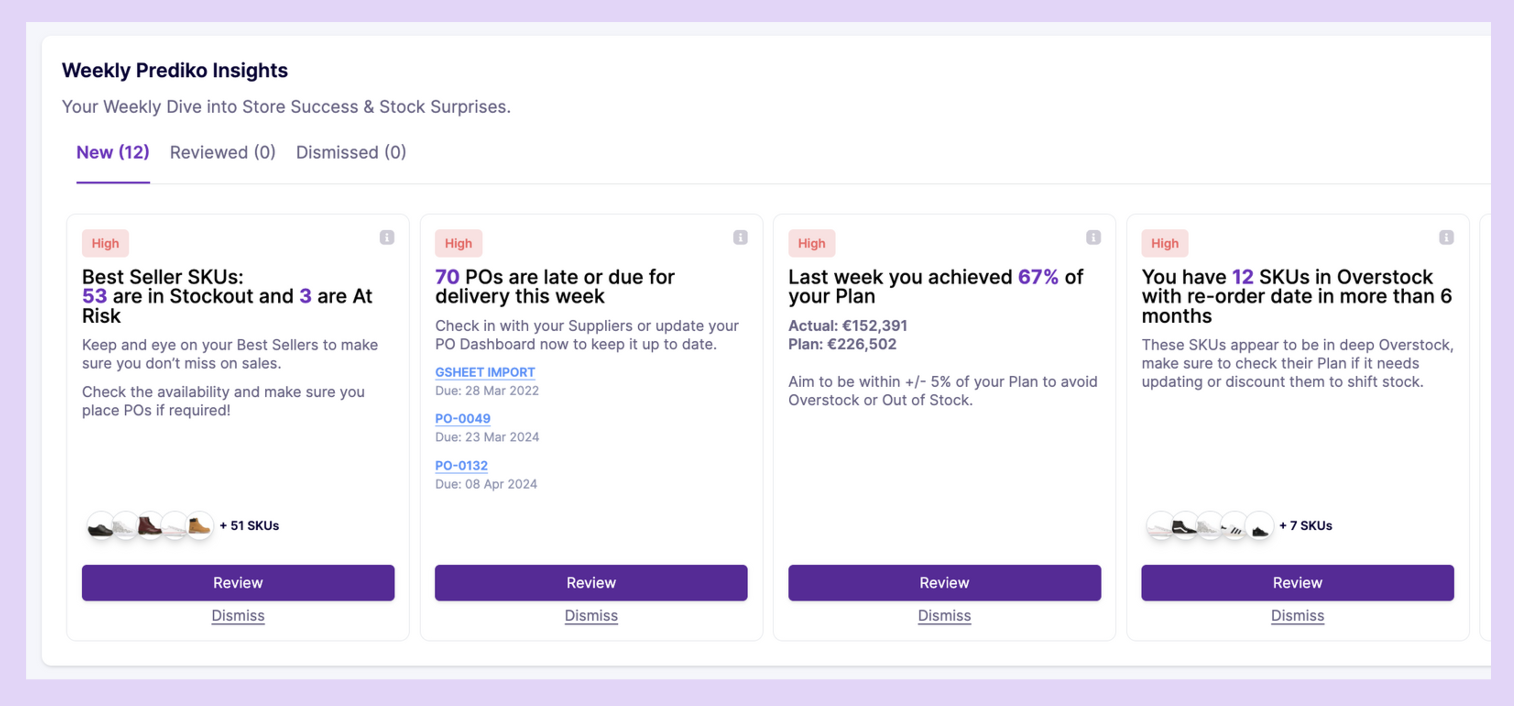
Insights & Analytics: Prediko goes beyond basic Shopify reports, offering deep insights into your product performance. You’ll get alerts on overdue or pending purchase orders, as well as visibility into SKUs at risk of stockouts or excess inventory.
With real-time reports, you can monitor the retail value of your inventory, track key metrics like stock health, and receive automated updates directly to your inbox—daily or weekly. Prediko’s smart nudges guide you to make timely purchases based on lead times, safety stock levels, and optimal stock cover units.
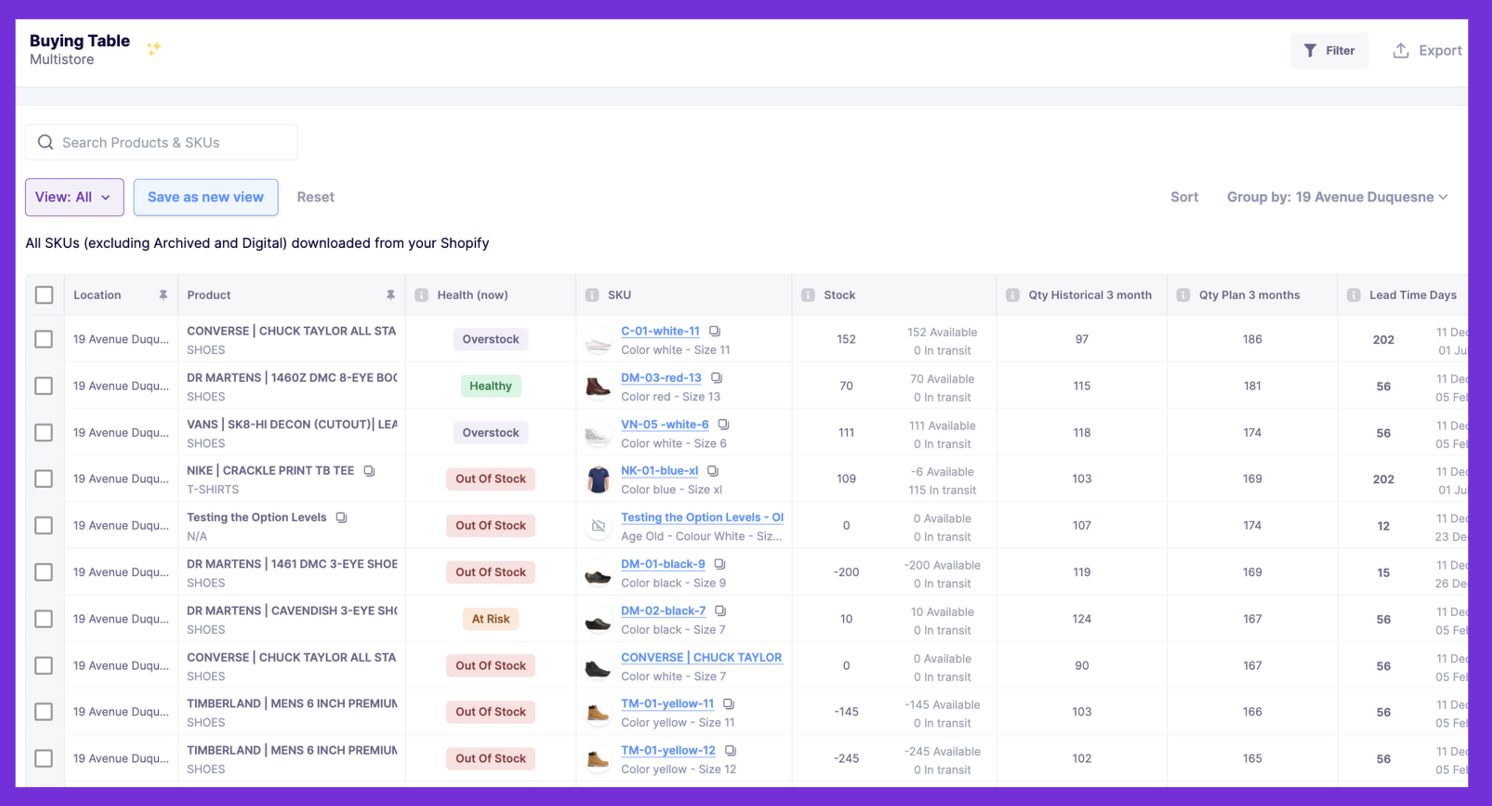
Predictive Buying Table: Prediko’s Buying Table gives you a comprehensive view of your inventory, showing key details like weekly sales history, days of cover, ideal reorder dates, and lead times. Each SKU comes with a health bar, providing you with a snapshot of potential stock issues before they become a problem.
You can also customize your inventory view at SKU, Category or Product-level using Prediko’s 100+ filters to tailor the data to your exact needs.
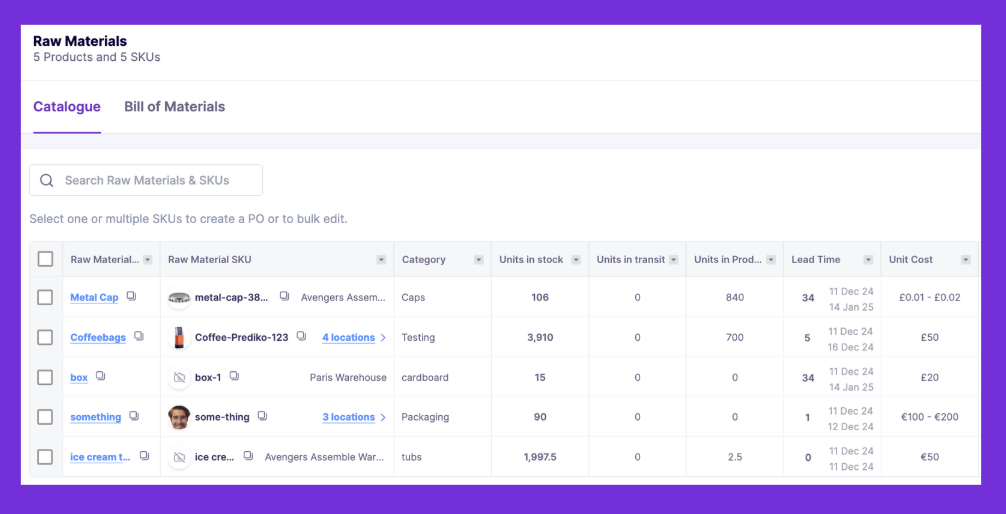
Raw Material Inventory Management: For stores that rely on raw materials or multi-step manufacturing processes, Prediko also offers robust material inventory management software. It helps you keep track of the materials needed to create finished goods, ensuring that production never stalls due to a lack of supplies.
Prediko provides all the tools you need to streamline your inventory replenishment process, enabling you to focus on scaling your business without worrying about stock issues.
Pros
- Offer agentic-based replenishment
- Handles replenishment for complex variants and bundles across channels
- Responsive support team
- Raw material replenishment for manufacturing businesses
Cons
- Integrations with some WMS/3PLs are still in development
Pricing
Prediko's pricing is broadly divided into three umbrellas
- Starter Plan: 49/month
- Growth Plan: $199/month
- Enterprise Plan: $349/month
The app’s pricing is based on revenue volume rather than feature distinction, with all plans offering the same core capabilities. The pricing plans scale with size and revenue of your business.
Best suited for:
- Fast-growing Shopify brands
- D2C operators
- Businesses managing large SKU catalogs
- Brands needing AI-driven forecasting
2. Fabrikator
TL;DR: Great for automating demand forecasts, managing backorders, and sending restock alerts. Fabrikator helps you stay proactive with purchasing decisions right from the dashboard.
Fabrikator is an inventory planner that can help with demand forecasting, stock replenishment, backorder management, and purchase order management for Shopify stores.
Main Features of Shopify App
- Demand forecasting: Generate demand forecasts using historical sales data
- Purchase order creation: Create purchase orders and share them with suppliers from platform itself.
- Smart stock alerts: Receive alerts when it’s time to restock, helping maintain optimal stock levels.
Pros
- Comes with backorder and pre-order automation
- Automated purchase order creation
Cons
- Pricing can compound for heavy backorder businesses
- Some merchants report onboarding friction
Pricing
The Seed plan costs $99/month, the Scale Up plan is $149/month, and the Growth plan is $199/month.
Best suited for:
- Shopify-first businesses
- Brands needing PO automation
- Teams replacing spreadsheet workflows
Related Read: Fabrikator vs Prediko
3. SKULabs
TL;DR: Built for serious multichannel sellers, SKULabs supports barcode-based fulfillment, real-time tracking, and bulk order processing ideal for warehouse-based operations.
is a multi-channel inventory, warehouse, and order management solution for businesses of all sizes.
The platform offers mobile apps for both Android and iOS, allowing you to pick orders, print shipping labels, and track performance on the go so that you and your team are always in the loop.
Main Features of Shopify App
- Order processing workflows: Set workflows for packaging, processing, and shipping.
- Barcode-based order fulfillment: Streamline order fulfillment and returns with barcode scanning.
- Bulk purchase order creation: Simplify reordering with bulk purchase orders and reordering suggestions.
Pros
- Strong warehouse execution and shipping features, including barcode scanning
- Responsive support team and accessible documentation
Cons
- Becomes expensive as you scale
- Some users mention feature limitations and onboarding/enablement gaps
Pricing
The Basic plan starts at $299/month, the Pro plan at $999/month, and the Enterprise plan at $1,999/month.
Best suited for:
- Warehouse-heavy businesses
- Multi-channel sellers
- Teams with fulfillment complexity
4. Assisty
TL;DR: Leverages AI to forecast demand across multiple stores and locations. Best suited for businesses managing bundled products and complex inventory flows
Assisty is an AI inventory management and planning tool. It is ideal for stock replenishment across multi-store and multi-location businesses, including those that sell bundles.
Main Features of Shopify App
- Demand forecasting: Forecast inventory demand based on historical data, seasonal trends, events, etc
- Multi-location Tracking: Manage inventory across multiple locations with inter-location transfers and location-specific insights
Pros
- Knowledgeable and approachable support
- Easy to use and set up
Cons
- Pricing/entitlement changes can frustrate some users
- Performance reliability concerns, like navigation lag, errors mentioned in some reviews
Pricing
Assisty’s pricing is based on the Shopify plan you’re on. For Shopify Plus users, there are two options: the Pro plan at $99 per store/month and the Enterprise plan at $499 per store/month.
Best suited for:
- Multi-location Shopify brands
- Businesses with bundled products
- Operators managing multiple warehouses
5. Inventory Planner
TL;DR: Offers powerful forecasting and buying recommendations to prevent stockouts or overstocking. Automatically creates vendor-specific purchase orders and syncs with your sales data.
Inventory Planner is an app that automates demand forecasting, stock replenishment, and purchase order creation. Using the app, you can balance stock levels across multiple locations, reducing the risk of stockouts.
Main Features of Shopify App
- Demand Forecasting: Forecast demand based on seasonality, trends, and product performance
- Buying recommendations: Receive recommendations on what, when, and where to order
- Automated purchase orders: Generate purchase orders with vendor minimums, cost prices, and other order specifications
Pros
- Offers inventory turnover/cash-flow planning
- Replenishment across locations
Cons
- Pricing is expensive for smaller budgets
- Frictions such as data syncing delays and initial complexity in forecast configuration
Pricing
The app is free to install, but plans start from $249.99/month and are based on your annual revenue.
Best suited for:
- Mid-market brands
- Financial inventory planning
- Businesses with seasonal demand variability
Related Read: Here is the list of the top alternatives to Inventory Planner app
6. Cin7 Core
TL;DR: Ideal for hybrid D2C and B2B businesses. Cin7 Core brings advanced inventory and cost tracking together with seamless integrations across sales channels.
Cin7 makes inventory management simple and accessible to D2C and B2B Shopify brands of all sizes.
Main Features of Shopify App
- With Cin7, get a complete picture of all the inventory production costs and inventory status.
- Simplify inventory management with live updates.
Pros
- Unifies inventory, orders, and channel data
- Offers an integrated barcode scanning system
Cons
- Users report missing features and dissatisfaction with the cancellation/support process
- Reviews highlight integration friction (especially with Shopify) that can complicate operations
Pricing
Cin7 Core plan starts from $349/month with a free trial available.
Best suited for:
- Hybrid B2B + D2C businesses
- Brands with operational complexity
- Businesses needing supply chain visibility
Related Read: Best Cin7 alternatives for Shopify brands
7. Katana
TL;DR: Best for brands that need to manage both manufacturing and inventory. Katana gives real-time visibility into stock, production schedules, and order fulfillment from a single platform.
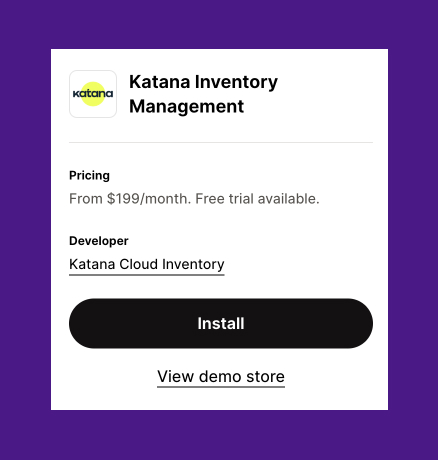
Lastly, we have Katana, an inventory management solution that helps you keep track of both your stock and manufacturing operations in real time. It consolidates sales, production, and accounting into one platform, eliminating inefficient tab switching.
You can easily manage incoming orders from all your sales channels, track product availability, and issue purchase orders based on combined inventory and reorder points. Plus, it allows you to send key financial data to accounting software like QuickBooks and Xero, keeping everything connected and organized.
Main Features of ShopifyApp
- Shop Floor Control: Control floor-level operation with Katana’s shop floor management
- Manufacturing management: Track production schedules, costs, and stock levels
- Real-time inventory tracking: Monitor inventory across all locations and orders, including B2B & B2C
- Demand forecasting: Forecast demand using historical data to plan stock levels effectively
Pros
- Offers manufacturing-native replenishment
- Dedicated onboarding specialist
Cons
- Reviews frequently mention limited functionality or missing features
- Users point out integration issues with systems like QuickBooks and Shopify
Pricing
The Starter plan costs $179/month, the Standard plan is $359/month, and the Professional plan is priced at $799/month, billed annually.
Best suited for:
- Manufacturing brands
- Businesses managing raw materials
- Production-focused operations
Which Inventory Replenishment Software Is Best for Your Business?
When Excel Inventory Management Stops Scaling
Spreadsheets often work for small businesses early on, but manual inventory planning becomes difficult as operations grow.
Common signs spreadsheets are no longer enough include:
- Increasing stockouts
- Growing SKU counts
- Multiple warehouse locations
- Bundle or kit complexity
- Manual purchase order creation
- Supplier lead time issues
- Inventory mismatches across channels
- Difficulty forecasting demand
Inventory replenishment software helps automate these workflows while improving forecasting accuracy.
How We Selected the Best Inventory Replenishment Software
To identify the best inventory replenishment software tools, we evaluated platforms using practical operational criteria.
1. Forecasting Accuracy
We prioritized software that uses historical sales data, seasonality patterns, and inventory trends to improve demand forecasting.
2. Automation Capabilities
We evaluated how effectively each platform automates:
- Reorder calculations
- Purchase order generation
- Inventory monitoring
- Restock alerts
3. Shopify Compatibility
Since many eCommerce businesses operate on Shopify, we prioritized tools with strong Shopify integrations and real-time inventory syncing.
4. Integrations
We assessed whether tools integrate with:
- ERP systems
- WMS platforms
- Accounting software
- 3PL providers
- POS systems
5. Pricing Transparency
We considered whether pricing scales reasonably with operational complexity and business size.
6. Merchant Reviews
We reviewed merchant feedback to better understand:
- Ease of onboarding
- Reliability
- Support quality
- Operational usability
Key Features to Look For in Inventory Replenishment Software
Real-Time Inventory Tracking
Real-time inventory syncing helps businesses avoid stockouts and overselling across sales channels.
Demand Forecasting
Forecasting tools help businesses predict future inventory needs using historical sales data and seasonal demand patterns.
Multi-Location Support
Businesses operating across multiple warehouses or retail locations need inventory visibility across all locations.
Purchase Order Automation
Automated purchasing workflows reduce manual operational work and improve replenishment efficiency.
Inventory Health Reporting
The best replenishment software helps identify:
- Slow-moving inventory
- Overstock risk
- Stockout risk
- Excess inventory carrying costs
Integration Flexibility
Inventory software should integrate cleanly with eCommerce, accounting, warehouse, and logistics systems.
Common Inventory Replenishment Mistakes
Many inventory problems come from operational processes rather than inventory volume itself.
Common mistakes include:
- Relying entirely on spreadsheets
- Ignoring supplier lead times
- Forecasting using incomplete data
- Carrying excess safety stock
- Not tracking bundle components accurately
- Failing to sync inventory across channels
- Delaying purchase order creation








.avif)