




Growth is every Shopify merchant’s goal, but scaling introduces unique issues that basic features of Shopify alone can’t address. For instance, jewelry brands often require specialized inventory solutions to manage their unique product variants and high-value items
Critical tasks like syncing inventory across sales channels often result in errors and stock imbalances. Tracking product variants becomes more complex as your catalog grows. For merchants juggling multiple sizes, colors, or bundle configurations, a Shopify variant inventory tracker helps simplify stock updates, avoid fulfillment errors, and keep variant-level data aligned across locations.
Add to that the complexities of managing suppliers, handling returns, and forecasting demand.
We share some common Shopify inventory issues, how inventory software can solve them, and a overall list of the top seven software you can choose from.
Common Shopify Inventory Issues
Here are 5 common Shopify inventory issues:
1. Lack of in-built demand forecasting
Shopify’s native features don’t include demand forecasting. This means merchants cannot predict future sales based on past performance, seasonality, or market trends unless they have the bandwidth to do complex calculations manually.
Without accurate forecasts, merchants risk overstocking slow-moving items or running out of popular products, both of which impact revenue and customer satisfaction.
2. No real-time stock visibility across sales channels
Shopify’s inventory dashboard doesn’t record sales done outside Shopify. Items sold through other platforms or offline channels don’t automatically update in Shopify unless manually entered or maintained on a separate spreadsheet.
This puts merchants at serious risk of overselling products they can’t fulfill and damaging customer trust and business reputation.
3. Absence of raw material management
The default Shopify features do not support raw material management for manufacturers. Businesses depend on external tools for ordering and tracking the components needed for production.
This gap disrupts manufacturing processes and causes delays in fulfilling customer orders.
4. Can’t manage purchase orders and suppliers
Shopify doesn’t let you track purchase orders (POs) or manage supplier communications.
If you're currently using Shopify's native Stocky app and finding it limited, here are a few Stocky app alternatives worth considering
5. Basic reports and analytics
While Shopify offers some analytics, they are limited to high-level metrics like sales performance. The platform doesn’t provide detailed inventory reports, low-stock alerts, demand forecasting, or profitability tracking, making it harder to make accurate data-backed decisions.
If you're noticing these discrepancies or missing stock updates regularly, it's crucial to understand why your inventory might not be tracked properly on Shopify.
Getting the right Shopify app to tackle these common issues
Various app have popped up to tackle the common inventory issues faced by many Shopify merchants. These apps bridge the gaps in Shopify's native features and add value in the following ways
1. Real-time tracking and visibility
Inventory software gives you instant visibility into stock levels across all your sales channels. When an order is placed, your inventory is automatically updated, so you always have an accurate view of what’s available.
Implementing a Shopify safety stock strategy can also provide a buffer against this issue.
2. Automation for efficient workflows
With automated workflows, you can save a number of hours and reduce team workload and scope of error
For instance, when a product's stock drops below a predetermined level (say, 10 units), the tool can automatically generate purchase orders, notify suppliers, and even calculate optimal reorder quantities based on historical sales data.
3. Integration with Shopify and other tools
Scaling businesses often rely on multiple tools and platforms. Inventory software acts as the headquarters or a centralized dashboard, connecting seamlessly with Shopify and other tools like QuickBooks, ShipHero, and marketplaces including Amazon and Walmart.
4. Advanced reporting and granular insights
Tracking granular metrics like top-selling products, gross profit, return rate, and days of cover, help you make timely decisions on inventory levels, pricing, procurements, and promotions.
5. Prevention of stockouts and overstocking
Shopify inventory apps have evolved over time and now use predictive models and AI algorithms to anticipate future inventory based on historical data, seasonal trends, and sales patterns. These apps can predict possible stockouts weeks in advance, recommend ideal inventory levels, and even suggest markdown strategies for slow-moving products.
Such proactiveness helps prevent out-of-stock situations, adjust procurement strategies, reorder accurate inventory levels, and reduce overstocking and unnecessary storage costs.
6. Improved customer satisfaction
By making products available when customers want them, you can reduce out-of-stock instances, minimize shipping delays, and bring in repeat business through reliable service delivery.
Up-to-date stock information also allows you to fulfill orders promptly, avoid negative reviews, and create a hassle-free shopping experience.
We also talked through many of these growing pains — from supplier issues to forecasting gaps — in our episode of the Limited Supply podcast, featuring practical examples from fast-growing brands.
6 Shopify Inventory App That Can Help Solve These Common Issues
No.1 👉 Prediko's AI Inventory Management App
Here is why we are at No.1 👉
We are an inventory OS that lets omni-channel brands plan and order their stock easily. With focus on cutting down repetitive tasks and using AI for smarter decision-making, it unifies demand planning, supply planning, purchase order management, raw materials tracking, and in-depth reporting.
Our seamless integration with Shopify and 100+ WMS, 3PLs and eCommerce tools makes it a standout option for scaling businesses.
See Prediko in action
2. Assisty

Assisty is an inventory planning and management platform that removes the hassles from your inventory processes. It improves visibility across locations and automates replenishment and reporting, helping Shopify merchants save time and make faster, more informed decisions.
3. Genie

Genie is a collaborative and easy-to-use solution with capabilities to track, plan, order, and analyze inventory. It eliminates the manual spreadsheet processes, gives access to real-time data, and allows you to set up inventory workflows within minutes.
4. Qoblex
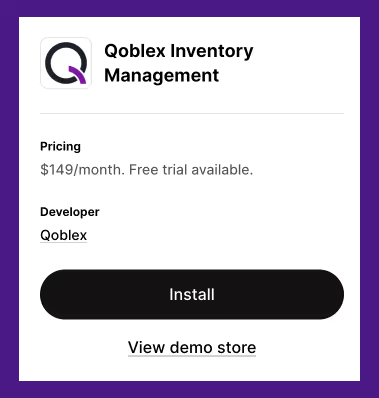
Qoblex is an inventory management software that lets you manage multiple aspects of the supply chain including manufacturing, forecasting, inventory, and fulfillment. It also offers a B2B eCommerce platform that can be easily integrated with your existing operations.
5. Inventory Planner
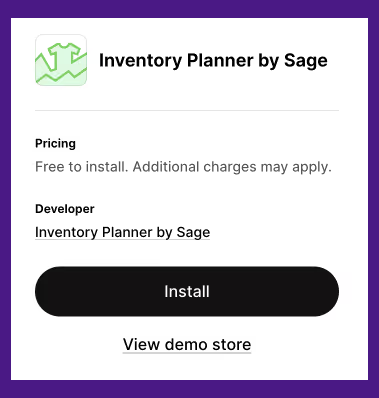
Inventory Planner’s straightforward platform helps you tackle Issues like overstocks, stockouts, forecasting, and data consolidation. It has a support team of former buyers and merchandisers who understand the common merchant challenges and provide expert-led onboarding, training, and support.
6. SKULabs
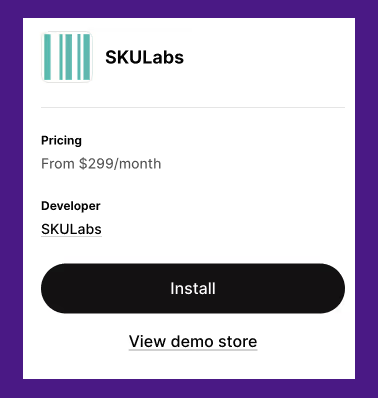
Lastly, we have SKULabs that brings your retail and wholesale stores, marketplaces, and brick-and-mortar sites into one app. In addition to inventory management, it powers fulfillment workflows with features like barcode scanning, label printing, and access to discounted shipping rates.
Leave Your Inventory Issues Behind with the right Inventory Software
An inventory software not only solves common Shopify inventory issues but offers much more. We have covered all the features of best Shopify inventory management apps.
Wondering if it’s time for you to switch to dedicated inventory software? Look for these common issues.
- Frequent stockouts or tied-up capital due to overstocking
- Difficulty in tracking inventory across multiple locations
- Slow or inaccurate order fulfillment processes
- Errors in inventory counts or data entry due to their manual nature
- Limited visibility into sales trends or stock performance
Over 2500+ Shopify brands trust Prediko to tackle these common inventory issues. Become one of them by taking a free 14-day trial.









.avif)