




It's important to get an accurate inventory forecast for the whole year. Accurate forecast reduces risk of overstocking or understocking by ~98%. We tried and tested a lot of inventory forecasting software, tools and apps and narrowed down the list to just Top 14.
Why we have kept ourselves at the top of this software list - It's because Prediko's forecasting ability is suitable for both SMBs and large businesses.
If you want to go beyond forecasting and balance stock levels across SKUs and locations, see our guide to the best inventory optimization software for Shopify brands.
Comparison of the Best Inventory Forecasting Software
Please note that some of these software are only Shopify apps and available on the Shopify App Store, while others offer broader inventory forecasting capabilities.
List of Highly Rated Software for Inventory Forecasting (as per reviews)
No. 1 👉 Prediko’s AI Inventory Forecasting & Management App
TL;DR: AI-powered forecasting trained on 25M+ SKUs. Offers ~95% accuracy.
4.9 ⭐ (250+ Reviews on Shopify App Store)
Features that make Prediko better than other inventory forecasting software
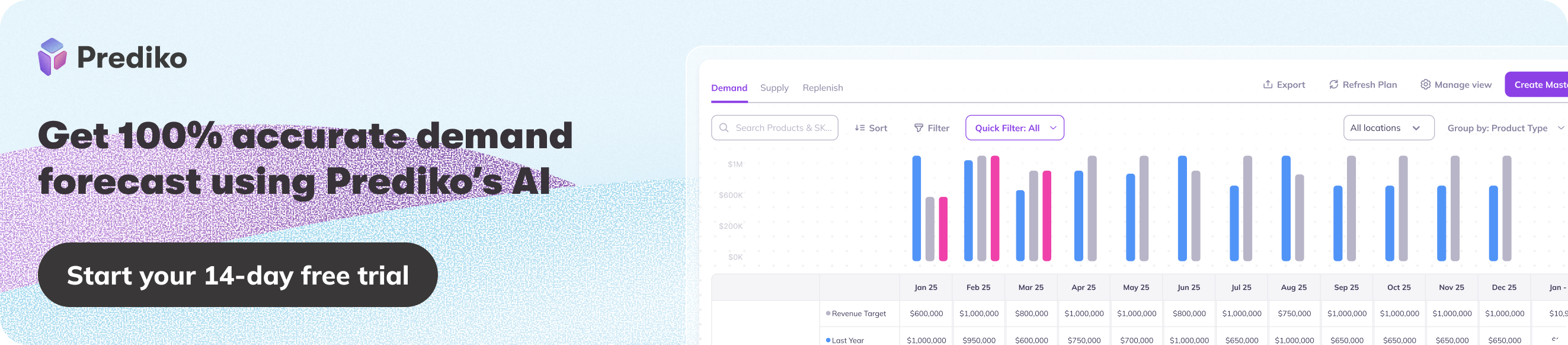
- AI-powered software that accurately predicts future demand for your products based on historical data and trends.
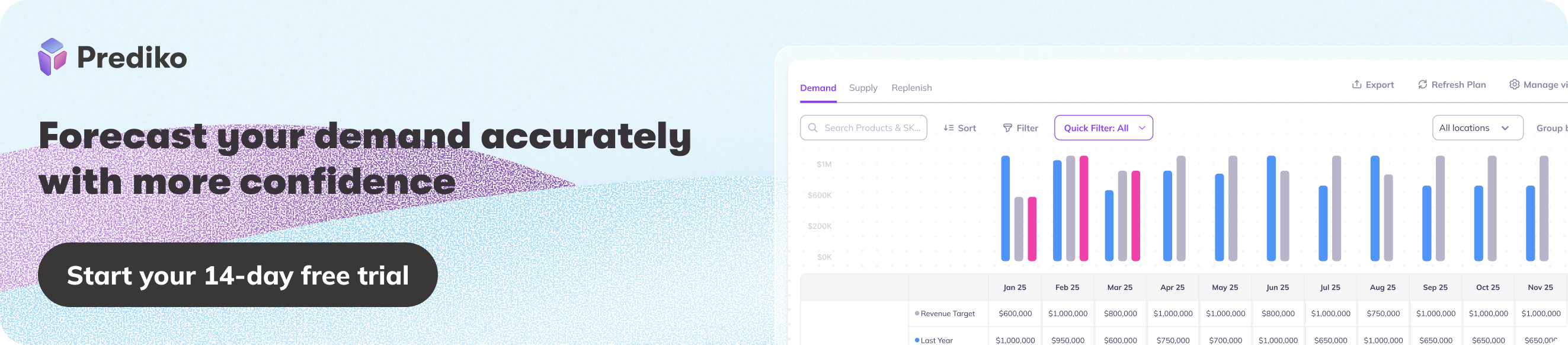
- Visual representation of sales data over time allows for easy identification of trends and patterns, ensuring that inventory decisions support overall supply chain optimization goals
- Our model factors factors in multiple sales channels and has accuracy as high as ~95%.
- Download reports of your forecasts and demand plan.
- Manage multiple suppliers per SKU as Prediko tracks separate lead times and pricing for each supplier, so your forecasts and POs reflect who's actually fulfilling the order
- Intuitive design for easy forecast configuration, data review and has inbuilt inventory tracking
Pricing
Prediko's starter plan starts from $49/month. It's a revenue based pricing model that includes all core features and includes onboarding and support.
Pros
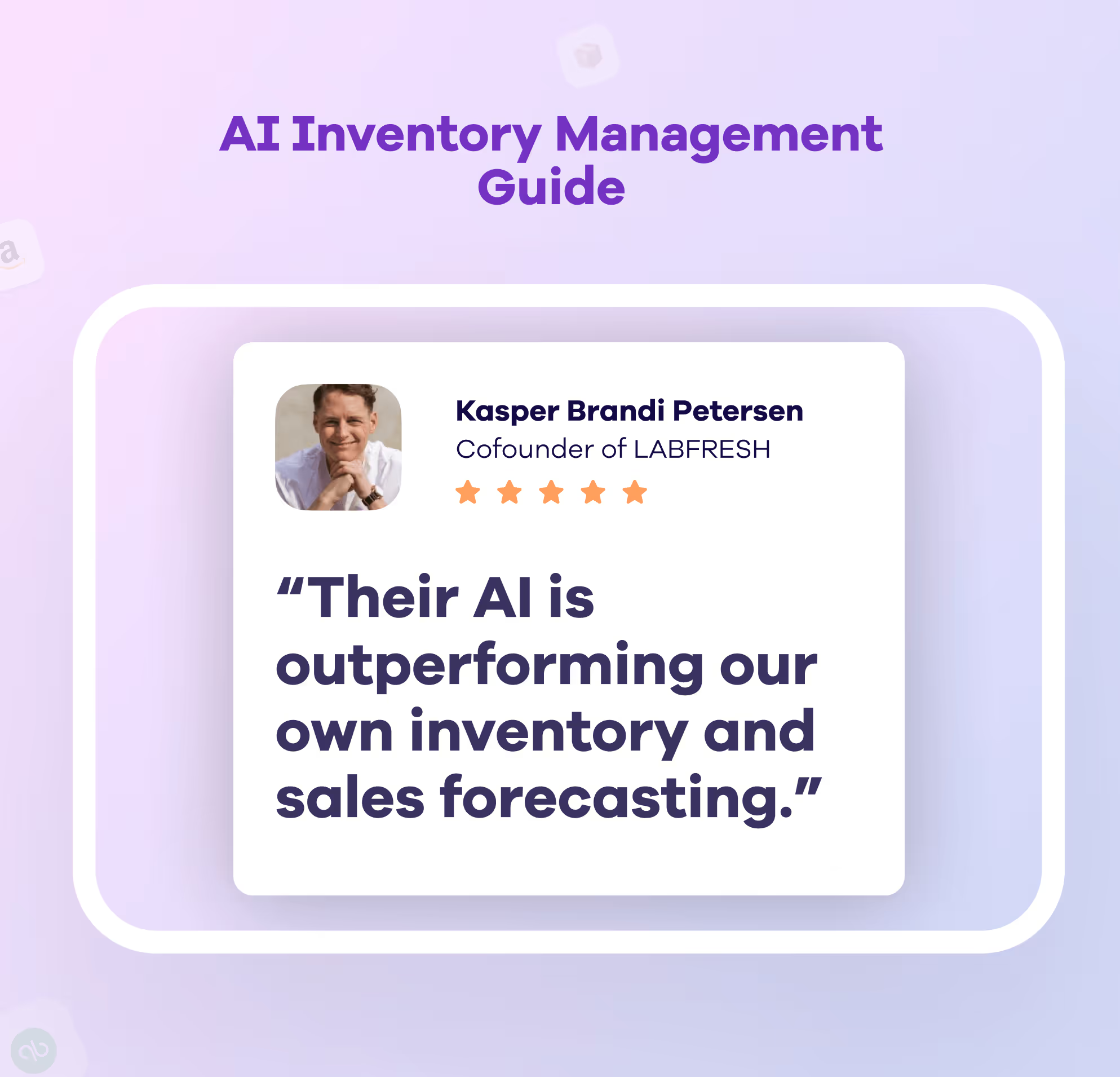
- LabFresh (appeared on Dragon's Den) had this to say about Prediko's AI inventory forecasting accuracy
Prediko's AI is outperforming internal inventory & sales forecasting at LabFresh (Dutch Brand that makes life-proof clothing that stays clean and fresh for many days.)
.webp)
Cons
- Right now Prediko doesn't have a native solution for Amazon. Coming out soon.
Best For
D2C & Shopify brands that want multi-location forecasting.
Reviews
4.9/5 rated on Shopify App Store based on 250+ reviews
2. Bee Low Stock Alert & Forecast
TL;DR: Simple forecasting with alert scheduling and sales velocity tracking.
Features
- Create scheduled alerts when your inventory forecast falls down below the threshold.
- Get sales and inventory forecast reports with export functionality
Pricing
Couple of plans offered by Bee Low Stock Alert & Forecast: Free, Professional ($5.99/month), Advanced ($11.99/month) and Enterprise Plan ($39.99/month)
Pros
- The forecasting module takes into account the sales velocity of the product.
Cons
- More alerts focussed rather than forecasting first
Best For
Brands that want alerts along with simple forecasting without breaking the bank.
Review
4.8 rating based on 128 reviews
3. Inventory Forecasting Hero
TL;DR: Basic reorder and forecasting support to save time and minimize waste.
Features
- Save time and money by streamlining the forecasting process.
- Maximize profits & minimize waste by always having the right forecast
- Get reorder quantities and deadlines for each product
Pricing
Free for stores under $5k/month revenue, $15/month paid plan for larger stores.
Pros
- Clean spreadsheet replacement
- PO-friendly forecasting for brands
Cons
- Not a fit for complex multiple-warehouse and locations
Best For
Small Shopify merchants still forecasting in Excel or Sheets, especially with one warehouse.
Review
4.9/5 rating on Shopify App store based on 17 reviews
4. Stockbot Inventory Forecasting
TL;DR: Combines forecasting with low stock alerts. Ideal for identifying slow-movers.
Features
- Identify slow-moving products, allowing you to make decisions on whether to continue stocking them or adjust your inventory strategy
- Prevent dead stock and tie up capital in overstocking by accurately forecasting replenishment quantities
- Avoid the hassle of manual calculations
Pricing
Stockbot Inventory Forecasting offers multiple plans: Free, $9/month Alerts, $25/month Forecasting.
Pros
- Low cost alerts
- Demand forecasting & replenishment recommendations
Cons
- More of a utility software rather than a complete solution
Best For
Small-to-mid-sized Shopify stores that mainly need restock alerts plus simple forecasting
Review
4.7/5 based on 37 reviews
5. Monocle AI inventory forecasts
TL;DR: Best AI Forecasting tool focused on sales lift and order value. Automation using AI saves hours.
Features
- Use forecasting to tap into emerging opportunities and optimize their average order value
- Data-driven forecasts enable businesses to make decisions about safety stock
- Eliminate the need for manual forecasting and saving valuable employee hours
Pricing
Monocle AI inventory forecasts offers multiple plans: $47/month, $67/month and $89/month.
Pros
- AI forecasting
- PO workflow with forecasting & straight-forward order-volume pricing
Cons
- Integrations are limited that are mentioned on the listing
Best For
Brands on Shopify that want forecasting plus product association
Review
4.3 / 5 rating based on 27 reviews
Here is a list of top inventory management apps & software for Shopify
6. Cogsy
TL;DR: High-visibility forecasting tool with robust integrations and flexible planning.
Features:
- This inventory forecasting software is tech stack agnostic. This software integrates with the ops tools you’re already using
- This software helps brands and businesses to bring inventory forecasts and operations into clear view
- Cogsy’s inventory forecasting helps you to achieve greater agility, alignment, and control throughout your brand.
Compare both Inventory Planner and Cogsy - See which one is better.
Pricing
Cogsy offers two plans: One plan is $49/month and the other one is $199/month.
Pros
- Strong scenario forecasting
- 12-month forecasting horizon
Cons
- 60-day SKU-page cap is restrictive
- Less transparent than Enterprise solutions on forecasting architecture
Pricing
Current public pricing page shows a single all-in-one plan at $199/month with a 14-day trial.
Best For
Brands running on Shopify & Amazon that need forecasting to help with launches, growth planning and event readiness.
Review
4.9 / 5 based on 13 reviews
7. Bucey AI Inventory Forecast
TL;DR: AI-led forecasting app with omni-channel focus.
Features
- Achieve better stocking decisions with data-drven forecasts.
- Free up capital by optimizing slow-moving items & safety stock through better forecasts
Pricing
Bucey AI Inventory Forecast pricing starts from $20/month.
Pros
- Packs in more forecasting ambition
- AI-powered forecasting across market dynamics, trends, seasonality, price and promotional impacts
Cons
- Docs are very few on forecast horizon
Best For
Omnichannel retailers and brands that want inexpensive AI-led forecasting with scenarios
Review
5.0 / 5 based on 4 reviews
8. Logistified Inventory Forecast
TL;DR: A strong operations heavy tool that is great for teams that care about execution (POs, transfers, suppliers) as much as forecasting
Features
- Calculate the precise quantities needed for restocking using forecast models.
- Seamlessly monitor your store in real-time for accurate forecasting.
Pricing
Essential is $12/month, Enhanced $29/month and Elevate $59/month, all with a 14-day free trial.
Pros
- It has BOM forecasting
- Has stockout-date forecasting
Cons
- Needs proper setting up for different business complexities
Best For
Merchants who want forecasting tightly connected to POs, lead times, MOQ rules and day-to-day replenishment.
Review
5.0 / 5 based on 18 reviews
9. Sensible Inventory Forecasting
TL;DR: Basic quantity forecasting for small teams & multi-supplier support.
Features:
- Good forecasting ensures products don't run out of stock.
- Give suggestions based on past sales data and forecasting
Pricing
Pricing starts from $29/month.
Pros
- Forecasts inventory across windows you choose 14, 30, 60 or 90 days
- Simplicity in terms of operations
Cons
- Can't do advanced inventory forecasting
Best For
Small and mid-size merchants that want to get out of spreadsheets
Review
5 / 5 based on 10 reviews
Irrespective of the software that you select, we have covered how to properly do inventory forecasting on Shopify.
10. Netstock Inventory Planning
TL;DR: Cloud-based inventory forecasting that brings ERP data to life for smart replenishment.
Features
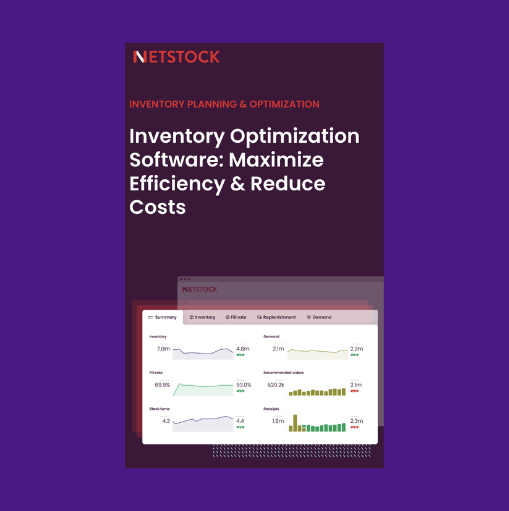
- Automatically assigns inventory‑forecasting models per item, location, channel, and customer, leveraging historical sales, seasonality, promotions, and lost‑sales adjustments.
- Highlights forecasting KPIs such as stock‑vs‑model, excess, stockouts, fill rates, and early alerts on a single visual dashboard..
- Integrates smoothly with major ERPs (NetSuite, SAP, Microsoft Dynamics, Sage, Odoo, Fishbowl, etc.)
Pricing
Pricing starts at $900/month on annual subscriptions. Forecasting and ordering appear in Essentials. Advanced adds AI Pack, advanced forecasting and extended planning horizon. Demand Planner is a custom-quote add-on for more flexible forecasting.
Pros
- One of the cleanest forecasting frameworks in the mid-market
- Forecasting accuracy is very high
Cons
- Initial onboarding might not be enough on it's own
- Pricing might be higher for normal businesses
Best For
ERP-connected distributors, wholesalers and manufacturers that need collaborative forecasting
Review
4.6 / 5 based on 168 ratings
11.StockTrim Inventory Forecasting
TL;DR: Forecast demand and reorder quantities with ease.
Features
- Forecasts demand using historical sales and adjusts forecasts based on trends.
- Offers forecasting suggestions and future demand visibility for all products.
- Built-in AI improves forecasts over time.
Pricing
Starter plan is $199/month. Growth plan is $299/month. Ultra plan is $399/month. Enterprise plan is custom.
Pros
- Forecast groups and lifecycle management
- New-product forecasting without history
Cons
- Need for more native integrations
Best For
Small and growing brands, especially ecommerce brands and manufacturers
Reviews
4.9/5 based on 14 reviews on Capterra
12. RELEX Inventory Optimization
TL;DR: Retail-grade supply chain forecasting for large enterprises with complex operations.
Features
- Automates forecasting and supply chain planning.
- Leverages AI to create better forecasts, optimize seasonal stock, and improve availability.
Pricing
Custom pricing based on scale, modules, and integration requirements.
Pros
- One of the complete forecasting systems in this list
- Forecast dashboarding
Cons
- It works best when brands have a lot of data & solid supply-chain methodology
Best For
- Large retailers, manufacturers and wholesalers with highly granular planning problems
Reviews
4.6 Based on 21 reviews on G2
13. o9 Solutions
TL;DR: AI-powered demand forecasting tool for enterprise brands with complex operations.

Features
- Combines inventory forecasting with supply chain modelling and scenario planning.
- Helps enterprises reduce working capital by improving forecasting demand accuracy and lead time insights.
Pricing
Quote Only Pricing Available
Pros
- Integrates demand signals from internal and external data sources, including POS, weather, and macroeconomic data.
Cons
- Complex, resource-heavy implementation
- Occasional performance issues
Best For
Suitable for enterprise-level businesses across retail, manufacturing, and pharma.
Review
4.2/5 based on 18 reviews on G2
Frequently Asked Questions on Inventory Forecasting Software
What are the top inventory solutions with forecasting and reporting tools?
The top inventory solutions that combine forecasting with reporting include Prediko (AI demand forecasting with downloadable reports and real-time alerts), Netstock (ERP-integrated forecasting with KPI dashboards), StockTrim (demand and reorder quantity reports for SMBs), and RELEX (enterprise-grade shelf and supply chain reporting).
Do any AI inventory apps offer a free trial to test forecasting accuracy during a busy season?
Prediko offers a 14-day free trial which is enough time to validate forecasting accuracy against your real sales data. Since Prediko's AI is trained on 25M+ SKUs and factors in seasonality patterns, you can run it through a peak period and compare its predictions against actuals before committing.
Which inventory forecasting tools use AI to predict demand based on seasonality?
Several tools factor in seasonality, but the depth varies a lot. Prediko builds seasonality directly into its AI model. It analyzes historical sales trends, adjusts for seasonal spikes, and gives you forward-looking demand estimates per SKU. Netstock also accounts for seasonality within its ERP-connected demand models. RELEX and o9 Solutions do this at enterprise scale with more configurability.
Which AI inventory forecasting tools deliver the most accurate demand predictions?
Prediko delivers up to ~95% forecast accuracy, trained on data from 25M+ SKUs across Shopify brands. Its model accounts for multiple sales channels, seasonal trends, and historical patterns — which is why brands like LabFresh have reported it outperforming their internal forecasting. Other tools like Netstock and RELEX offer strong accuracy for ERP-heavy businesses. For D2C Shopify sellers, Prediko is consistently the top performer in this category.
Which company offers the best Shopify inventory planning and forecasting?
Prediko is the top-rated inventory planning and forecasting app on the Shopify App Store, with a 4.9-star rating across 200+ reviews.
What's the best solution for SKU-level demand forecasting across channels?
For multi-channel SKU-level forecasting, Prediko handles Shopify as the primary channel while Sumtracker is strong if you also sell on Amazon, eBay, Walmart, and Etsy. For enterprise-level cross-channel complexity, o9 Solutions and RELEX pull in demand signals from multiple sources including external data.
Are there cloud-based platforms that offer real-time data and AI-powered forecasting for retail inventory management?
Yes. Prediko is fully cloud-based and syncs in real time with your Shopify store. Netstock is another cloud-based option, purpose-built for businesses using ERP systems. Both give you live inventory visibility alongside forward-looking AI forecasts.
Is there a solution that can forecast demand for seasonal items and automatically create POs for my suppliers?
Yes. Prediko does exactly this. It forecasts demand for seasonal products based on historical trends, then auto-generates purchase order recommendations with suggested quantities and timing. You can review and send POs directly to suppliers from within the platform. This removes the manual step of translating a forecast into an actual order.
Why need a forecasting software other than inbuilt inventory management within an eCommerce platform like Shopify?
While eCommerce platforms like Shopify provide basic inventory management, dedicated forecasting software offers advanced features such as AI-powered demand prediction, automated reorder calculations, and low stock alerts. These tools help optimize stock levels, reduce stockouts, improve supply chain efficiency, and enhance overall operational performance.
What kind of customization options are available in these inventory forecasting software?
Customization options often include personalized alert settings, demand forecasting models tailored to specific business needs, adjustable reorder points, and customizable dashboards or reports highlighting the most relevant metrics.
Do inventory forecasting software support international businesses and multiple currencies?
Yes. Many inventory forecasting software support international operations with multi-currency options, language support, and management of inventory across multiple locations and regions.
How frequently should I update my inventory data in these software?
Inventory data should ideally be updated in real-time or at least daily. Many software solutions offer automatic synchronization with Shopify to ensure the most accurate demand forecasting and inventory management.
What are the benefits of using a paid inventory forecasting software over a free one?
Paid inventory forecasting software generally offers advanced features, AI-driven analytics, detailed reporting, superior customization, and reliable customer support. Free versions often lack these capabilities, making paid tools better for scaling and optimizing stock levels efficiently.
Are there any inventory forecasting software that offer real-time analytics and reporting?
Yes. Many inventory forecasting tools, including Prediko, provide real-time analytics and reporting to deliver up-to-date insights on inventory levels, sales trends, and demand forecasts.
Can these software integrate with other tools like accounting software and ERP systems?
Most advanced inventory forecasting software can integrate with accounting tools, ERP systems, and other eCommerce platforms, streamlining operations and providing a unified view of supply chain and inventory performance.








.avif)