


We searched for inventory planning software available for eCommerce brands and compiled the search into a top 10 list.
Comparison of the 10 Best Inventory Planning Software & Tools
The comparison below is based off latest data in Quarter 4' 2026.
How We Evaluated This List
We evaluated each software against these criteriaa:
- Inventory planning complexity coverage
- Reorder point and safety stock automation
- Pricing transparency
- Support for bundles or raw materials (BOM).
Prediko is ranked first as the product we know best, not because it wins on every parameter in isolation. We update this list based on new features and if a particular software gets better reviews as compared to peers.
Wherever another software has a better feature, we've mentioned that clearly above: Cin7's multi-warehouse receiving, for example, or Cogsy's tie to financial planning.
Which are the best inventory planning software?
Good for most eCommerce brands: Prediko - AI-Powered Inventory Planning
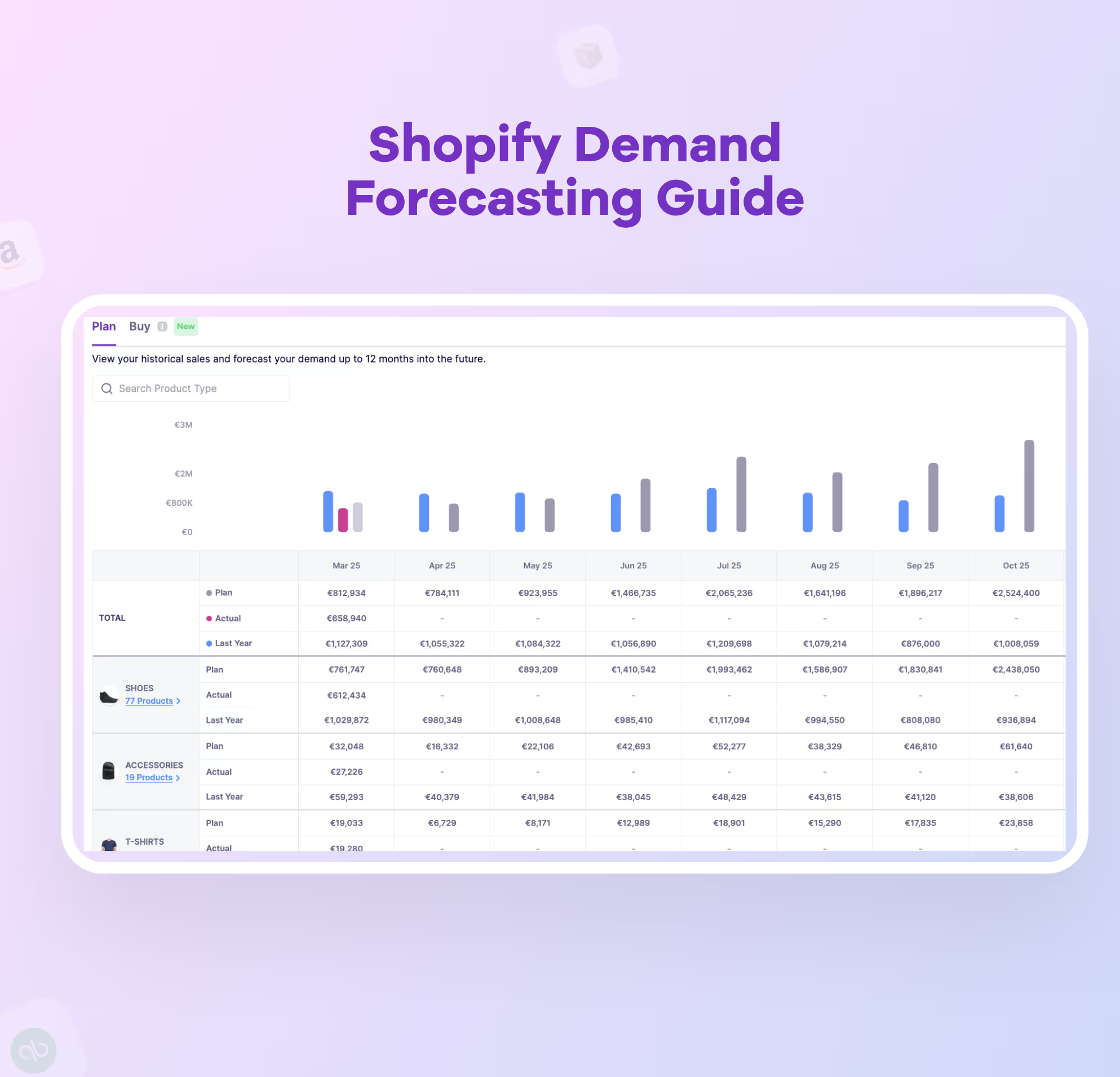
Prediko is purpose-built for modern eCommerce brands on Shopify & Amazon. It combines AI inventory planning with integrated purchasing recommendations, so the plan and the buy happen in the same workflow.
What it does well
- Connects directly to Shopify & Amazon and syncs all sales, inventory, and PO data in real time
- Plans inventory at the SKU level, factoring in seasonality, growth, and sales velocity
- Generates purchase order recommendations based on lead times, safety stock, and days of cover
- Includes raw material and BOM planning for brands that manufacture or bundle
What sets it apart
Prediko's Buying Table sits next to the demand plan, so you can go from planning to PO in one click. It supports multiple warehouses and stores, handles bundles and subscription products, and gives full visibility into what's moving, what's not, and what needs to be ordered next.
Prediko's AI agent can also handle tasks directly: refreshing forecasts, creating draft POs, generating reports, and surfacing SKUs at risk. It's built for modern D2C teams who want to plan without the manual overhead.
Pricing
From $49/month. All plans include unlimited SKUs, POs, and users. 14-day free trial available.
Best for
Modern eCommerce brands that want a single software for inventory planning, tracking, and purchasing, especially those managing multiple SKUs, warehouses, or raw materials.
Prediko holds a 4.9/5 rating on G2 and 4.9/5 on the Shopify App Store
2. Brightpearl
Brightpearl is an inventory planning software built for omnichannel brands. It covers inventory planning, order processing, and fulfillment across multiple sales channels in one system.
What it does well
- Plans inventory and manages fulfillment across channels like Shopify, Amazon, and wholesale
- Automates purchasing workflows including supplier management and PO creation
- Connects warehouse, accounting, and logistics into a central system
What sets it apart
Brightpearl is designed for brands where inventory, orders, and accounting need to move in sync. It works best for multi-channel operations with real warehousing complexity, not pure D2C Shopify stores.
Pricing
Custom quote based on order volume and features.
Best for
Mid-market omnichannel retailers that need a full retail operations system, not just demand planning.
3. Cin7
Cin7 is an inventory management and planning system that connects your product catalog, warehouses, suppliers, and sales channels into one platform. It's built for product businesses that sell across multiple channels and need visibility across the supply chain.
What it does well
- Plans inventory across multiple warehouses and locations in real time
- Handles purchase orders, supplier management, and receiving workflows
- Connects to Shopify, Amazon, wholesale, EDI, and 3PLs
- Automates order routing, fulfillment, and stock allocation
What sets it apart
Cin7 is strong on the operations side: receiving, transferring, and tracking inventory at scale. Its inventory planning features are more basic compared to specialist tools, an area our demand planning software comparison covers in more depth, but the depth of its order management and supply chain connectivity makes it a solid operational foundation.
Pricing
From $349/month. Enterprise plans available.
Best for
Product businesses that need a connected inventory, order management, and fulfillment system across multiple channels and warehouses.
4. Inventory Planner
Inventory Planner is an established inventory planning software tool for eCommerce and multichannel retailers. It focuses on replenishment recommendations and purchase order planning, connecting to Shopify, Amazon, and other channels.
What it does well
- Generates replenishment suggestions based on sales velocity and lead times
- Provides inventory planning across product categories and channels
- Supports multi-location inventory and multi-currency purchasing
- Integrates with Shopify, Amazon, QuickBooks, and warehouse tools
What sets it apart
Merchants mainly use Inventory Planner to replace spreadsheet-based purchasing. Their review summary says it cuts reordering from hours a day to minutes a week.
Pricing
Custom pricing based on your store's revenue.
Best for
E-commerce brands moving replenishment and PO planning off spreadsheets across several sales channels.
5. Linnworks
Linnworks is a multi-channel order and inventory management platform built for high-volume sellers. It centralizes product listings, inventory, and order processing across marketplaces, sales channels, and warehouses.
What it does well
- Manages listings, inventory, and orders across channels like Shopify, Amazon, eBay, and more
- Automates order routing, shipping rules, and warehouse workflows
- Provides stock forecasting and reorder point management
- Supports multi-location inventory with barcode scanning and warehouse management tools
What sets it apart
Linnworks is strong on order volume and marketplace breadth. If you're selling across 5+ channels with high daily order counts, it's built to handle that scale. Its inventory planning features are more operational than forecast-driven.
Pricing
Custom quote based on order volume and modules.
Best for
High-volume sellers operating across multiple marketplaces who need centralized order management with inventory tracking.
6. Skubana / Extensiv
Extensiv (formerly Skubana) is an order management and fulfillment operations platform. It connects Shopify and other sales channels with warehouse management, 3PL partnerships, and order routing logic.
What it does well
- Manages order routing and fulfillment across multiple 3PLs and warehouses
- Provides inventory tracking and stock movement across locations
- Automates replenishment triggers based on inventory thresholds
- Connects to Shopify, Amazon, and major fulfillment networks
What sets it apart
Extensiv is strong for brands with complex fulfillment setups: multiple 3PLs, distributed warehouses, or high volumes of daily orders. Demand forecasting is limited, but operational execution is deep.
Pricing
Custom quote.
Best for
Brands with complex multi-location fulfillment operations that need centralized order management and warehouse connectivity.
7. inFlow Inventory
inFlow Inventory manages stock levels, sales, and purchases in one system built to scale from a single-person operation up to a team of about 50, with tools to reorder ahead of time instead of reacting to a stockout.
What it does well
- Tracks stock levels, sales, and purchases in one system for teams from solo founders up to about 50 people
- Lets you reorder ahead of time rather than after a stockout
- Supports multi-location inventory tracking
- Adds bill of materials and assembly tracking for kits or bundles through its Manufacturing add-on
What sets it apart
inFlow backs up its software with its own hardware, barcode scanners and label printers sold directly alongside the platform, and it's used by more than 50,000 businesses. It's SOC 2 and GDPR compliant, which matters if you're evaluating vendors against a security checklist.
Pricing
From $129/month (billed annually), Entrepreneur plan. 14-day free trial, no credit card required.
Best for
Small and mid-size product businesses that want an easier on-ramp than a full ERP, especially those that also need barcode-scanning hardware.
8. Fabrix
Fabrix is an inventory planning tool built specifically for fashion and apparel brands. It handles the complexity that comes with size and color variants, seasonal buying, and supplier minimums.
What it does well
- Manages variant-level demand forecasting across sizes, colors, and styles
- Supports pre-season buying with sell-through targets and open-to-buy planning
- Tracks performance by attribute (color, size, fabric) across collections
- Integrates with Shopify and wholesale channels
What sets it apart
Fabrix is purpose-built for fashion. If your catalog is heavy on variants, seasonal drops, and size-run forecasting, it handles nuances that generic tools miss. It's less suited for non-apparel categories or brands needing end-to-end supply chain visibility.
Pricing
Custom quote.
Best for
Fashion and apparel brands with complex variant structures and seasonal buying cycles.
9. Cogsy
Cogsy is a inventory planning and management software for consumer brands. It connects sales forecasts with planning, helping teams align inventory planning decisions with cash flow and revenue targets.
What it does well
- Generates forecasts tied to revenue targets and inventory investment
- Provides scenario planning to model the impact of different buying decisions
- Tracks performance against plan with plan vs. actuals reporting
- Integrates with Shopify, Klaviyo, and financial tools
What sets it apart
Cogsy connects planning to financial oversight. If your team needs to align inventory decisions with a budget or runway, it bridges the gap between demand forecasting and cash planning. It's less focused on operational day-to-day purchasing workflows.
Pricing
Custom quote.
Best for
Consumer brands where inventory planning needs to connect directly to financial planning and investor reporting.
10. Finale Inventory
Finale Inventory is a cloud-based inventory management system for product businesses managing stock across multiple warehouses or sales channels. It tracks inventory movement, handles purchase orders, and connects to Shopify and other platforms.
What it does well
- Tracks inventory across multiple warehouses with barcode scanning and receiving workflows
- Manages purchase orders, supplier records, and stock replenishment
- Connects to Shopify, Amazon, WooCommerce, and shipping tools
- Provides cost tracking, FIFO/LIFO accounting, and custom reporting
What sets it apart
Finale is strong on warehouse operations and inventory tracking. It's a solid middle-ground tool for product businesses that need more than basic Shopify inventory management but don't need complex demand forecasting.
Pricing
From $99/month. Higher tiers for additional warehouses and users.
Best for
Product businesses with multi-warehouse operations that need reliable inventory tracking and purchasing without enterprise complexity.
How to Choose the Right Inventory Planning Software
The right software depends on your stage, catalog complexity, and where your planning is breaking down. Here's a quick framework.
1. Automated reorder points vs. manual entry
Some software calculate safety stock and reorder points for you, factoring in lead time and demand velocity. Others leave that math to a spreadsheet or a manual field. If your team is still eyeballing when to reorder, this is usually the first thing to fix.
2. Forecast-first vs. operations-first
Some tools are built around inventory planning and purchasing recommendations. Others are operations platforms that include some forecasting as a secondary feature (Cin7, Linnworks, Extensiv). Know which problem you're actually solving.
3. SKU count and complexity
For catalogs under 200 SKUs, simpler tools work. Above that, you need tools that can handle segmentation, variant-level forecasting, and multi-location planning without manual effort.
4. Manufacturing or bundling needs
If you make or assemble products, you need BOM and raw material forecasting. Only a few tools on this list (Prediko, Cin7) handle it well.
5. Budget and team size
Entry-level software like inFlow work for early-stage stores still figuring out their process. Paid tools like Prediko offer AI-level accuracy for small teams without needing a dedicated planner. Enterprise platforms come in at higher price points with longer onboarding timelines.
Frequently Asked Questions About Inventory Planning Software
What does inventory planning software do?
It connects your sales history, stock levels, and supplier lead times to tell you what to buy, how much, and when, calculating a reorder point (the stock level that triggers a new purchase order) instead of leaving that math to a spreadsheet.
What is the best analytics tool for inventory planning?
The best analytics tool for inventory planning turns raw sales and stock data into a forecast and a plan-versus-actuals view, rather than a dashboard of historical numbers.
How much does inventory planning software cost for a small Shopify store?
Inventory planning software for a small Shopify store costs anywhere from free to around $350 a month. Stocky was the only free option before its shutdown. Prediko starts at $49/month, and operations-heavy software such as Cin7 start at $349/month.
What's the difference between inventory planning software and demand planning software?
The two overlap heavily, but inventory planning software adds the operational layer, purchase orders, safety stock, and reorder points, on top of the forecast. Most tools above do both. The difference is how far each one goes into an actual purchase order.
Is there still a free inventory planning option for Shopify now that Stocky is shutting down?
Stocky, Shopify's free native app, already shut down. See Stocky's sunsetting timeline or Stocky alternatives for Shopify for what to do next. A free replacement doesn't exactly exist - Prediko's own customers are already living this transition.
Can inventory planning software handle bundles or raw materials (BOM), not just finished goods?
Some can, but most tools built for finished-goods retail can't. Prediko and Cin7 are the two tools here with native BOM and raw material planning.
Which inventory planning tools are best for reorder point and safety stock automation?
Prediko calculates safety stock and reorder points automatically based on lead time and sales velocity. Linnworks and Inventory Planner offer similar automation.
Are there inventory platforms with low-stock alerts and automated reorder workflows?
Yes. Prediko sends daily and weekly stock health alerts before a stockout or overstock happens. Skubana/Extensiv automates replenishment triggers based on inventory thresholds.
Can inventory planning software reduce overstocking and excess stock?
Yes, that's the core job of a safety stock and reorder point calculation - Ordering enough to avoid a stockout without carrying more than you'll sell. Software that calculate this automatically can easily catch overstock risk earlier than tools that rely on manual entry or basic reports.










.avif)