


We compare these AI-powered inventory forecasting software in terms of features, pricing, integrations, and ideal use cases.
Comparison of the best 6 AI Powered Inventory Forecasting Software
If you're specifically exploring agent-based tools, our guide on Best AI Agents for Inventory Forecasting breaks down platforms that can forecast demand, surface SKU risks, and support replenishment decisions through AI-led workflows.
1. Prediko: Best AI Inventory Forecasting for modern eCommerce brands
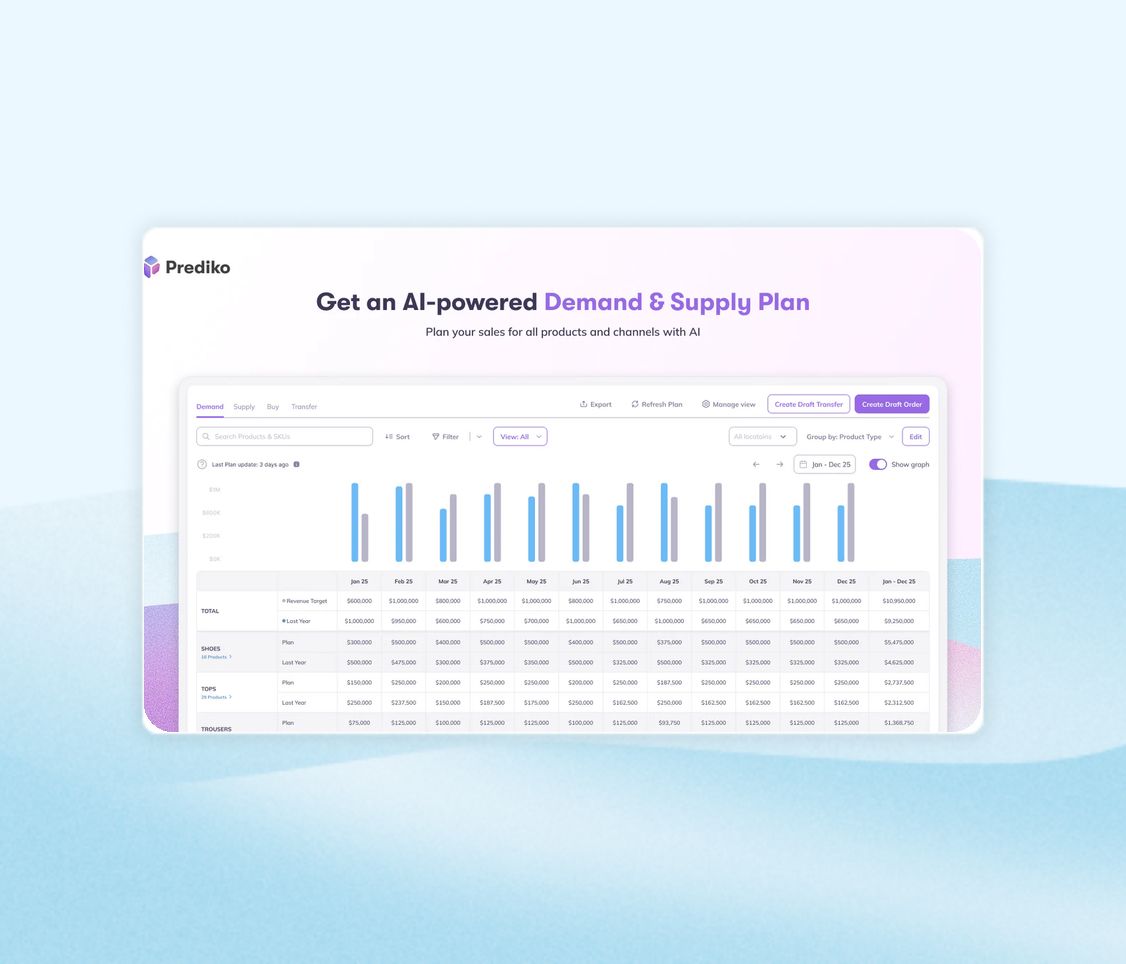
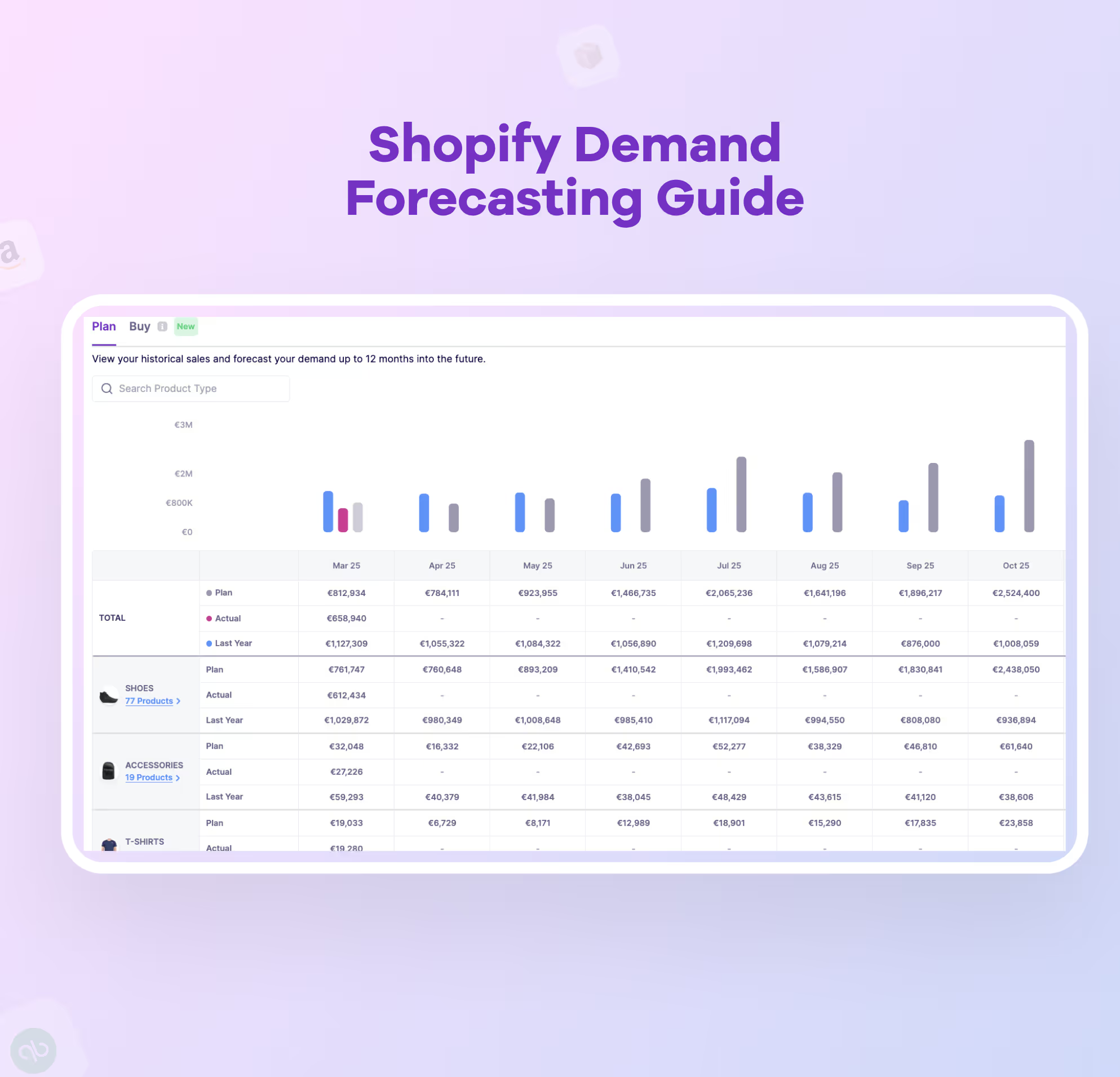
Prediko is an AI-powered inventory forecasting software built specifically for modern eCommerce brands. Our forecasting AI is trained on 15 million of SKUs across 25+ industries to generate demand forecasts, inventory health scores, and automated purchase order recommendations across multiple locations.
Key features
- SKU-level AI inventory forecasting using historical sales, seasonality, and trends
- Buying Table for 1-click purchase order creation based on inventory forecast and stock levels
- Multi-location inventory forecasting across warehouses and stores
- Assign multiple suppliers to the same SKU, each with its own lead time and pricing to easily switch and place POs
- Raw material and BOM forecasting for brands that manufacture or bundle products
- AI agent for creating POs, running forecasts, and surfacing SKU risks through natural language
Integrations
Native Shopify integration (direct, no middleware), Amazon and 100+ 3PL and WMS connections including ShipHero, ShipBoB.
Pricing
Starts at $49/month. Includes unlimited SKUs, users, and POs across all plans. 14-day free trial available.
Best for
Shopify brands managing complex SKU catalogs, multi-location stock, bundles, raw materials, or subscription products. Particularly strong for brands outgrowing spreadsheets and needing a connected forecast-to-purchase workflow.
For a broader look at top forecasting software options on the market, see our comparison of the best inventory forecasting software.
2. Netstock: Best for ERP-Integrated Inventory Planning
Netstock is a demand forecasting and inventory optimization platform designed primarily for businesses already running an ERP system. It works by layering intelligent demand planning and replenishment logic on top of your existing ERP data.
Key features
- Automated demand forecasting with seasonality and trend adjustment
- Dynamic safety stock and reorder point calculations
- Supplier lead time tracking and purchase order management
- What-if scenario analysis for demand and supply changes
- Native integrations with major ERP systems (SAP, Sage, Netsuite, Microsoft Dynamics)
Integrations
Deep ERP integrations (SAP Business One, Sage, Microsoft Dynamics, NetSuite, Epicor, and more). Limited Shopify-native capability.
Pricing
Available on request. Pricing is based on SKU count and ERP tier.
Best for
Businesses running established ERP systems that want to layer demand-driven inventory planning on top of their existing operations without replacing core infrastructure.
3. Cin7: Best for Multichannel Inventory Forecasting
Cin7 is a connected inventory and order management platform with AI-powered demand forecasting built in through its ForesightAI module. It's designed for businesses selling across multiple channels who need a single system to manage stock, orders, and purchasing.
Key features
- ForesightAI for AI-driven demand forecasting and restock recommendations
- Real-time inventory visibility across channels, warehouses, and locations
- Purchase order management and supplier tracking
- Multi-channel integrations including Shopify, Amazon, wholesale, EDI, and 3PLs
- Barcode scanning, receiving, and warehouse workflows
Integrations
Shopify, Amazon, eBay, Xero, QuickBooks, 3PLs, EDI, and 700+ others through native and third-party connectors.
Pricing
Starts at $349/month. Enterprise pricing available.
Best for
Growing product businesses that need a connected operations platform across multiple sales channels, with demand forecasting as one component of a broader inventory and order management system.
4. Logility: Best for Enterprise Inventory Optimization
Logility is an enterprise supply chain planning platform with a dedicated InventoryAI+ module for demand forecasting and inventory optimization. It's built for complex multi-tier supply chains where inventory decisions need to account for production constraints, distribution networks, and service levels across multiple locations.
Key features
- InventoryAI+ for demand forecasting and multi-echelon inventory optimization
- Dynamic safety stock calculations based on service level targets
- Inventory segmentation by SKU, location, and demand tier
- Scenario modeling for supply disruptions, demand shifts, and product launches
- Advanced analytics and reporting for supply chain performance
Integrations
Connects to major ERP systems (SAP, Oracle, Microsoft Dynamics). Designed for mid-to-large enterprises with existing technology stacks.
Pricing
Available on request. Enterprise pricing based on scope and modules.
Best for
Enterprise and mid-market companies with complex, multi-tier supply chains that need integrated demand forecasting and inventory optimization across production, distribution, and retail.
5. NetSuite: Best for ERP-Native Inventory Forecasting
NetSuite includes native demand planning and inventory forecasting through its Supply Chain Management module. It's designed for businesses already running NetSuite as their ERP, where inventory forecasting is one part of a fully integrated business management system covering finance, operations, and supply chain.
Key features
- Demand planning using historical sales data, trends, and open orders
- Automated reorder points and safety stock calculations
- Real-time inventory commitments across locations and channels
- Multi-location inventory tracking with detailed transfer and adjustment workflows
- Native connection to NetSuite purchasing, order management, and financials
Integrations
Native within NetSuite ERP. Connects to Shopify and other platforms through third-party connectors or SuiteApps.
Pricing
Available on request. Pricing depends on modules, user count, and contract terms.
Best for
Businesses already running NetSuite that want inventory forecasting natively integrated with their ERP without adding a separate planning tool.
6. Inventory Planner: Best for Multi-Channel Retail Forecasting
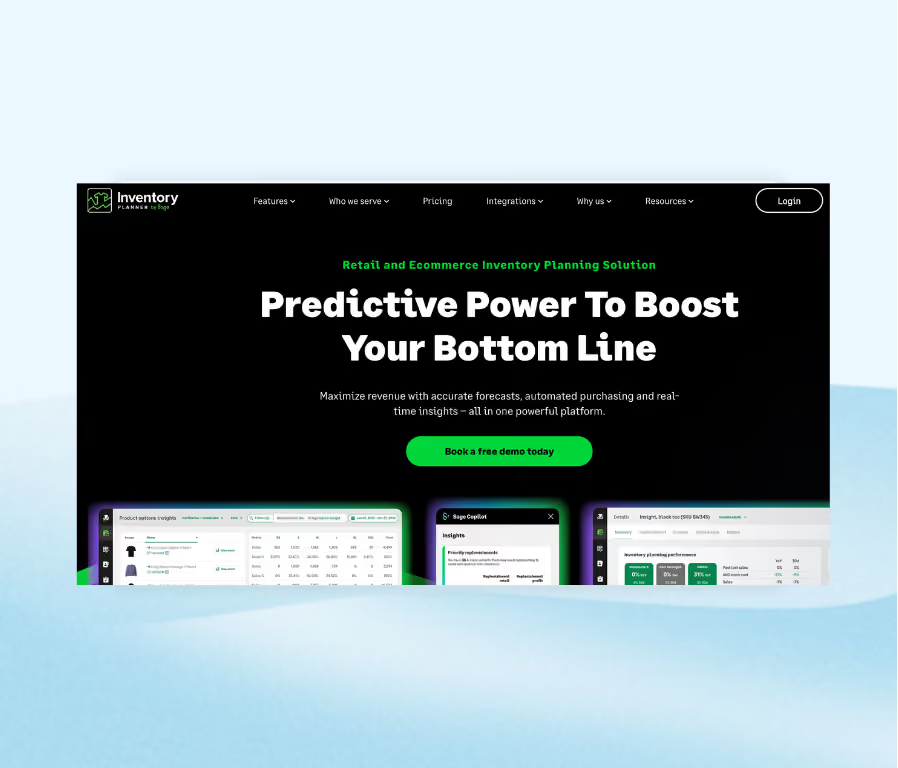
Inventory Planner is a demand forecasting and replenishment platform built for retailers selling across multiple channels and marketplaces. It combines machine learning and time-series models to forecast demand at the SKU level and recommend reorder quantities.
Key features
- Inventory Planner AI for demand forecasting based on historical sales, seasonality, and trend analysis
- Multi-channel forecasting across marketplaces including Amazon, Walmart, eBay, and BigCommerce
- Automated reorder point and reorder quantity recommendations
- Multi-warehouse and multi-location inventory planning
- Reporting and dashboards for inventory performance
Integrations
Shopify, Amazon, Walmart, eBay, BigCommerce, and various accounting and ERP systems.
Pricing
Available on request.
Best for
Retailers and wholesalers selling across multiple marketplaces that need established, multi-channel demand planning.
Brands with a Shopify-first, fast-moving catalog may find Prediko's native Shopify sync and faster onboarding a better fit; see our full Inventory Planner alternatives comparison for a deeper breakdown.
How to Evaluate AI-Powered Inventory Forecasting Software
Most tools in this category claim to "use AI," but what that actually means in practice varies significantly. Here's what to look at when evaluating options.
1. How does the AI actually work?
Ask vendors to explain their forecasting methodology. The best tools combine classical time-series models with machine learning, giving you a baseline that can adapt to real demand shifts. Tools that only show historical averages with a basic trend line aren't doing much beyond Excel.
Prediko's AI is trained on millions of SKUs across 15+ industries, which means it already understands common demand patterns before it even sees your data.
2. Does it update in real time?
A forecast that refreshes weekly can miss fast-moving demand shifts. Look for tools that sync sales and inventory data continuously and adjust recommendations when conditions change, not just at the end of a planning cycle.
3. What does it do with the forecast?
Forecasting is only useful if it leads to a decision. The best tools don't just generate a number; they tell you what to order, flag which SKUs are at risk, and make it easy to act. Prediko connects the forecast directly to the Buying Table, so the path from insight to purchase order is a single step.
4. How does it handle edge cases?
New products with no sales history, bundles, raw materials, promotions, and seasonal spikes all break simple forecasting models. Ask how the tool handles each case relevant to your catalog.
5. Can your team actually use it?
A tool that requires a data analyst to interpret results isn't practical for most D2C or mid-market teams. Look for clear dashboards, actionable alerts, and onboarding processes that don't take months.
6. What's the real cost of implementation?
For Shopify brands, Prediko connects in minutes and requires no technical setup. Enterprise tools / AI demand planning software often involve months of implementation, data migration, and training, with ongoing maintenance costs on top of licensing fees.
Which Inventory Forecasting Tool Should You Choose?
The right tool depends on your current setup, SKU complexity, and where your forecasting is breaking down most.
If you're running on Shopify, the answer is straightforward: Prediko is built specifically for this environment, and the gap between it and generic planning tools is significant, both in ease of use and the quality of recommendations it generates.
For ERP-based businesses, Netstock and Logility offer deep integrations and sophisticated planning capabilities, but come with longer implementation timelines and higher price points.
For businesses running NetSuite or needing multichannel inventory management at scale, NetSuite's native module, Cin7, or Inventory Planner may be worth evaluating depending on what you already have in place.
Whatever you choose, the key is moving away from reactive, spreadsheet-based planning toward a system that surfaces the right information at the right time and makes it easy to act. You can learn more about finding the right fit in our full breakdown of inventory forecasting options by category.
Frequently Asked Questions on AI Inventory Forecasting Software & Tools
What is AI-powered inventory forecasting?
AI-powered inventory forecasting uses machine learning models to analyze historical sales, market trends, and operational data to predict future product demand. Unlike rule-based systems, AI forecasting adapts to new patterns without manual reconfiguration.
How accurate are AI inventory forecasting tools?
Accuracy varies significantly by tool and product type. The best AI tools reduce forecast error by 20–40% compared to manual methods, but they require clean data, sufficient sales history, and regular calibration to maintain accuracy.
Can AI inventory forecasting tools integrate with Shopify?
Yes. Prediko is the leading AI inventory forecasting tool built natively for Shopify. It connects directly without middleware, syncing all sales, inventory, and purchasing data in real time.
What data does AI inventory forecasting software use?
Most tools use a combination of historical sales data, inventory levels, lead times, and seasonal patterns. Advanced tools also factor in growth trends, product attributes, and demand broken down by channel or location to generate reliable forecasts.
Key Questions to Ask Before Choosing an AI Inventory Forecasting Tool
Does the tool integrate with Shopify?
Yes. Software such as Prediko, Flieber, and Inventory Planner offer direct integrations.
Can AI automatically create purchase orders?
Some software automate PO generation based on forecasts.
Does it support multi-warehouse planning?
Enterprise tools like Logility and NetSuite support multi-location planning. Prediko covers this for Shopify brands at a fraction of the price.









.avif)