




If you've ever stared at a Shopify inventory report and thought "I have no idea if this is too much stock or not enough", Weeks of Supply (WOS) is the single number that answers it.
It's not a forecast. It's not a reorder point. It simply tells you that at today's sales rate, how many weeks until you stock out?
Master this one formula and you'll stop guessing about reorders, stop tying up cash in dead stock, and stop apologizing to customers when your hero SKU goes out of stock the week before Black Friday.
In this article, we cover
- The exact weeks of supply formula (with a calculator you can copy)
- Three worked examples from real Shopify brands
- How to set a target WOS for every SKU (most guides skip this)
- WOS vs. days of supply vs. inventory turnover: when to use which
- Why static WOS breaks for seasonal brands, and what to do instead
What is Weeks of Supply?
Weeks of Supply (WOS) is the number of weeks your current on-hand inventory will last, given your recent average weekly sales.
If you sell 50 units a week and you have 400 units in your warehouse, you have 8 weeks of supply.
That's it. It's a ratio: current stock divided by sell-through speed, expressed in time.
Retailers, wholesalers, and DTC brands all use it because it answers the question every operator actually cares about: "How long do I have before I run out?"
How to Calculate Weeks of Supply: Using The Weeks of Supply Formula
The core formula is:
Weeks of Supply = On-Hand Inventory ÷ Average Weekly Sales
Where:
- On-Hand Inventory = units currently in your warehouse, 3PL, and retail locations available to sell (don't count damaged, reserved, or in-transit stock unless you have a reason to)
- Average Weekly Sales = units sold per week, averaged over a recent window (commonly the last 4, 8, or 12 weeks)
Worked example #1: A single Shopify SKU
You sell a stainless-steel water bottle. Last 8 weeks of Shopify sales:
Average weekly sales = 840 ÷ 8 = 105 units/week
On-hand inventory today = 525 units
WOS = 525 ÷ 105 = 5.0 weeks
You have five weeks of stock. Whether that's good or bad depends on your target WOS, which depends on your supplier lead time. We'll get to that in a minute.
Should You Use Weeks of Supply or Days of Supply?
Same idea, different denominator.
Days of Supply = On-Hand Inventory ÷ Average Daily Sales
Use days of supply for fast-moving SKUs where a week is too coarse, let’s say perishables, FMCG, hero SKUs doing 100+ units/day.
Use weeks of supply calculation for everything else. For most Shopify brands selling apparel, accessories, home goods, supplements, or beauty, weeks is the right unit.
The numbers stay readable (5.0 weeks reads cleaner than 35 days), and weekly cycles match how most teams plan.
Choosing the Right Sales Window
The "average weekly sales" part of the formula hides a decision: averaged over how many weeks?
There's no universal answer, but here's the rule of thumb:
The trap: a 4-week average right after a viral TikTok will tell you to over-order for the next year. A 12-week average right before peak season will leave you understocked. Always check your sales window against the calendar before trusting the WOS number.
Smarter approach: use forecasted demand, not historical demand
Static WOS uses what already happened. That breaks any time the future doesn't look like the recent past: peak season, a new ad campaign, a price change, a new sales channel.
The upgrade is to swap historical average sales for forecast average sales:
Forward Weeks of Supply = On-Hand Inventory ÷ Forecast Average Weekly Sales
Forecast WOS uses next-period demand instead of last-period demand.
A forecasting tool like Prediko handles this automatically per SKU on your Shopify store, but you can build a working version in a spreadsheet with a 3-month moving average × a seasonality index.
Use whichever fits your stage, but know that historical WOS is a lagging indicator. Forward WOS is the one operators actually plan with.
Free Weeks of Supply Calculator (Spreadsheet)
Copy these columns into Google Sheets. Replace the example values with your own.
Then add a sixth column F: Action with this formula:
=IF(D2 < E2*0.5, "REORDER NOW",
IF(D2 < E2, "Reorder soon",
IF(D2 > E2*2, "Overstocked", "Healthy")))
That's the entire stock-health dashboard most early-stage Shopify brands need. Pull on-hand from Shopify Admin → Products → Inventory; pull average weekly sales from your Shopify Sales by product report (or any analytics tool) for the last 56 days ÷ 8.
What's a Good Weeks of Supply Target?
This is where most articles stop. They give you the formula, then leave you to figure out whether 5 weeks is good or terrible.
The honest answer: your target WOS depends on lead time, safety stock, and sales variability and it's different for every SKU.
The simplest target-WOS formula:
Target WOS = Supplier Lead Time (weeks) + Safety Stock (weeks)
Where safety stock in weeks is roughly the buffer you want against demand spikes and supplier delays, typically 25-50% of lead time for established SKUs, more for new launches or unreliable suppliers.
One thing that trips up a lot of operators: safety stock is in addition to your lead time, not built into it.
A brand sourcing from overseas with a 21-week lead time once asked us whether their safety stock setting already accounted for that lead time. It doesn't. Lead time tells Prediko when to alert you to reorder.
Safety stock is the buffer that ensures stock is still on shelf when the shipment arrives. They're separate inputs, and confusing the two is how you end up ordering too late.
Worked example #2: Setting a target
You source the water bottle from a factory in Vietnam.
- Lead time: 10 weeks (production + freight + customs + 3PL receiving)
- Safety stock buffer: 50% of lead time = 5 weeks (long lead time, variable freight)
Target WOS = 10 + 5 = 15 weeks
That means: as soon as you drop below 15 weeks of supply, you need to place the next PO. If you let yourself coast down to 10 weeks before ordering, your factory's lead time means you'll stock out before the new shipment lands.
One of our customers with a 14-day lead time wanting 60–90 days of cover used a simple rule: set safety stock equal to lead time (14 days), then set days of cover to 90. That gives a healthy range of 14–90 days at delivery.
Worked example #3: A local SKU
You also sell a printed T-shirt fulfilled by a US-based print-on-demand partner.
- Lead time: 1 week
- Safety stock buffer: 100% (high lead time variability, low absolute lead time) = 1 week
Target WOS = 1 + 1 = 2 weeks
Remember, short lead times don't mean you can skip the safety stock calculation, they just mean the numbers are smaller.
A specialty food brand working with Prediko had a 2-week supplier lead time and wanted 60–90 days of cover across their catalogue. Their starting rule: set safety stock equal to lead time.
That gave them a floor of 14 days and a ceiling of 90, with Prediko flagging anything that dropped below the floor. Simple to set, easy to adjust per SKU as they learned which suppliers were reliable and which weren't.
Same formula. Wildly different numbers. Target WOS isn't a brand-level setting; it's a per-SKU setting based on how that SKU's supply chain actually works.
Target WOS cheat sheet
How to Interpret Your Weeks of Supply Number
Once you have current WOS and target WOS side by side, here's how to read the gap:
1. WOS far below target → Reorder *yesterday*
If current WOS is less than half your target (e.g. target 8, current 3), you're in stockout territory. Place the PO immediately and consider air-freighting to compress lead time.
2. WOS slightly below target → Reorder this week
The healthy zone. Your reorder is timely, your factory has runway, and you'll receive new stock before you bottom out.
3. WOS at target → All good, no action
Inventory is doing what it's supposed to. Move on.
4. WOS 1.5× to 2× target → Watch the sell-through
You're carrying more stock than you planned. Sometimes that's intentional (peak season, viral product); sometimes it's the early warning of slowing demand. Check the trend of weekly sales, not just the average.
5. WOS more than 2× target → Overstock
You've tied up cash in inventory you can't sell fast enough. Options: promotion, bundling, B2B/wholesale offload, or last resort markdown to clear and free up working capital. The longer overstock sits, the more it costs you in warehousing and obsolescence.
Weeks of Supply vs. Inventory Turnover vs. Reorder Point
These three metrics get confused constantly. Here’s a quick reference:
- WOS is forward-looking and operational. You use it daily/weekly.
- Turnover is backward-looking and financial. You use it for board reports and capital planning.
- Reorder point is a trigger. WOS tells you when to hit that trigger.
If you only have time for one, use WOS. It's the most actionable for day-to-day inventory decisions on Shopify.
Common Weeks of Supply Mistakes (And How to Avoid Them)
1. Using lifetime-average sales instead of recent
A SKU that sold 50/week for a year and 200/week for the last month doesn't have "115 average weekly sales." It has 200, and you need to plan accordingly. Recent windows reflect current reality.
2. Forgetting in-transit inventory
When you've already shipped a PO that lands in three weeks, your effective WOS three weeks from now is (on-hand + in-transit) ÷ avg weekly sales measured at landing.
Most brands track this as "weeks of supply with open POs." It prevents the classic mistake of double-ordering because today's number looks scary.
3. Using a single WOS target for every SKU
Already covered above. Per-SKU is the only correct way.
4. Ignoring seasonality
A 6-week WOS in mid-November for a Christmas-gift SKU is not the same as a 6-week WOS in mid-February for the same SKU.
The same number means "danger" in one case and "overstock" in the other. Forward WOS (using forecasted demand) fixes this; static WOS doesn't.
5. Calculating once a month
WOS is most useful when it's live. If you only check it monthly, you'll miss the two-week window where you should have ordered. Most healthy Shopify ops check WOS weekly at minimum and modern forecasting tools surface it daily.
When Static WOS Stops Being Enough
For a single-SKU brand with steady demand, the spreadsheet method works fine.
It breaks down when you have:
- 50+ SKUs: manually maintaining target WOS per SKU becomes a job in itself
- Multiple sales channels: Shopify + Amazon + wholesale all draw from the same inventory pool but at different rates
- Strong seasonality: flat averages over- or under-state demand at every turning point
- Active paid acquisition: sales rates shift with ad spend, making historical averages misleading
- Multiple warehouses or 3PLs: on-hand is distributed, and WOS needs to be per-location
At that scale, dedicated demand-forecasting tools become a important for sustenance and growth. They run a forward WOS per SKU, factor in seasonality and trend, integrate open POs and in-transit, and surface a daily reorder queue.
Prediko does this natively for Shopify brands, offering AI demand and supply planning by SKU and season, a dynamic replenishment table with smart buy alerts built around your lead times and safety stock.
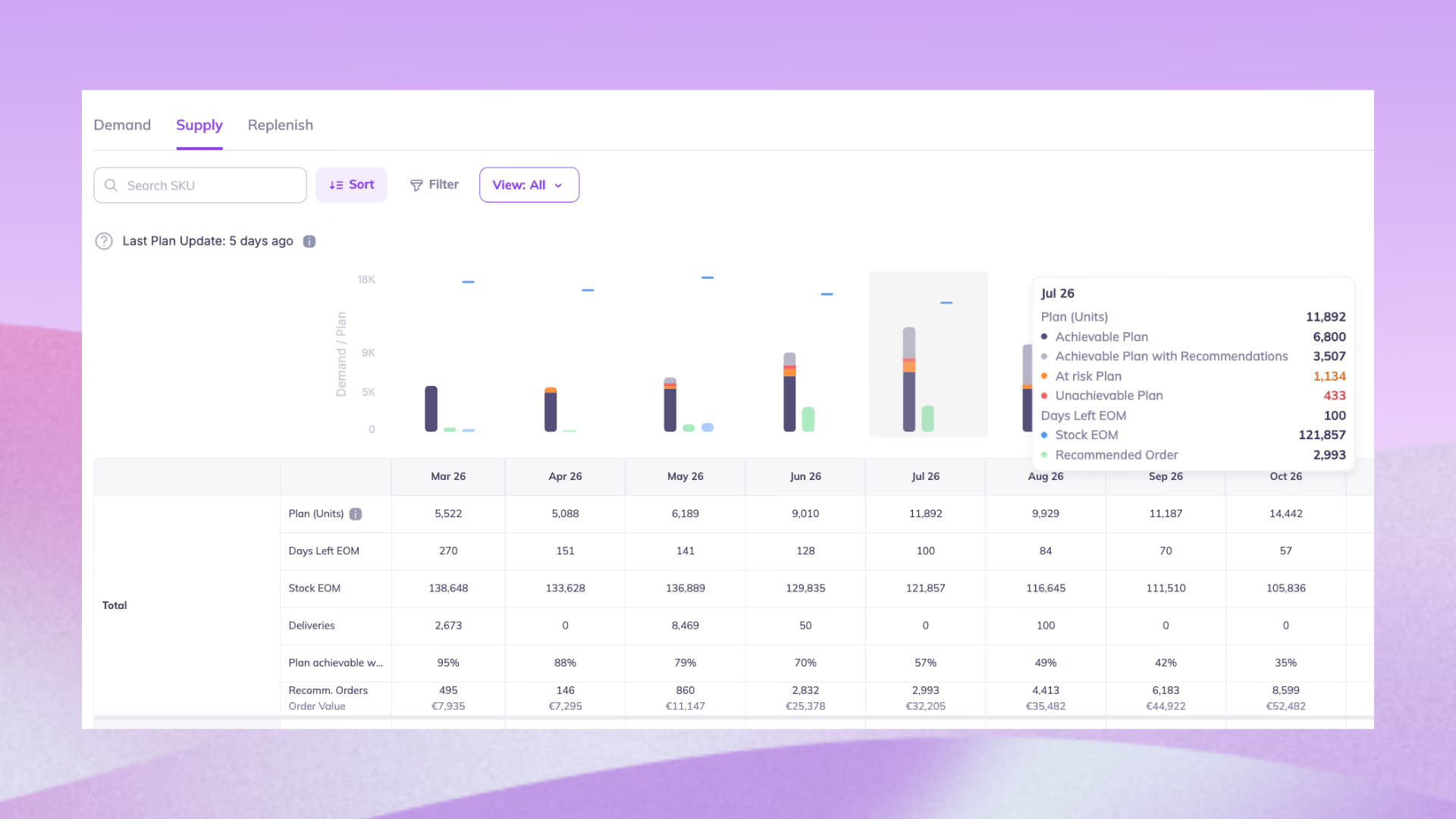
It also offers one-click PO creation synced with your WMS and inventory reports across all locations.
Remember, static WOS shows you the present. Forward WOS is what you need to actually plan with and that’s exactly what tools like Prediko help with.
Frequently Asked Questions
Q: What does WOS mean in inventory?
WOS stands for Weeks of Supply. It is the number of weeks your current inventory will last at your current sales rate. It's calculated as on-hand inventory divided by average weekly sales.
Q: How do you calculate weeks of supply in Excel?
Put on-hand units in column B, average weekly sales in column C, and use =B2/C2 in column D. Add a target WOS column and a conditional formula to flag SKUs to reorder.
Q: What's the difference between weeks of supply and weeks of cover?
They're the same metric, "weeks of cover" is more common in UK/EU retail, "weeks of supply" in US retail. Both mean "how long current stock will last."
Q: What's a good weeks of supply for a Shopify store?
There's no single number. Your target WOS equals your supplier lead time plus a safety-stock buffer, calculated per SKU. Domestic POD SKUs sit at 2–3 weeks; overseas sea-freight SKUs sit at 14–18 weeks.
Q: Can weeks of supply be negative?
No, but it can be zero, that's a stockout. It can also be misleadingly high right after a sales dip, which is why a forward-looking WOS based on forecast demand is more reliable than historical WOS alone.











.avif)