




$1.2 trillion. This is what the global retailers lose annually to out-of-stock situations, with North American merchants alone absorbing $144.9 billion in losses.
North American merchants face a particularly sharp edge of this crisis. Consumer expectations for fast, reliable fulfillment have never been higher, and the margin for error has never been thinner.
That’s why open-to-buy planning has evolved from a legacy retail workflow into a must-have for modern brands, including those on Shopify.
What is an Open-to-Buy (OTB) Plan?
Open-to-Buy is an inventory management strategy that helps retailers calculate exactly how much inventory they need to purchase in order to meet sales targets while maintaining positive cash flow.
The OTB framework relies on three interconnected components:
- Planned Sales: Your forecasted revenue for a given period, which is the basis of the entire calculation
- Inventory Levels: The ending stock you need on hand to support future demand without tying up excess capital
- Markdowns: Anticipated discounts, returns, and shrinkage that reduce the inventory value and must be accounted for upfront
For scaling Shopify brands, this distinction matters a lot. Merchants who operate without an OTB framework routinely cycle between overstock situations that drain cash and stockouts that send customers to competitors. OTB breaks that cycle.
It's the bridge between your revenue goals and your purchasing decisions and understanding its components is the foundation for implementing it effectively, which is exactly what the next section covers.
Who Should Use Open-To-Buy Planning?
Open-to-buy planning is most valuable for:
- Shopify brands with 100+ SKUs
- Ecommerce teams managing seasonal inventory
- Multi-channel retailers
- DTC brands forecasting purchase orders monthly
- Brands struggling with stockouts or excess inventory
- Merchants managing long supplier lead times
In short, if you're spending more time fixing inventory mistakes than making decisions, OTB planning is what you need.
The 5-Step Open-to-Buy Planning Process
Now that you understand what OTB planning in retail is and why it matters, let's break down exactly how to build one.
Whether you're starting from scratch or refining an existing open to buy plan template, these five steps form the foundation of every effective OTB strategy.
Step 1: Forecast sales based on historical data
Start with your Shopify sales history (ideally 12 to 24 months) and identify trends, seasonal spikes, and growth plans. Adjust for any planned promotions or new product launches that could shift demand.
Step 2: Factor in planned markdowns and returns
Sales revenue isn't the only variable. Account for markdowns you're planning to clear slow-moving stock, plus typical return rates by category.
Ignoring these numbers inflates your open to buy budget and leads to over-buying. A realistic view here protects your margins downstream.
Step 3: Calculate your ending inventory target
Decide how much inventory you want on hand at the end of the period. This is your safety net, enough to prevent stockouts without tying up unnecessary capital.
Step 4: Assess on-hand and on-order stock
What do you already have? Pull your current inventory levels and any purchase orders already in transit. These existing commitments reduce how much new buying you can actually do.
Step 5: Determine the final OTB budget
Here's where it all comes together. According to Shopify, the standard formula for the OTB budget is:
Planned Sales + Planned Markdowns + Planned End of Month Inventory − Beginning of Month Inventory = Open-to-Buy at Cost
Let’s take an example
This formula gives you a clear, defensible number to guide purchasing decisions. The math is straightforward. The challenge, as we'll explore next, is keeping those inputs accurate in real time.
Why Manual Open To Buy Plan Templates Fail Fast-Growing Brands
Understanding what is an open to buy plan is just the starting point. Building one is the real battle and if you’re doing it inside a spreadsheet, then it is a recipe for costly, compounding errors, especially once your Shopify store starts scaling. Here’s why.
1. The spreadsheet trap
Manual OTB templates require constant data entry: updating sell-through rates, adjusting planned sales, and reconciling stock on hand.
Every step introduces human error. A misplaced formula, a stale import, or a forgotten vendor lead time can quickly skew your entire buying budget.
In practice, these small mistakes spiral, leading to overstocks and out-of-stocks.
2. The real cost: lost customers and revenue
Slow manual updates don't just hurt your margins; they drive customers straight to competitors.
69% of online shoppers will immediately abandon their purchase and switch to a competitor if their desired item is out of stock, according to Opensend.
Even more alarming: 91% of customers refuse to wait for a restock, leading to permanent customer churn. When your OTB spreadsheet is updated weekly or monthly, you're always losing customers in between.
3. Static templates vs. real-time velocity
Shopify's sales environment moves fast. Flash sales, viral trends, and seasonal spikes can shift demand within hours. A static template simply can't keep pace. By the time you've manually updated your figures, the window to act has already closed.
Common Pitfalls in OTB Planning (And How to Avoid Them)
Retail or Shopify inventory management often fails at predictable points. Knowing these pitfalls helps maintain a functional OTB plan.
- Over-relying on historical data is a common mistake. Past sales patterns are useful but can't predict changing consumer behavior or trends. A static budget only minimizes costs when demand is predictable, which is rare.
- Lead times and shipping delays are other blind spots. Calculating OTB without accounting for these factors results in late inventory, shrinking sales windows, and markdowns. Work backward from a realistic in-store date.
- Treating the OTB budget as a suggestion undermines the process. Buyers who override limits for exceptions take away the discipline of OTB. The budget is a cash flow limit, not a negotiable ceiling.
- The Excel trap is where rigor collapses. Manual spreadsheets introduce errors and stale data. If using spreadsheets, consider structured forecasting models.
Avoiding these pitfalls turns OTB from a theory into a reliable system, distinguishing merchants who control profitability from those who react to it.
The right software eliminates these gaps entirely, which is exactly what the next section explores.
Choosing the Best OTB Software for Your Shopify Store
Once you've moved past the limitations of manual spreadsheets, the next question becomes: what should you actually look for in a software solution? The wrong choice can mean trading one set of headaches for another.
Here's a practical checklist of must-have features before you commit.
Must-have features for Shopify OTB software
- Native Shopify integration: Real-time data sync with your store is non-negotiable. Modern OTB software must connect directly to your e-commerce platform to eliminate the data lag that makes spreadsheet-based plans unreliable within days of building them.
- AI-driven demand forecasting: Simple moving averages don't account for seasonality, promotions, or shifting consumer trends. Look for tools that use demand sensing to anticipate what's coming.
- Daily OTB visibility: Monthly data leaves too much room for error. The best platforms update your OTB plan in real time, so purchasing decisions reflect today's stock levels and velocity.
- Intuitive interface: Legacy ERP systems carry loads of complexity that slow teams down. A modern merchant needs clarity and an intuitive platform, not a 40-hour training.
- Purchase order automation: The platform should translate forecasts directly into actionable POs, reducing manual work between planning and execution.
Why integration is the foundation
Without a live connection to your Shopify store, every other feature is compromised. Inventory counts go stale, sales data drifts out of sync, and the margin for human error widens fast.
The tools that win are those that remove the distance between data and decision. Real-time visibility turns OTB from a monthly ritual into a daily check, one that scales as your catalog and order volume grow.
That shift from reactive to proactive planning is exactly what the right software enables. To see what that looks like in a live business context, the next sections break down a real-world example worth studying closely.
Prediko: An AI-Driven OTB Planning Software
Prediko replaces static spreadsheets with a dynamic, real-time OTB system integrated directly with Shopify. It eliminates the "Excel trap" by centralizing demand planning, supply planning, and purchase order management in a single source of truth.
Key features include
- AI-powered demand forecasting: Trained on over 25 million SKUs, Prediko accounts for seasonality, growth trends, and promotions to set accurate data-backed purchase limits.
- Supply planning: A PO calendar that shows how much of which SKUs would you need each month (and overall), along with the expected budget for the year.
- Replenish table: This helps you transition from a demand forecast to a purchase order in one click, ensuring orders align with current sales velocity and lead times.
- Proactive stock alerts: Automated warnings flag stockout or overstock risks before they impact margins, allowing for real-time OTB budget adjustments.
- Raw material OTB planning: Extends your OTB budget down to the component level, linking finished goods forecasts to raw material requirements so procurement stays ahead of production.
For brands still weighing the leap from manual buy OTB planning to automated forecasting, real-world results tend to settle the debate faster than any feature comparison.
Kuppa Joy Reduced 90% Ordering Errors With Prediko
Kuppa Joy, a community-focused coffee brand, faced significant operational friction across its eight retail shops, roastery, bakery, and centralized warehouse.
The challenge: "Shot in the Dark" Procurement
Before implementing Prediko, Kuppa Joy relied on a mix of spreadsheets and whiteboards. Their strategy was essentially a "shot in the dark", taking the previous year's order numbers and applying a flat multiplier.
This manual process lacked visibility into warehouse-specific needs and varying lead times, resulting in frequent over-ordering and unexpected shortages.
The solution: Usage-based OTB planning
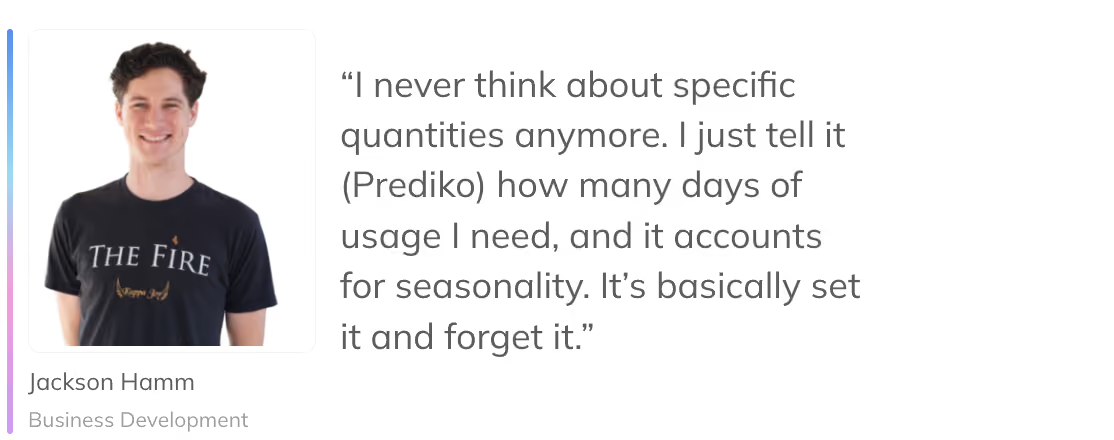
Kuppa Joy shifted from static, guess-based ordering to Prediko’s dynamic, usage-based planning model. By defining "days of coverage" rather than fixed inventory quantities, they allowed the system to automatically adjust for seasonality and current trends.
The results
What used to be hours of manual work is now streamlined and predictable. The team spends less time fixing errors and more time making better decisions.
- 10 hours/week saved on inventory tasks
- 900+ purchase orders created
- 90% reduction in ordering errors
Improve Your Business Profitability with Structured OTB Planning
Open to buy planning is a fundamental shift from defensive, intuition-based purchasing to a proactive, data-driven one.
By moving away from static budgets and embracing a rolling open to buy retail model, you stop viewing inventory as "frozen capital" and start treating it as a liquid asset that fuels growth.
Implementing a structured open-to-buy process, especially one using a software, ensures your retail inventory management is optimized for both market volatility and internal stability.
The end result is higher inventory efficiency, fewer forced markdowns, and a healthier bottom line.
If you wish to get started with automated OTB planning, try Prediko free for 14 days.
Frequently Asked Questions
What is open to buy and why is it important for retail inventory management?
It is a financial budget that determines the specific amount of merchandise a buyer can purchase for a specific period. It is a critical component of retail inventory management because it prevents under- and over-purchasing, allowing retailers to remain agile.
How do you calculate the open to buy formula?
To use the open to buy formula, you take your Planned Sales plus Planned Markdowns and Planned End-of-Month Stock, then subtract your Beginning of Month Stock and any inventory currently On Order.
How does the open-to-buy process improve inventory efficiency?
A structured open-to-buy process improves inventory efficiency by aligning your procurement directly with actual consumer demand. By setting strict limits on receipts based on sell-through data, you minimize the risk of overstocking and reduce the need for profit-killing markdowns.
How often should an OTB plan be updated?
Ideally, weekly or daily. Real-time updates help Shopify brands react faster to sales changes, stock risks, and supplier delays.
What metrics affect OTB calculations?
Key metrics include:
- Forecasted sales
- Inventory on hand
- Sell-through rate
- Lead times
- Planned markdowns
- Safety stock
- Inventory on order










.avif)