




“Be careful what you commit to.”
That’s how one Shopify merchant described their experience after 10 months of using Inventory Planner.
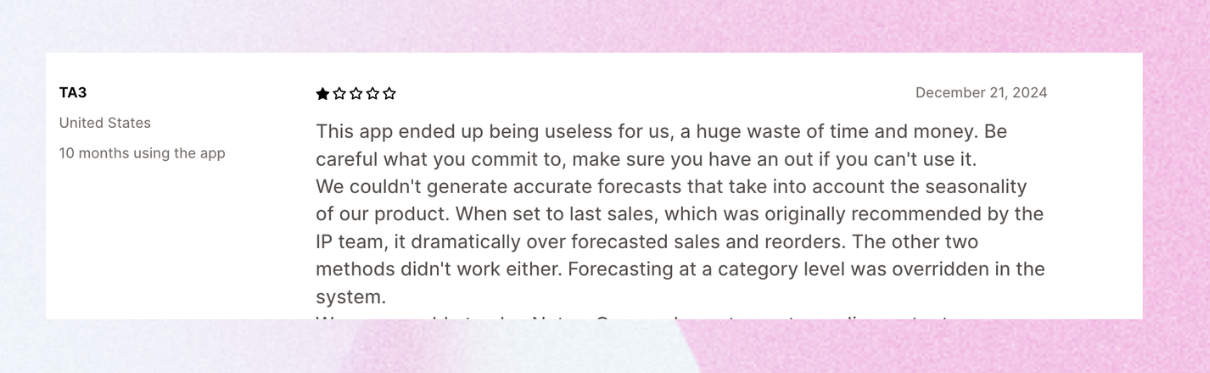
The core issue? Forecasting that didn’t reflect reality.
So the real question is: Is Inventory Planner forecasting still the right fit for modern Shopify brands, or is there a more reliable, seasonality-aware alternative?
We compare Inventory Planner forecasting with Prediko’s AI-driven forecasting to see which one is suited for modern D2C brands.
Inventory Planner Forecasting Vs Prediko’s Forecasting
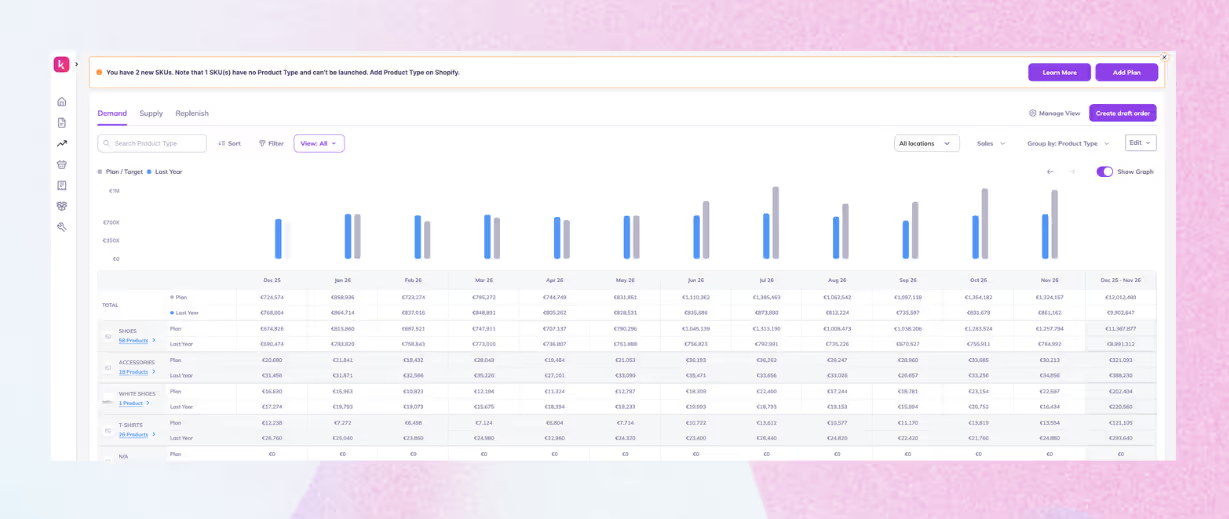
Inventory Planner and Prediko both solve the same problem. Both use data to guide purchasing decisions and reduce stockouts.
But the operational experience is very different.
The difference isn’t just in the forecasting logic. It shows up in what you can track, how your team works inside the platform, and how quickly you can act on decisions.
Ultimately, the choice comes down to this: do you need a traditional, hands-on planning tool for retail environments or a modern, automated system designed for speed and agility?
Here’s how the two compare.
1. Forecasting engine backend logic
Both Inventory Planner and Prediko use data-driven forecasting, but the underlying logic and level of automation differ significantly.
Inventory Planner
Inventory Planner uses a combination of machine learning and time-series models to forecast demand based on
- Historical sales performance
- Seasonality patterns
- Trend analysis at the SKU level
This approach works well for brands with consistent historical data and predictable demand cycles. However, some users report needing manual adjustments to handle
- Rapidly changing demand
- Strong seasonality
- Fast-moving or newly launched SKUs
As a result, forecast accuracy can depend heavily on how actively teams monitor and tune the system.
Prediko
Prediko is powered by an AI algorithm trained on 25M+ SKUs across 15 industries, allowing it to learn from broader demand patterns rather than relying solely on a brand’s own history.
Its forecasting engine offers
- 12-month rolling demand plans
- Easy forecast adjustments based on planners’ expertise
- Automatic forecast generation for new SKU launches
- Plan achievability metrics to assess forecast reliability
- Reported 90%+ forecast accuracy to help reduce stockouts
In addition to demand forecasting, Prediko automatically generates supply plans to validate the budget, recommends purchase quantities and timings, and creates POs with a click.
You can still fine-tune forecasts, but the app is designed to minimise constant manual intervention.
Key takeaways
2. Forecasting capabilities
Both platforms cover the fundamentals of demand forecasting, but they diverge when it comes to depth, flexibility, and support for complex business models.
Inventory Planner and Prediko both
- Generate SKU-level demand forecasts
- Recommend reorder quantities to prevent stock-outs and overstocking
- Support multi-location inventory planning
These shared capabilities make either tool viable for basic inventory forecasting needs. However, there are some nuances that we will discuss below.
Inventory Planner
Inventory Planner is built to support multi-channel retail operations, offering forecasting across
- Multiple warehouses
- Marketplaces such as Amazon, Walmart, and eBay
- Ecommerce platforms like BigCommerce
However, there are some operational limitations noted by users, which include
- Limited native support for subscription-based demand forecasting, meaning recurring orders often need to be modeled through historical sales or manual adjustments
- Bundles are treated as virtual kits, with demand distributed to component SKUs but not tracked as independently stocked items
- Shopify data is synced through API, and some users report occasional sync delays or inconsistencies that may affect how quickly forecasts reflect the latest sales data
Brands managing time-sensitive inventory, subscriptions, or complex bundled product structures may therefore rely on manual adjustments or external systems to complement Inventory Planner’s forecasting workflows.
Prediko
Prediko extends forecasting beyond finished goods, making it suitable for manufacturers and modern D2C brands.
Its capabilities include
- Raw materials forecasting, with support for importing BOMs and linking finished-goods demand to component-level forecasts.
- Forecasting for subscription-based products. Sync Protein used Prediko’s subscription forecasting to accurately account for recurring demand, trends, and seasonality in their replenishment planning.
- Real-time native sync across multiple Shopify stores and warehouses, powered by 100+ integrations and a public API.
- Bundles appear at the bundle level in the demand plan, and the replenishment view shows the underlying component demand derived from those bundles.
While Prediko’s ecosystem is primarily Shopify-centric, it supports 100+ integrations, including Amazon, to create a fully connected workflow. This focused approach enables deeper real-time data syncing and more responsive forecasting within the Shopify environment.
Key takeaways
3. Ease of use in creating a forecast
Ease of use plays a major role in how quickly teams can trust and act on forecasts. Both platforms take very different approaches to usability and onboarding.
Inventory Planner
Inventory Planner offers a feature-rich interface with extensive configuration options. While powerful, this depth can feel complex and overwhelming, particularly for smaller teams.
Common usability challenges noted in user reviews include
- A steep learning curve during initial setup
- Difficulty customising dashboards and reports
- Inaccurate forecasts for highly seasonal and fast-moving products
As a result, onboarding typically takes more than two weeks, often requiring dedicated training and ongoing internal ownership.
Prediko
Prediko is designed as a plug-and-play forecasting solution, prioritising speed and simplicity without sacrificing depth.
Key usability highlights include
- Store and data connections completed within a maximum of 24 hours
- Full platform adoption typically achieved in 2-4 weeks
- An intuitive user interface focused on guided workflows rather than manual configuration
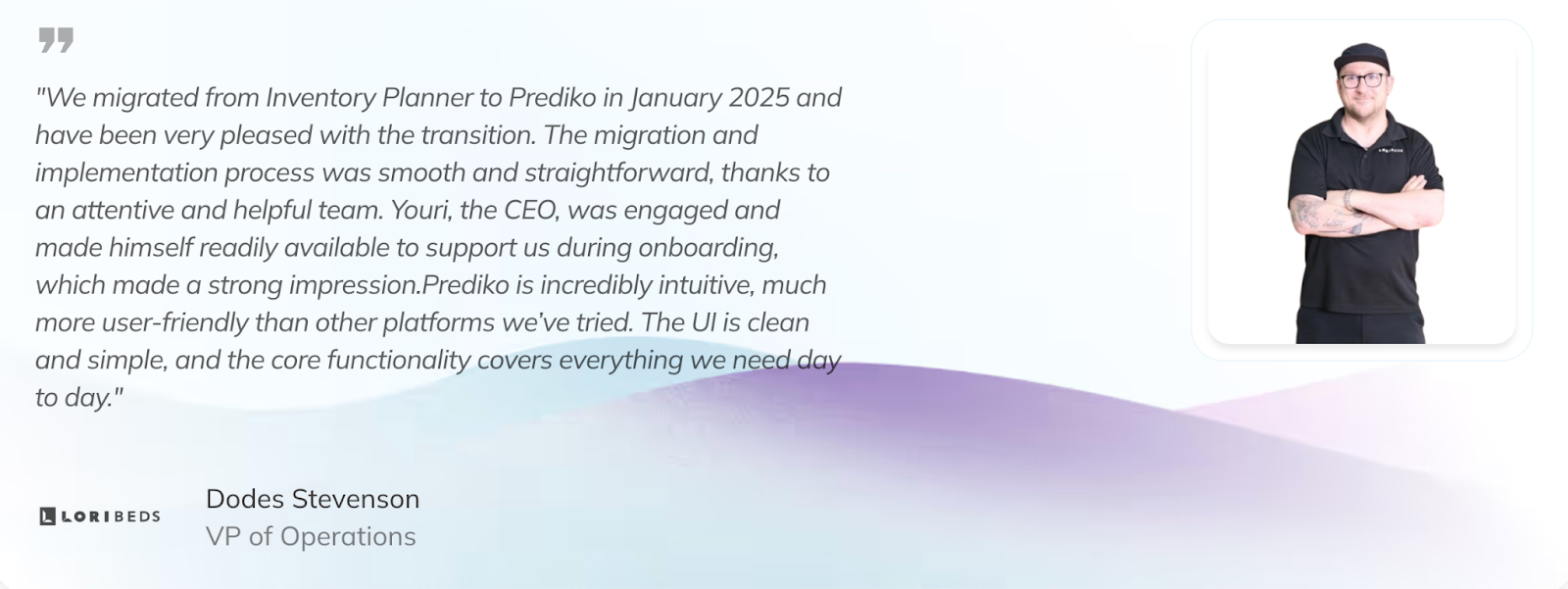
Lori Beds, a Shopify brand that migrated from Inventory Planner, highlighted Prediko’s smooth transition process and ease of use, citing faster, more user-friendly onboarding.
Key takeaways
4. Ideal use‑cases for demand forecasting
While both platforms deliver demand forecasts, they are built for different business models, team structures, and operational priorities.
Inventory Planner
Inventory Planner is best suited for established retailers and wholesalers that:
- Operate across multiple sales channels and marketplaces
- Require deep integrations with ERPs, accounting systems, and external platforms
- Have larger teams capable of managing complex configurations and ongoing forecast adjustments
Its forecasting framework is well-suited for enterprise or multi-brand environments that prioritize stability and system integration over speed and simplicity.
Prediko
Prediko is designed for Shopify-centric brands, particularly those that value speed, automation, and modern AI-driven decision-making.
It is especially well-suited for brands that
- Run lean teams and need fast time-to-value
- Manage manufacturing workflows or raw-material dependencies
- Are scaling rapidly and require forecasts that adapt in real time
Prediko’s plug-and-play setup, native raw-materials forecasting, and proprietary AI trained on 15M+ SKUs make it a strong fit for both established brands and high-growth businesses looking for next-generation forecasting capabilities.
Key takeaways
Bonus: Shopify Featured Prediko as a Recommended App for Forecasting
Choosing the right software for your business comes down to confidence. You need to know that the tools you rely on are proven to work.
Prediko is listed by Shopify as a top solution for inventory forecasting and management. It has also earned a near-perfect 4.9-star rating and strong reviews from 2500+ Shopify merchants who face the same challenges you do.
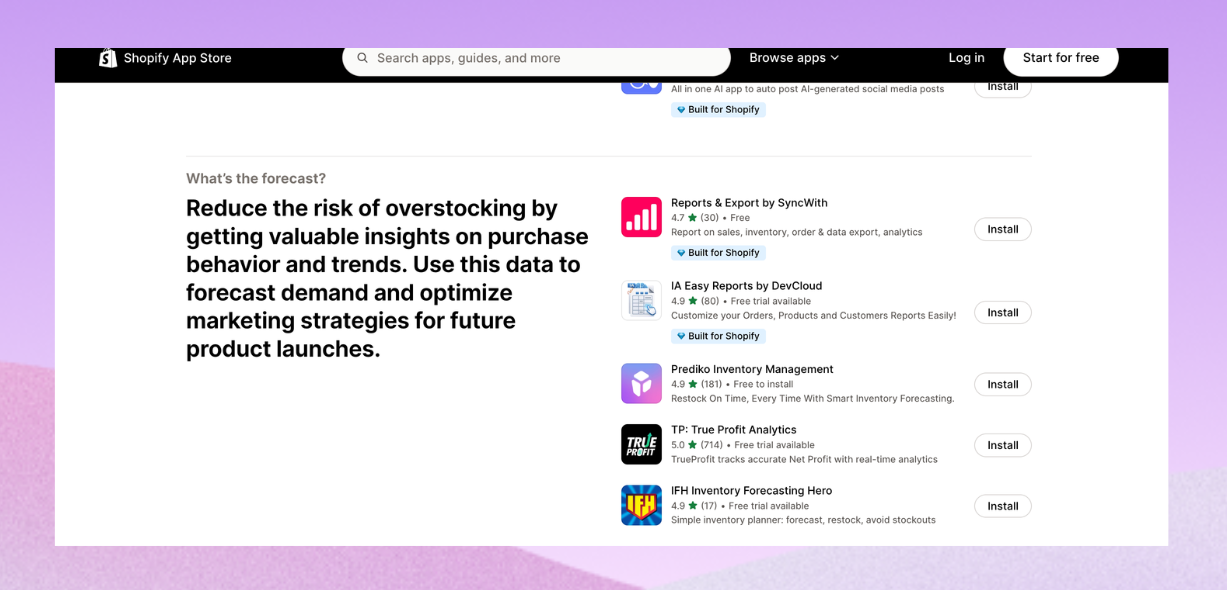
This is a major signal of credibility, showing that the platform is recommended by Shopify itself and adopted by a broad base of verified Shopify users.
It also demonstrates the real value merchants have gained and how deeply the platform is integrated into the ecosystem they rely on every day.
Inventory Planner Forecasting Vs Prediko’s Forecasting: Which One Should You Choose?
Both Inventory Planner and Prediko offer sophisticated forecasting capabilities, but they are built on very different philosophies.
Inventory Planner is designed for complex, multi-channel retail environments, offering deep integrations and granular control often at a higher cost and with a steeper learning curve. It works best when teams have the time and resources to manage forecasting actively.
Prediko, on the other hand, focuses on intelligent, accessible, and actionable AI forecasting tailored to the Shopify ecosystem. Its emphasis is on automation, speed, and usability, helping brands make confident inventory decisions without heavy manual effort or long onboarding cycles.
If you’re ready to experience Prediko forecasting in action, start your 14-day free trial right away.
Frequently Asked Questions
What are the best Inventory Planner alternatives for Shopify?
For Shopify merchants, Prediko is one of the strongest alternatives, offering AI-driven forecasting, faster onboarding, and native support for raw materials and subscriptions.
Which Shopify app offers the most accurate forecasting?
Prediko is the top choice for accuracy on Shopify. Unlike legacy tools that rely on static historical averages, Prediko uses an AI-first engine that constantly learns from real-time data and complex demand signals. This allows it to predict demand with far greater precision.
Does Inventory Planner have AI features?
Yes. Inventory Planner by Sage added an AI assistant called Sage Copilot, available on its Premium tier. It surfaces priority replenishments, flags overdue deliveries, and flags products missing cost prices, alongside an Option Insights report that breaks down top-performing products by size, color, and material.
What features does Inventory Planner lack that other tools provide?
Inventory Planner users often cite a steep learning curve, limited report customization, limited support for subscription-based forecasting, and slower syncing with large datasets. These factors can make the platform feel less flexible compared to some tools.
How long does migration from Inventory Planner take?
Switching to Prediko is designed to be instant. While Inventory Planner typically requires 2+ weeks for setup and training, Prediko connects and syncs your historical data in minutes. Because the AI calibrates automatically, you can migrate and be fully operational in no time without the need for manual CSV mapping or complex configuration.









.avif)