




Shopify AI agents can now do much more than write product descriptions or answer basic customer questions.
The latest agents can analyze store data, identify problems, recommend the next action, and in some cases actually execute that action. They can create purchase orders, resolve returns, answer pre-purchase questions, recommend products, launch marketing campaigns, analyze store performance, and handle customer calls.
But there is no single AI agent that is best at every Shopify workflow.
An inventory team needs an agent that understands SKUs, forecasts, stock levels, suppliers, lead times, and purchase orders. A customer service team needs an agent that understands orders, returns, policies, and customer history. A marketing team needs access to customer profiles, campaigns, segments, and performance data.
That makes the right question:
Which Shopify AI agent is best for the specific job you want to automate?
Here are seven of the strongest options to consider in 2026.
Best Shopify AI Agents at a Glance
What Is a Shopify AI Agent?
A Shopify AI agent is an AI-powered system that connects with Shopify data and performs or assists with ecommerce tasks based on instructions, customer behavior, store data, or predefined business rules.
A Shopify AI agent may access data such as:
- Products and variants
- Inventory levels
- Orders
- Customers
- Sales history
- Customer conversations
- Marketing activity
- Website behavior
The actions available depend on the agent.
For example, an inventory AI agent can analyze SKU-level demand and recommend reorder quantities. A customer support agent can retrieve an order status and respond to a customer. A marketing agent can create an email campaign or customer segment.
This ability to combine data analysis with actions separates an AI agent from a basic chatbot that only generates text.
What Can AI Agents Automate on Shopify?
Shopify AI agents can automate tasks across inventory, store administration, customer service, marketing, and onsite conversion.
1. Inventory planning and replenishment
Inventory AI agents analyze data such as historical sales, inventory levels, lead times, incoming purchase orders, and seasonality.
They can then help teams:
- Forecast SKU demand
- Identify stockout risks
- Identify excess inventory
- Calculate reorder quantities
- Determine reorder timing
- Create purchase orders
- Monitor incoming inventory
2. Shopify store administration
AI assistants built into Shopify can help merchants work with store data through natural-language instructions.
Examples include:
- Creating discounts
- Editing products
- Creating collections
- Generating reports
- Analyzing sales
- Creating customer segments
- Generating store content
- Building Shopify Flow workflows
3. Customer support
Customer service AI agents can use order and customer data to answer repetitive questions.
Common examples include:
- "Where is my order?"
- "Can I return this item?"
- "When will this product be back in stock?"
- "Can I change my shipping address?"
- "Which product should I buy?"
4. Marketing automation
Marketing AI agents can analyze customer and campaign data to help create:
- Email campaigns
- SMS campaigns
- Customer segments
- Automated flows
- Signup forms
- Product recommendations
- Marketing reports
5. On-site personalization
AI can also change what a shopper sees based on behavioral and Shopify data.
Examples include:
- Personalized product recommendations
- Cart recovery messages
- Cross-sell recommendations
- Recently viewed products
- Exit-intent offers
- Customer-specific popups
Shopify AI Agent vs Chatbot vs Assistant vs Shopify Flow
Shopify Flow is extremely useful when the merchant already knows the exact rule.
An AI agent becomes more useful when the right action depends on multiple variables that need interpretation.
For example:
Shopify Flow
Low inventory → Send notification.
Inventory AI agent
Demand forecast + current stock + incoming inventory + lead time + safety stock → determine whether stock actually needs ordering → calculate quantity → prepare PO.
The difference is the reasoning layer between the trigger and the action.
Two Types of Shopify AI Agents
There is another distinction Shopify merchants should understand in 2026.
Not every Shopify AI agent works for the merchant.
Some work for the shopper.
Merchant-facing AI agents
These help operate the Shopify business.
Examples include:
- inventory agents,
- support agents,
- marketing agents,
- store-management agents,
- sales agents,
- and voice agents.
Prediko, Sidekick, Gorgias, Yuma, Lyro, Allo, and Klaviyo fall primarily into this category.
Shopper-facing AI agents
These help consumers discover and buy products.
Examples include AI shopping experiences within ChatGPT, Google AI Mode and Gemini, Microsoft Copilot, and Meta.
Shopify's Agentic Storefronts make eligible merchant products available to supported AI shopping channels. Shopify Catalog helps provide product information for discovery, while Shopify's Universal Commerce Protocol supports commerce interactions between AI agents and merchants.
This article focuses mainly on merchant-facing Shopify AI agents, the tools that help brands operate their business.
1. Prediko: Best AI agent for Shopify inventory planning & management

Prediko is one of the smartest Shopify AI agents for inventory management and planning designed specifically for brands that need to move beyond spreadsheets.
It serves as an intelligent layer for your supply chain, using advanced AI to plan inventory, manage purchase orders (POs), and optimize cash flow.
What sets Prediko apart is execution. Instead of navigating multiple screens, teams can use the AI agent to refresh forecasts, create and update purchase orders, manage incoming stock, and generate reports through simple, chat-based commands.
Forecasting and operations stay tightly linked, so planning doesn’t break down at execution.
What does Prediko offer?
- AI-powered demand forecasting: AI to predict sales and quantities with high accuracy, factoring in seasonality, trends, stockouts, bundle demand, and incoming POs. This helps brands reduce stockouts by up to 30% and avoid tying up capital in overstock.
- Chat-based inventory operations: The AI agent executes commands like refreshing demand plans, selecting SKUs, generating reports, and scheduling updates, all while reducing manual work. You can also connect Prediko to ChatGPT, Claude, or any MCP-capable tool and run these same commands from the AI assistant you already use.
- Automated replenishment suggestions: Receive smart “Buy Now” recommendations for finished goods and raw materials for up to one year based on forecasted demand, lead times, and safety stock levels.
- Context-aware AI assistance: The agent remembers context within a session and uses Prediko’s documentation to guide workflows and answer platform questions.
- Real-time multi-location inventory visibility: Track stock health across all SKUs, stores, and warehouses with automatically updated dashboards.
- Centralized purchase order management: Create, manage, and track POs seamlessly with built-in forecasting logic guiding quantities.
- Collaborative workflows: Give teams shared access to forecasts, stock insights, and POs, ensuring one source of truth across operations.
- Connected ecosystem: With 100+ integrations, Prediko connects effortlessly with Shopify, ERPs, 3PLs (like ShipBob), and WMS systems. This means your inventory data is synced in real-time across your entire tech stack.
Prediko Pricing
Prediko offers tiered pricing based on your store’s revenue. Plans start at just $49/month for small businesses and scale up with the revenue of the business. All plans include unlimited SKUs, purchase orders, and users. Try Prediko with a 14-day free trial.
2. Sidekick: Best Shopify AI agent for store management
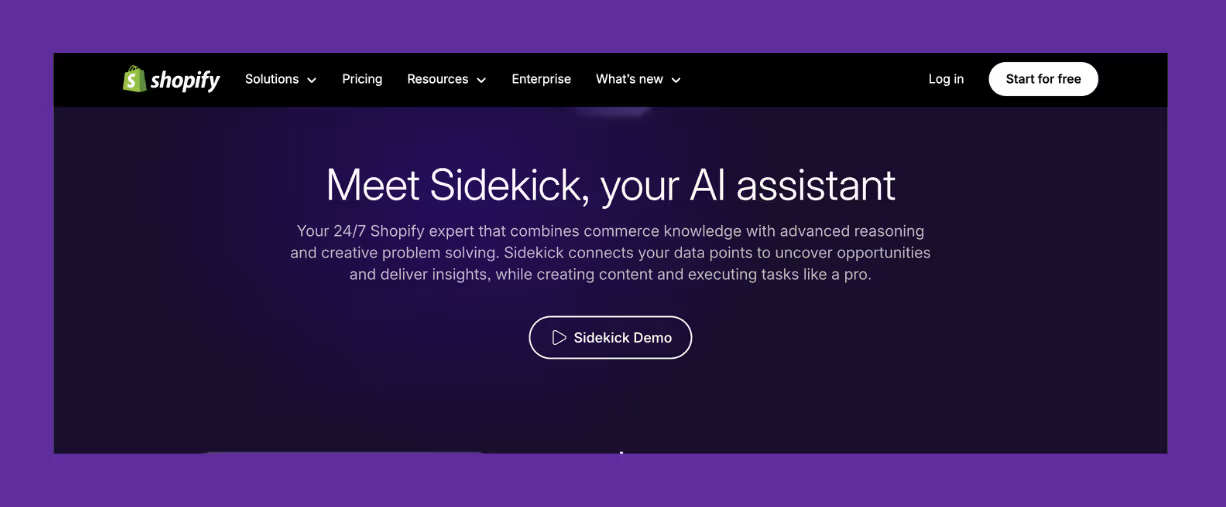
Sidekick is Shopify’s native AI assistant, built directly into the Shopify admin and designed to understand the full context of your store.
It serves as a 24/7 operational partner that can execute tasks, generate creative content, and surface insights through a conversational interface.
With direct access to your store’s backend data, Sidekick can instantly perform actions like “create a discount code for my summer sale” without relying on third-party tools or permissions.
What does Sidekick offer?
- Contextual task execution: Sidekick can modify your shop design, change theme settings, or create collections based on simple text prompts, reducing the technical barrier for complex admin tasks.
- Data analysis on demand: Merchants can ask complex questions like "Why did my sales drop last Tuesday?" and Sidekick will analyze store data to provide a summarized explanation, saving hours of manual reporting.
- Creative automation: It generates high-converting product descriptions, blog posts, and email subject lines that fit your brand voice, making the content creation process much faster.
Sidekick Pricing
Sidekick is included as part of standard Shopify plans (Basic, Shopify, Advanced, and Plus), though specific features may carry extra costs depending on the final release structure.
3. Gorgias: Best Shopify AI agent for customer service
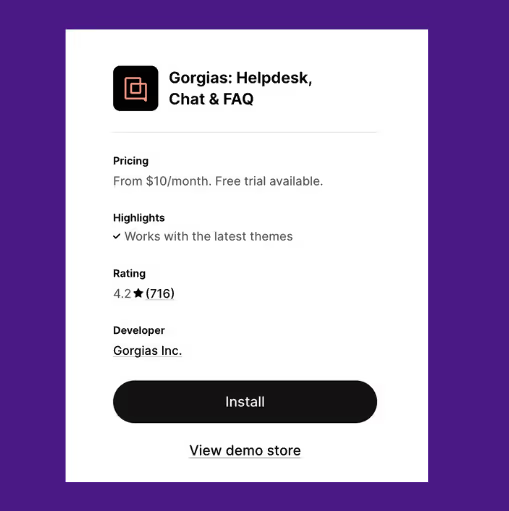
Gorgias is an e-commerce-focused helpdesk platform that includes two powerful AI agents: Shopping and Support.
The Shopping Assistant engages visitors with personalized greetings and product recommendations based on their behavior, while the Support Agent can resolve support tickets autonomously or route them to the appropriate teammate when needed.
What does Gorgias offer?
- Automation: Gorgias AI can automate up to 50% of incoming support tickets, specifically repetitive inquiries like order status and return requests, drastically lowering support costs.
- Revenue generation: The AI Shopping Assistant can detect pre-sales questions and sentiment, prioritizing high-value conversations or offering personalized discount codes to close sales, turning support into a profit center..
- Contextual responses: By pulling data directly from Shopify, the AI drafts responses that include specific order details, tracking numbers, and customer history, providing personalized service at scale.
Gorgias Pricing
Gorgias operates on a ticket-volume model. Plans start at $10/month for 50 tickets, scaling up to Enterprise levels for high-volume. The AI features are an add-on or included in higher-tier plans.
4. Allo: Best AI voice agent for Shopify customer service
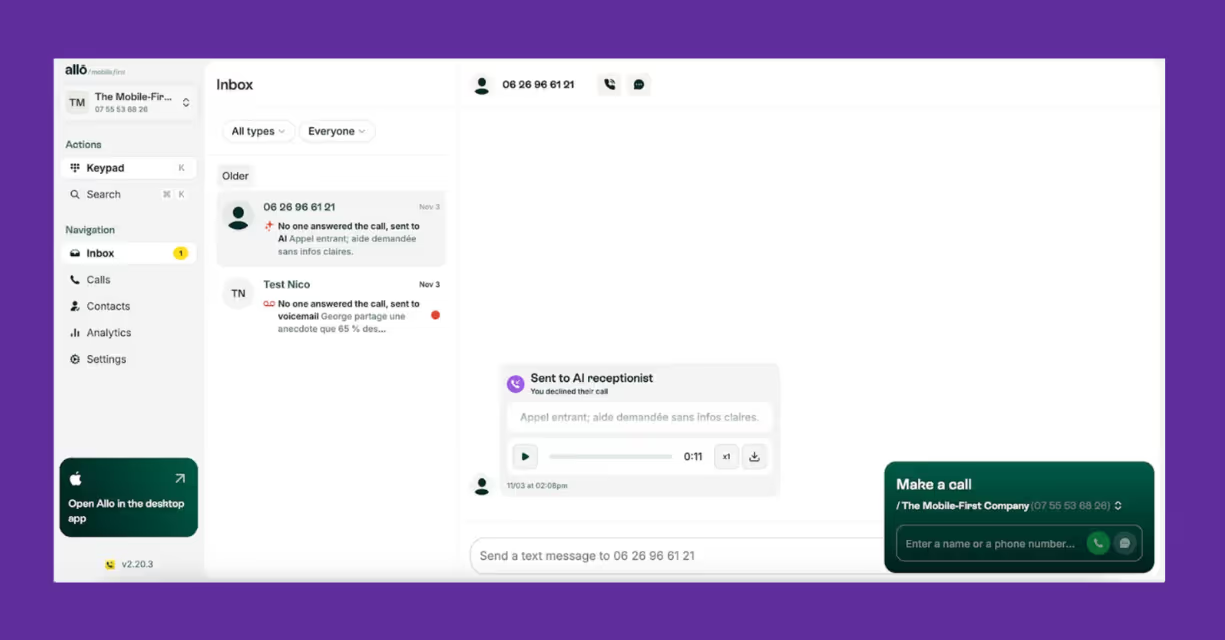
Allo is an AI phone system that offers a deep integration with Shopify.
While many brands shy away from phone support due to cost or time constraints, Allo allows merchants to get their incoming calls handled by an AI answering service.
It can answer common questions and transfer their call to an employee if necessary
What does Allo offer?
- Infinite scalability: Allo helps your teams scale phone discussions. The AI answering service reduces the number of incoming calls, the AI IVR routes your callers to the right person inside your team and the AI assistant generates handy call summaries.
- Complex issue resolution: The agent connects with Shopify to perform actions like checking order status, processing returns, or updating shipping addresses in real-time during the call.
- Brand voice customization: You can configure the AI's tone, speed, and personality to match your brand, creating a consistent auditory experience for customers.
Allo Pricing
Allo offers two plans:
- The Starter plan which costs $25/month. It includes 1 user max, unlimited calls, a local phone number, AI-generated call summaries, and an IVR.
- The Business plan at $45/month per user. It includes integrations (including Shopify), unlimited AI answering service, SMS and international calls.
5. Eesel AI: Best Shopify AI agent for customer support
eesel AI helps Shopify stores answer product, shipping and order questions using their catalog, policies and live order data. It connects with existing helpdesks and passes complex cases to your support team. Pricing starts at $0.40 per support ticket or chat session.
What does eesel AI offer?
• Product answers grounded in your catalog, policies and FAQs.
• Live order tracking and support for return questions.
• Connections with helpdesks including Zendesk, Gorgias and Freshdesk.
• Multilingual replies, configurable tone and human escalation.
• $50 in free AI usage credits to test it right away, with no credit card required.
• A CLI for developers who want Claude Code, Codex or another coding agent to help set up and manage eesel from the terminal, with account access and integration approvals controlled by the user.
Pricing
Pay as you go: $0.40 per support ticket or chat session, covering all messages within that interaction. Standard usage has no platform fee or monthly minimum. New accounts receive $50 in free usage.
6. YourGPT: Best AI agent platform for support, sales, and operations
YourGPT is an AI-first platform that help business to build and deploy autonomous agents across customer support, sales, and internal operations. Moving beyond the limitations of standard chatbots, it executes complex, performs multi-step actions and triggers direct API actions with full control over the agent’s autonomy.
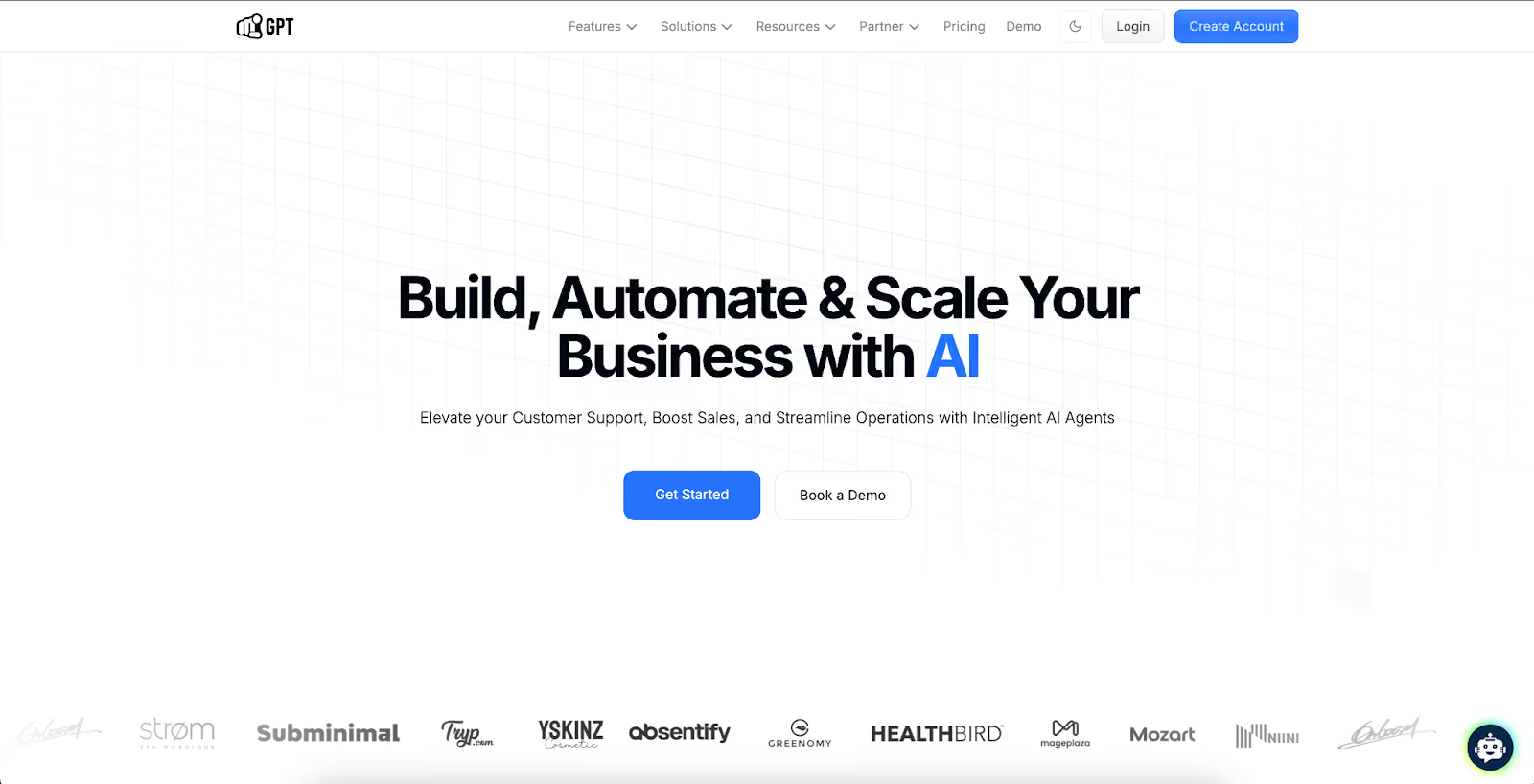
It functions as a unified operational layer across Web, WhatsApp, Messenger, Telegram, Email, LINE, and more, centralizing conversations in a single inbox with complete context retention. Trained on your business data through multi-source inputs, it delivers accurate, action-driven outcomes, resolving up to 80 percent of routine queries before human intervention. When escalation is required, handoffs are seamless and fully contextual, eliminating information loss and maintaining continuity.
What does YourGpt offer?
- Complete AI Suite: It provides a complete AI suite for customer support, sales, and business operations, featuring a no-code builder, AI studio, helpdesk app, voice agents, email integration, and campaigns.
- Action-Oriented AI: AI that understands all modalities, including text, voice, and image, resolves issues and performs real-time actions rather than just deflecting them.
- Self-Learning Agents: AI agents that continuously adapt and improve over time.
YourGpt Pricing:
Starts at $39/month; Professional at $79, Advanced $349 (billed annually), and Enterprise plans are available.
7. Wisepops: Best Shopify AI agent for on-site engagement
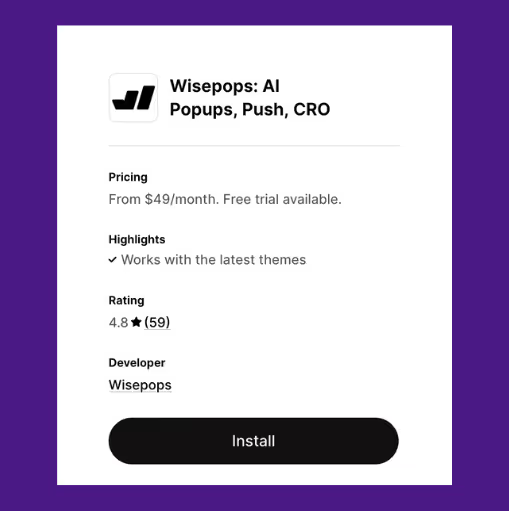
Wisepops is an on-site marketing platform that uses AI to maximize visitor value through intelligent popups, bars, and notifications.
Its AI agent analyzes visitor behavior in real-time (such as scroll depth, mouse movement, and page history) to trigger the most relevant message at the exact moment a user is likely to convert.
What does Wisepops offer?
- AI wishlist & recommendations: The AI can suggest products or prompt users to save items to a wishlist based on browsing behavior, increasing session value.
- Smart targeting: Instead of generic popups, Wisepops uses predictive targeting to show offers only to users who need a nudge, preserving user experience for those who are already likely to buy.
- Goal-driven automation: You set a goal (e.g., "Grow email list" or "Increase AOV"), and the AI optimizes the timing and format of campaigns to achieve that specific metric.
Wisepops Pricing
Pricing is based on pageviews per month. Plans start at $49/month for up to 100,000 pageviews, making it accessible for growing brands, with enterprise tiers for high-traffic sites.
8. Klaviyo: Best Shopify AI agent for email marketing automation
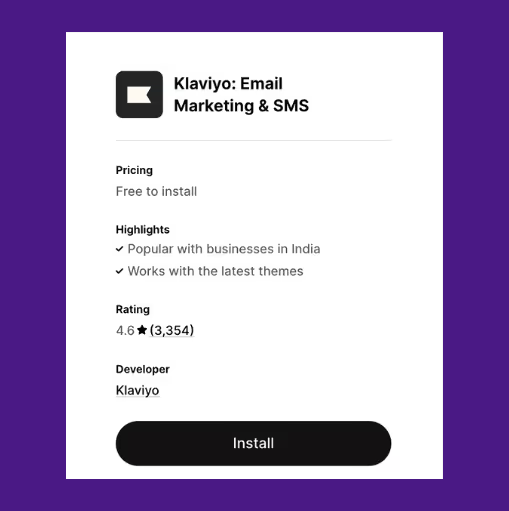
Klaviyo is a leading marketing automation platform for Shopify, powered by its advanced K:AI engine.
It goes far beyond basic email sending by acting as an intelligent data scientist for your marketing team.
Klaviyo aggregates customer data to predict future behavior and automates smart segmentation and content creation.
What does Klaviyo offer?
- Predictive analytics: Klaviyo AI calculates Customer Lifetime Value (CLV), predicts next order date, and churn risk for every profile. This allows you to trigger flows exactly when a customer is ready to buy or at risk of leaving.
- Generative AI for content: The platform can generate high-performing email subject lines, SMS copy, and even build entire email templates based on your brand guidelines and campaign goals.
- A/B testing automation: AI automatically tests variations of your campaigns and shifts traffic to the winning version in real-time, maximizing revenue per recipient.
Klaviyo Pricing
Klaviyo has a tiered pricing model based on the number of active contacts in your database. There is a free tier for up to 250 contacts, with paid agent plans starting from $50 per month.
Best Shopify AI Agent by Workflow
Notice how different these jobs are.
That is why trying to find one universal “best Shopify AI agent” usually produces the wrong answer.
The better question is:
Which part of your Shopify operation should an agent own?
Which Shopify AI Agents Can Reduce Live Support Work?
Customer support is currently one of the strongest use cases for Shopify AI agents.
Three of the most relevant options in this list are:
Gorgias for Shopify-native conversational commerce, order management, and support.
Yuma for higher-volume ecommerce support operations.
Tidio Lyro for conversational support, product questions, and smaller or mid-sized stores.
These agents can reduce the number of repetitive conversations that need human involvement.
Typical automation candidates include:
- order status,
- delivery information,
- return policies,
- product availability,
- basic returns,
- cancellations,
- common product questions,
- and discount questions.
That does not mean AI should handle every interaction.
High-value customers, unusual edge cases, emotionally sensitive complaints, payment problems, fraud concerns, and complex exceptions are usually better candidates for human escalation.
The strongest support-agent implementations therefore combine:
AI resolution + clear guardrails + human handoff
rather than trying to eliminate people entirely.
What Are the Best AI Agents for Shopify Order Tracking and Returns?
For this specific workflow, Gorgias and Yuma are the strongest options in this list.
Both can connect customer conversations with Shopify order data and perform supported post-purchase actions.
Gorgias AI Agent can handle conversations involving order tracking, returns, order changes, cancellations, and shipping updates, while also handing conversations to human agents when required.
Yuma similarly works with Shopify order, customer, product, refund, and support data and can perform actions such as refunds, cancellations, and order edits.
Tidio Lyro is also worth considering for stores that need lighter order-status automation alongside live chat and conversational sales.
What AI Agents Can Handle Pre-Purchase Questions for Shopify?
Pre-purchase agents need a different type of context from traditional support bots.
They need to understand:
- product information,
- stock availability,
- shopper intent,
- current cart contents,
- previous questions,
- and ideally product relationships.
Gorgias, Yuma, and Tidio all operate in this area.
Tidio Lyro is especially notable for conversational product discovery because it can use Shopify catalog and cart information to make stock-aware recommendations and allow customers to add recommended items directly to their cart.
Gorgias AI Agent can also act as a shopping assistant, helping shoppers find products and supporting upsell or discount workflows using Shopify context.
Which AI Agent Is Best for Shopify Inventory and Order Automation?
If the problem is inventory planning rather than customer orders, the requirements change completely.
A useful inventory agent needs to understand:
- SKU sales,
- current inventory,
- incoming inventory,
- forecast demand,
- supplier lead times,
- reorder points,
- locations,
- and purchase orders.
Prediko is built specifically around these relationships.
For example:
Flag all products likely to stock out within six weeks.
Then:
Show only products without enough incoming inventory.
Then:
Create a draft PO for the remaining SKUs.
Through Prediko's MCP integration, compatible AI tools can access inventory, forecasts and purchase orders and execute approved write actions such as creating or updating POs.
This is fundamentally different from an order-support agent.
Customer-order automation deals with purchases customers have already placed.
Inventory-order automation deals with the stock the merchant needs to buy from suppliers.
How to Choose an AI Agent for a High-Volume Shopify Store
AI agents become more valuable as Shopify operations become more complex, but the cost of choosing the wrong system also increases.
For high-volume stores, evaluate these factors.
1. Start with workflow coverage
Define exactly what the agent needs to own.
For example:
Resolve order-tracking tickets.
is much clearer than:
Improve customer support with AI.
The more specific the workflow, the easier it is to compare tools.
2. Check Shopify data access
Find out exactly what the agent can read.
Depending on the workflow, this might include:
- products,
- inventory,
- customers,
- orders,
- returns,
- locations,
- discounts,
- subscriptions,
- or fulfillment information.
3. Check write permissions
Then determine what it can actually change.
Can the agent:
- refund an order?
- cancel it?
- edit it?
- create a PO?
- receive inventory?
- issue a discount?
- add an item to cart?
- launch a campaign?
An AI system that only recommends an action is fundamentally different from one that can execute it.
4. Look at human approval
For high-impact workflows, understand when a human remains in the loop.
Approval controls are especially important for:
- refunds,
- pricing,
- purchasing,
- customer credits,
- marketing spend,
- and inventory changes.
5. Evaluate your existing stack
A high-volume merchant may already rely on:
- Shopify Plus,
- ERP software,
- Gorgias or Zendesk,
- subscription platforms,
- a 3PL,
- warehouses,
- Klaviyo,
- accounting software,
- and BI systems.
An agent that cannot access the information required to complete the workflow may create more fragmentation rather than less.
6. Test exception handling
Ask vendors what happens when the AI does not know what to do.
A strong answer should include:
- human handoff,
- permissions,
- fallbacks,
- audit trails,
- error handling,
- and escalation rules.
7. Measure outcomes rather than prompts
Do not evaluate an agent based on how impressive its chat interface looks.
For support, measure:
- autonomous resolution rate,
- resolution time,
- escalation rate,
- CSAT,
- and cost per resolution.
For inventory, measure:
- stockout rate,
- SKU availability,
- excess inventory,
- inventory turnover,
- forecast accuracy,
- and planning time.
For marketing, measure:
- campaign output,
- conversion,
- revenue per recipient,
- incremental revenue,
- and time spent executing campaigns.
How Shopify AI Agents Connect to Your Store
Not all AI agents connect to Shopify in the same way.
Understanding the connection layer helps explain why some agents can do more than others.
1. Native Shopify AI
Shopify Sidekick operates directly inside Shopify.
The advantage is immediate store context and minimal integration work.
2. Shopify apps and APIs
Platforms such as Prediko, Gorgias, Yuma, Tidio, Klaviyo, and Allo connect Shopify with their own application.
Depending on permissions, these integrations can read Shopify data and potentially write changes back.
3. Model Context Protocol (MCP)
MCP lets compatible AI clients connect to external tools and data.
Prediko, for example, provides an MCP server that allows compatible clients such as ChatGPT and Claude to query inventory, forecasts, and POs and access permitted inventory actions.
This creates an architecture like:
AI client
↓
MCP
↓
Prediko
↓
Shopify inventory and operational data
Instead of forcing operators to open a separate interface for every task, specialized software can become accessible from the AI environment where they already work.
4. Universal Commerce Protocol (UCP)
UCP solves a different problem.
Shopify co-developed UCP with Google as an open protocol for commerce between AI agents and merchants.
It supports the commerce journey from product discovery through cart and checkout interactions.
Think of the difference this way:
MCP: Helps an AI agent use tools and business systems.
UCP: Helps shopping agents transact with merchants.
They are related to agentic commerce, but they solve different problems.
What Are Shopify Agentic Storefronts?
Shopify Agentic Storefronts are the shopper-facing side of the AI-agent ecosystem.
Instead of requiring a customer to begin every shopping journey on a traditional ecommerce website, Shopify can make eligible merchant products available through supported AI channels.
Shopify currently lists channels including:
- ChatGPT,
- Google AI Mode and Gemini,
- Microsoft Copilot,
- and Meta.
Depending on the channel and merchant configuration, shoppers can discover products through AI conversations and either continue to the Shopify store or use supported Shopify-powered checkout experiences.
Shopify Catalog acts as an important discovery layer by structuring product information so AI systems can understand and recommend products.
This creates two parallel agent ecosystems:
Agents helping merchants operate Shopify
and
Agents helping shoppers buy from Shopify merchants
Both will increasingly matter.
Benefits of Using AI Agents on Shopify
Used in the right workflow, AI agents can create several operational advantages.
Less repetitive work
Routine actions such as checking orders, answering common questions, reviewing stock, or building standard campaigns can be automated.
Faster decisions
Agents can bring information from multiple sources together instead of forcing employees to manually search through several platforms.
24/7 availability
Customer-facing agents can continue handling supported conversations outside normal working hours.
Better operational scale
A growing Shopify business can handle more products, customers, conversations, and transactions without every increase requiring an equivalent increase in manual work.
More consistent execution
When instructions, permissions, and workflows are well defined, agents can apply the same process repeatedly without missing steps.
The key is to automate well-defined operational problems, rather than adding AI simply because a tool offers it.
Frequently Asked Questions About AI Agents for Shopify
Final Thoughts: The Best Shopify AI Agent Depends on the Job
The Shopify AI-agent ecosystem is quickly moving beyond simple chatbots and content generators.
The useful distinction is no longer:
Does this product use AI?
It is:
What context does the AI understand, what decisions can it make, and what actions can it safely execute?
For general Shopify administration, Sidekick provides the native AI layer.
For inventory forecasting, replenishment, and purchase orders, Prediko provides a specialized inventory agent.
For customer-support automation, Gorgias and Yuma provide deep ecommerce workflows.
For AI phone support, Allo covers voice.
For pre-purchase conversations and product discovery, Tidio Lyro combines conversational AI with Shopify catalog and cart context.
For lifecycle marketing, Klaviyo K brings agent-driven execution into customer campaigns.
For many growing Shopify brands, the end state will not be one universal AI agent.
It will be several specialized agents, each operating within a clearly defined part of the business:
Sidekick → Store administration
Prediko → Inventory and purchasing
Gorgias or Yuma → Customer support
Allo → Phone calls
Lyro → Conversational shopping
Klaviyo → Marketing
The brands that get the most value from AI agents will be the ones that give each agent a clear job, the right data, the right permissions, and the right level of human oversight.









.avif)